Agonistic behaviour in dogs: what owners must know
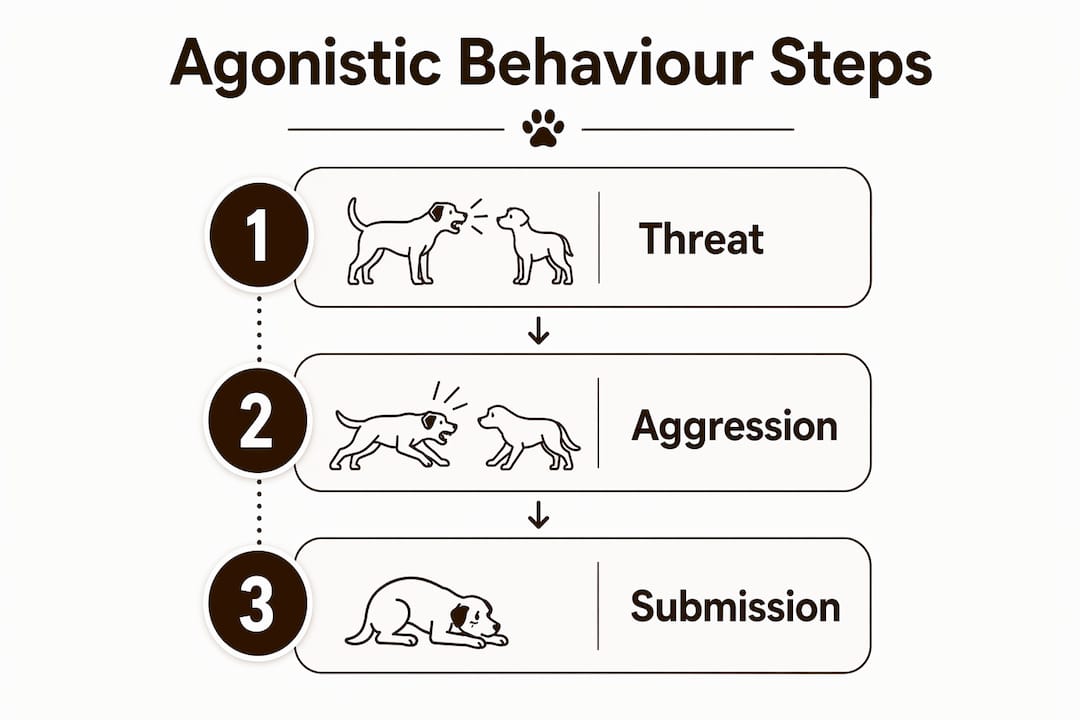
Agonistic behaviour in dogs is defined as the full spectrum of conflict-related behaviours, including threat displays, aggression, and submission, used to resolve disputes with minimal physical harm. The term comes from ethology, the scientific study of animal behaviour, and covers far more than aggression alone. Most dog owners only notice the growl or snap, but that moment is usually the final step in a long sequence of communication. Understanding what is agonistic behaviour in dogs gives you the tools to read your dog accurately and respond in ways that actually help.
What are the key components of agonistic behaviour in dogs?
Agonistic interactions consist of three core components: threat, aggression, and submission, which occur in a sequence aimed at minimising physical risk. Each component plays a distinct role in how dogs communicate conflict.
Threat displays
Threat displays are ritualised signals a dog uses to warn another individual before committing to a physical confrontation. These include growling, stiffening, a hard stare, raised hackles, and a stiff tail held high. Ritualised agonistic behaviours function as communication signals that prevent escalation to physical attacks. A dog that growls is not being “bad.” It is being honest.
Aggressive acts
Physical aggression, such as snapping or biting, occurs when threat displays fail to resolve the dispute. These acts are typically brief. The biological cost of injury is high for both parties, so dogs are wired to keep physical conflict short. Threat behaviour signals hostility intended to make an opponent back down and usually precedes physical aggression or submission.
Submission
Submission ends the conflict. A dog may roll onto its back, avert its gaze, lower its body, or lick the muzzle of the other dog. These signals communicate defeat and prevent further attack. The sequence of threat, aggression, and submission is the full agonistic cycle.
Key warning signs to recognise:
Lip licking or yawning in tense situations
Whale eye (showing the whites of the eyes)
Freezing or sudden stillness
Low growling with a stiff body
Slow, deliberate tail wagging at half-mast
Pro Tip: Treat every growl as information, not defiance. Punishing a growl removes a warning signal and increases the risk of a bite with no prior notice.
What causes agonistic and aggressive behaviour in dogs?
Fear, anxiety, and pain are the most common motivations for aggressive and agonistic displays in dogs. This is the veterinary consensus, and it matters because it shifts the focus from “bad dog” to “dog in distress.”
When a dog feels threatened, its body releases cortisol and adrenaline. These stress hormones prepare the body for fight or flight. A dog in this physiological state is not making a moral choice. It is responding to a perceived threat with the tools evolution gave it.
Common triggers include:
Fear and anxiety: Unfamiliar people, dogs, sounds, or environments
Pain: A dog in physical discomfort will guard the painful area and may snap when touched
Resource guarding: Food, toys, resting spots, or even a person can trigger protective agonistic displays
Frustration: A dog that cannot reach something it wants, such as another dog behind a fence, may redirect that frustration as aggression
The threshold for aggression is not fixed. It shifts throughout the day based on accumulated stressors. A dog that handles the morning walk calmly may react aggressively to the same trigger in the afternoon after a noisy car ride and a vet visit. You can read more about this in the aggressive dog threshold management guide from Happy-dogtraining.
Pro Tip: Watch for subtle stress signals like excessive sniffing, slow movement, or sudden disinterest in food. These often appear before any visible agonistic display and signal that your dog is approaching its threshold.
How does understanding agonistic behaviour improve dog socialisation?
Recognising agonistic signals gives you the ability to intervene before a situation escalates. That is the practical payoff of understanding canine social behaviour.
Socialisation must occur during the critical window of 3–12 weeks of age, with repeated, predictable interactions being the foundation of social competence. Puppies that meet a wide variety of people, animals, and environments during this period develop stronger emotional regulation as adults. Missing this window does not make a dog unsocialisable, but it does make the process harder and slower.
Here is how to apply this understanding practically:
Prioritise quality over quantity in social encounters. Repeated, calm interactions with familiar dogs build social resilience far more effectively than chaotic visits to a busy dog park.
Respect agonistic signals during play. If your dog stiffens or growls during play, separate the dogs calmly. Do not punish the signal.
Avoid forcing greetings. Allowing your dog to approach at its own pace reduces fear-based agonistic responses.
Recognise that dog social interactions are fluid and context-dependent, not governed by fixed rank. Dominance-based training methods misread agonistic behaviour and often make it worse.
Build predictability into your dog’s social life. Dogs that know what to expect from their environment show lower baseline stress and fewer agonistic incidents.
The outdated idea of a linear dominance hierarchy has been rejected by modern research. Applying dominance-based corrections to agonistic behaviour suppresses the signal without addressing the cause. The result is a dog that stops warning before it bites. Understanding inter-dog aggression causes helps owners move past these myths and into genuinely effective management.
What are the challenges of interpreting agonistic behaviour in urban dogs?
Urban dogs face a specific social problem. They live in socially crowded but relationally sparse environments, surrounded by many dogs but lacking consistent, familiar social partners. This combination impairs emotional regulation and leads to faster arousal escalation.
A dog that passes twenty strangers on a morning walk in Singapore is not socialising. It is managing repeated low-grade social stress with no resolution. Over time, this accumulates.
The table below outlines common misinterpretations owners make in urban settings and what the behaviour actually signals:
What owners see | What it often means |
Dog sits calmly at the park | Possible stress-induced withdrawal, not social comfort |
Dog ignores other dogs | May reflect avoidance coping, not confidence |
Dog plays roughly then snaps | Arousal threshold exceeded; needs a break |
Dog lunges on lead | Frustration or fear amplified by lead restriction |
Dog freezes near strangers | Early threat assessment, not stubbornness |
A dog’s aggression threshold is dynamic and influenced by accumulated stressors such as poor sleep, noise, and pain. This is sometimes called the “stress bucket” concept. Each stressor adds to the bucket. When it overflows, the dog reacts. Owners who only see the final reaction miss all the smaller stressors that filled the bucket throughout the day.
Calm or withdrawn behaviour can reflect stress-induced shutdown rather than genuine social ease. This is one of the most common misreadings in urban dog ownership, and it is why expert guidance matters.
What are effective methods to manage agonistic behaviour in dogs?
The most effective approach to managing agonistic behaviour addresses the underlying emotional state, not just the surface behaviour. Suppressing a growl without resolving the fear that caused it is like removing a smoke alarm instead of putting out the fire.
Evidence-based management strategies include:
Threshold management: Keep your dog below the level of stimulation that triggers a reaction. Increase exposure gradually and always at a pace the dog can handle. The evidence-based methods for reactive dogs guide from Happy-dogtraining covers this in practical detail.
Counter conditioning: Pair the trigger (another dog, a stranger) with something the dog loves, such as a high-value treat. Over time, the trigger predicts good things rather than threat.
Gradual exposure: Systematic desensitisation reduces the emotional charge of a trigger through repeated, controlled, low-intensity exposure.
Addressing pain and health: A veterinary check is the first step for any dog showing new or worsening agonistic behaviour. Pain is a leading cause of aggression.
Reward-based training: Marker training and positive reinforcement build the dog’s confidence and give it alternative behaviours to offer in stressful situations.
Success in behaviour change requires addressing emotional causes like fear and pain, not applying labels like “dominant” or “stubborn.” Dogs Trust and the Merck Veterinary Manual both confirm this position. Dominance-based corrections increase fear and anxiety, which are the very drivers of most agonistic behaviour.
Pro Tip: If your dog’s agonistic behaviour is frequent, intense, or has resulted in a bite, consult a certified behaviourist before attempting management on your own. Early professional input prevents the behaviour from becoming entrenched.
Key takeaways
Agonistic behaviour in dogs is a communication system, and understanding it is the most direct route to preventing aggression and building a calmer, more confident dog.
Point | Details |
Agonistic behaviour is broader than aggression | It includes threat displays and submission, forming a full conflict-resolution sequence. |
Fear and pain drive most displays | Address the emotional cause first; suppressing the signal without resolving the cause worsens outcomes. |
Early socialisation shapes lifelong responses | The 3–12 week window is critical; quality, repeated interactions with familiar partners build resilience. |
Urban environments create hidden stress | Accumulated daily stressors lower the aggression threshold; calm behaviour does not always mean comfort. |
Dominance-based methods are counterproductive | Modern research confirms dog interactions are fluid; reward-based training produces safer, lasting results. |
What I have learned from years of watching owners misread their dogs
Every week, I speak with owners who describe their dog as “unpredictable” or “aggressive out of nowhere.” In almost every case, the dog was not acting without warning. The owner simply did not know what to look for.
The most common mistake I see is punishing the growl. It feels logical. The dog made a threatening sound, so you correct it. But that correction teaches the dog that warning signals bring punishment. The dog learns to skip the warning. The bite that follows genuinely does seem to come from nowhere, because the owner trained away the early signals.
The second mistake is confusing stillness with calm. A dog that freezes at the dog park is not relaxed. It is often in a state of stress-induced shutdown, managing an overwhelming situation by going very quiet. Owners praise this as “good behaviour” and keep the dog in the situation longer, which deepens the stress.
What actually works is shifting your attention from what the dog does to why it does it. Fear, pain, and frustration are the engines behind almost every agonistic display. When you address those, the behaviour changes. Reward-based training, threshold management, and genuine socialisation with familiar partners produce dogs that are genuinely calm, not just suppressed.
The science on this is clear and consistent. The Dogs Trust and the Merck Veterinary Manual both point in the same direction. Empathy and evidence work. Punishment and dominance do not.
— Mark
How Happy-dogtraining can help with agonistic and reactive behaviour
If your dog’s agonistic behaviour is affecting your daily life, professional support makes a measurable difference. Happy-dogtraining offers specialist consultations and structured programmes designed specifically for dogs showing aggression, reactivity, and fear-based conflict behaviours.
The aggressive behaviour consult is the right starting point for dogs with a history of biting, intense reactivity, or frequent agonistic displays. For dogs that need structured socialisation and threshold work in a group setting, the reactive dog class provides a safe, controlled environment with expert guidance. Happy-dogtraining’s AVS-accredited trainer brings over 20 years of experience and provides free lifetime support after training, so you are never left managing alone.
FAQ
What is agonistic behaviour in dogs?
Agonistic behaviour is the full range of conflict-related behaviours in dogs, including threat displays, aggression, and submission. It is a communication system used to resolve disputes with minimal physical harm.
Is agonistic behaviour the same as aggression?
No. Aggression is one component of agonistic behaviour. The full sequence also includes threat displays such as growling and stiffening, and submission signals such as rolling over or averting the gaze.
What causes agonistic behaviour in dogs?
Fear, anxiety, and pain are the most common causes, according to veterinary consensus. Resource guarding and frustration are also frequent triggers, and a dog’s threshold shifts throughout the day based on accumulated stress.
Should I punish my dog for growling?
Punishing a growl removes a warning signal without addressing the cause. Dogs that are corrected for growling often stop warning before they bite, which increases the risk of injury. Address the underlying fear or discomfort instead.
When should I seek professional help for my dog’s agonistic behaviour?
Seek professional support if your dog’s displays are frequent, escalating, or have resulted in a bite. Early intervention from a certified behaviourist produces faster and safer outcomes than waiting for the behaviour to worsen.
Recommended
Comments