Check AVS dog trainer accreditation in Singapore: 4 accepted certs

AVS runs the ACDT scheme and publishes the official list of AVS-accredited certified dog trainers on gov.sg. That registry is the benchmark for competency and humane, science-based training in Singapore, so it pays to check it before you book anyone. If a trainer’s name isn’t there, ask questions before you hand over your dog.
TL;DR:
Only trainers listed on the official AVS registry are verified to meet Singapore’s science-based and humane training standards, so always check before booking.
Accreditation is required for breeds under licensing rules or if AVS has directed your dog into training, making vetting essential for compliance.
Confirm trainers’ credentials by verifying their certification numbers directly with IAABC, CCPDT, ABS, or ACVB, and avoid unlisted or expired certificates.
Trainers must maintain active certifications and agree to AVS terms; expired or non-compliant trainers can be removed from the list at any time.
Accredited training involves assessment, positive reinforcement, owner education, and support, but the specific session content depends on your dog’s needs and issues.
Table of Contents
What is AVS dog trainer accreditation and where do you check it?
The official AVS-Accredited Certified Dog Trainers list is a live registry, not a static directory printed once and forgotten. Each entry shows the trainer’s name, their relevant certification, their business name, and contact details, so you can match the person standing in your living room to the credential on record.
Use it properly and it becomes your fastest shortlisting tool. Here’s how:
Search the trainer’s full name and business name exactly as they appear on their website or booking page.
Note the certification listed against them (IAABC, CCPDT, ABS, or ACVB) and the date you checked.
Take a screenshot or save the page reference for your own records, since the list is updated as trainers are added or removed.
Cross-check the business name against what appears on invoices or contracts before you pay a deposit.
AVS updates this list as accreditation status changes, so a trainer who was listed six months ago isn’t guaranteed to be listed today. Checking on the day you book, not the day you first heard their name, is the habit worth building.
What is the ACDT scheme and why did AVS introduce it?
The AVS-Accredited Certified Dog Trainer (ACDT) scheme launched on 10 December 2022 to set a national benchmark for competency in dog training. Before this, Singapore had no single reference point for judging whether a trainer’s methods were sound or their qualifications genuine.
AVS built the scheme around humane, science-based training methods, with particular attention to managing aggression responsibly rather than suppressing it through fear or force. That emphasis matters because poor handling of an aggressive dog can escalate a manageable behaviour problem into a dangerous one.
For owners, accreditation gives a shortcut through an otherwise crowded market. Instead of guessing which trainer actually understands canine behaviour science, you get a name vetted against a known standard, published by NParks itself.
Which certifications does AVS accept?
AVS doesn’t invent its own qualifying exam. Instead, it recognises credentials from four established certifying bodies: IAABC, CCPDT, ABS, and ACVB. Each tests something slightly different, and knowing the distinction helps you match a trainer’s background to your dog’s actual problem.
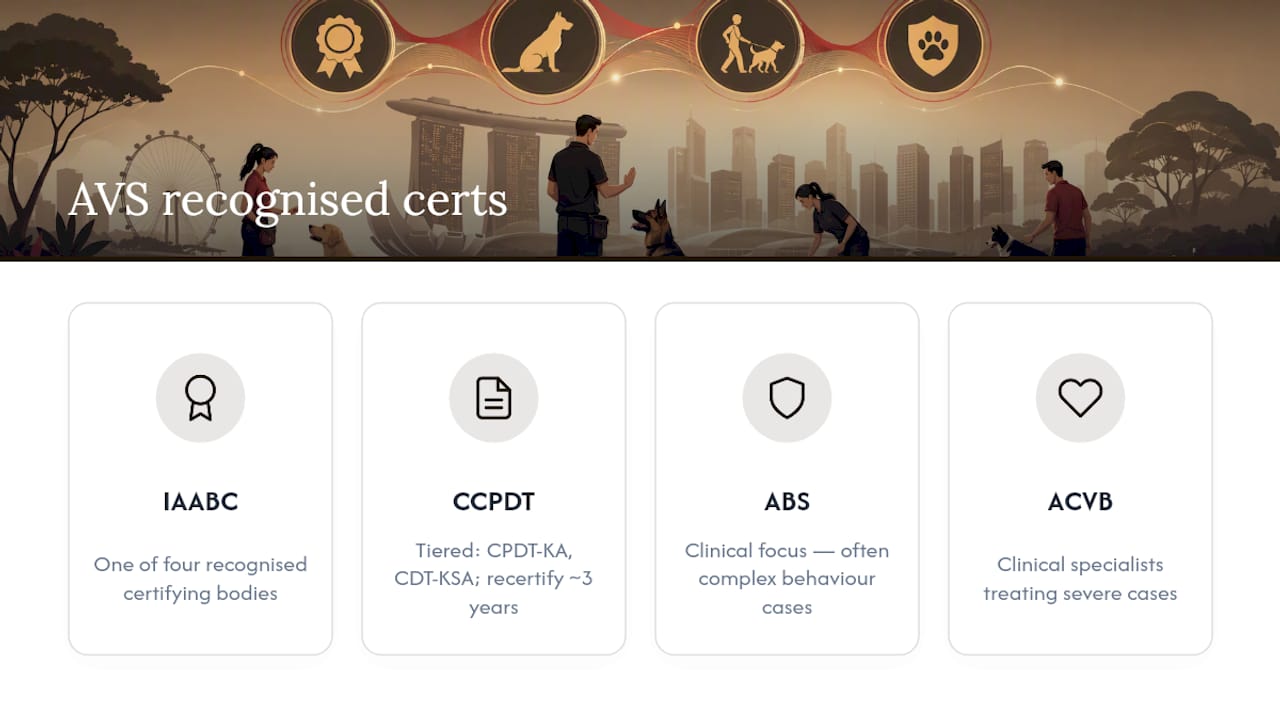
CCPDT, for instance, offers tiered credentials such as CPDT-KA and CDT-KSA, reflecting either knowledge-based testing or a combination of knowledge and observed hands-on skill. CCPDT also requires recertification roughly every three years, which keeps working trainers current on methods rather than resting on a qualification earned a decade ago. ABS and ACVB, by contrast, tend to sit at the more clinical end, often associated with behaviour specialists handling complex cases rather than general obedience work.
This is why two AVS-accredited trainers can look quite different on paper. One might specialise in puppy foundations, another in severe aggression cases, yet both meet the same AVS threshold for entry.
When is accreditation mandatory, and when is it your choice?
For most Singapore dog owners, booking an AVS-accredited trainer is voluntary, driven by a sensible desire for quality rather than any legal requirement. That changes for specific cases.
Accreditation becomes mandatory for breeds listed under the Animals and Birds (Dog Licensing and Control) Rules, and for dogs that AVS has individually assessed and directed into training. If your dog falls into either category, engaging a trainer who isn’t on the AVS list isn’t a shortcut. It’s a compliance gap.
This tends to surface most often during licensing renewals, adoption of a scheduled breed, or after a dog has been involved in an incident that triggered an AVS assessment. If you’re unsure whether your situation is mandated, check directly with AVS before booking rather than assuming a general obedience class will satisfy the requirement.
How do you verify a trainer’s accreditation before you book?
Confirming accreditation takes minutes, and it’s worth doing every single time, even for a trainer you’ve used before. Follow these steps:
Search the AVS master list using the trainer’s exact name and business name, and record what certification is listed against them.
Ask the trainer directly for their certification number and its expiry or renewal date, comparing it against what you found online.
Contact the certifying body (IAABC, CCPDT, ABS, or ACVB) if anything looks inconsistent, since AVS itself advises owners to verify directly with the certifying organisation when in doubt.
Watch for warning signs: a trainer absent from the AVS list, a certificate that’s clearly expired, or vague, evasive answers when you ask a direct question about their credentials. Our own checklist for spotting genuine trainer qualifications covers similar red flags in more depth.
Pro Tip: Ask for the certification number, not just the certification name. Anyone can claim to be “CCPDT certified” in conversation, but a specific number lets you cross-check it against the certifying body’s own records in seconds.
How do trainers keep their AVS accreditation current?
Accreditation isn’t a one-time badge. Trainers must keep their external certification active and sign onto AVS’s Terms of Accreditation (TOA), which sets ongoing conduct and competency expectations.
If a trainer’s underlying certification lapses, say their CCPDT credential expires without recertification, or they breach the TOA, AVS can remove them from the list entirely. This is also why the old PADT scheme matters to understand. PADT was discontinued on 10 December 2024, and trainers who once held that older accreditation aren’t automatically carried over. They had to meet ACDT’s criteria and reapply.
That’s a useful reminder for owners too. Re-checking the registry before each new booking, even with a trainer you’ve used before, costs you nothing and protects you from relying on outdated information.
What does AVS-accredited training actually look like in practice?
Accreditation tells you a trainer meets a standard. It doesn’t tell you what a session actually involves, which is where local context helps. At Happy-dogtraining, AVS-aligned work spans a range of common needs, from a 4-week intensive obedience programme built around AVS-scheduled dogs to one-on-one aggression consultations and reactive dog classes.
Sessions typically start with an assessment of the dog’s specific triggers and history, followed by a structured plan using positive reinforcement and marker training rather than punishment-based correction. Owner education runs alongside the dog’s training, since a family that understands why a technique works is far more likely to maintain it once formal sessions end. Follow-up support, including a safety plan for higher-risk cases, is a standard part of how accredited training should be delivered.

When should accreditation be the deciding factor?
Accreditation is essential, not optional, once your dog or breed falls under a mandated case. Outside that, treat it as one of the strongest trust signals available, though not the only one worth weighing.
A trainer’s specialism matters just as much as their credential and training approach. Someone certified in general obedience isn’t automatically the right fit for severe aggression, and someone skilled with aggression cases might be overkill for a bouncy puppy that just needs manners. Combine your AVS check with references, a clear look at programme fit, and a direct conversation about how the trainer would approach your dog’s specific issue.
Verify the registry, ask pointed questions about method and experience, and request an initial assessment before committing to a full programme.
— Mark
Book an AVS-accredited trainer in Singapore
Some local providers offer AVS-aligned training, helping owners find accredited trainers without guessing among unverified options. Accredited trainers typically build programmes around humane, science-based methods, often including ongoing support after sessions end.

If your dog needs foundational manners, Private Obedience Dog Training Classes cover one-on-one sessions tailored to your household. For AVS-scheduled dogs or mandated cases, the Intensive Obedience Plus programme is built specifically around those requirements. Dealing with aggression or reactivity calls for a different approach entirely, and an Aggressive Behaviour Consult starts with a proper assessment rather than a generic class.
Check the AVS registry, then get in touch to book an assessment and find the right programme for your dog.
Where to verify accreditation and apply
The AVS-ACDT scheme overview explains eligibility, accepted certifications, and the Terms of Accreditation in full.
The official list of AVS-accredited trainers is the live registry to check before booking anyone.
Trainers seeking accreditation apply through the gov.sg ACDT application form.
The original NParks announcement confirms the scheme’s launch and its replacement of PADT.
Always access these through the official gov.sg domain rather than a third-party link, and treat any site outside gov.sg claiming to host the “real” AVS list with caution.
Sources
AVS‑Certified Accredited Dog Trainers Scheme (ACDT) | Animal and Veterinary Service (AVS)
List of AVS‑Accredited Certified Dog Trainers | Animal and Veterinary Service (AVS)
AVS launches new AVS‑Accredited Certified Dog Trainer Scheme
Become a Dog Trainer: A Profession Built on Knowledge and Skill - CCPDT
FAQ
Who are some AVS-accredited certified dog trainers?
The official AVS list names every currently accredited trainer along with their certification and business details. Happy-dogtraining’s trainer holds AVS accreditation and appears on that registry, alongside other qualifying trainers across Singapore.
How do you become a certified dog trainer in Singapore?
You first earn a recognised external certification from IAABC, CCPDT, ABS, or ACVB, then apply to AVS through the ACDT application form. AVS reviews the application against scheme criteria before granting accreditation and adding the trainer to the public list.
How can I check if a dog trainer is qualified?
Search their name and business on the AVS accredited trainers list and note the certification shown against them. If they’re not listed or something looks unclear, contact the certifying body directly, such as CCPDT or IAABC, to confirm the credential is current.
What is the most recognised certification for dog training?
There’s no single “best” certification, since AVS accepts four different bodies covering different specialisms. CCPDT credentials like CPDT-KA are widely recognised for general obedience competency, while ABS and ACVB tend to align more with behaviour specialists handling complex or clinical cases.
Is AVS accreditation the same as the old PADT scheme?
No. PADT was discontinued on 10 December 2024, and trainers who held that older accreditation don’t carry it over automatically. They must meet current ACDT criteria and reapply to appear on the active registry.
Recommended
Comments