End Barrier Frustration in Singapore Dogs With a Stepwise CC&D and CAT/BAT Plan
- Mark McDade
- 6 hours ago
- 11 min read
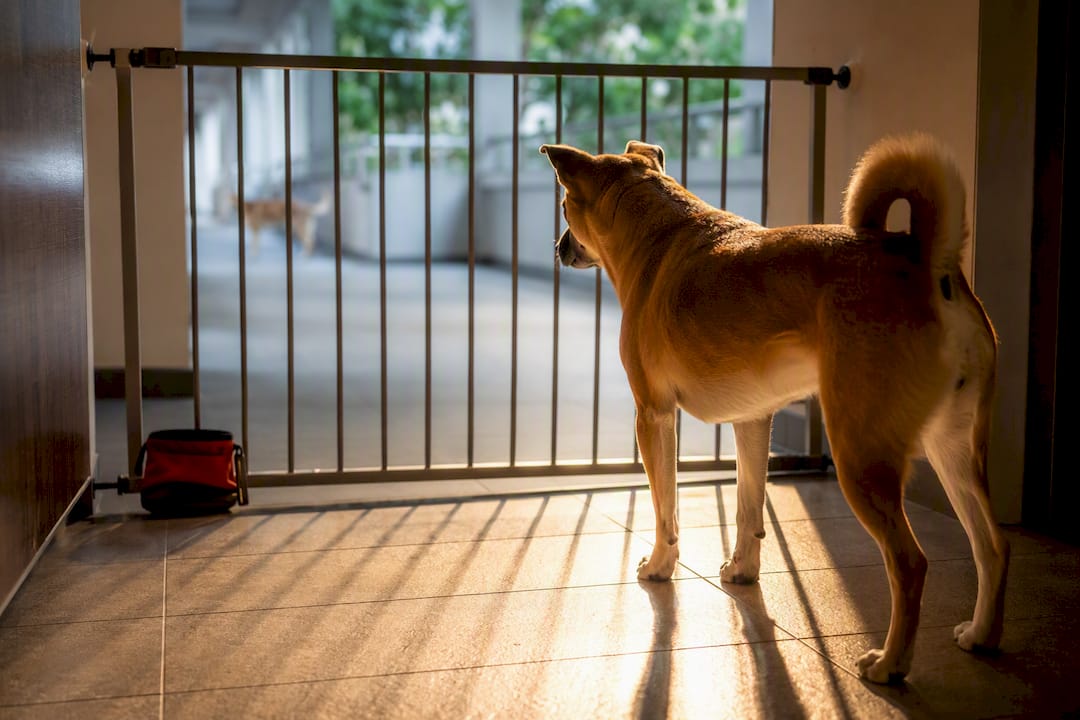
Barrier frustration is an emotional response where your dog becomes anxious or wildly overexcited because a fence, gate, window or leash stops them reaching something they want. It’s situational rather than a sign of permanent aggression, and most dogs who show it are perfectly friendly off lead. Your first move isn’t training. It’s management: block the view, keep your distance from the trigger, and never punish the noise.
TL;DR:
Blocking the view with opaque materials effectively reduces visual triggers and is recommended as the first line of environmental management.
Recognising early signs such as stiff body language, fixed stare, and repetitive barking helps intervene before escalation into lunging or snapping.
Training should focus on gradual desensitisation at the dog’s threshold, combined with layer-in treatments like CAT or BAT, and must be supported by management to prevent setbacks.
Management strategies and patience are crucial, as physical barriers and decreased exposure gradually build a low-arousal baseline for successful training.
Professional help is advisable for cases involving redirected aggression, rapid escalation, or when safety is at risk, and trainers should prioritize reward-based methods.
Table of Contents
What causes barrier frustration in dogs?
Barrier frustration rarely comes from nowhere. It builds through a mix of missed development, unmet needs and, sometimes, plain genetics.
The critical socialisation window between roughly 3 and 18 weeks shapes how a puppy handles novelty for life. A dog that missed calm, varied exposure to people, other dogs and everyday sights during this stage is more likely to react with alarm rather than curiosity later on. That said, plenty of well-socialised dogs develop the habit in adulthood too, often after a stressful house move or a change in routine.
Several factors tend to feed the behaviour:
Limited socialisation in early puppyhood, or a gap between 3 and 18 weeks with too little varied exposure
Under-exercised or under-stimulated dogs carry higher baseline arousal, so smaller triggers set them off faster
Breed and individual drive matter. Terriers bred to chase, and working breeds bred to guard or herd, are naturally more prone to fence-line fixation
The rehearsal effect. Every time barking or lunging makes the trigger retreat or disappear, the behaviour gets negatively reinforced and becomes more automatic next time
That last point is the one most owners miss. It’s not that the dog is “getting worse”. It’s that the behaviour is working, from the dog’s point of view, every single time it’s allowed to happen.
Recognising the signs before they escalate
Barrier frustration has a recognisable build-up if you know where to look. A forward-leaning stance, a fixed stare at the trigger, and stiff, repeated high-pitched barking usually come first. Lunging and snapping at the barrier itself follow if nothing interrupts the pattern.
Watch for these signals:
Forward lean with weight over the front paws, tail high and stiff
Fixed staring at the person, dog or vehicle beyond the barrier
Repetitive, escalating barking that rises in pitch
Lunging, jumping or scratching at the fence, gate or window
Displacement behaviours: spinning, tail chasing, or self-directed nibbling and biting when the dog can’t reach the trigger
Redirected aggression towards a nearby dog, person or object because the real target is unreachable
Pro Tip: If your dog snaps at a housemate dog seconds after the trigger disappears, that’s redirected aggression, not a random spat. Separate them immediately and treat the barrier incident as the real cause.
Repetition is what turns a nuisance into a hazard. Every rehearsed episode raises the chance the next one ends in a bite, whether that’s redirected at another dog in the home or, in rarer cases, at the owner trying to intervene.
Managing the environment to reduce triggers
You can’t train your way past a dog that’s rehearsing the behaviour fifteen times a day. Cut the opportunities first, then build skills on top.
Block the view. Opaque window film, privacy slats woven into chain link, or even a temporary tarp over a problem section of fence removes the visual trigger entirely. This kind of environmental modification is genuinely first-line defence, not a stopgap.
Create buffer zones. If your dog reacts to the front gate, close off access to that side of the garden and let them use a rear zone instead. Buffer planting or a secondary inner fence can achieve the same effect where a full rebuild isn’t possible.
Stagger outdoor time. If a neighbouring dog is loose at set times, avoid letting your dog into the garden during that window rather than hoping today’s different.
Swap trigger access for enrichment. A frozen stuffed Kong, a snuffle mat, or a scattered scent-work session gives the dog something satisfying to do instead of patrolling the fence line.
Plan walks around peak traffic. Early morning or late evening routes, away from the school run or the dog park rush, cut down daily rehearsal opportunities without any training at all.
Pro Tip: Background sound helps more than owners expect. A radio or white noise machine near a reactive window can mask the footsteps and voices that trigger the first bark.
None of this fixes the underlying emotional response. It buys you the calm, low-arousal baseline that actual training needs to work.
A step-by-step plan to retrain the response
Environmental changes stop the rehearsal. Training changes the emotion underneath it. The method with the strongest track record is desensitisation and counterconditioning, known as CC&D, and it works because it’s built entirely around staying calm.
Start by finding your dog’s threshold: the distance or intensity at which they notice the trigger but don’t yet bark, lunge or fixate. This is the only place training should happen.
Find the under-threshold distance. Walk your dog towards the trigger (or bring the trigger into partial view) and stop the moment you see the first hint of arousal, before any reaction. That’s your starting line.
Run short CC&D sessions. Feed continuously for 10 to 30 seconds the instant the trigger appears, then remove the trigger from view and stop feeding. Repeat.
Keep sessions brief. One to three minutes is plenty at first. Extend only once your dog reliably takes treats and stays relaxed across several repetitions.
Close the distance gradually. Move a metre closer only after multiple calm sessions at the current distance, never before.
Layer in CAT or BAT once basics are solid. Constructional Aggression Treatment (CAT) rewards calm behaviour by having the trigger, arranged with a helper, retreat the moment your dog relaxes. Behaviour Adjustment Training (BAT) gives your dog choice and space, using movement away from the trigger as the reward for a calmer alternative behaviour.
Both CAT and BAT need a helper who can read your dog’s body language and move on cue, which is why they’re best run with a trainer the first several times. Track progress through concrete markers, not gut feeling:
Calm, brief orienting glances at the trigger instead of a fixed stare
Longer stretches of relaxed body language at the same distance
The ability to close distance without a return of the original signs
Faster recovery time after an unplanned trigger appearance
Our aggressive dog threshold management guide walks through threshold work in more depth if you want a companion resource while you practise.
Common mistakes that stall progress
Most setbacks come down to a handful of habits, and they’re easy to fix once you see them.
Punishing the growl or bark. Growling is communication, not defiance. Suppress the warning and you don’t remove the stress, you just remove your dog’s ability to tell you about it before they bite.
Letting the rehearsal happen “just this once”. Every successful reaction reinforces the pattern. One missed gate-check undoes several good training days.
Mixed signals from multiple handlers. If one person allows barking at the fence and another blocks it, your dog gets a confusing, inconsistent picture of what’s expected.
Running sessions too long or too close. Pushing past threshold “to see what happens” teaches your dog that panic is the normal response, not the exception.
Pro Tip: Keep one marker word (we use “yes”) and a pot of high-value treats by the door at all times. Consistency in the tool matters as much as consistency in the plan. Our troubleshooting guide for training setbacks covers more recovery strategies if you’ve hit a wall.
When barrier frustration needs professional help
Some situations call for a trainer’s eyes on the problem straight away, not after months of trying alone.
Treat these as red flags:
Any bite, even a minor one that didn’t break skin
Redirected aggression between dogs living in the same household
Rapid escalation despite consistent management at home
A dog that can’t settle even at what should be a safe distance
A proper behaviour consult starts by ruling out medical causes such as pain or vision changes, which can make an otherwise calm dog suddenly reactive. From there, a trainer maps your dog’s actual threshold, watches how you handle triggers, and assesses the home environment for easy wins you might have missed. AVS-accredited consults, intensive obedience programmes, and longer behaviour plans are the typical next steps depending on severity.
Barrier frustration versus anxiety and true aggression
These three get lumped together constantly, and mixing them up leads to the wrong fix.
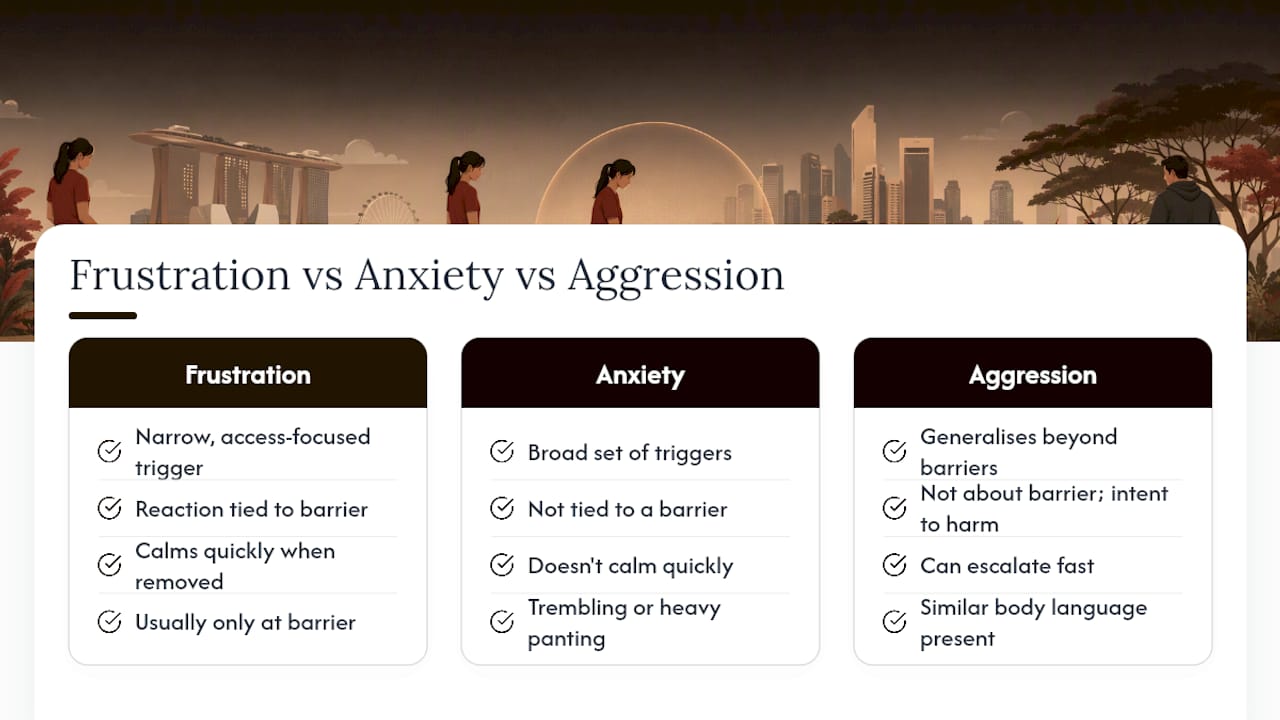
Barrier frustration is fundamentally about wanting access to something and being blocked. Take the barrier away, and many of these dogs greet the same trigger calmly, sometimes within seconds. That’s the giveaway: the emotional charge is tied to the physical obstruction itself, not to the person, dog or object beyond it.
General anxiety runs differently. An anxious dog reacts to a much broader set of triggers, often shows physical signs like trembling or excessive panting even without a barrier present, and doesn’t calm down quickly once the trigger is removed. Anxiety usually needs a wider management plan, sometimes alongside veterinary input, rather than the targeted CC&D work that suits barrier frustration.
True aggression, meanwhile, is about intent to harm rather than frustrated access. A genuinely aggressive dog may show similar body language at a fence, but the behaviour generalises well beyond barriers, escalates faster, and carries a higher bite risk from the outset.
The overlap causes real confusion because the visible signs, barking, lunging, a hard stare, look almost identical across all three. The distinguishing test is context: does the reaction disappear the moment the barrier is removed, does it happen only with a narrow set of triggers, and does the dog recover quickly once the object of frustration is out of sight. Answering those questions honestly is usually enough to tell frustration apart from anxiety or aggression, though a professional assessment is the safer route for anything ambiguous.
Keeping the improvement once training works
Training gains fade fastest when owners stop managing the environment the moment the dog seems better. Treat the first few months after visible progress as a maintenance phase, not a finish line.
Keep the visual barriers in place even after your dog stops reacting reliably. Removing them early, to “test” the dog, is one of the most common ways owners undo months of work in a single afternoon. The same goes for buffer zones and staggered outdoor access: hold them for longer than feels necessary.
Revisit CC&D sessions periodically, even briefly, especially after a house move, a new pet in the household, or a long gap without exposure to the trigger. Dogs don’t unlearn an emotional response permanently after a handful of good weeks. They maintain it through continued, low-pressure practice.
Watch for small regressions rather than waiting for a full relapse. A slightly longer stare, a stiffer stance, one extra bark before settling. These are worth a return to shorter distances and smaller steps for a week or two, not a sign the whole plan has failed. Long-term success with barrier frustration looks less like a single breakthrough and more like a gradually rising baseline of calm, with occasional dips you manage quickly rather than ignore.
What successful management actually looks like
Two patterns come up repeatedly in dogs that overcome barrier frustration, regardless of the specific trigger.
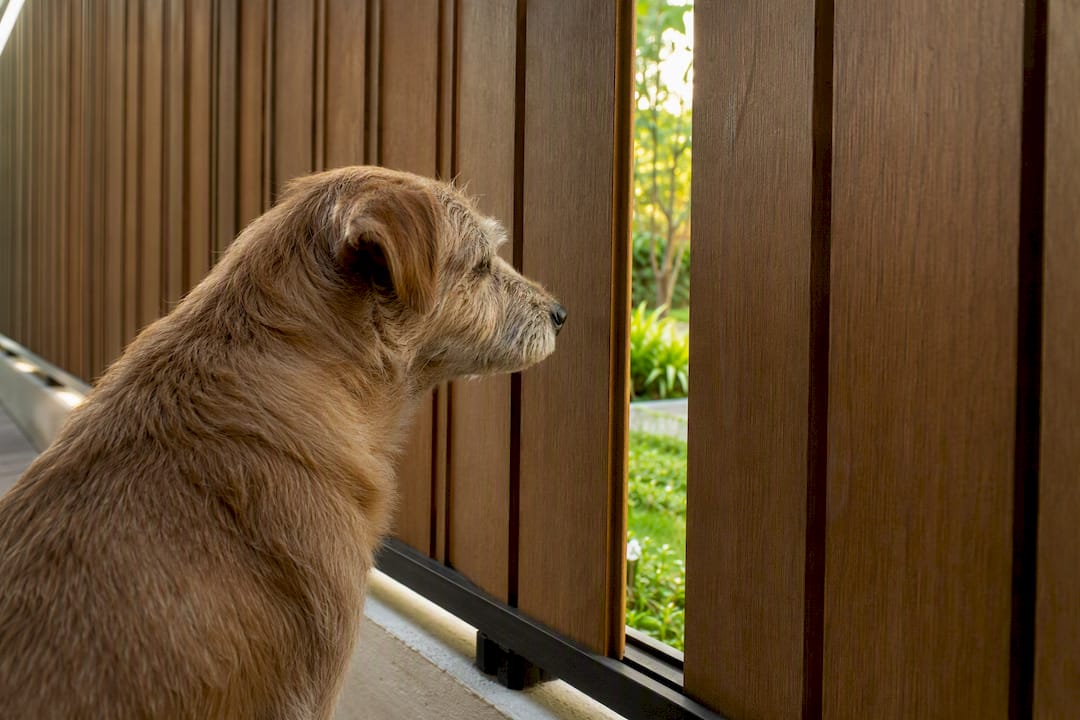
The first is the dog whose reactivity was almost entirely rehearsal-driven. A young terrier mix, for example, who’d spent a year barking at the same gap in the garden fence every time the neighbour’s cat walked past. Blocking the gap with privacy slats and running two weeks of short CC&D sessions at the remaining sightline was often enough to see a dramatic drop in reactions, because the behaviour had never been reinforced by anything deeper than habit and an achievable “win” each time.
The second pattern involves genuine territorial drive layered on top of poor early socialisation, typically in working or guarding breeds. These cases need longer timelines and usually benefit from CAT sessions with a trained helper, because the dog needs to learn that calm behaviour, not vigilance, is what makes the “threat” retreat. Progress here tends to be measured in weeks of gradually closing distance rather than a fast turnaround.
What both cases share is the sequencing: management first to stop rehearsal, then structured desensitisation, then a maintenance phase. Skipping straight to training without blocking the trigger access almost always stalls, because the dog keeps getting rewarded for the old behaviour between sessions. The order matters as much as the techniques themselves.
Choosing the right trainer for a complex case
Not every barrier frustration case needs a specialist, but the ones involving redirected aggression, multiple dogs, or rapid escalation genuinely do.
Look for accreditation first. In Singapore, that means checking for AVS-mandated obedience programme compliance and a trainer with documented experience in aggression cases specifically, not just general obedience. Ask directly how many barrier reactivity or fence-fighting cases they’ve handled, and whether their methods are reward-based rather than reliant on corrections or punishment, given how easily punishment backfires with this particular behaviour.
A good consult should include a threshold assessment on your own property, a look at your handling and daily routine, and a written plan you can follow between sessions, not just verbal advice you’ll half-remember by the next morning. Trainers should also be upfront about timelines. Anyone promising a fixed, fast turnaround for a case involving redirected aggression between household dogs is oversimplifying a genuinely variable process.
An editorial take on what actually moves the needle
Most advice on barrier frustration focuses on the training technique, as if picking the right protocol is the hard part. It isn’t. The hard part is getting owners to commit to environmental management long enough for training to matter, and to stop quietly undoing progress by testing the dog too soon.
Mark has spent over 20 years working through exactly this pattern with Singapore families, as an AVS-accredited trainer building humane, science-based programmes around each dog’s specific triggers. The cases that succeed fastest are rarely the ones with the most sophisticated CAT or BAT protocol. They’re the ones where the owner blocked the fence gap on day one and didn’t touch it again for six weeks. Happy-Dog Training’s approach leans on that discipline as much as on the technique itself, and it’s why lifetime post-training support matters more than any single session.
— Mark
Book a barrier frustration consult with Happy-Dog Training
If management alone hasn’t settled things, or your dog’s shown any redirected aggression, a personalised programme beats trial and error every time. Happy-Dog Training’s aggressive behaviour consult starts with an on-site threshold assessment, so the plan is built around your dog’s actual triggers rather than a generic script.
For dogs that need structured, hands-on work, the 4-week AVS-approved intensive obedience programme combines CC&D groundwork with real-world practice around triggers, guided by a trainer with over 20 years’ experience. Every programme includes a personalised plan and free lifetime support after training ends, so gains from week four don’t quietly slip by month six. To get started, book a consult and bring notes on when the reactions happen, how your dog behaves once the trigger’s gone, and what you’ve already tried. That single conversation usually clarifies more than weeks of guessing alone.
Sources
Recommended
Comments