Board and train programme evaluation checklist: your guide
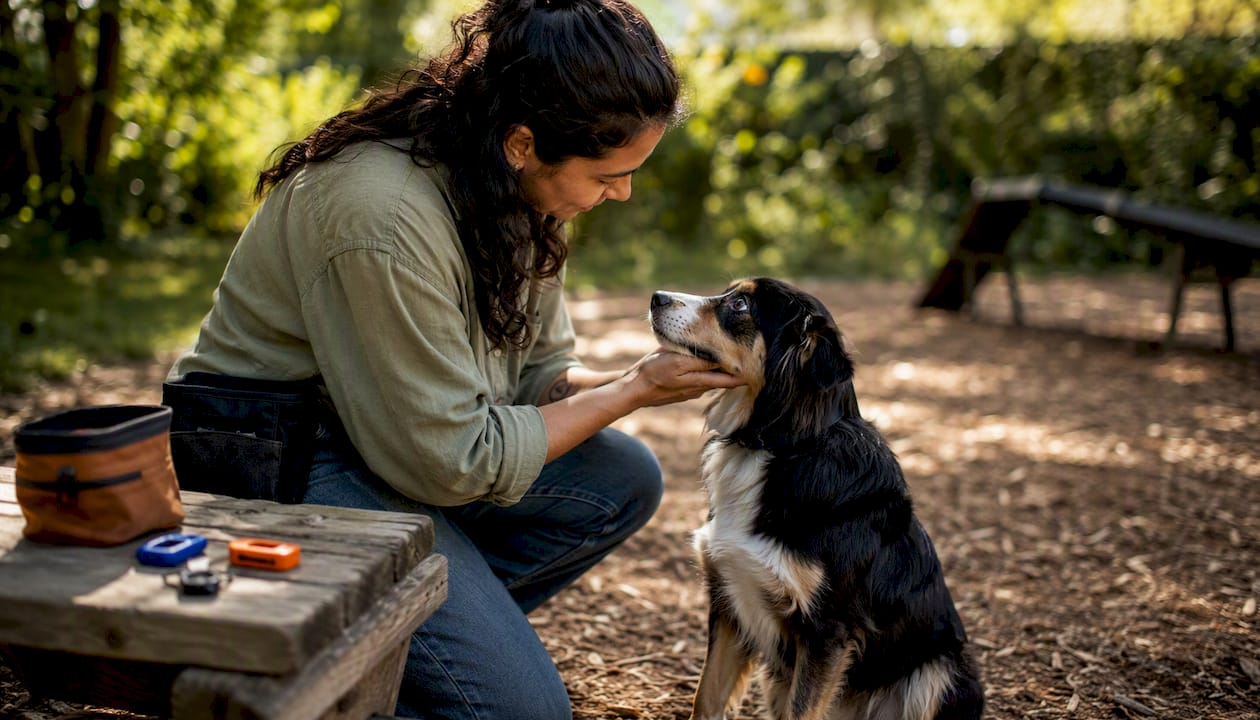
A board-and-train programme is worth booking only when it includes four non-negotiables: a hands-on pre-boarding behavioural assessment, daily structured training sessions with documented objectives, mandatory owner transition lessons, and a written follow-up evaluation schedule. Without all four, even a well-intentioned programme risks producing results that fade within weeks of your dog coming home.
Frameworks like Kirkpatrick’s Four Levels of Evaluation and CDC training-effectiveness guidance confirm that measuring learning transfer in context, not just immediate performance, is what separates genuine progress from temporary compliance. Happy-dogtraining applies this same principle: every programme is built around measurable goals, owner coaching, and a structured follow-up plan.
Before you book, confirm all four of these:
A documented behavioural intake assessment completed before acceptance
A written training plan with specific, measurable objectives
Scheduled owner transition sessions (hands-on, not just a handover chat)
A written follow-up schedule with at least one delayed evaluation check
Table of Contents
What should you confirm before handing over your dog?
Use this checklist when contacting providers. Each item takes under five minutes to verify by phone or on a website.
Welfare and safety
Proof of current vaccinations required (Kennel Cough/Bordetella, core vaccines)
Parasite prevention confirmed and documented
Emergency veterinary plan in writing
Insurance cover for the dog during the stay
Trainer qualifications and methods
Named trainer qualifications or CPD memberships listed
Force-free or science-based methods stated explicitly
No aversive tools (prong collars, shock collars) used without written explanation
Case notes or behaviour-modification experience documented
Programme structure
Pre-acceptance behavioural evaluation offered (not optional)
Daily training session length and frequency stated
Real-world or off-site proofing included
Written training plan provided before drop-off
Owner involvement and follow-up
Mandatory owner transition session(s) included in the programme fee
Written follow-up schedule provided
At least one delayed check-in offered a few weeks post-handover
References or before/after video evidence available on request
What does a proper pre-booking assessment look like?
A credible provider will not accept your dog without first understanding what they are working with. A proper behavioural intake involves a hands-on evaluation, typically 30–60 minutes, where the trainer observes your dog’s responses to strangers, other dogs, handling, and mild stressors. The outcome is documented: either an acceptance with a written training plan, or a referral to a specialist for issues such as severe aggression or deep-rooted fearfulness, which often require behaviour modification beyond a standard board-and-train package.
Medical and welfare paperwork matters just as much. Reputable providers require proof of up-to-date vaccinations, a parasite prevention record, details of any medication (clearly labelled with dosage and timing), and a signed emergency care authorisation. Preparing your dog thoroughly before drop-off reduces disruption during training and protects every dog in the facility.
The trainer-client planning conversation should produce three things: agreed measurable objectives (“reliable recall in a park with distractions”), a written training plan, and signed consent. If a provider skips this step and simply takes your dog in, that is a red flag.
Pro Tip: Ask the trainer during your intake call: “What would cause you to decline a dog?” A confident, specific answer (e.g. unassessed bite history, unmanaged medical conditions) signals professional practice. Vague or evasive answers suggest the provider accepts any dog regardless of fit.
What should a quality board-and-train programme include?
Trainer qualifications and ethical methods
Look for named qualifications, CPD evidence, or membership of recognised bodies. Force-free, science-based behaviour analysis is the standard you should expect. Ask specifically whether aversive tools are ever used and under what circumstances. A trainer who cannot answer clearly, or who dismisses the question, is not the right fit.
Daily training structure
A quality programme includes multiple short, focused sessions daily rather than one long block. Well-structured daily schedules combine hands-on training, supervised enrichment, and rest. Ask for a sample day’s timetable. Vague answers like “we train throughout the day” are not sufficient.
Real-world proofing and socialisation
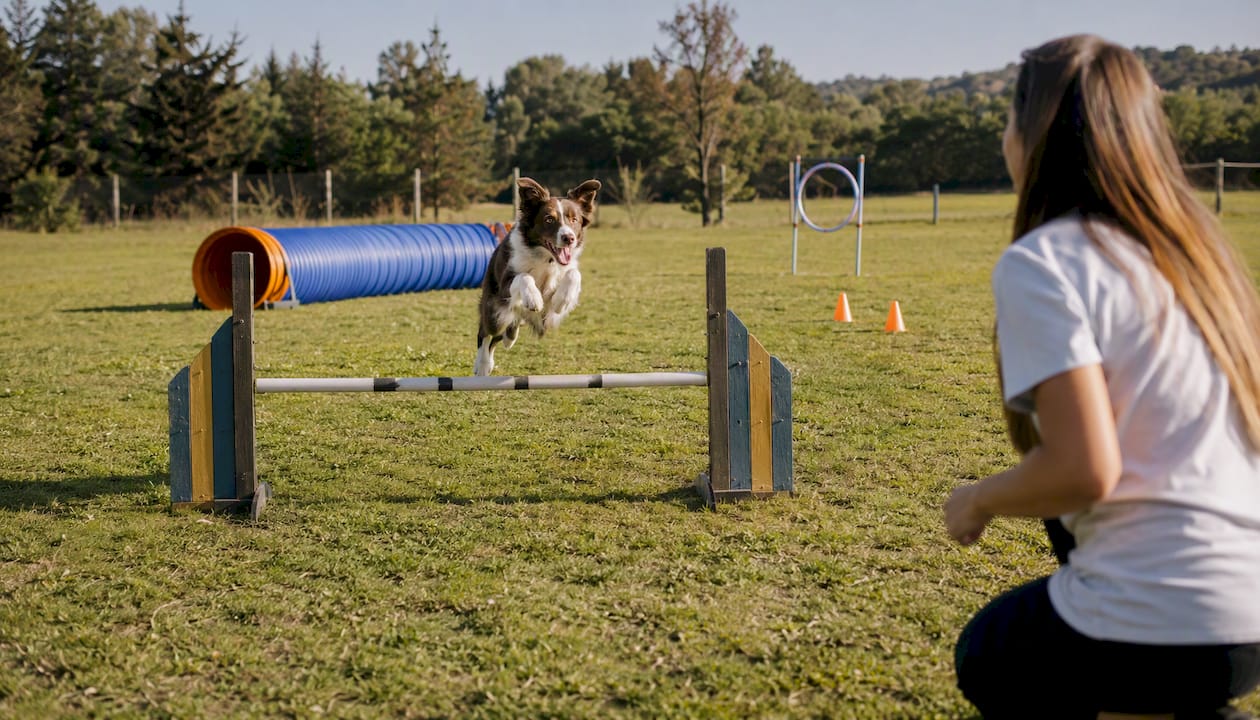
Skills learned only in a kennel environment rarely transfer reliably to your home. Good programmes include off-site practice, simulated home scenarios, and controlled socialisation with other dogs and new environments. Training environment quality is one of the strongest predictors of lasting results.
Trust signals to look for
Written pre- and post-programme behavioural reports
Video evidence of progress (before/after clips)
Client references available on request
Mandatory owner-transfer sessions included, not sold as an add-on
How do you measure whether the training actually worked?
Adapting Kirkpatrick’s Four Levels to dog training gives you a practical framework for judging outcomes at every stage.
Kirkpatrick level | Dog-training equivalent | How to measure it |
Level 1: Reaction | Owner and dog experience during the programme | Owner satisfaction survey; trainer’s daily notes |
Level 2: Learning | Skills the dog reliably demonstrates at handover | Practical skills check at the transition session |
Level 3: Transfer | Behaviour in your home and real environments | Structured home observations over 2–4 weeks |
Level 4: Results | Household impact (reduced stress, safer walks) | Owner-reported outcomes at 4–8 week follow-up |
CDC guidance recommends pre/post assessments and delayed follow-up to measure genuine transfer, not just immediate performance. The CDC’s postcourse evaluation questions can be adapted directly for owner surveys after handover. The EDUCATOOL toolkit offers a validated 12-item questionnaire covering reaction, learning, behaviour, and results, which translates well into a post-programme owner check-in.
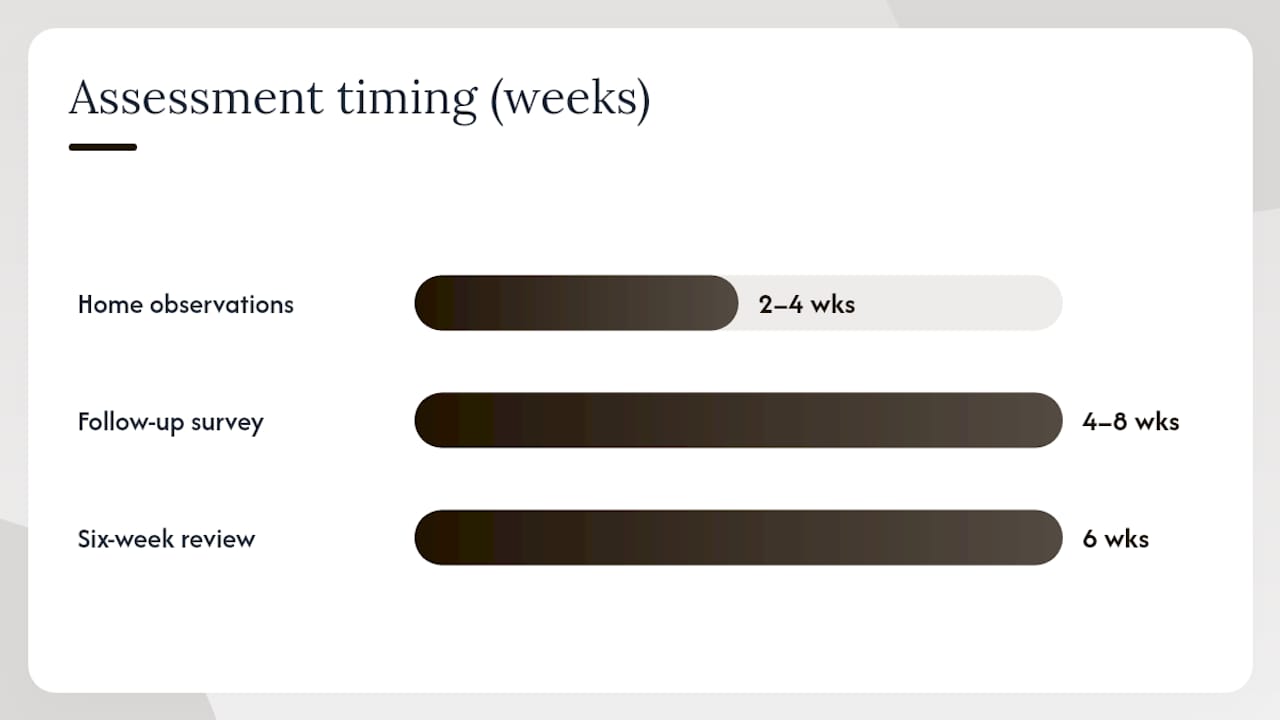
Pro Tip: Schedule a structured home observation a few weeks post-handover. Ask yourself: “Can my dog perform the trained behaviours in three different real-world settings without prompting?” If the answer is no, contact the trainer immediately rather than waiting for the six-week review.
A simple outcome rubric:
Accept: — Dog performs target behaviours reliably in at least three real-world settings; owner can replicate the training cues confidently
How can you score and compare programmes objectively?
Dimension | Score 1 (poor) | Score 2 (acceptable) | Score 3 (strong) |
Trainer qualifications | No named credentials | CPD or informal experience | Recognised qualification + behaviour-modification evidence |
Training methods | Aversive tools used | Mixed methods, unclear policy | Force-free, science-based, documented |
Intake process | No pre-assessment | Basic phone screen | Hands-on behavioural evaluation with written outcome |
Daily training | Unspecified | General schedule stated | Detailed timetable with session lengths |
Owner transition | Not included | Brief handover only | Hands-on sessions, written cue guide |
Outcomes measurement | None | Verbal feedback only | Written pre/post report + delayed follow-up |
Welfare protocols | No documentation | Vaccination required | Full welfare pack: vaccinations, emergency plan, insurance |
Ongoing support | None | Email available | Scheduled reviews + written follow-up schedule |
Scoring thresholds:
20–24 points: Accept. Strong programme with evidence-based practice.
13–19 points: Consider with caveats. Ask for written clarification on weak areas before booking.
Below 13 points: Walk away. Core safeguards are missing.
To score multiple providers:
Print or copy the table above for each provider
Score each dimension honestly based on written evidence, not verbal promises
Weight owner transition and outcomes measurement most heavily if long-term results matter to you
What questions should you ask, and what are the red flags?
Questions to ask every provider:
“Can you describe your pre-acceptance behavioural evaluation process?”
“What training methods do you use, and do you ever use aversive tools?”
“How many hands-on training sessions will my dog receive each day?”
“What does the owner transition session involve, and how long does it last?”
“How do you measure and document progress?”
“What is your emergency veterinary protocol?”
“Can I see a sample pre/post behavioural report?”
Red flags to walk away from:
No pre-acceptance evaluation offered
Refusal to allow owner involvement at handover
Vague outcome descriptions (“your dog will be better”)
No vaccination or welfare checks required
Aversive tools used without written explanation or owner consent
No written training plan or follow-up schedule
Unwillingness to provide references or before/after evidence
Verify answers by requesting documents. A confident, professional provider will send a sample report or reference contact without hesitation.
What are realistic timelines and what drives the cost?
Industry practice suggests 1–3 weeks for basic obedience and up to six weeks for complex behaviour issues such as reactivity or aggression. Duration must match the stated objectives. A longer stay is not automatically better; what matters is reliable behaviour in real-world settings and a confident owner at handover. See the types of board-and-train programmes available to match format to your dog’s needs.
Cost drivers:
Trainer experience and specialist qualifications
One-to-one daily training vs shared-care arrangements
Accommodation standard and facility quality
Inclusion of owner coaching sessions
Number of follow-up check-ins included
Add-ons genuinely worth paying for:
Additional owner transition sessions (the single strongest predictor of lasting results)
A written post-programme report with measurable outcomes
Scheduled remote check-ins at two and six weeks post-handover
Key takeaways
A board-and-train programme is only as good as its owner transition plan: without documented objectives, hands-on handover sessions, and a written follow-up schedule, even strong kennel results will fade at home.
Point | Details |
Pre-booking assessment is non-negotiable | Decline any programme that accepts your dog without a hands-on behavioural evaluation. |
Owner transition sessions predict long-term success | Hands-on coaching at handover, not just a verbal briefing, is the single strongest quality indicator. |
Measure outcomes at Level 3 and 4 | Use structured home observations and owner-reported outcomes at 4–8 weeks, not just handover performance. |
Longer stays do not equal better results | Match programme length to objectives; prioritise real-world proofing and owner coaching over kennel time. |
Happy-dogtraining’s approach | Happy-dogtraining builds every programme around measurable objectives, force-free methods, and structured owner coaching with free lifetime support. |
What the evaluation checklist gets wrong most of the time
Most owners focus on the wrong end of the programme. They scrutinise the facility photos, ask about the kennel size, and check whether the trainer seems friendly. These things matter, but they are not what determines whether your dog is still reliably sitting at a kerb six months later.
The transfer session is the real product. Everything that happens in the kennel is preparation for that 90-minute handover. A trainer who rushes it, or who hands you a printed sheet and calls it coaching, has not finished the job. The kennel stay is the rehearsal; the owner transition is the performance.
There is also a tendency to treat the evaluation checklist as a one-time exercise. The scoring table in this article is most useful when you return to it at the two-week and six-week marks and score your dog’s actual home behaviour against the stated objectives. If the scores drop, that is information, not failure. It tells you exactly where to focus the follow-up work.
One more thing: a programme that refuses to share a sample pre/post behavioural report is not protecting client privacy. It is protecting itself from scrutiny. Ask for one. A confident provider will have it ready.
Happy-dogtraining can help you evaluate and run this process
Choosing a board-and-train programme is a significant decision, and the evaluation work should not fall entirely on you. Happy-dogtraining offers personalised programmes built on over 20 years of science-based, force-free practice, with every placement preceded by a thorough behavioural assessment and followed by structured owner coaching sessions.
Every programme includes a written training plan with measurable objectives, mandatory owner transition sessions, and a written follow-up schedule. Free lifetime support is included after training, so you are never left managing regression on your own. Whether your dog needs basic obedience, fearfulness treatment, or a more intensive behaviour-modification programme, the 4-week AVS-approved intensive programme is a structured, evidence-backed starting point. To discuss your dog’s specific needs and get a clear picture of what a well-run programme looks like in practice, get in touch with Happy-dogtraining today.
Useful sources and further reading
The following sources informed the checklist, evaluation framework, and practical guidance in this article.
Training Evaluation | Berkeley Lab Training
Training effectiveness: evaluate training and measure effectiveness | CDC
EDUCATOOL: development and measurement properties of a generic educational course assessment toolkit — Frontiers in Education
Board and Train Dog Training: Do These Programs Really Work? — Haven Dog Training (blog)
Preparing your dog for a board and train stay: the ultimate success checklist — SitMeansSit
What should I pack for Board & Train? Essential checklist for dog owners — Rob’s Dogs
Recommended
Comments