Stop Your Dog Barking at Guests: 3 Force Free Steps for Singapore
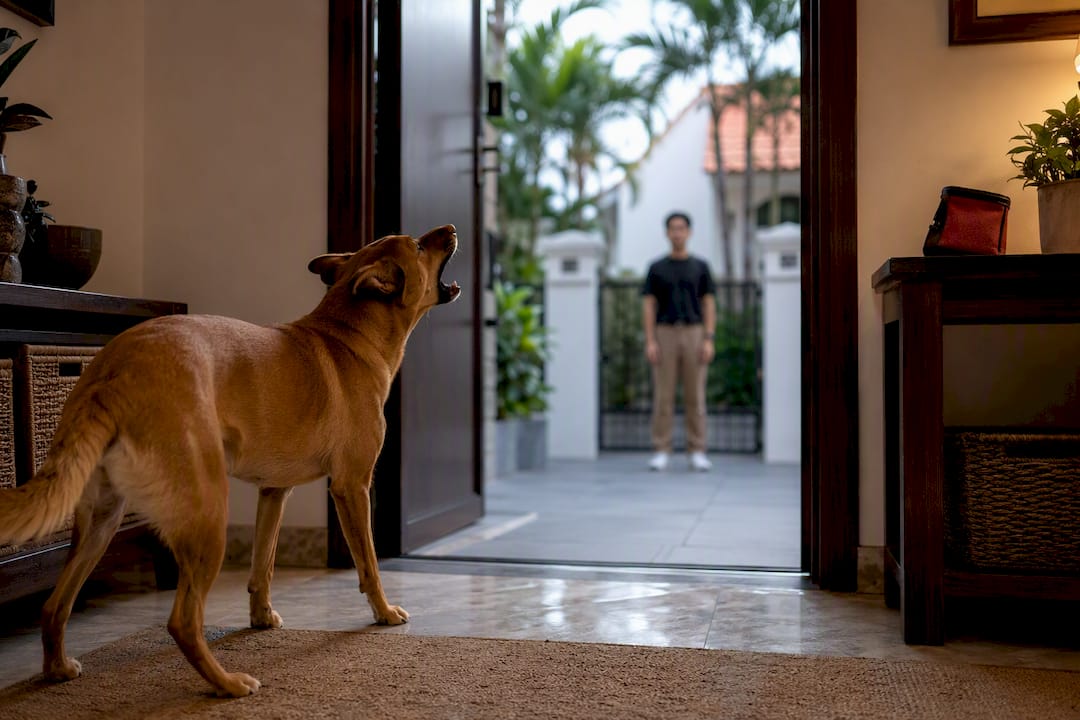
Your dog barks at guests because of one of three drivers: territorial instinct, fear, or excitement, and each needs a different fix. The reliable path is to manage the moment (contain the dog, brief your guests), teach a “quiet” or “settle” cue, and use counter-conditioning to change how your dog feels about visitors. If your dog has ever snapped or bitten, stop inviting guests over as practice and get a vet check and a certified trainer’s help first.
TL;DR:
Many dogs bark at guests due to territorial, fearful, or excited motives, each requiring different management and training approaches.
Immediate management should involve pre-emptive containment and clear guest instructions to avoid reinforcing the barking pattern.
Training should focus on building calm responses through gradual desensitization, cue teaching, and controlled door interactions over several weeks.
Environmental modifications and routine consistency help reduce triggers, but medical or behavioral intervention may be necessary for aggressive or escalating cases.
Understanding the specific type of bark and preparing guests properly can significantly improve long-term behavior, especially when combined with professional guidance.
Table of Contents
Why does my dog bark at guests?
Barking at visitors isn’t one problem with one solution. It’s usually one of three distinct drivers, and mistaking one for another is why so many owners feel stuck.
Territorial barking happens because your dog sees the front door as the edge of its patch, and a knock or doorbell signals an intruder. You’ll see stiff posture, forward-leaning body weight, and a deep, repetitive bark that often stops once the “intruder” is let in and sniffed.
Fear-based barking looks different: ears pinned back, tail tucked, weight shifted backwards even while barking forward. This dog isn’t defending territory, it’s trying to make something frightening go away. Purina Singapore notes that identifying which of the three drivers is at play matters because the intervention differs sharply.
Excitement barking is the easiest to misread as aggression. High-pitched, rapid barking paired with a wagging tail, spinning, or jumping usually means your dog is overjoyed, not threatened.
A few patterns worth watching:
Doorway-only barking that stops once the guest is inside often points to territorial behaviour.
Window or fence barking at passers-by, unconnected to your door, suggests a broader reactivity pattern worth addressing separately.
Barking at specific visitor types (children, men, people in hats) often signals fear tied to limited early exposure.
Getting this diagnosis right decides whether you need management, desensitisation, or simple impulse-control training.
Immediate safety and management when guests arrive
Before you think about training, you need a plan that stops today’s visit turning into a rehearsal for tomorrow’s barking. VCA Hospitals recommends containing the dog before guests arrive rather than managing the chaos after the doorbell rings.
Secure your dog in another room or behind a baby gate before the guest knocks, not after. Give them a food puzzle or a stuffed chew to keep their brain busy while the “scary” thing happens on the other side of a door.
Brief your guests before they step inside. Ask them to ignore the dog entirely, avoid eye contact, and not approach until your dog is visibly calm and you’ve given the go-ahead.
Let your dog settle before any introduction. If the barking hasn’t stopped within a minute or two of the guest’s arrival, keep the dog contained for the whole visit rather than forcing an introduction.
If your dog has ever shown biting behaviour towards a visitor, stop treating every guest arrival as a training opportunity. A safer plan for dogs with visitor aggression means prioritising containment over exposure until a clinical behaviourist has assessed the dog properly.
Pro Tip: Put a laminated card by your front door listing the three guest instructions (ignore, no eye contact, wait for the nod). Guests forget verbal briefings within seconds of walking in, but a card on the door catches their eye every time.
Step-by-step training plan to reduce barking at guests
Training a calmer response isn’t about correcting the bark itself. It’s about rewiring what your dog expects to happen when a visitor arrives, and that takes structured repetition rather than one dramatic breakthrough session.
1. Start below the threshold. Work at a distance or volume where your dog notices the trigger (a knock, a doorbell sound from your phone) but doesn’t erupt. Reward calm attention immediately with high-value treats, small pieces of chicken or cheese work well.
2. Teach “quiet” or “settle” as a standalone skill. Away from any real guest pressure, shape moments of silence: wait for a pause in barking (even accidental), mark it with a word like “quiet,” and reward. Repeat daily in short, boring five-minute sessions until the cue reliably interrupts barking on its own.
3. Counter-condition at the door. Once your dog holds “quiet” reliably in low-pressure drills, recruit a friend to simulate a real visit. Have them knock, wait, and only step inside once your dog is calm and rewarded.
Knock happens → dog looks at you instead of the door → reward.
Helper enters and sits down, ignoring the dog → reward for continued calm.
Helper stays seated for several minutes while you reward calm intervals → session ends before the dog gets bored or aroused again.
4. Increase realism gradually. Add real doorbells, actual guests, and longer visits only once each previous stage is solid. Rushing this step is the single most common reason training stalls, dogs pushed past their threshold too soon simply relearn to bark harder.
Keep every session short, no more than ten minutes, and always end on a success rather than pushing until the dog fails.
Pro Tip: Practise the guest-arrival drill with the same “helper” three or four times before rotating in a new person. Dogs generalise faster when one variable changes at a time, rather than facing a brand-new face and a brand-new drill simultaneously.
Preventing rehearsal: environmental fixes and routine changes
Every time your dog barks and the “threat” retreats, backs off, or the visitor eventually gets ignored into leaving them alone, the barking gets reinforced. Breaking that self-rewarding cycle matters as much as any formal training session.
Start with what your dog can actually see and hear:
Block window views with curtains, frosted film, or furniture that removes vantage points over the street or front path.
Ask visitors to text on arrival rather than knocking cold, giving you time to secure the dog calmly instead of reacting to a startle.
Play white noise or low music near the front door to soften the sudden acoustic trigger of a doorbell.
Increase daily exercise and enrichment. A dog running on pent-up energy escalates faster and recovers slower; a well-exercised dog has more capacity to stay under threshold.
None of these changes teach your dog anything new, but they buy you the calm window in which real training can actually happen. Territorial displays are often a normal part of canine behaviour, and early socialisation combined with calm-at-the-door routines reduces the risk of escalation over time.
When barking needs a vet check or professional help
A veterinary exam should be the first stop, not the last resort, when barking at guests appears suddenly or gets worse. Pain, hearing changes, and cognitive decline in older dogs are under-recognised causes of new reactivity, and the Merck Veterinary Manual lists ruling out medical causes as a standard step before any behaviour plan begins.
Certain signs mean you shouldn’t wait to see if training alone fixes things:
Any snapping, lunging with contact, or biting directed at a visitor.
Barking that escalates in intensity or duration despite consistent management.
A dog you genuinely cannot contain safely during a normal visit.
A qualified behaviourist or AVS-accredited trainer typically starts with a written safety plan, moves through stepwise desensitisation at a pace the dog can handle, and refers to a vet for medication when anxiety is severe enough to block learning. The Merck manual also notes that SSRIs or trazodone can support behaviour modification in high-anxiety dogs under veterinary supervision, not replace it.
Understanding different types of barks and their meanings
Not every bark means the same thing, and learning to read the difference saves you from misjudging your dog’s state at the worst possible moment.
An alert bark tends to be sharp, low, and repetitive, three or four short bursts, often with a pause where the dog checks whether you’ve noticed the “threat” too. This is your dog doing its job: flagging something unusual, then waiting for your response.
A fearful bark carries a different rhythm: higher pitched, sometimes mixed with growling or whining, and paired with retreating body language rather than advancing. A fearful dog wants distance, not confrontation, even though the noise can sound aggressive to an unfamiliar ear.
A playful or excited bark is fast, high, and often accompanied by a loose, wiggling body and a wagging tail held mid-height or higher. This dog isn’t warning anyone, it’s simply overwhelmed with enthusiasm and hasn’t learned a calmer way to express it yet.
Growling deserves particular respect, whichever bark type it accompanies. It’s a warning signal, not misbehaviour, and punishing it teaches a dog to skip the warning next time and escalate straight to a snap. Reading the bark correctly before you react is often the difference between calming a nervous dog and accidentally frightening it further.
How to prepare guests for interaction with the dog
Most guest-related barking gets worse because visitors do exactly the wrong thing on instinct: they lean towards the dog, make direct eye contact, and talk in an excited, high-pitched voice. All three read as pressure to an anxious or territorial dog.
Brief every visitor with three simple rules before they walk in. First, ignore the dog completely on arrival, no talking to it, no reaching out a hand, no crouching down to “say hello.” Second, avoid direct eye contact, particularly with a dog you don’t know; a hard stare reads as a challenge in canine body language. Third, let the dog approach in its own time, and only then offer a treat, tossed gently to the side rather than held out towards the dog’s face.
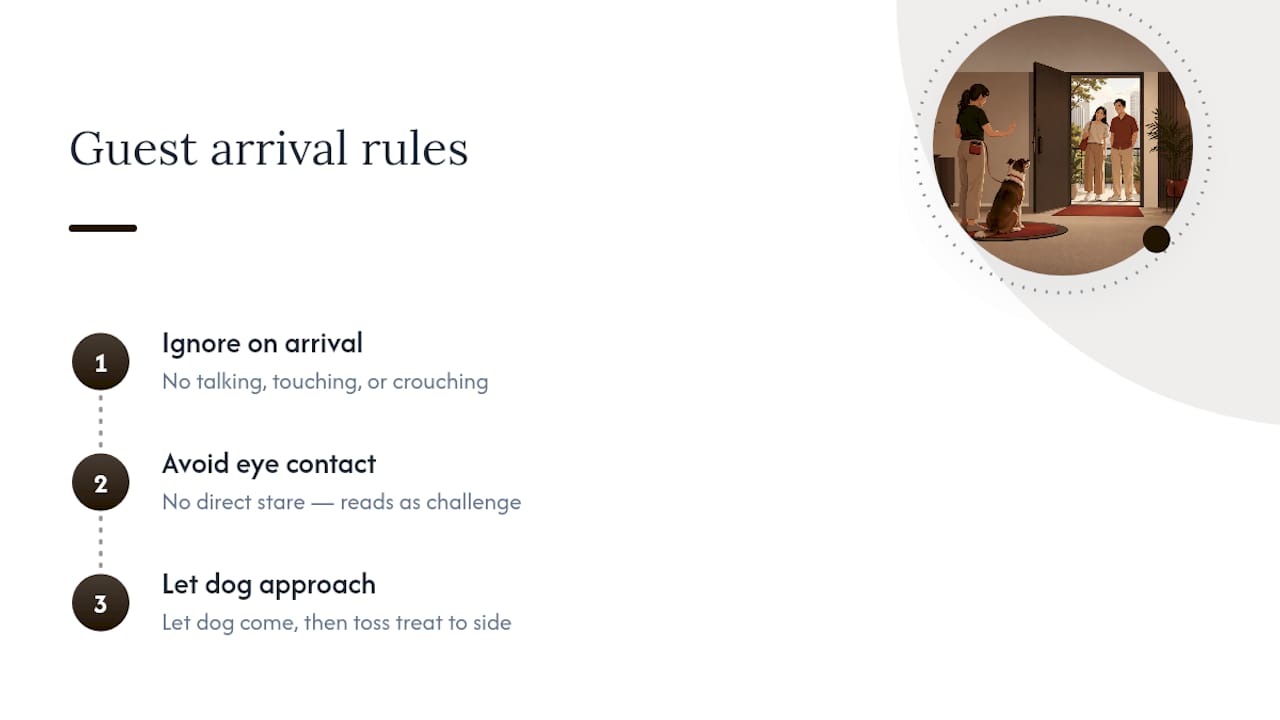
This sequence matters because it removes the guest as a source of pressure and turns them into a predictable, low-stakes presence instead. A dog that’s used to being rushed at by excited visitors learns that people arriving means overwhelm; a dog that’s consistently ignored until it chooses to engage learns that visitors are boring at worst and rewarding at best.
Keep treats by the door specifically for this purpose, small, soft, and easy for a guest to toss without fumbling. Consistency across every single visitor, not just the ones you remember to brief carefully, is what actually shifts the pattern long term.
Do calming aids and tools actually help?
Tools like a pressure wrap or a pheromone diffuser can take the edge off a dog’s baseline anxiety, but they’re a support for training, not a substitute for it. Neither one teaches your dog what to do when a guest arrives.
A snug-fitting wrap applies gentle, constant pressure that some dogs find genuinely soothing, similar to swaddling an infant. Results vary considerably between individual dogs, so treat it as worth trying rather than guaranteed. Dog-appeasing pheromone diffusers work on a similar logic, releasing a synthetic version of a calming maternal pheromone into the air, and can help lower general household anxiety over the weeks leading up to a training push.
Neither tool replaces the vet check, and neither will stop a territorial dog from barking at the door on its own. Think of them as scaffolding around the real work: they can lower the volume on background anxiety enough to make training sessions more productive, particularly for dogs whose barking is fear-driven rather than territorial or excitement-based.
If you’re setting up a genuinely calm environment for visits, general pet-safety basics matter too, from a comfortable, secure containment space to tick and parasite protection if your dog spends time outdoors before guests arrive.
Building a long-term plan that actually sticks
A single good training session won’t undo months or years of rehearsed barking. What changes the pattern permanently is consistency: the same guest-arrival routine, the same cue word, the same reward criteria, repeated by everyone in the household, every single time.
Write the plan down if that helps keep it consistent, particularly if more than one person answers the door. Decide together what “calm enough” looks like before rewarding, what the settle cue actually sounds like, and who’s responsible for briefing guests before they arrive. Inconsistency, one person rewarding calm silence while another lets the dog barrel at the door, is one of the fastest ways to stall progress that was otherwise working.
Expect the timeline to be measured in weeks, not days, particularly for fear-based barking. Territorial and excitement barking often respond faster to consistent settle training, while fearful dogs need slower, carefully paced counter-conditioning that respects their threshold at every stage. Revisit your environmental fixes periodically too: a dog that’s stopped barking at the window for six months can relapse quickly if a new litter of curtains gets left open during a heatwave.
Reinforcement doesn’t stop once the behaviour improves. Dogs that go months without practice, without the odd refresher reward for calm greetings, tend to drift back towards old patterns. Treat the occasional guest visit as an ongoing practice opportunity rather than a finished project.

A trainer’s take on getting this right
Safety comes before sentiment, always. Rule out pain first: a dog that suddenly starts guarding the door may be telling you something hurts, not that it’s suddenly become territorial. Beyond that, predictable routines beat clever tricks every time, dogs settle faster with consistency than with a single “breakthrough” session. For owners who feel out of their depth managing real-world reactivity, structured guided practice, such as a Dog Reactive Dog Class, gives you repetition with expert eyes watching, which is hard to replicate alone.
Three things to try today: secure your dog before the next knock, teach “quiet” in a boring five-minute session tonight, and write your guest-briefing script on a card by the door.
— Mark
How Happy-dogtraining can help with barking at guests
If your dog has a history of snapping, the barking keeps escalating despite consistent effort, or you simply can’t manage visits safely on your own, professional support closes that gap faster than trial and error at home. Happy-dogtraining works directly with Singapore dog owners facing exactly this problem, offering a hands-on alternative to piecing together generic advice from forums and videos.

An assessment typically starts with understanding your dog’s specific triggers and history, followed by a tailored plan rather than a one-size-fits-all script. Depending on severity, that might mean a behaviour consultation focused on aggression and safety planning, guided practice through the Dog Reactive Dog Class, or the structured 4-week AVS-approved intensive programme for owners who want a complete, guided reset. Every programme includes ongoing support after training ends to help maintain progress. If barking at guests has become a source of genuine stress rather than a minor annoyance, book an assessment and get a plan built around your dog specifically.
Sources
FAQ
How do I get my dog to stop barking at guests?
Contain your dog before guests arrive, brief visitors to ignore the dog, and teach a “quiet” or “settle” cue through short, consistent training sessions rather than relying on corrections in the moment.
Why is my dog barking at visitors?
It’s usually one of three drivers: territorial instinct, fear, or overexcitement, and figuring out which one is at play (through body language and context) shapes which training approach works best.
Why do dogs bark when guests leave?
This often reflects the same territorial or excitement drive triggered by arrivals, since a guest leaving can feel like another disruption to the dog’s routine or “watch” over the home.
Why do dogs bark when visitors arrive?
A knock or doorbell is a strong, sudden trigger, and without prior training, most dogs default to alerting, guarding, or simply getting overexcited because they haven’t learned a calmer alternative response yet.
When should I get professional help for guest-directed barking?
Seek a vet check and a qualified trainer or behaviourist immediately if your dog has snapped or bitten, if barking is escalating despite consistent management, or if you cannot safely contain the dog during visits.
Recommended
Comments