Beat Stranger Fear in 2–3 Days: Singapore Trainer Plan
Updated: 5 days ago
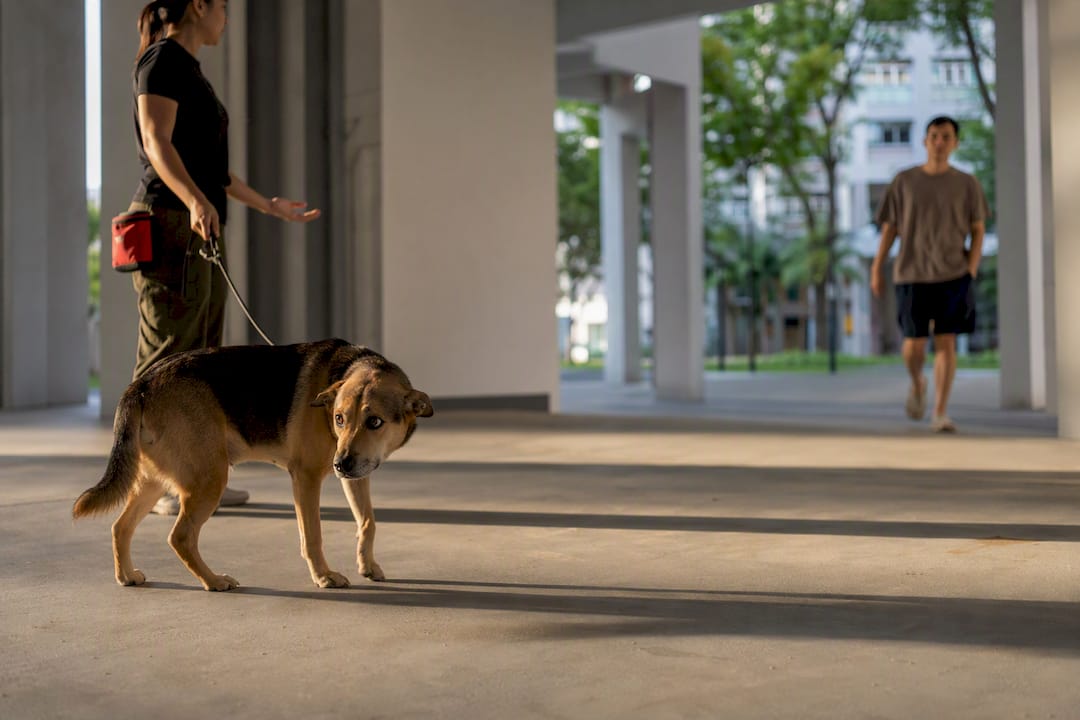
Yes, most dogs can learn to feel calmer around unfamiliar people through patient, reward-based desensitisation combined with sensible management. The aim isn’t turning your dog into a social butterfly. It’s building tolerance and keeping everyone safe. If your dog has ever growled, snapped, or bitten, keep them on-lead or behind a barrier around visitors and don’t force any contact until you’ve had proper guidance.
TL;DR:
Dogs on a structured behavior plan often show improved calmness after about a week.
Socialization during the critical period from 3 to 14 weeks significantly impacts a dog’s future confidence around strangers, especially if missed.
Training should focus on gradual distance counterconditioning and teaching calm, alternative behaviors, with progress reassessed every 5 to 7 days initially.
Managing visits and public outings with short sessions, distance regulation, and avoiding forced interactions helps prevent escalation of fear.
Professional support is advisable if a dog exhibits severe avoidance, repeated aggression, or cannot settle despite consistent management.
Table of Contents
What does dog fear of strangers actually look like?
Fear doesn’t always announce itself with barking and lunging. It often whispers first.
Watch for the overt signs: barking at the door, cowering behind your legs, hiding under furniture, or trying to bolt. These are the easy ones to spot. The subtler signs matter just as much, because they’re the early warning system that lets you step in before things escalate:
Stiff, frozen posture with a closed mouth
Repeated lip licking or yawning when nothing is tiring
“Whale eye” — the whites of the eyes showing as the dog looks sideways
Tucked tail, lowered body, or leaning away from the person
Excessive shaking off or scratching with no obvious itch
A dog that goes from stiff to snapping in seconds hasn’t suddenly become aggressive. It’s usually been signalling discomfort the whole time and simply ran out of options.
Pro Tip: If you’re not sure whether your dog is “fine” or just frozen, look at the tail and the eyes together. A wagging tail with a stiff body and whale eye is not a happy dog.
Statistic Callout: Tufts University’s Collaborative for Shelter Dogs notes that dogs on a structured behaviour plan are typically reassessed 3 to 4 days after starting, with many showing more neutral behaviour within just 2 to 3 days of consistent, calm management.
Why do some dogs develop stranger danger while others don’t?
Three things usually drive fear of unfamiliar people: missed socialisation, genetics, and past experience.
The critical socialisation window runs from roughly 3 to 14 weeks of age, according to Cornell University’s veterinary college. A puppy that meets a wide variety of calm, friendly people during that window tends to build a mental library of “strangers are fine.” Miss that window, whether through a rescue background, illness, or simply an under-socialised breeder situation, and the dog often defaults to caution as an adult.
Genetics plays a role too. Some lines and breeds are simply more reserved or watchful by temperament, and no amount of training will turn a naturally cautious dog into an extrovert.
Then there’s learned experience:
A single frightening encounter (a stranger who grabbed at the dog, a child who cornered it)
Owners who unintentionally reward fear by picking the dog up and cooing every time it panics
Repeated forced greetings that taught the dog strangers mean pressure, not choice
Understanding why socialisation matters for a puppy’s development helps explain why adult dogs vary so much in confidence.
A step-by-step training plan for a fearful dog
Before any training begins, set the stage properly. Keep a lead or long line on hand for control, use baby gates or a crate as a safe retreat, and never let a stranger corner or reach for your dog. Comfort comes from predictability, so keep sessions short and end on a good note every time.
Distance counterconditioning. Find the distance at which your dog notices a stranger but doesn’t react. Toss high-value treats near your dog, not toward the stranger, so the reward has nothing to do with approaching anyone. Keep sessions short and note how quickly your dog relaxes.
Teach an alternate behaviour. A simple “look at me” cue gives your dog something calm to do instead of staring, freezing, or barking. Reward the eye contact generously, so checking in with you becomes more appealing than fixating on the person.
Gradually close the distance. Once your dog is consistently relaxed at one distance, shrink the gap by small increments and introduce different people, ages, and appearances. Watch for the subtle stress signals covered earlier. Any stiffness or lip licking means you’ve moved too fast.
Maintain and generalise. Practise in new locations, with new people, and slowly fade the high-value treats to intermittent rewards once calm behaviour is reliable.
Run several of these short sessions daily rather than one long one. Dogs learn better in small, low-pressure doses, and short sessions are easier to keep positive from start to finish.
AVSAB’s guidance on scaredy dogs is specific on one point that trips up a lot of owners: ignore the dog during early exposure and toss treats at a distance rather than holding one out to lure them closer. Luring creates a conflict between wanting the treat and fearing the hand holding it. A tossed treat lets the dog choose to approach on its own terms, which is exactly the point.
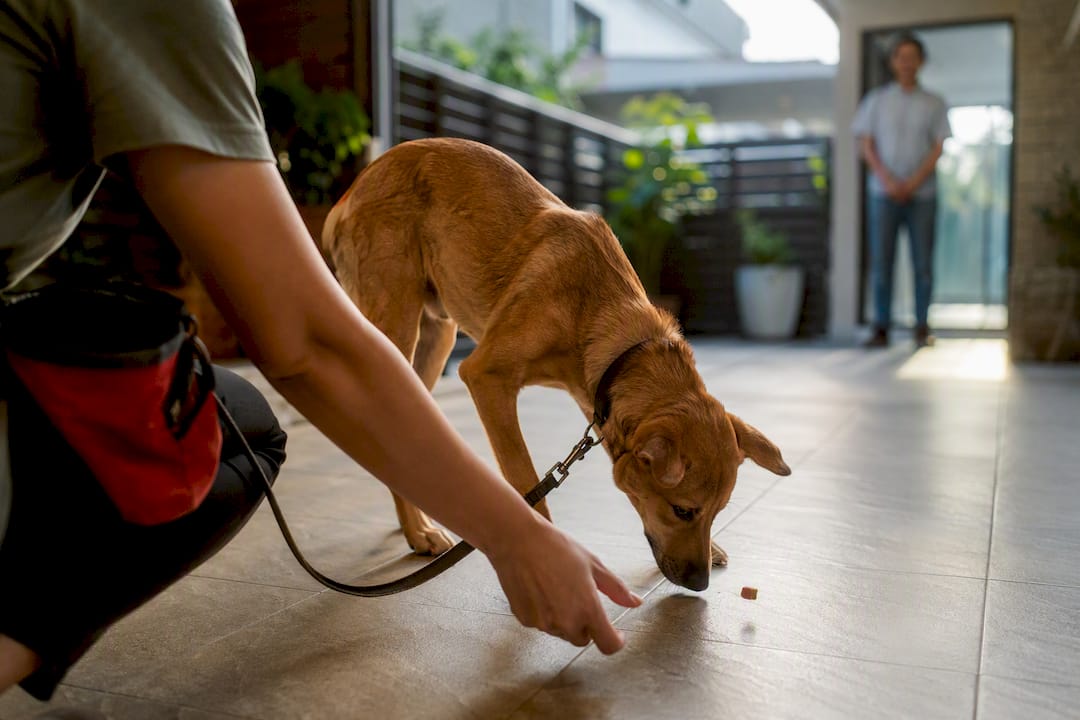
Pro Tip: Toss treats slightly behind or beside your dog rather than toward the stranger. This gives your dog an escape route and keeps the choice to engage entirely theirs.
Reassess progress every 3 to 4 days at first, then weekly. If a technique isn’t producing calmer body language within that window, it’s worth adjusting rather than persisting out of habit. A behaviour modification plan built around these checkpoints keeps both you and your dog on track without guesswork.
Managing visitors, walks, and everyday encounters
Training sessions matter, but daily life is where most of the pressure actually happens. A few adjustments make a real difference:
Don’t let your dog watch people arrive at the door. Excitement and anxiety both build fastest at that first moment of contact.
Ask visitors to come in, sit down, and ignore your dog completely. Toss treats near them and let your dog approach when curious, never before.
On walks, choose quieter times of day and cross the street or create space when you see someone approaching.
Use your “look at me” cue the moment you spot a stranger, rewarding calm attention before your dog has the chance to react.
If a situation feels too much, that’s your cue to remove your dog to a crate or another room. That’s management working as intended, not a failure.
Brief guests and delivery personnel in advance: no reaching down, no direct eye contact, no talking to the dog until it chooses to engage.
None of this requires special equipment or a lot of time. For carers looking after dogs with special needs, understanding pet therapy for dementia: what carers need to know can provide valuable insights into safe human-dog interactions. It just requires consistency and a willingness to prioritise your dog’s comfort over a stranger’s desire to say hello.
When should you call in a professional?
Some situations are beyond what a home programme should tackle alone. Get professional support if you see:
Any history of biting or snapping that made contact
Lunging that’s getting more frequent or more intense over time
Severe avoidance: refusing food, shaking, or trying to escape entirely
A dog that can’t settle even after several weeks of consistent management
A proper behaviour consult typically includes a full assessment, a written behaviour modification plan, and safety advice, including muzzle training where appropriate. Expect follow-up sessions to track progress against the same short checkpoints used at home. Tufts’ shelter behaviour resources note that tailored plans reduce escalation risk far more reliably than ad hoc attempts to “push through” fear. Realistic timelines usually show early softening within days, with measurable change over several weeks.
Fear or aggression: how do you tell the difference?
Fear and aggression toward strangers often look identical in the moment. A growl is a growl, but the motivation behind them is completely different, and that difference should shape how you respond.
A fearful dog is trying to increase distance from something it finds threatening. Growling, barking, snapping, or lunging in this context are all defensive: the message is “stay away,” not “I want to hurt you.” Take away the stranger, and the dog typically calms within seconds. Genuine aggression, by contrast, is far less common and often involves a dog that continues to pursue or escalate even when given space to retreat, or shows resource guarding and predatory focus unrelated to fear.
Experts widely agree that what looks like “bad behaviour” is frequently anxiety wearing a defensive mask. Punishing a growl teaches a fearful dog that warning signals bring punishment, not relief, which can suppress the growl while leaving the underlying fear (and the bite risk) fully intact. That’s precisely why humane, science-based methods focus on reducing the fear itself rather than suppressing its symptoms. If you’ve noticed this kind of defensive behaviour closer to home, the same logic applies to understanding why dogs growl at family members: it’s rarely about dominance, and almost always about discomfort.
How to safely assess your dog’s fear level in different contexts
Fear isn’t a fixed trait. Most dogs sit somewhere on a sliding scale that shifts depending on location, number of strangers, and how much choice the dog has in the interaction.
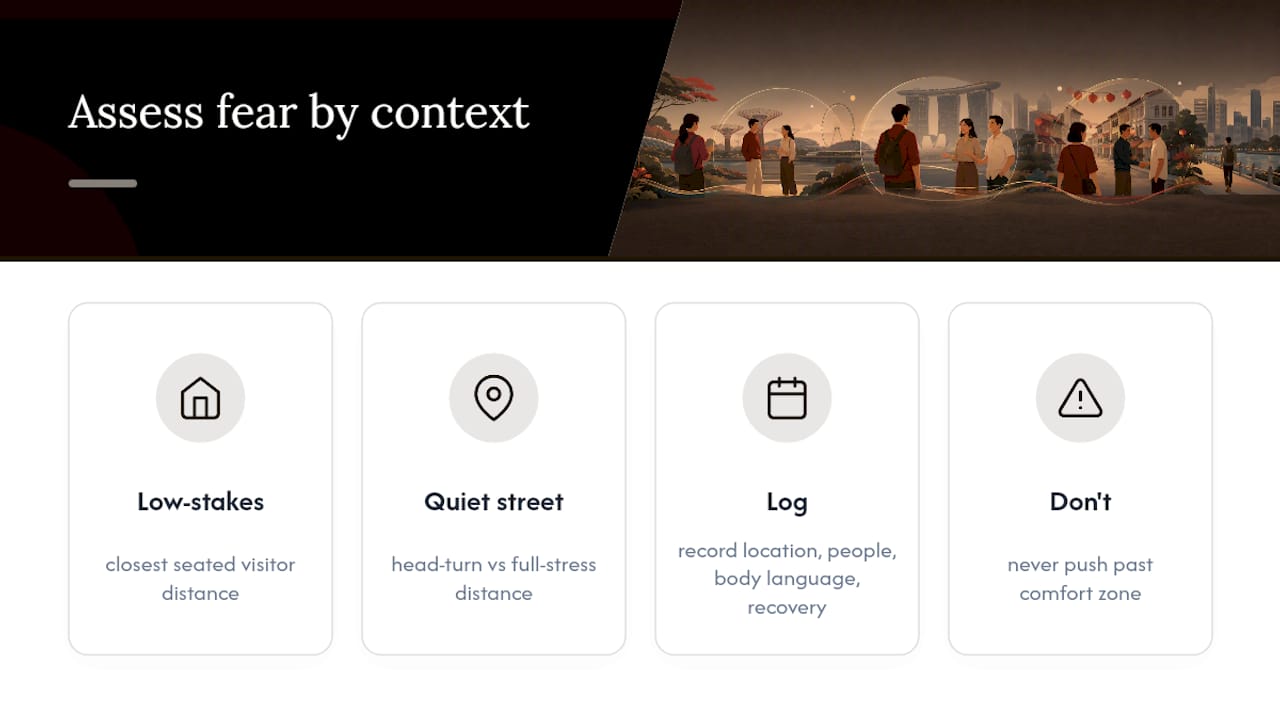
Start by testing distance thresholds in low-stakes settings. In your own home, note how close a seated, ignoring visitor can get before your dog stiffens or retreats. On a quiet street, note the distance at which a passing stranger triggers a head turn versus a full stress response. Busy places, cafés, markets, vet waiting rooms, are the hardest test, since noise and unpredictable movement stack on top of the stranger itself.
Keep a simple log for a week or two: location, number of people, your dog’s body language, and how quickly they recovered. Patterns usually emerge fast. Some dogs cope fine one-on-one but unravel in crowds. Others are fine outdoors but tense the moment someone enters their home. That pattern tells you exactly where to focus training first, rather than treating “fear of strangers” as one single problem to solve everywhere at once.
Never test thresholds by deliberately pushing a dog past its comfort zone to “see what happens.” That’s not assessment, it’s exposure without a safety net, and it can undo weeks of careful counterconditioning in a single bad encounter.
Why the standard advice on stranger fear often falls short
Most guidance out there focuses on introducing dogs to strangers faster than it should. Owners are told to “let people say hello” or “get the dog used to it,” when the far more useful skill is teaching the dog to ignore strangers calmly and check in with you instead.
The habit worth breaking is treating fear as a problem to be pushed through rather than a signal to be respected. Punishing a growl or forcing a greeting doesn’t remove the fear. It just removes the dog’s ability to tell you about it, which is a far worse outcome. The owners who make the fastest progress are the ones who accept a slower timeline in exchange for genuine trust, and who treat calm avoidance as a perfectly acceptable long-term outcome for a naturally cautious dog.
Prioritise the checkpoints, not the calendar. A dog that’s calmer at day four than day one is on track, regardless of how far it still has to go.
— Mark
How Happy-Dog Training can help you get there faster
Reading a training plan is one thing. Applying it correctly while your own dog is stressed, and a stranger is standing at your door, is another. Happy-Dog Training builds behaviour modification plans around your dog’s specific triggers, not a generic checklist.
A behaviour consult typically starts with an assessment of your dog’s fear level across the contexts that matter most to your household, home visitors, walks, or both, followed by a written plan with clear, short-term checkpoints. Bring notes on when the fear started, what triggers it, and any incidents so far. For dogs showing defensive or aggressive responses alongside fear, our aggressive behaviour consult is built specifically for that overlap, and every programme comes with free lifetime support once training ends. If you’d rather start with a structured group setting, our AVS-approved intensive programme covers obedience foundations that support calmer behaviour around people generally. Book a consult through our main booking page to get a plan built around your dog, not a stranger’s.
Sources
Recommended
Comments