Dog peeing when left alone: what owners should do
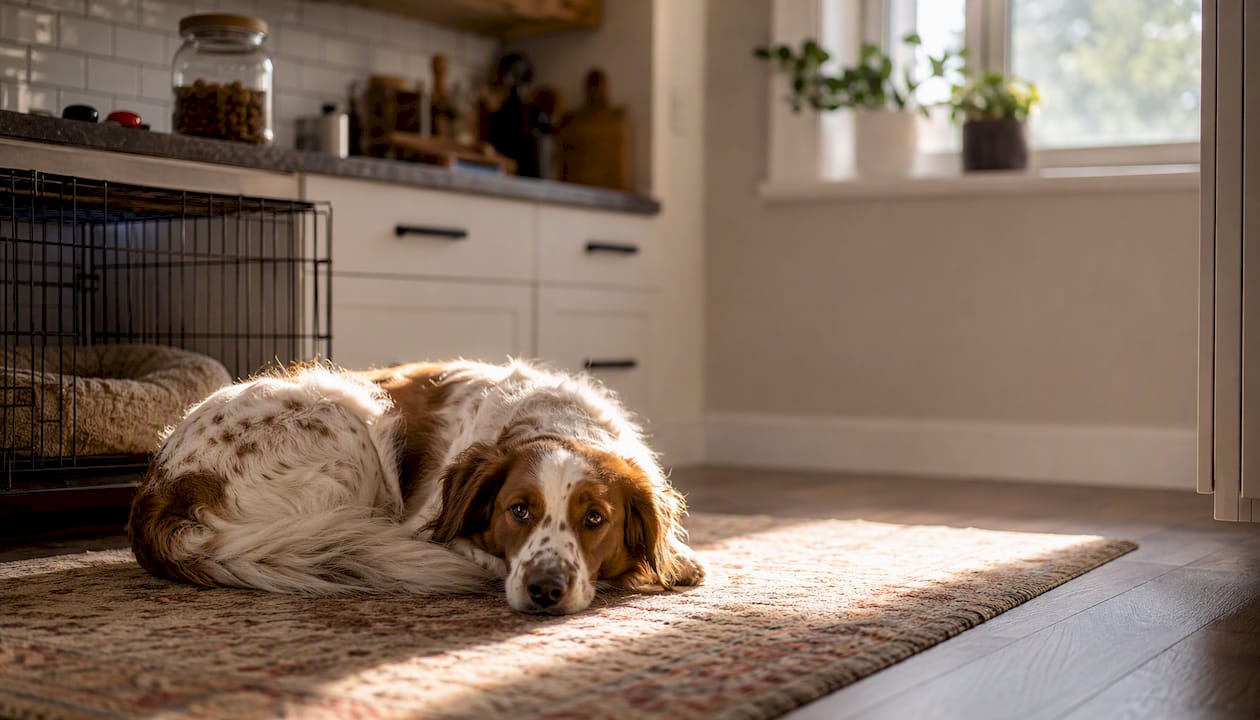
If your dog only wees inside when you leave, the most likely causes are a medical condition that needs ruling out or a panic response from separation anxiety. Start today: book a veterinary check, stop all punishment, and set up a camera so you can see exactly when and how accidents happen.
What to do right now:
Book a vet appointment, especially if you notice straining, blood in the urine, increased drinking, or if your dog is older
Stop scolding or punishing your dog for accidents you find after the fact — this worsens anxiety and teaches nothing
Set up a phone or tablet camera before you leave to record timing and behaviour
Note the exact times accidents happen: at departure, shortly after, or on your return
Use an enzymatic cleaner on soiled areas to remove scent and reduce re-soiling
Confine your dog to a comfortable, manageable space while you organise diagnosis and treatment
Understanding whether this is a medical problem or a separation anxiety response is the single most important step. The sections below walk you through diagnosis, immediate management, and a long-term plan.
Key takeaways
Dogs that urinate when left alone most often have either a medical condition or separation anxiety, and identifying the correct cause before starting treatment is what determines whether the plan actually works.
Point | Details |
Rule out medical causes first | Book a vet check before any behaviour work, especially if red flags like straining or blood in urine are present. |
Timing reveals the cause | Note whether accidents happen at departure, during absence, or on return — this directs the entire treatment plan. |
Never punish after the fact | Punishment worsens anxiety and teaches nothing; clean with an enzymatic product and focus on prevention instead. |
Use gradual desensitisation | Start with micro-departures and build duration slowly, logging progress weekly to track improvement. |
Happy-dogtraining can help | AVS-accredited, personalised separation anxiety programmes with free lifetime support are available for owners who need structured professional guidance. |
A trainer’s perspective on realistic expectations
Working through separation anxiety takes patience, and the owners who do best are the ones who stop blaming themselves or their dog and start treating the problem as what it actually is: a distress response that responds well to the right plan. Progress rarely looks like a straight line. There will be good weeks and setbacks, and a setback does not mean you have failed — it usually means the last step was slightly too large. What matters is keeping the sessions short, the rewards consistent, and the expectations realistic. Most dogs show meaningful improvement within a few weeks of a well-structured programme, though severe cases can take several months. The emotional weight of managing this alone is real, and that is exactly why having a knowledgeable, consistent support system alongside you makes such a difference. At Happy-dogtraining, we build programmes around each dog’s specific history and pace, and our lifetime support means you have someone to call when things get hard, not just when things are going well.
How Happy-dogtraining supports dogs with separation anxiety
If your dog is struggling with house-soiling when alone and you are ready for structured, professional support, Happy-dogtraining offers behaviour consultations and personalised desensitisation programmes designed specifically for separation anxiety and related issues. The AVS-accredited approach means every plan is grounded in science, tailored to your dog, and built to last.
Private sessions work through your dog’s specific triggers at their own pace, and the board and train option suits owners who need faster progress in a supervised environment. When you book, bring your video footage, your accident log, and any notes from your vet — the more detail you share at the first session, the faster a precise plan can be built. Book a private consultation or visit Happy-dogtraining to find the right programme for your dog.
Table of Contents
Is your dog peeing when left alone for medical or behavioural reasons?
This is the question that shapes everything else. Vetster advises ruling out medical causes before assuming a behavioural problem, because conditions such as urinary tract infections, diabetes, kidney disease, and neurological issues can all produce accidents regardless of whether you are home or not.
Medical red flags to watch for
Take your dog to the vet promptly if you notice any of the following:
Straining or crying when urinating
Blood in the urine
Drinking and urinating far more than usual (polydipsia/polyuria)
Accidents happening at night or when your dog is asleep
Sudden onset in a previously reliable adult dog
Your dog is a senior (generally over seven years old)
These signs point to a physical cause. A vet can run a urinalysis, blood panel, and physical examination to rule out infection, endocrine disorders, or incontinence before any behavioural work begins.
Behavioural patterns that point to separation anxiety
If your dog is medically clear, look at the pattern. Separation anxiety tends to produce accidents only when the dog is alone, often accompanied by other distress signs such as vocalisation, destruction near doors or windows, pacing, or drooling. The ASPCA notes that urination and defecation are listed features of separation anxiety and tend to occur alongside these other anxiety signs.
One distinction worth making early: urine marking and anxiety-related urination are not the same thing. According to the American Veterinary Society of Animal Behavior, marking typically involves small amounts deposited on vertical surfaces, while inappropriate urination produces larger volumes on horizontal surfaces. Neutering reduces marking in roughly 70–80% of male dogs but does not address anxiety-related accidents.
A third possibility is an incomplete housetraining history, particularly in younger dogs or rescues who never fully learned the rules. This tends to produce accidents at any time, not specifically during absences.
Pro Tip: When you visit the vet, bring a written log of accident times, frequency, and location; photos or video footage; a list of any medications or supplements your dog takes; and notes on any recent changes to diet, routine, or household. This saves time and helps the vet reach a diagnosis faster.
What the timing of accidents tells you about the cause
Dogs Trust explains that accidents can occur at three distinct points during a separation event, and that knowing exactly when they happen is one of the most valuable pieces of information you can gather.
At departure: Accidents happen as you are getting ready to leave or within the first few minutes. This often signals a very high anxiety response triggered by pre-departure cues (picking up keys, putting on shoes). You may also notice pre-departure signals such as panting, shadowing, or restlessness before you have even opened the door.
Shortly after you leave: The dog settles briefly, then panics. Accidents happen within the first 30–45 minutes of absence. This is the most common pattern in separation anxiety.
On your return: Accidents happen just before or as you arrive home. This can indicate excitement-related urination or submissive urination rather than anxiety, and the treatment approach differs.
Co-occurring signs that strongly suggest anxiety rather than a simple housetraining gap include:
Barking, howling, or whining audible to neighbours
Scratching or chewing at doors, windows, or skirting boards
Pacing or circling caught on camera
Drooling or salivating excessively
Escape attempts, sometimes causing self-injury
A camera is often decisive here. Set one up before you leave and review the footage when you return. If a neighbour, dog walker, or pet sitter can observe your dog during your absence, their report is equally useful. Video evidence clarifies timing and co-occurring behaviours in a way that owner memory alone cannot.
Short-term steps to reduce accidents and stress today
While you are organising a vet check and working towards a long-term plan, these practical measures limit damage and keep your dog calmer.
Manage the environment
Confine your dog to a space that feels safe and reduces the risk of accidents spreading. A crate works well if your dog is already comfortable in one; a small, dog-proofed room is a good alternative. Remove soiled bedding immediately and clean all affected areas with an enzymatic cleaner. Standard household cleaners do not fully break down urine proteins, so the scent remains and encourages re-soiling. PetMD recommends enzymatic products specifically for this reason.
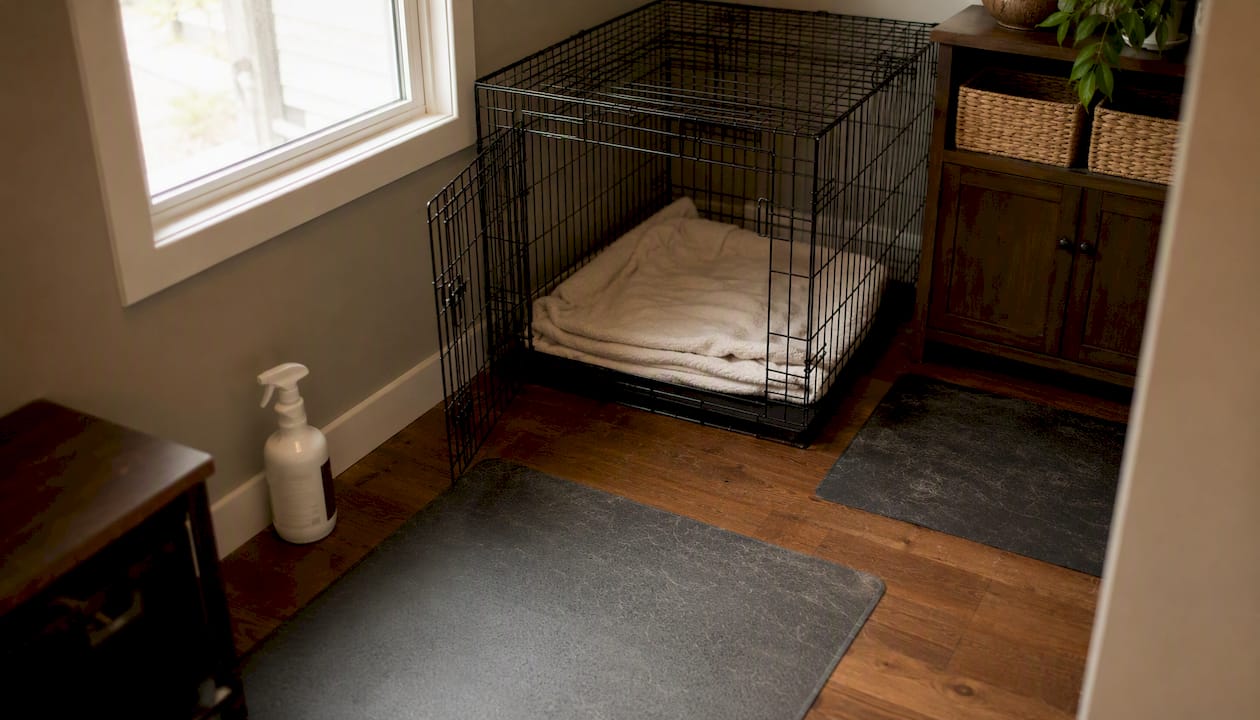
Pee pads or protective bedding can reduce mess in the short term, but avoid leaving soiled pads in place for extended periods, as this can reinforce the habit of toileting indoors.
Reduce stress around departures and arrivals
Give your dog a good walk or active play session before you leave so physical energy is lower
Offer a food puzzle, stuffed Kong, or sniffing enrichment just before departure to create a positive association with your leaving
Keep departures and arrivals calm and low-key — long, emotional goodbyes raise anticipatory anxiety
Avoid scolding when you return to find an accident; the dog cannot connect the punishment to an earlier event, and VCA Animal Hospitals confirms this approach worsens anxiety
When you cannot be home
If your working hours mean your dog is regularly alone for more than a few hours, consider a trusted friend, a professional dog walker, or a reputable doggy day care for short periods. Choose someone who understands that your dog may be anxious and who will keep arrivals and departures calm. This is a management measure, not a cure, but it reduces the number of accidents and the cumulative stress your dog experiences while you work on the underlying cause.
Short-term action | Why it helps |
Enzymatic cleaner on soiled spots | Removes scent cues that encourage re-soiling |
Confinement to a safe space | Limits accident spread and reduces escape risk |
Exercise before departure | Lowers physical arousal and anxiety at the moment of leaving |
Food puzzle at departure | Builds a positive association with you leaving |
Calm arrivals and departures | Reduces anticipatory and excitement-related urination |
Pro Tip: Film your departure routine as well as your absence. Owners are often surprised to see that their dog begins showing anxiety signs — panting, pacing, watching the door — well before the front door closes. Spotting these early cues helps you and a trainer target the right stage of the departure sequence.
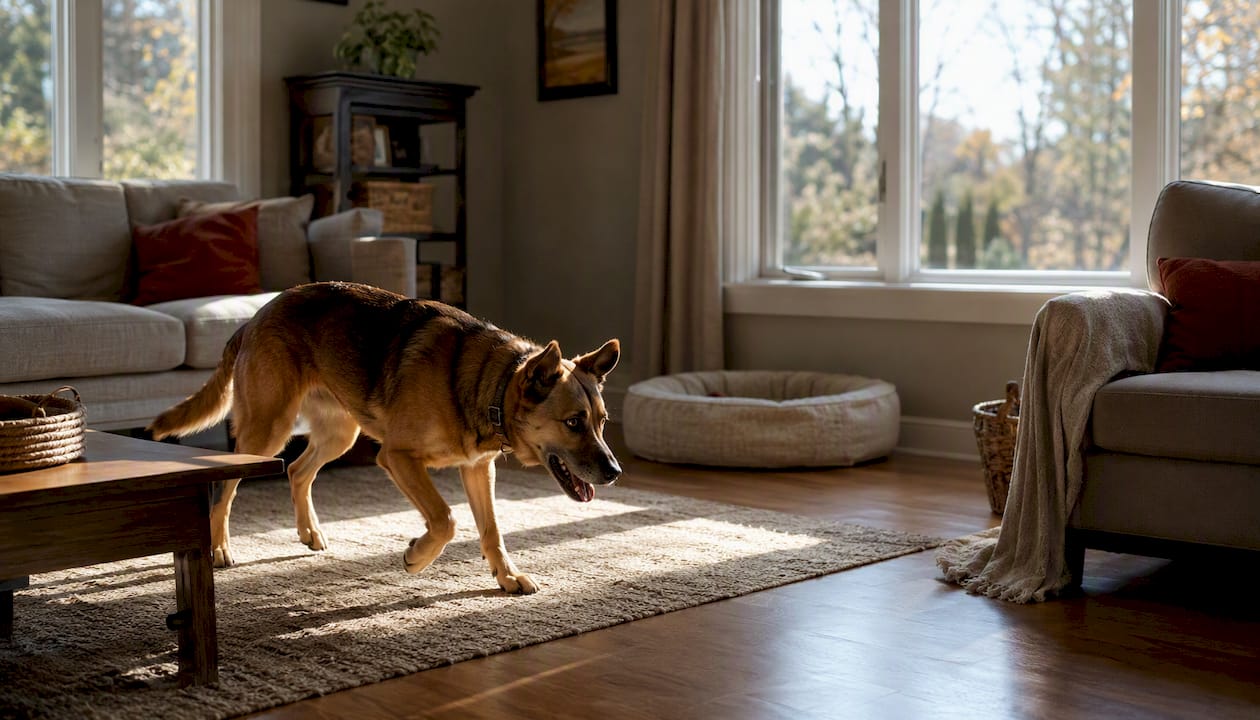
A step-by-step behaviour plan for dogs urinating when alone
Behaviour modification combining gradual desensitisation with counterconditioning is the evidence-backed first-line treatment for separation anxiety. The goal is to teach your dog that being alone is safe and even pleasant, by starting at a duration they can manage without distress and building up very slowly.
Establish a calm baseline. Before any alone practice, spend a few days building independence skills at home. Reward your dog for settling on their bed while you move to another room. Keep sessions short (one to two minutes) and end before any anxiety appears.
Start with micro-departures. Step outside the front door for five seconds, return calmly, and reward calm behaviour. The aim is for your dog to feel nothing in particular about your leaving. Repeat several times across the day.
Increase duration in tiny steps. Add five to ten seconds at a time, only when your dog is consistently relaxed at the current duration. There is no fixed weekly schedule; progress is led by the dog’s response, not the calendar.
Pair departures with something good. Give a stuffed food toy or scatter feed just before you leave. This is counterconditioning: your departure predicts something enjoyable. Remove the toy when you return so it keeps its value.
Build to longer absences gradually. Once your dog is comfortable with departures of five to ten minutes, begin extending in larger increments. Short, structured intervals are more effective than occasional long absences.
Log every session. Record the duration, your dog’s behaviour during and after, and whether an accident occurred. This log is your progress tracker and your evidence for a trainer or vet if you need to escalate.
Measuring progress
Small improvements come first: your dog settles faster after you leave, or the first accident-free session appears. Substantial change — consistently dry for one to two hours — typically takes several weeks to a few months, depending on severity. Signs your dog’s separation anxiety is improving include reduced vocalisation on camera, fewer accidents per week, and a calmer demeanour on your return.
Pro Tip: Set a daily target you can actually achieve — for example, three five-minute practice departures. Missing a day is fine; what matters is consistency over weeks, not perfection on any single day. If your dog has an accident during a session, you have moved too fast. Drop back to the previous duration and rebuild from there.
Progress metric | What to track |
Accidents per week | Should decrease as duration tolerance builds |
Calm duration on camera | Time before first distress sign appears |
Behaviour on return | Calmer greetings suggest lower overall arousal |
Session completion rate | Consistency across the week matters more than any single session |
When should medication or a vet referral be considered?
Medication is not a replacement for behaviour work, but it can make training possible for dogs whose anxiety is too severe to allow any learning. Vets commonly consider pharmacological support when a dog is injuring itself during escape attempts, when panic is so intense that even micro-departures trigger a full stress response, or when a structured behaviour plan has been followed consistently for several weeks without meaningful progress.
A vet can provide diagnostic tests to confirm or rule out medical contributors, short-term anxiolytics for specific high-stress situations (such as a house move or a change in routine), and longer-term medication combined with a training plan. All medication requires monitoring and should never be used without veterinary oversight.
Pro Tip: If your vet is not familiar with canine behavioural pharmacology, ask for a referral to a certified veterinary behaviourist or an AVS-accredited trainer who works alongside vets. Medication paired with a structured desensitisation programme produces better outcomes than either approach alone.
When to hire a professional trainer or behaviourist
Some situations call for professional support from the start. Seek help without delay if:
Your dog is injuring itself trying to escape (chewing through doors, breaking through barriers)
Accidents are happening every single day despite consistent management
The emotional strain on your household is becoming significant
You have followed a behaviour plan for four to six weeks with no measurable improvement
Your dog shows multiple severe anxiety signs simultaneously (self-injury, destruction, and vocalisation together)
A qualified behaviourist or accredited trainer will take a detailed history, coordinate with your vet to confirm medical causes have been excluded, and build a personalised desensitisation plan. Some cases benefit from supervised sessions or a board and train programme where the dog practises alone time in a structured environment.
Questions to ask at first contact:
What credentials do you hold, and are you AVS-accredited?
How much experience do you have specifically with separation anxiety?
What does a typical treatment timeline look like for a case like mine?
How do you measure progress, and what does success look like?
What follow-up support is available after the programme ends?
Happy-dogtraining holds AVS accreditation and offers personalised programmes built around each dog’s specific history and severity. With over 20 years of experience in science-based behaviour work, the team provides free lifetime support after training, so you are never left managing a setback alone. Consistency in your training approach matters enormously with separation anxiety, and having a single, coherent plan from a qualified professional makes a real difference to outcomes.
Sources
Recommended
Comments