Singapore Dog Training Timeline: 2–4 Weeks, 3–12 Months
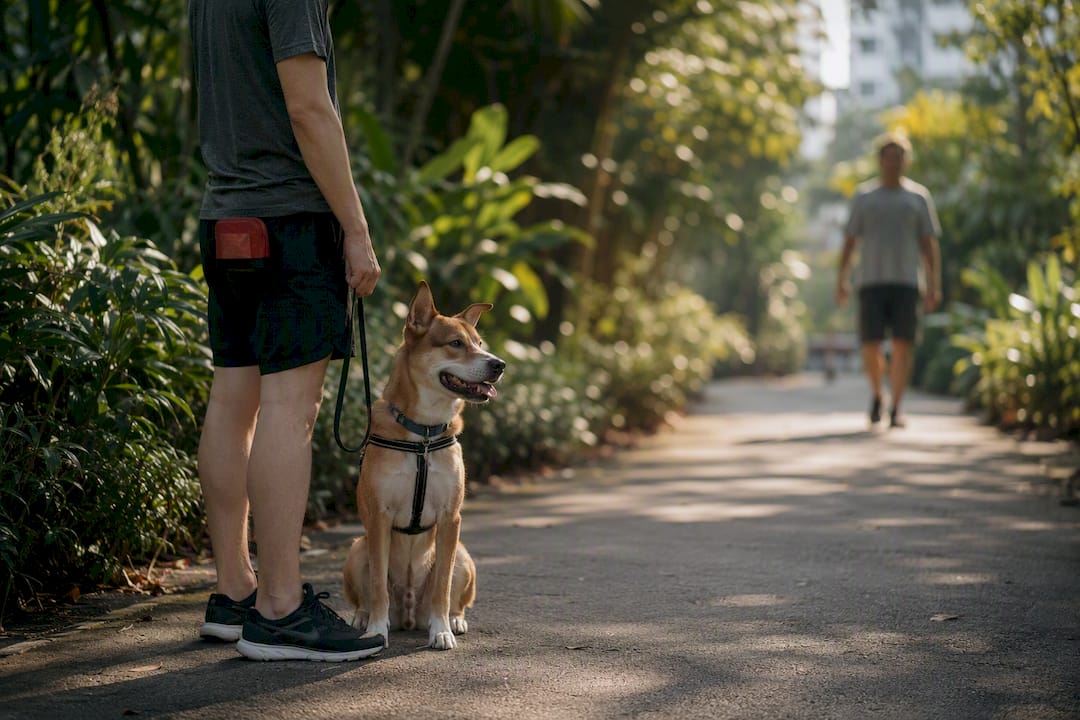
Most owners see the first genuine signs of change within 2 to 4 weeks of starting professional training, but reliable, lasting behaviour modification for issues like reactivity, fear, or aggression typically takes 3 to 12 months. The exact number depends heavily on how long the problem has existed and how consistently you practise between sessions. Basic obedience moves faster; deep-rooted emotional responses take longer to rewire.
TL;DR:
Behavior modification for issues like aggression or severe anxiety generally takes between 6 to 12 months, especially for longstanding problems.
Improvement can often be observed as early as two to four weeks, with small changes such as faster recovery from triggers and calmer responses.
Factors such as the duration of the problem, breed tendencies, owner consistency, trigger manageability, and health issues strongly influence how quickly progress occurs.
Training plans typically involve frequent short practice sessions multiple times daily, with longer-term goals built in stages based on progress and distraction proofing.
An initial professional assessment is essential to determine a realistic timeline tailored to the dog’s specific triggers, history, and temperament.
Table of Contents
Dog training timeline by problem type
Not every issue moves at the same pace, and lumping “training” into one bucket sets you up for disappointment. A dog that pulls on lead needs a different clock to a dog that panics when left alone.
Here’s how the ranges typically break down, based on what trainers see across hundreds of cases and what the wider behaviour literature supports:
Basic obedience (sit, stay, recall, loose-lead walking): Dogs often learn the mechanics within days to weeks, but proofing those skills against real-world distractions typically takes 3 to 6 months of consistent practice.
Mild leash reactivity: Expect roughly 6 to 8 weeks to build the foundational structure (impulse control, engagement, redirection), with several more months needed before the response is fully proofed around unpredictable triggers.
Moderate fear or anxiety: Cases involving desensitisation and counterconditioning generally need 2 to 4 months of gradual exposure work before you see a genuinely calmer dog.
Separation anxiety: This is one of the slower categories to resolve, often running 2 to 6 months, and sometimes longer for dogs with a long history of panic responses when left alone.
Aggression or severe reactivity: These cases commonly require 6 to 12 months or more, and many owners will manage the condition indefinitely rather than eliminate it entirely.
These aren’t arbitrary numbers. Behaviour modification research consistently places meaningful, durable change for anxiety and aggression cases in that 3 to 12 month window, with milder issues resolving faster. If your dog’s issue spans more than one category (say, a reactive dog with an anxious temperament underneath), plan for the longer end of the relevant ranges rather than the shorter one.
What makes a training timeline longer or shorter?
Two dogs with the same diagnosis can have wildly different recovery speeds, and the reasons usually come down to five variables you can actually assess before you start.
How long the problem has been present. A behaviour that’s been rehearsed for three years is more entrenched than one spotted in month two, and duration of the problem is one of the strongest predictors of how long treatment will take.
Breed tendencies, disposition, and age. A naturally anxious breed or an older dog with ingrained habits often needs more repetitions to shift than a young, biddable one.
Owner consistency and skill. This is the variable you have the most control over, and it matters more than most owners expect.
How manageable the triggers are. A dog reactive to skateboards in a quiet cul-de-sac has an easier path than one reactive to every dog on a busy corridor with no way to create distance.
Underlying medical issues. Pain, thyroid imbalances, and other health conditions can masquerade as behaviour problems and will stall progress until a vet addresses them.
Owner behaviour deserves special attention here, because it’s the one lever you pull every single day. Peer-reviewed research on treatment outcomes links consistent application of the trainer’s protocol directly to better results. A skilled trainer can design the right plan, but they’re not in your home for the other 23 hours of the day.
Pro Tip: Keep a simple daily log of what triggered a reaction, how your dog responded, and how long it took them to settle afterwards. Patterns that are invisible day to day often jump out clearly after two or three weeks of notes, and that log becomes gold for your trainer when adjusting the plan.
How professional programmes are structured
Professional programmes tend to follow one of a few common shapes, and knowing which one fits your situation helps you set the right timeline expectations from day one.
Weekly private sessions. The trainer meets you once a week, sets homework, and reviews progress. This format suits most obedience and mild behavioural work and typically runs for 6 to 12 sessions.
Intensive multi-week programmes. Compressed into roughly four weeks, these front-load the foundational work quickly, which suits owners who want fast structural gains before moving into longer-term proofing.
Multi-month behaviour plans. Aggression, severe anxiety, and complex reactivity cases usually need 8 to 15 or more sessions spread across months, with the plan adjusted as the dog’s responses shift.
Board-and-train options. The dog lives with the trainer for a set period, useful for accelerating foundational skills, though transfer training with the owner afterwards is essential for the gains to hold.
Whichever format you choose, daily practice is what actually consolidates the work. Short, frequent sessions of 5 to 15 minutes, repeated several times a day, tend to move a dog forward faster than one long weekly drill. A trainer typically builds your timeline in three stages: an initial assessment to identify triggers and baseline behaviour, a written plan with staged goals, and then incremental proofing that gradually adds distraction and duration once each stage is solid. If you want a sense of what that daily practice looks like in a home setting, structured home obedience routines are a good place to start.
How do you know if training is actually working?
Progress rarely announces itself with a single dramatic breakthrough. It tends to show up in small, measurable shifts that are easy to miss if you’re not paying attention.
In the first few weeks, watch for a calmer initial response to a trigger and a faster recovery time afterwards. A dog that used to bark for two minutes and now stops after thirty seconds is making real progress, even if the barking hasn’t disappeared. Over the following months, the milestone shifts to reliability: can your dog hold that calmer response at home with mild distractions, and eventually in public or novel situations?
Setbacks are normal, not a sign of failure. Behaviour change is rarely linear, and a bad day after a genuinely good week usually just means your dog met a new or stronger version of an old trigger.
Escalate to a vet or veterinary behaviourist when:
Aggression is intensifying rather than easing, despite consistent training.
Emotional responses (panic, shutting down, explosive reactivity) haven’t shifted at all after several months of proper work.
You suspect pain, illness, or a neurological issue is driving the behaviour.
For separation anxiety specifically, a simple progress checklist can help you distinguish a genuine plateau from real regression.
Age-specific training milestones and how long each stage takes
Age changes the training clock more than most owners realise, because a puppy’s brain and an adult dog’s established habits respond to very different paces of work.
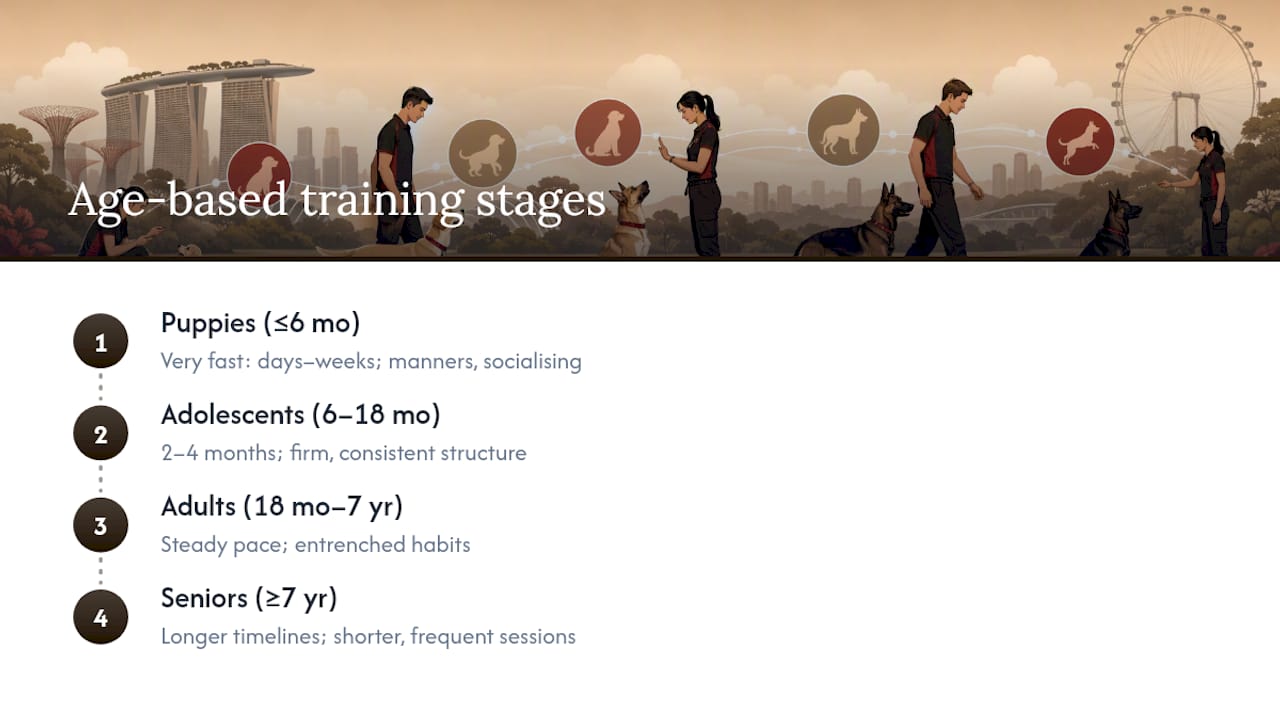
Puppies (up to around 6 months): Basic manners, house training, and early socialisation typically show progress within days to a few weeks, since puppies have no competing habits to unlearn. This is the fastest window you’ll ever get.
Adolescents (roughly 6 to 18 months): This is often the hardest stretch, not the easiest. Hormonal changes and a growing independent streak can make a previously reliable puppy seem to regress, and it commonly takes 2 to 4 months of firm, consistent structure to get through it without losing ground.
Adults (18 months to around 7 years): Training moves at a steady, predictable pace here, following the problem-type ranges covered earlier. Established habits, good or bad, are more entrenched, so timelines lean toward the middle to longer end of each bracket.
Seniors (7 years and older): Physical comfort and sensory decline (hearing, vision) often shape the pace more than cognition does. Sessions typically need to be shorter and more frequent, and timelines for new behaviours can run longer simply because the dog needs more repetitions to compensate for reduced sensory input.
Why the socialisation window shapes everything that follows
The critical socialisation period, roughly 3 to 14 weeks of age, is the single biggest lever in a dog’s long-term behavioural trajectory, and it closes long before most owners start formal training.
A puppy that meets a wide variety of people, dogs, surfaces, sounds, and environments during that window tends to arrive at adolescence with far fewer fear-based triggers to unpick later. Miss that window, or fill it with negative experiences instead of positive ones, and you’re often looking at months of desensitisation and counterconditioning work as an adult to undo what could have been prevented in weeks as a puppy.
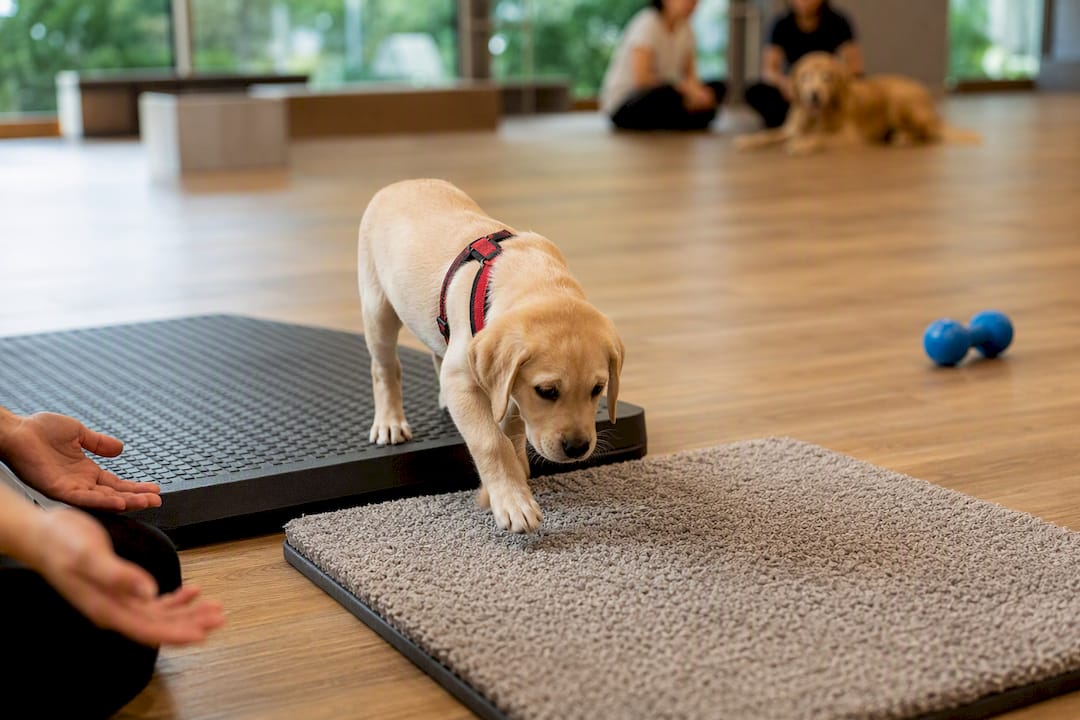
This is why so many “aggression” or “reactivity” cases that land with professional trainers are, underneath, undersocialised dogs reacting to novelty with fear. It also explains why the same intervention (say, calm exposure to strangers) takes a puppy two weeks and an adult dog four months: the puppy is building a new association from scratch, while the adult is unlearning a rehearsed one. If your dog missed a strong socialisation window, don’t expect it, or a trainer, to compress that catch-up work into a fortnight. Structured puppy socialisation groups exist specifically to make the most of this stage while it’s still open.
Does your training method change how fast you see results?
Yes, and this is one of the most consequential decisions an owner makes before a programme even starts. The method shapes not just the speed of change but whether the change holds.
Positive reinforcement and clicker training tend to build reliable behaviour steadily, because the dog is forming a clear, positive association between a cue and an outcome it wants. This approach is slower to show a dramatic first result than some aversive methods, but it consolidates well and rarely produces the fallout that undoes progress later. Recommended behaviour-modification techniques such as desensitisation, counterconditioning, and shaping are built on this same reward-based foundation.
Aversive techniques can sometimes suppress an unwanted behaviour quickly, which looks like fast progress on the surface. The same veterinary guidance explicitly discourages punishment and flooding for most behaviour cases, because suppressing the visible symptom without changing the underlying emotional response often leads to the problem resurfacing later, sometimes worse, and sometimes as a different behaviour entirely. That’s not a faster timeline. It’s a delayed one with extra complications attached.
Does your own experience level affect how quickly your dog improves?
It does, and often more than owners expect going into a programme. A first-time dog owner and someone who’s raised five dogs will typically move through the same trainer’s plan at different speeds, simply because reading a dog’s body language and applying consistent timing is itself a skill.
If you’re newer to dog ownership, build in extra time for yourself to learn the mechanics alongside your dog. This isn’t a weakness; it’s the honest starting point most people are at. Reading a foundational resource on how dogs actually learn from their environment before your first session means you’ll spend less time confused during homework and more time practising correctly. A beginner-friendly potty training guide is a useful example of the kind of plain-language resource worth reading before you start, even if your dog’s core issue is behavioural rather than house training.
Owners who feel unsure about timing rewards or reading stress signals often benefit from asking their trainer to demonstrate a skill slowly, then narrate what they’re watching for in the dog’s posture and pace, before handing the exercise back over. That small extra step at the start of a programme tends to shave weeks off the overall timeline, because it prevents the small, repeated timing errors that quietly stall progress.
An accredited trainer’s view on realistic timelines
Every dog gets a different clock, and that’s not hedging, it’s how behaviour modification actually works. Certification and years of hands-on cases don’t make a dog change faster on their own, but they cut out the wasted weeks that come from a poorly matched technique or a plan that ignores the dog’s specific triggers. The trainer’s job is to build the map. Yours is to walk it daily. Free lifetime support exists precisely because progress, once achieved, still needs occasional reinforcement to stay solid for the life of the dog.
— Mark
Ready to get a personalised training timeline?
Reading ranges online only gets you so far. What actually tells you how long your dog’s programme will take is an assessment with someone trained to read your dog’s specific triggers, history, and temperament, rather than a general estimate. Some AVS-approved intensive programmes and longer multi-session behaviour packages are built around that same principle: assess first, then design the pace around what this dog, not the average dog, actually needs.
An assessment typically involves observing your dog’s response to key triggers, reviewing the history of the problem, and discussing your household’s daily routine, all of which feed into a realistic, written timeline rather than a guess. From there, sessions are structured around science-based methods, with free lifetime support included once the programme ends, so gains don’t quietly slip once formal sessions stop. If you’re ready to find out what a realistic timeline looks like for your dog, book an assessment for the AVS-approved intensive programme and get a plan built around your dog’s actual starting point.
Sources
FAQ
How long until I see any improvement at all?
Many owners notice small, genuine changes, like a faster recovery after a trigger, within 2 to 4 weeks of starting consistent professional training and daily practice.
How many sessions does professional training usually take?
Early improvement in milder cases often needs around 6 to 12 sessions, while complex behaviour cases like aggression or severe anxiety commonly require 8 to 15 or more sessions spread across months.
Can training ever fully cure aggression?
Realistically, most aggression cases move toward reliable long-term management rather than a permanent cure, with meaningful improvement typically taking 6 to 12 months or longer.
Why does my dog seem to regress after a good week?
Setbacks are a normal part of a nonlinear process, usually triggered by a new or stronger version of an old stimulus, not a sign the plan has failed.
Does Happy-dogtraining offer a structured timeline for behaviour issues?
Yes. Individual timelines can be built from initial assessments, covering everything from AVS-approved intensive obedience work to longer behaviour modification packages for fear, anxiety, and aggression.
Recommended
Comments