2–3 Weeks to Calm Puppy Fear Periods for Singapore Owners

Puppy fear periods are normal developmental windows, not warning signs. The first commonly appears around 8 to 11 weeks, with a second wave often between 6 and 14 months. The quickest first step? Stay calm, drop the pressure, reward relaxed behaviour, and never force your puppy towards whatever has spooked them.
TL;DR:
Most fear periods last around two to three weeks and typically occur between 8 and 11 weeks, with a second phase usually from 6 to 14 months.
Recognizing fear signs includes sudden startle, avoidance, clinginess, body posture, whale eye, and refusal to walk, often persisting across multiple contexts.
The best support involves reducing pressure, using gradual counter-conditioning, short reward-based sessions, and maintaining consistent routines to build confidence gradually.
Punishing or forcing puppies during fear periods can worsen anxiety and cement negative associations, so retreating and rewarding calm behavior is crucial.
Puppies with unresolved fear or prolonged distress may need veterinary assessment or professional behavior therapy to prevent long-term behavioral issues.
Table of Contents
What is a fear period and why it happens
A fear period is a short, temporary stretch when your puppy’s brain is genuinely reorganising itself. Neural pathways linked to caution and threat detection become more sensitive for a few weeks, then settle back down. It’s not a personality flaw and it’s not a sign your training has gone wrong.
There’s a purpose behind it. As puppies gain independence, from around 8 weeks when they leave their litter, to adolescence when they start testing the world alone, a bit of extra wariness keeps them from wandering into danger without their mother’s guidance. Nature builds caution into the timeline on purpose.
This is exactly why the AVSAB’s puppy socialisation position statement urges owners not to wait until every vaccination is done before starting gentle, positive exposure. Missing that window entirely can leave a puppy more prone to fearfulness later, though it can still be worked on.
What a fear period is not:
A permanent shift in temperament
Evidence that you’ve “ruined” your puppy
A reason to abandon socialisation altogether
Something that requires punishment or correction to fix
When fear periods happen and how long they typically last
Timing varies a little between puppies, but the pattern is well documented. Purdue University’s developmental outline sets out two primary windows:
First fear period: roughly 8 to 11 weeks, often coinciding with a new home and the end of littermate company
Second fear period (adolescence): roughly 6 to 14 months, frequently tied to hormonal changes and growing independence
Milder secondary dips: some puppies show a smaller wobble around 4 to 6 months, and giant breeds sometimes show a later adolescent phase around 14 to 18 months, reflecting their slower physical maturation
Most episodes last around 2 to 3 weeks, according to the American Kennel Club, and to Purdue’s research. You’ll usually notice the fog lifting gradually: your puppy recovers faster after a startle, approaches things they avoided last week, and needs fewer treats to walk past a “scary” bin.
The critical socialisation window, roughly 3 to 14 weeks, overlaps directly with that first fear period. Puppies who miss positive exposure during this stretch are at greater risk of general fearfulness later on, which is one reason early socialisation matters so much, even while your puppy is going through a wobble.
How to recognise a fear period: signs and body language
Fear periods have a recognisable shape once you know what to look for. On any given walk, watch for:
Sudden startle or freeze at something previously ignored, like a wheelie bin or a hanging coat
Avoidance or backing away, refusing to approach a person, object, or doorway
Clinginess, staying glued to your legs rather than exploring
Lowered body posture, tail tucked, ears back, body held low
Whale eye, the whites of the eyes showing as your puppy watches something sideways
Refusal to walk, planting all four feet and stopping altogether
A true fear period tends to show up across multiple, unrelated contexts (the vacuum, a stranger, a new floor surface) and persists over days or weeks, rather than fading within minutes. If a single scary event lingers unusually long, or your puppy seems off in other ways too, such as poor appetite or lethargy, book a vet check to rule out pain or illness sitting underneath the behaviour.
Practical steps to help your puppy through a fear period
The single most useful thing you can do is lower your expectations temporarily. If your puppy nailed a “sit” from three metres away last week and now struggles at one metre, that’s not backsliding. It’s the fear period talking. Break every task into smaller pieces and finish each session on a success, however tiny.
Counter-conditioning and desensitisation remain the gold standard here. Pair whatever’s frightening your puppy, a stranger, a skateboard, a new dog, with high-value treats or a favourite toy, starting at a distance where your puppy notices the trigger but doesn’t react strongly. Move closer only when your puppy stays relaxed, and retreat immediately if they tense up. The AKC’s guidance on training through fear periods is built around exactly this graded approach.
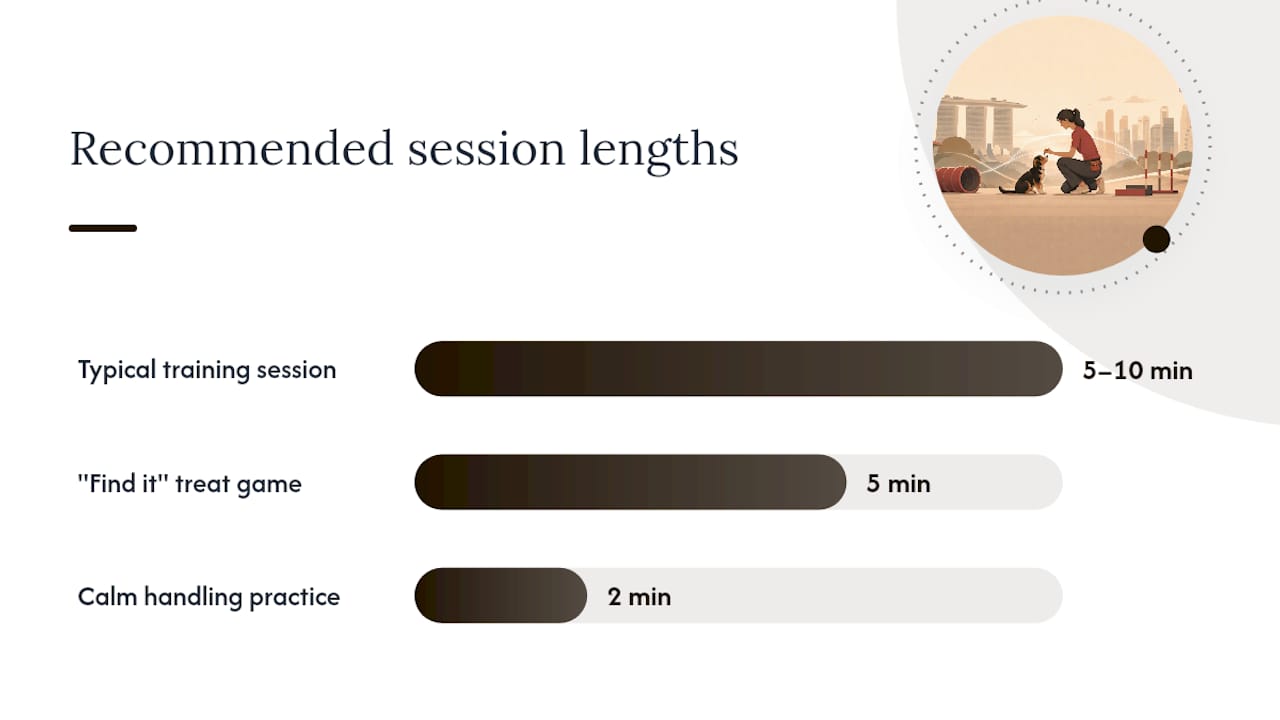
Keep sessions short, playful, and reward-based, five to ten minutes is plenty. A predictable daily routine, same walk times, same feeding schedule, same bedtime, gives your puppy’s nervous system something steady to lean on while everything else feels uncertain. Cornell University’s veterinary behaviour team points to this kind of consistency as genuinely protective against long-term anxiety.
For safe socialisation, stick to calm, fully vaccinated adult dogs, brief structured introductions, and gentle handling practice at home, touching paws, ears, and mouth briefly before rewarding.
Some daily examples worth trying this week:
A five-minute “find it” treat scatter game in a familiar room
Two minutes of calm handling practice before dinner, paired with praise
A quiet, cosy crate or bed your puppy can retreat to without being followed or fussed over
Pro Tip: If your puppy refuses a treat they’d normally snatch up, that’s usually a clearer signal of stress than any amount of barking or backing away. Treat refusal means you’re too close to the trigger, so create more distance before trying again.
What not to do and common mistakes that prolong fear
Forcing, flooding, or punishing during a fear period tends to backfire badly. Dragging your puppy towards a frightening object, or scolding them for growling or freezing, can cement a negative association that outlasts the fear period itself.
Common mistakes worth avoiding:
Luring too fast. Coaxing your puppy right up to the scary thing rather than working from a safe distance
Stacking triggers. Combining a vet visit, a noisy street, and a strange dog into one outing is a lot for a nervous puppy to process at once
Punishing the reaction. Barking or shrinking away is communication, not disobedience
Comparing to “before.” Expecting the same confidence they showed a month ago sets everyone up to feel discouraged
If your puppy freezes mid walk, the better move is simple: reward calm behaviour at the current distance, redirect to an easy, familiar cue like “touch” or “sit,” or quietly walk away from the situation altogether. There’s no shame in retreating.
When to seek professional help or veterinary assessment
Most fear periods resolve within a few weeks without drama. Contact a professional if you notice any of these:
Fear lasting beyond 3 to 4 weeks with no sign of easing
The reaction spreading to more and more situations rather than fewer
Escalation into growling, snapping, or genuine aggression
Refusal to eat, drink, or severe, persistent distress
The San Diego Humane Society notes that fear stretching past that 3 to 4 week mark is less likely to be a simple developmental phase and more likely something needing structured treatment.
Start with your vet to rule out pain, illness, or sensory issues driving the behaviour. From there, a certified, force-free trainer or veterinary behaviourist can build a proper behaviour modification plan, which typically includes a graded exposure schedule, coaching for you as the owner, and, in more severe cases, a referral for medication support alongside training.
How Happy-Dog Training approaches puppies through a fear period
At Happy-Dog Training, sessions start with a proper assessment, not a template. With over 20 years in the field and AVS accredited trainers on staff, the approach centres on understanding what’s actually driving a puppy’s reaction before building a plan around it.
A typical routine looks like this: an initial consultation, short daily homework set for the owner (often just five to ten minutes at a time), a gradual exposure schedule built around the puppy’s own pace, and weekly check ins to adjust as confidence grows.
One recurring pattern: owners who commit to tiny, consistent daily sessions, rather than occasional long ones, tend to see their puppy relax noticeably within a couple of weeks. It’s rarely about doing more. It’s about doing the right small thing, repeatedly, and Happy-dogtraining backs every client with free lifetime support once formal sessions end.
Long-term effects of unmanaged fear periods on puppy behaviour
Left unmanaged, a fear period doesn’t just resolve itself into confidence. Forced exposure, punishment, or simply ignoring the signs can turn a temporary developmental wobble into a lasting behavioural pattern.
The mechanism is fairly straightforward: if a puppy learns that a stranger, a noise, or a type of surface reliably predicts something unpleasant, whether that’s being dragged towards it or scolded for reacting, that association can generalise. A fear of one loud noise becomes a fear of loud noises generally. A wariness of one unfamiliar dog becomes wariness of dogs as a category.
Over time, unresolved fear can shift into chronic anxiety, increased reactivity, or defensive aggression, particularly if the puppy has no reliable way to escape or communicate discomfort during the sensitive window. This is part of why Purdue’s developmental research frames forced exposure during fear periods as something to actively avoid, rather than a shortcut that just needs a firmer hand.
The encouraging side of this is that the window for repair stays open longer than most owners expect. A puppy who missed ideal socialisation, or had a rough fear period handled clumsily, can still make real progress with patient, graded work later in life. It simply takes more time and more careful pacing than it would have taken at 10 weeks old.
Differences in fear periods among breeds and individual puppies
No two puppies move through a fear period identically. Breed, individual temperament, and early experience all shape how visible, and how intense, these phases turn out to be.
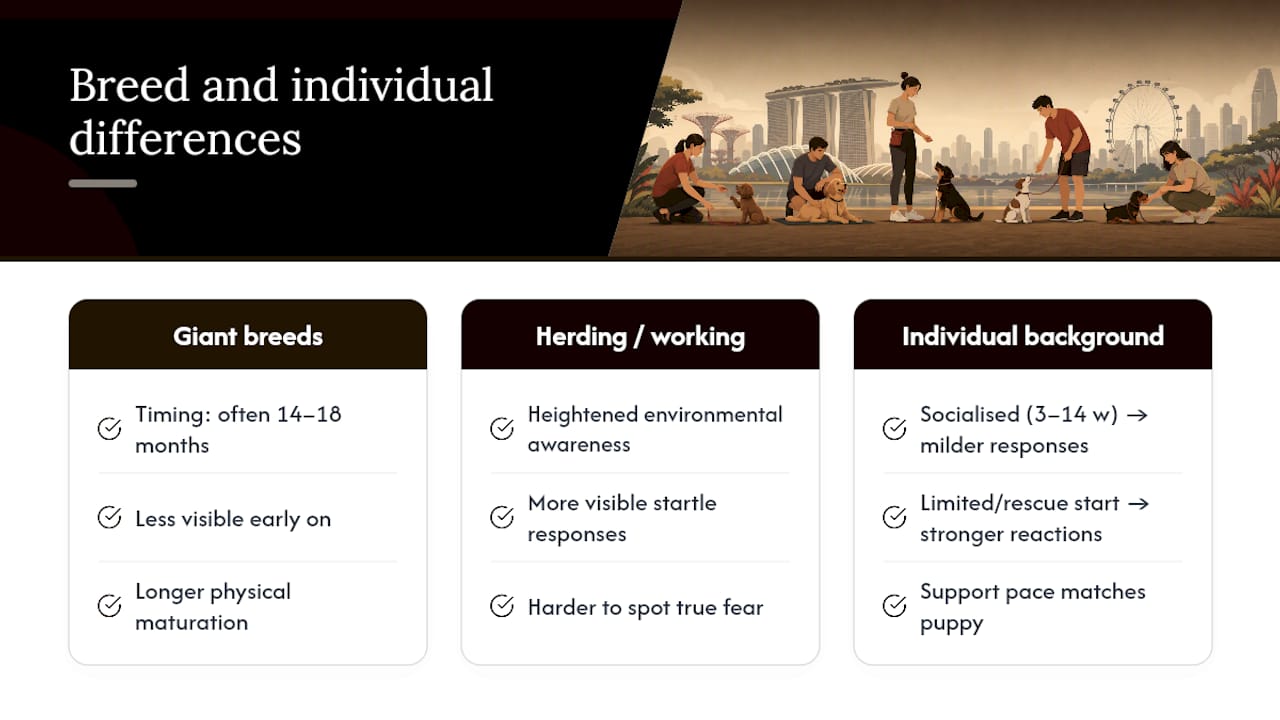
Giant breeds such as Great Danes or Mastiffs often show their adolescent fear period later than smaller breeds, sometimes stretching towards 14 to 18 months, simply because their overall physical and neurological maturation takes longer. Herding and working breeds, bred for heightened environmental awareness, sometimes display more visible startle responses even outside a fear period, which can make it trickier to tell a genuine fear phase apart from ordinary breed sensitivity.
Individual history matters just as much as genetics. A puppy who had a rich variety of calm, positive experiences during the 3 to 14 week socialisation window generally shows milder fear responses later. One with a limited or difficult start, a rescue puppy pulled from a rough situation, for instance, may show more pronounced reactions during both fear periods.
Confident, easygoing puppies might barely seem to notice their fear period at all, recovering from a startle in seconds. More sensitive puppies might need weeks of careful, low-key support to move through the same stage. Neither pattern is “wrong.” It simply means the pace of your support plan should match the puppy actually in front of you, not a generic timeline pulled from a book.
How to track and monitor your puppy’s progress through fear periods
A simple log makes an enormous difference here, mostly because fear periods are easy to misjudge day to day. One bad walk feels like a setback; a written record shows you the real trend.
Keep it basic. Note the date, what triggered a reaction, how intense it was on a rough scale of one to five, and how quickly your puppy recovered. Over two or three weeks, patterns tend to jump out: maybe recovery time is shrinking, or maybe the same specific trigger, a particular dog, a particular noise, keeps showing up while everything else has settled.
Photos and short videos work well too, especially for body language. It’s often easier to spot a lowered tail or stiff posture on video than to judge it accurately in the moment.
Watch for these markers of genuine progress:
Faster recovery after a startle, seconds instead of minutes
Willingness to approach something that was avoided the previous week
Fewer new triggers appearing over time, rather than more
A puppy who takes treats readily again in situations where they’d previously refused them
If the log shows the opposite pattern, more triggers, slower recovery, treat refusal becoming the norm, that’s your signal to loop in your vet or a certified trainer sooner rather than later, rather than waiting out the full 3 to 4 week window on hope alone.
Editorial take: what the research actually supports
Most puppy advice treats fear periods as an inconvenience to manage rather than a developmental stage to respect. That framing gets it backwards. The research from Cornell, Purdue, and the AKC all converges on the same underlying point: lowering pressure and criteria isn’t a workaround, it’s the actual treatment.
Where conventional advice falls short is in its impatience. Owners are told to “push through” or “socialise more,” without being told how gently that pushing needs to happen, or how quickly a poorly timed exposure can undo weeks of progress. The AKC’s own guidance on training through fear periods is far more conservative than most owners assume, and that conservatism is the point.
If you take one thing from all this, prioritise the daily log over the dramatic gesture. Owners who track small changes, recovery speed, treat acceptance, willingness to approach, catch problems weeks before they’d otherwise notice, and that early catch is what keeps a normal phase from becoming something bigger.
— Mark
Sources
FAQ
How long do puppy fear periods last?
Most fear periods last around 2 to 3 weeks, based on figures from the AKC and Purdue University. If fear persists well beyond that window or keeps intensifying, it’s worth arranging a vet check rather than waiting it out.
How can I help my puppy through a fear period?
Lower your training criteria, keep sessions short and reward-based, and use counter-conditioning by pairing the scary thing with treats at a safe distance. A predictable daily routine and calm, consistent handling also help enormously.
Is it normal for a 4 month old puppy to be scared of everything?
Some wariness around 4 months can be a milder secondary dip before the main adolescent fear period kicks in around 6 to 14 months. If the fear seems extreme, covers almost everything, or comes with appetite loss, a vet visit is a sensible next step.
What is the hardest period with a puppy?
Many owners find the adolescent fear period, roughly 6 to 14 months, harder than the first one, since it overlaps with hormonal changes, growing independence, and testing behaviour all at once. Structured, reward-based interactions and steady routines make this stretch considerably more manageable.
If your puppy’s fear period feels bigger than you can handle alone, Happy-dogtraining’s Puppy Play Socialisation Classes and dedicated Fearful Dog Classes are built around exactly this kind of graded, confidence-first approach, backed by free lifetime support once your sessions are complete.
Recommended
Comments