Force-free dog training methods guide for UK owners
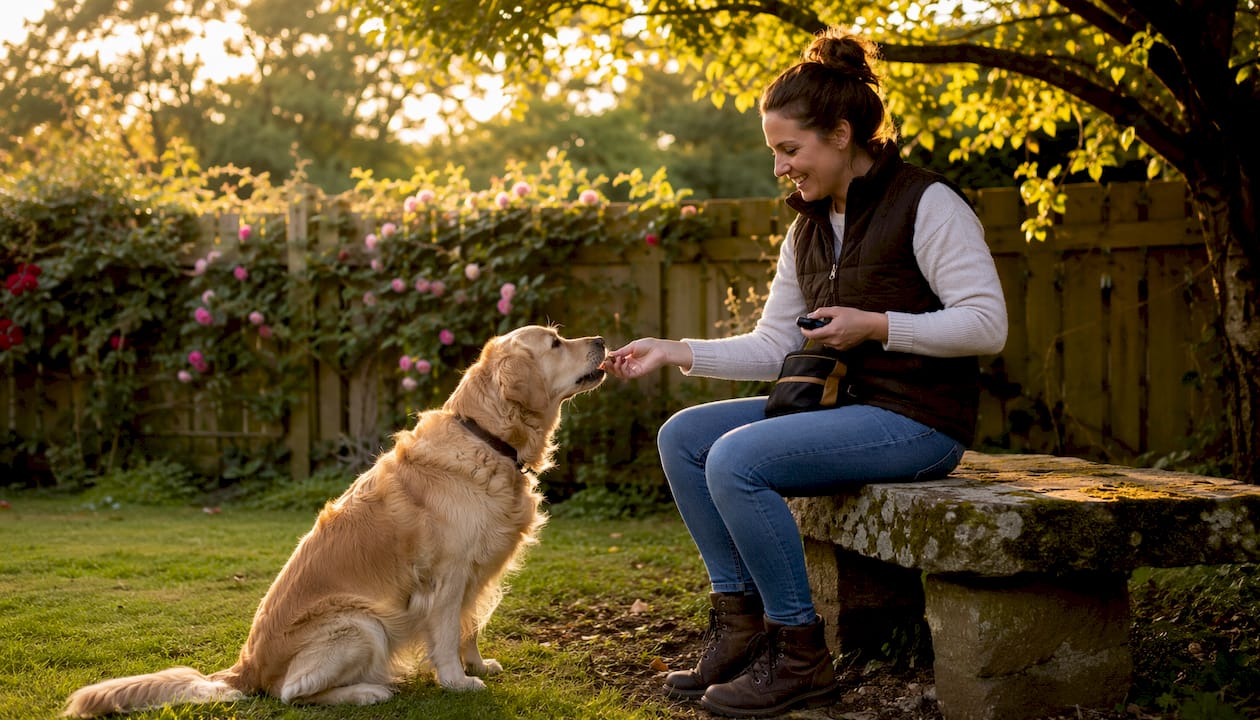
Force-free dog training uses rewards, clear marker signals and thoughtful management to teach reliable behaviour — no pain, no fear, no aversives. The RSPCA, Dogs Trust, and professional bodies such as the APDT UK all endorse reward-based methods as the most humane and effective approach available. Happy-dogtraining has built its entire programme around these principles, and this guide gives you everything you need to start today.
Three things you can do right now, before reading another word:
Choose your marker word. Say “yes” in a bright, clear tone the moment your dog does something you like, then immediately give a treat. That’s marker training in its simplest form.
Set up one 5-minute session. One quiet room, one reward pouch, one simple behaviour (a sit or a hand touch). Keep it to a small number of treats and stop on a success.
Remove one rehearsal opportunity today. If your dog jumps at the front door, use a baby gate before guests arrive. Effective management often outperforms correction because it stops the dog practising the very behaviour you want to change.
Table of Contents
What does “force-free” actually mean, and who endorses it in the UK?
Why force-free methods work: the evidence behind the benefits
Reinforcement vs punishment: what the difference means in practice
The force-free toolkit: markers, rewards, management and equipment
Step-by-step recipes for recall, loose-lead walking and sit/stay
How to socialise and start training puppies the force-free way
How long does force-free training take, and what does it cost in the UK?
When should you call a professional, and how do you choose the right one?
Why force-free training is misunderstood more than it is misused
Ready to put force-free training into practice with expert support?
What does “force-free” actually mean, and who endorses it in the UK?
Force-free training is a humane approach that teaches behaviour through rewards, clear cues, safe setup and calm repetition rather than fear, pain or physical correction. It is not permissive parenting for dogs, and it is not bribery. Structure, rules and expectations absolutely still exist — the difference is how you teach them. Instead of correcting a wrong guess, you make the right answer clear enough that guessing becomes unnecessary.
You may hear the terms “positive reinforcement training,” “reward-based training” and “force-free training” used almost interchangeably. They overlap significantly, though “force-free” is the broadest: it commits to avoiding all four aversive quadrants of operant conditioning, not just adding treats. The language you use around training also matters more than most owners realise. Collaborative terms such as “handler” (instead of “pack leader”), “cue” (instead of “command”) and “manners” (instead of “obedience”) reframe training as cooperative rather than confrontational — and that shift in mindset genuinely changes how owners behave in sessions.
The following UK organisations all endorse or actively promote force-free, reward-based methods:
RSPCA — publishes welfare guidance and campaigns against aversive training tools; its animal welfare science team actively supports positive reinforcement.
Dogs Trust — provides free owner resources, training videos and a network of rehoming centres that use reward-based methods exclusively.
Woodgreen — offers behaviour support and training guidance grounded in welfare science for owners across the UK.
APDT UK (Association of Pet Dog Trainers) — the UK’s leading professional body for dog trainers; members commit to a humane training policy and must demonstrate ongoing CPD.
APBC (Association of Pet Behaviour Counsellors) — the referral body for clinical behaviour cases; all members use evidence-based, welfare-positive approaches.
Pet Professional Guild UK — a membership organisation dedicated exclusively to force-free practitioners, with a published ethical code.
Why force-free methods work: the evidence behind the benefits
The practical case for gentle dog training techniques is strong, and it goes well beyond “being kind.” Punishment-based methods may appear to stop behaviour quickly, but they typically produce less resilient learning and carry a real risk of damaging the relationship between owner and dog. Reward-based training, by contrast, builds behaviour that holds up under pressure — in the park, at the vet, around other dogs.
Here are the direct benefits owners notice most:
Stronger trust. A dog that learns through rewards actively seeks out interaction with you. That engagement makes every future training session easier.
Reduced reactivity. Dogs trained without aversives are less likely to develop fear-based responses to triggers such as strangers, other dogs or traffic.
Safer handling. A dog that associates grooming, vet visits and nail trims with calm, rewarded experiences is far easier and safer to handle throughout its life.
Clearer communication. Marker signals give your dog precise, consistent information about which behaviour earned the reward — removing the ambiguity that causes frustration on both sides.
Better generalisation. Behaviour learned through positive reinforcement tends to transfer across environments more reliably than behaviour suppressed through punishment.
Consider a dog with leash reactivity — barking and lunging at other dogs on walks. A force-free plan typically starts by identifying the dog’s threshold distance (the point at which they notice but do not react), then uses high-value rewards to build a positive association with the trigger at that distance. Over several weeks, the threshold distance shrinks. Owners consistently report that their dog begins to look at them when another dog appears, rather than exploding forward. That shift happens because the dog has learned a new emotional response, not just a suppressed behaviour. For a deeper look at evidence-based methods for reactive dogs, the Happy-dogtraining resource library covers the full protocol.
Reinforcement vs punishment: what the difference means in practice
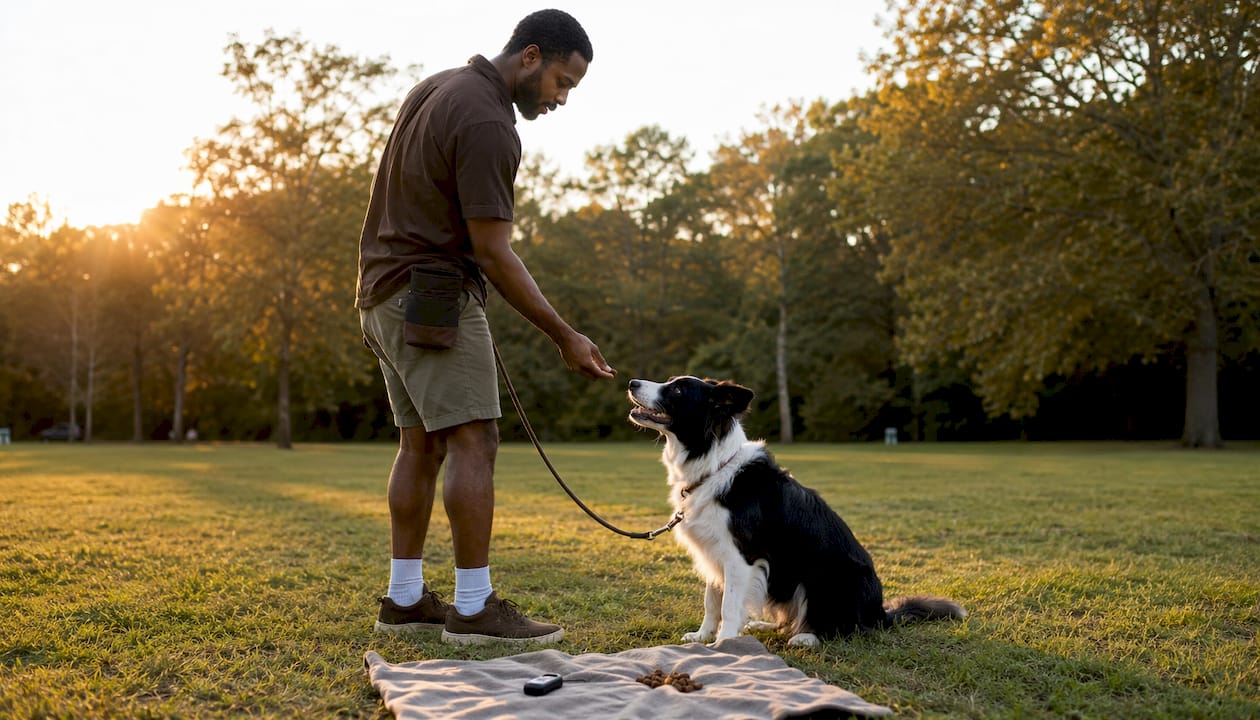
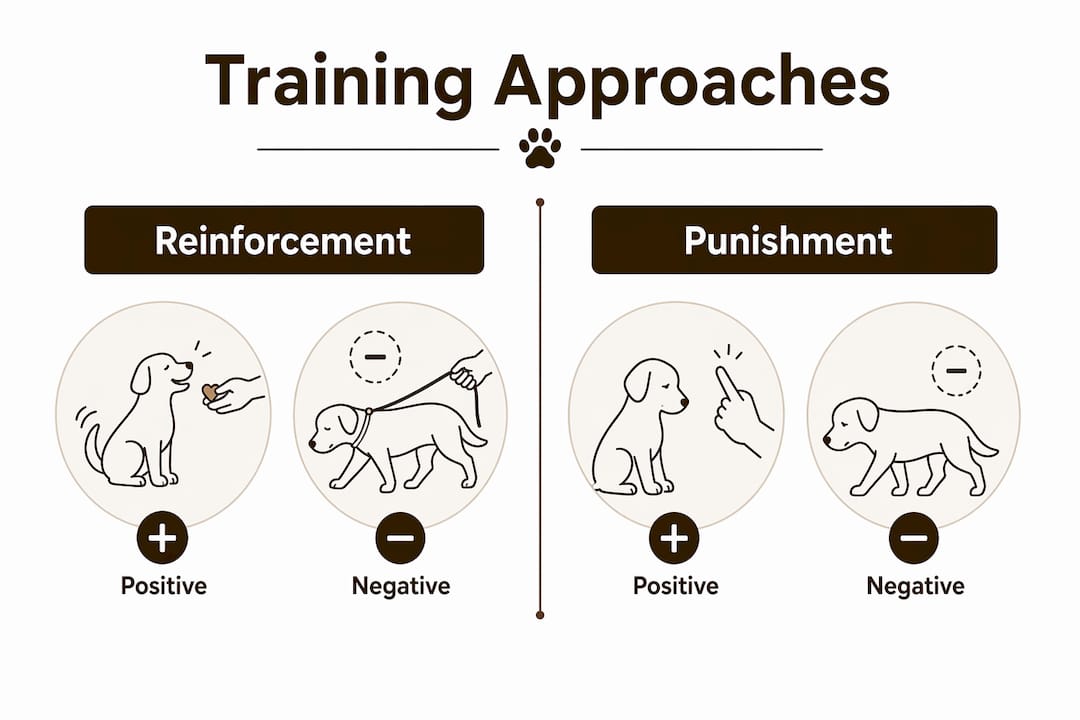
Understanding the four quadrants of operant conditioning sounds technical, but the practical version is straightforward. Reinforcement increases a behaviour; punishment decreases it. “Positive” means adding something; “negative” means removing something.
Approach | What happens | Welfare impact | Durability |
Positive reinforcement | Dog does X, you add a reward | Low stress, builds confidence | High — dog repeats what works |
Negative punishment | Dog does X, you remove something the dog wants (e.g. turn away when jumping) | Low stress when applied calmly | Good — dog learns what stops the reward |
Positive punishment | Dog does X, you add something unpleasant (e.g. a jerk, a shock) | Moderate to high stress risk | Lower — suppresses but does not teach |
Negative reinforcement | Dog does X to escape something unpleasant (e.g. pressure released when dog sits) | Moderate stress risk | Variable — depends on aversive intensity |
Force-free training uses positive reinforcement and, where appropriate, negative punishment. It avoids positive punishment and negative reinforcement entirely.
The equipment to avoid is clear: shock collars (e-collars), prong collars and choke chains all rely on pain or discomfort to modify behaviour. The Virginia-Maryland College of Veterinary Medicine notes that punishment-based tools, including shock collars and prong collars, can lead to fear, aggression and other behavioural issues. In the UK, the Animal Welfare Act 2006 provides the legal framework for animal welfare, and several veterinary and animal protection organisations have called for a ban on e-collars and similar aversive devices. Wales banned e-collars in 2010; England and Scotland have ongoing legislative discussions. Whatever the current legal position in your area, the welfare case against aversives is well established. For a fuller breakdown of humane training methods and what to avoid, the Happy-dogtraining guide covers the detail.
The force-free toolkit: markers, rewards, management and equipment
Force-free training is an active, structured approach. It needs planning and management rather than simply swapping treats for corrections. Here is what goes into a well-equipped session.
Marker signals
A marker is a precise signal that tells your dog “yes, that exact thing earned a reward.” You can use a clicker or a short word such as “yes.” The critical rule is the 1-second rule: mark within one second of the behaviour, then deliver the reward. Practise marker–reward pairings 10–20 times to “charge” the marker before using it in a real session. This means clicking or saying “yes,” then immediately giving a treat — no behaviour required yet. You are simply teaching your dog that the marker predicts something good.
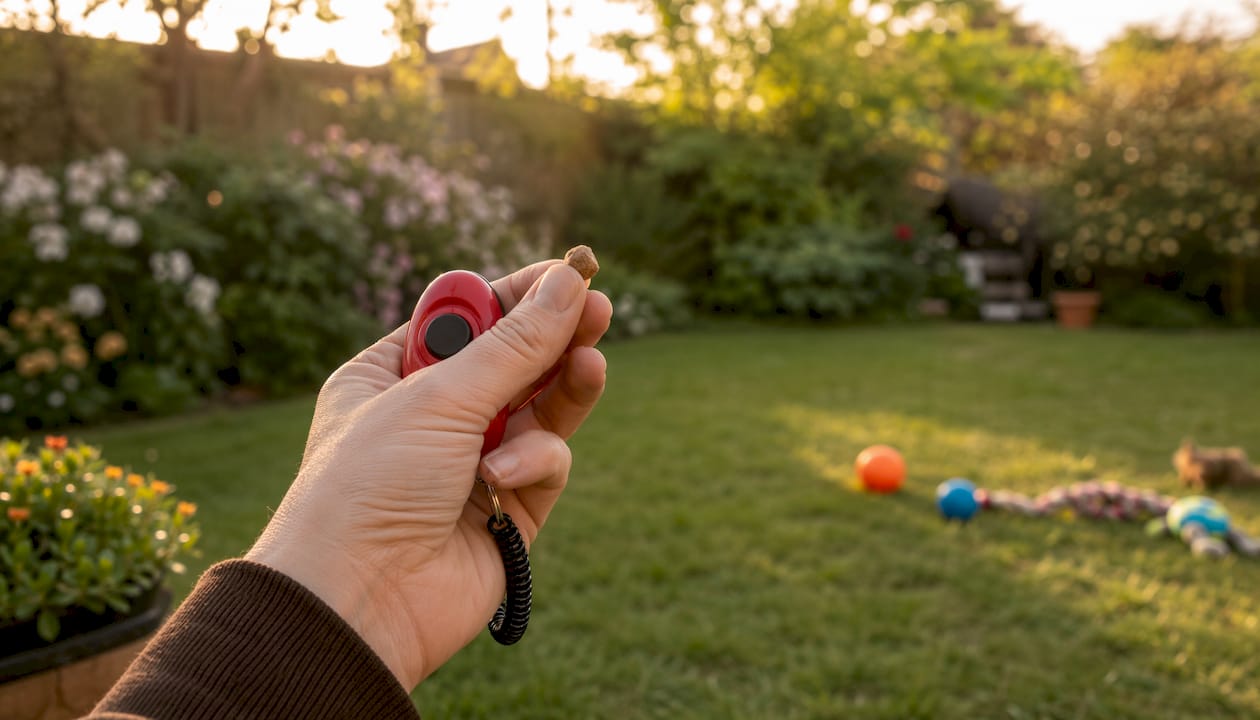
Pro Tip: If your timing feels off, practise the marker reflex without your dog first. Watch a ball bounce or a hand clap, and click or say “yes” at the exact moment of contact. Ten minutes of this builds the reflex-like timing that stops you accidentally rewarding the wrong behaviour.
Reward types and value
Not all rewards are equal, and the right one depends on the environment:
Food rewards — the most precise and easiest to deliver quickly; use small, soft pieces your dog can eat in under a second.
Play rewards — a short tug game or toy throw works well for high-drive dogs and adds variety.
Life rewards — access to sniffing, greeting a person, or going through a gate; these are powerful for dogs that are less food-motivated.
Match reward value to environmental difficulty. Practising a sit in your kitchen? A piece of dry kibble is fine. Practising recall in a busy park? Bring chicken or cheese. Insiders call this “paying for the performance,” and it is one of the most practical adjustments you can make.
Management tools and equipment
Flat collar — for ID tags; not for training pressure.
Front-clip harness — reduces pulling without causing pain; a good default for most dogs.
Long line (5–10 metres) — gives freedom during recall training while keeping the dog safe.
Baby gates and crates — prevent rehearsal of unwanted behaviours at home.
Avoid prong collars, choke chains and e-collars entirely. They are not necessary for any behaviour goal achievable through reward-based training, and the welfare risks are real.
Step-by-step recipes for recall, loose-lead walking and sit/stay
Recall
Start indoors, no distractions. Say your recall cue (“come” or your dog’s name plus “come”) once, in a bright tone.
The moment your dog moves toward you, mark with “yes.”
Reward generously when they arrive — several treats in a row, or a short play session.
Never call your dog to you for something they dislike (nail trims, bath time) until recall is very solid. Go to them instead.
Progress: move to the garden, then a quiet park on a long line, then gradually busier environments.
Troubleshooting: If your dog ignores the cue, you have moved too fast. Go back one environment level and raise your reward value.
Loose-lead walking
Stand still. The moment your dog creates slack in the lead, mark and reward.
Take two steps. If the lead stays loose, mark and reward again.
If your dog pulls, stop walking. Wait for slack, then mark and move again.
Build duration of loose walking before adding distance or distractions.
Teach duration, distance and distraction separately — raising all three at once causes failure. A dog that walks nicely for 30 seconds in the garden is not yet ready for a busy high street. For a full session plan, the Happy-dogtraining guide on home obedience training walks through the progressions step by step.
Sit/stay
Lure or shape a sit. The moment the dog’s bottom touches the floor, mark and reward.
Add a verbal cue (“sit”) just before the dog is about to sit naturally.
For stay: ask for a sit, wait one second, mark and reward. Gradually extend the duration in one-second increments.
Add distance only after the dog holds the sit reliably for five seconds at your side.
Common setbacks:
Dog over-threshold (distracted, panting, not taking treats): reduce difficulty immediately. Move further from the trigger or go back indoors.
Treat refusal: almost always a stress signal, not stubbornness. Lower the difficulty and try a higher-value reward.
Inconsistent marking: practise the marker reflex without the dog (see the pro tip above) before your next session.
How to socialise and start training puppies the force-free way
The socialisation window for puppies closes around 12–14 weeks of age, which means the weeks before full vaccination are the most important and the most time-pressured. The good news is that safe socialisation before full vaccination is possible — it just requires choosing low-risk environments.
Socialisation checklist (gradual exposure, always positive):
Different floor surfaces (grass, gravel, tiles, carpet)
Gentle handling of paws, ears and mouth by different people
Household sounds (vacuum cleaner, doorbell, washing machine) at low volume first
Car journeys (short, with a reward at the end)
Seeing other dogs from a safe distance (before vaccination is complete, avoid direct contact with unknown dogs)
Meeting calm, vaccinated dogs belonging to friends or family
Busy outdoor environments (carried or in a pram if not yet fully vaccinated)
Children, older people, people in hats or uniforms
Vaccination timing note: your vet will advise on the specific schedule, but most puppies are not fully protected until one to two weeks after their second vaccination. During this window, puppy classes run by reputable trainers in clean, controlled environments are generally considered lower risk than uncontrolled outdoor contact.
Starter exercises for puppies:
Marker loading — 10 repetitions of “yes” followed by a treat, twice a day.
Hand target — hold your flat palm in front of your puppy’s nose; the moment they touch it, mark and reward.
Mat work — place a small mat on the floor; reward any interaction with it, then gradually shape the puppy to lie down on it.
Keep sessions to two to three minutes for very young puppies. Frequency matters more than duration at this stage — five short sessions across a day beats one long one. A well-set-up home training space makes these short sessions far easier to fit into a busy day.
How long does force-free training take, and what does it cost in the UK?
Realistic timelines help you stay motivated rather than feeling like something has gone wrong.
Basic cues at home (sit, down, hand target): most dogs show reliable responses within 2–4 weeks of daily short sessions.
Loose-lead walking in low-distraction areas: 4–6 weeks of consistent practice for noticeable improvement.
Recall in the garden: 2–4 weeks to a reliable response; generalising to a busy park typically takes 3–6 months of progressive work.
Behaviour change for reactivity or fear: months rather than weeks, with professional guidance usually making a meaningful difference to the timeline.
On costs, UK pricing varies considerably by region and format:
Group classes typically run £8–£15 per session, with most programmes structured as a block of six to eight weeks.
Private one-to-one sessions generally range from £50–£100 per hour, depending on the trainer’s qualifications and location.
Multi-week behaviour programmes (for reactivity, fear or aggression) are usually priced as packages and can range from £200 upwards, reflecting the assessment, planning and follow-up involved.
Group classes are a good starting point for puppies and dogs with straightforward training goals. Private sessions save time when you have a specific behaviour challenge or when a dog finds group environments too stimulating to learn in. If your dog shows aggression, repeated panic responses or sudden behaviour changes, professional support is not optional — it is the faster and safer route.
When should you call a professional, and how do you choose the right one?
Some situations call for professional input straight away. Do not wait if your dog shows:
Aggression toward people or other dogs (growling, snapping, biting)
Repeated panic responses — hiding, trembling, destructive behaviour when left alone
Sudden onset behaviour changes with no obvious cause (pain is often a factor and needs ruling out by a vet first)
Fear responses that are escalating despite gentle handling
How to vet a force-free trainer in the UK
Ask these questions before booking:
Are you a member of the APDT UK, APBC or Pet Professional Guild UK?
Do you use any aversive tools or techniques, including e-collars, prong collars or physical corrections?
Can you describe your approach to a dog that is not responding to training?
Do you carry public liability insurance?
Will you provide a written plan or session notes?
Red flags to watch for:
Pressure to use a choke chain, prong collar or e-collar
Claims that your dog needs to be “dominated” or “shown who’s boss”
No welfare check at the start of a session (no assessment of the dog’s stress signals)
Reluctance to explain their methods or provide references
No written plan or follow-up support offered
A genuinely force-free practitioner will welcome these questions. If a trainer becomes defensive or dismissive when you ask about their methods, that tells you everything you need to know.
How an accredited force-free programme works in practice
Happy-dogtraining’s approach is built around the same principles this guide covers: marker training, reward-based shaping, management and owner education. The programme is AVS-accredited and backed by over 20 years of hands-on experience with dogs across a wide range of behavioural challenges, from basic obedience to fearfulness and aggression.
A typical 4–6 week force-free course covers:
Week 1: Marker loading, hand target, name response and management setup at home.
Week 2: Sit, down and mat work with duration building; introduction to loose-lead foundations.
Week 3: Recall foundations, leave it and threshold management for reactive or excitable dogs.
Week 4: Generalisation — practising all cues in new environments with progressive distraction levels.
Weeks 5–6 (where included): Owner skills refinement, troubleshooting specific challenges and a written progress summary.
Every client receives free lifetime support after completing the programme. That means you can return with questions weeks or months later, without booking a new session. For owners who want to see credentials before committing, Happy-dogtraining welcomes requests for evidence of accreditation and case examples. The intensive programme page outlines the full structure and how to book an initial consultation.
Key takeaways
Force-free dog training produces more durable, confident behaviour than aversive methods — and the practical steps to start are simpler than most owners expect.
Point | Details |
Start with a charged marker | Practise 10–20 marker–reward pairings before using the marker in a live session. |
Match reward value to difficulty | Use high-value treats (chicken, cheese) in distracting environments; kibble is fine at home. |
Build the three Ds separately | Raise duration, distance and distraction one at a time to avoid setting your dog up to fail. |
Management prevents rehearsal | Gates, long lines and crates stop unwanted behaviours from becoming habits while training catches up. |
Happy-dogtraining’s programme | An AVS-accredited 4–6 week course with lifetime support, covering markers, core cues and recall building. |
Why force-free training is misunderstood more than it is misused
There is a version of force-free training that owners sometimes encounter and rightly find unsatisfying: no structure, no clear expectations, treats handed out regardless of behaviour. That is not force-free training. It is just inconsistency with a treat pouch attached.
The genuine approach is demanding. It asks you to think clearly about what you want your dog to do, set up the environment so the right choice is the easiest choice, and mark the exact moment the right behaviour happens. That requires more skill and attention than a correction, not less. Owners who try force-free methods and feel they are “not working” have almost always skipped one of three things: management (the dog keeps practising the unwanted behaviour), marker timing (the reward is landing a second too late), or reward value (the treat is not interesting enough for the environment).
The dominance narrative — the idea that dogs are constantly testing your authority and need to be put in their place — has been comprehensively challenged by modern behavioural science. Dogs are not plotting. They are doing what has worked before. Change what works, and behaviour follows. That is a more optimistic picture than the dominance model, and it is also more accurate.
Punishment can look faster in the short term. A sharp correction stops a behaviour in the moment. But that suppression is not the same as learning, and the side effects — increased anxiety, redirected aggression, a dog that shuts down rather than engages — often show up weeks later. Small daily wins through reward-based training compound into something much more solid. Patience is not a weakness in this approach. It is the mechanism.
Ready to put force-free training into practice with expert support?
Happy-dogtraining offers a structured, AVS-accredited programme designed for owners who want real results without shortcuts. The course covers everything in this guide — marker training, core cues, recall building, loose-lead walking and owner skills — across four to six weeks of personalised sessions. Every programme includes free lifetime support, so you are never left troubleshooting alone.

Whether your dog is a puppy starting from scratch or an adult with established habits, the programme is tailored to their specific needs and temperament. For dogs showing aggression or fear-based responses, a dedicated behaviour consultation is the right starting point. To see the full programme outline, check accreditation details or book your first session, visit the intensive training programme page and get in touch today.
Useful UK sources and further reading
A short list of authoritative resources for owners who want to go deeper:
RSPCA (rspca.org.uk) — welfare guidance, advice on training tools to avoid and how to find a reputable trainer.
Dogs Trust (dogstrust.org.uk) — free owner resources, training videos and a behaviour helpline.
Woodgreen (woodgreen.org.uk) — behaviour support guidance and owner education materials.
APDT UK (apdt.co.uk) — the trainer search tool lets you find APDT-accredited force-free trainers by postcode.
APBC (apbc.org.uk) — referral directory for clinical behaviour cases; all members use welfare-positive methods.
Pet Professional Guild UK (petprofessionalguild.com) — member directory of force-free practitioners with a published ethical code.
Virginia-Maryland College of Veterinary Medicine — five practical training tips grounded in veterinary science, including guidance on socialisation and avoiding punishment-based tools.
PMC / NCBI — peer-reviewed research comparing reward and mixed training methods in working dogs, useful for owners who want the science behind the recommendations.
For further reading on choosing a trainer, the APDT UK’s “How to find a dog trainer” guidance is the most practical starting point for UK owners. For clinical behaviour referral (aggression, severe anxiety, compulsive behaviours), ask your vet for a referral to an APBC or CCAB-accredited behaviourist.
Recommended
Comments