How your dog's emotional state shapes learning
- Mark McDade
- 10 hours ago
- 13 min read
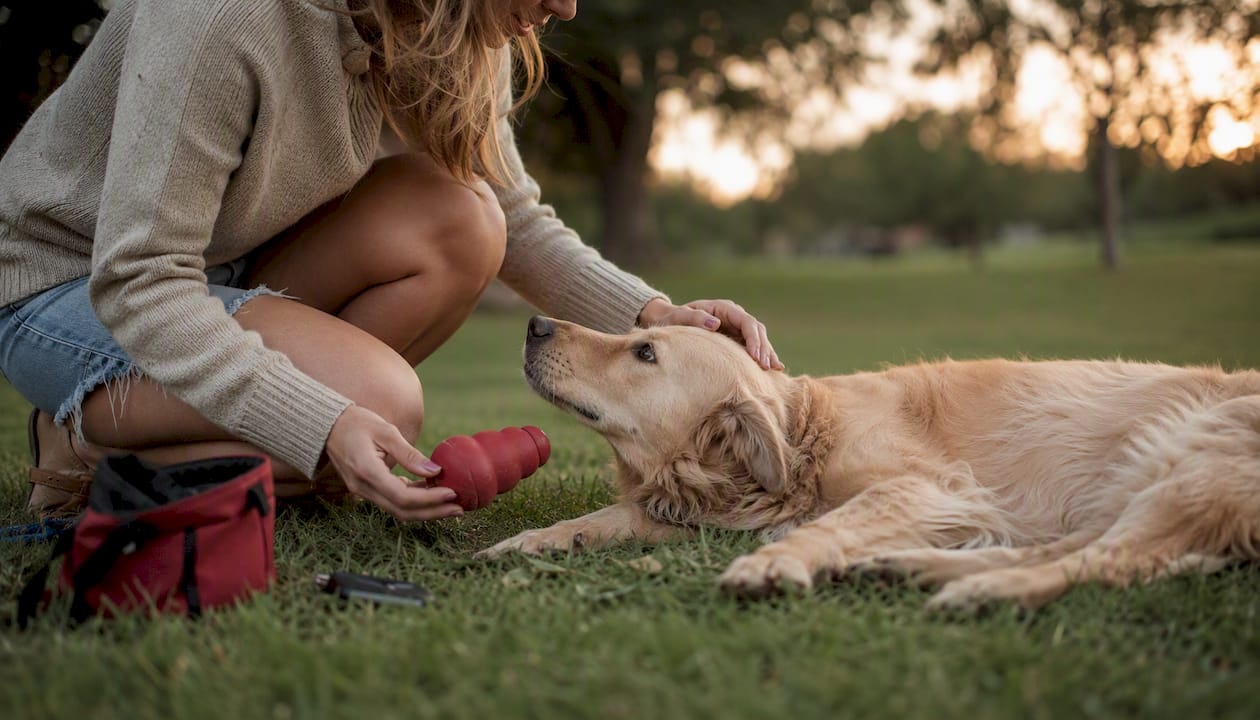
A dog’s emotional state directly and measurably changes how well they attend, learn, and retain training. This is not a soft, intuitive observation — it is backed by peer-reviewed research, including the response-landscape framework that maps how arousal and affective state interact with training methods to change the likelihood of desired behaviours. Mark, Happy-dogtraining’s AVS-accredited trainer with over 20 years of experience, applies this science in every session.
Three things to carry into your next training session right now:
Do: Check your dog’s arousal level before you begin. A relaxed, attentive dog learns faster and retains more than an over-excited or anxious one.
Don’t: Repeat a cue when your dog is showing stress signals. Repetition under stress deepens the wrong associations, not the right ones.
Immediate action: Take three slow breaths and soften your posture before you start. Your emotional state reaches your dog before your first cue does.
Key takeaways
A dog’s emotional state shapes every aspect of learning, from attention and motivation through to long-term memory consolidation, and your own emotional state reaches your dog before your first cue.
Point | Details |
Arousal and valence both matter | Learning works best at moderate arousal with positive valence; too high or too low disrupts attention and memory. |
Your stress reaches your dog | Human stress odour alone shifts dogs toward a more negative cognitive bias, reducing task willingness. |
Chronic stress harms learning | Prolonged elevated stress degrades memory consolidation and welfare; keep training below threshold consistently. |
Match method to state | Use the response-landscape framework to select the right operant quadrant for your dog’s current arousal and affect. |
Happy-dogtraining’s approach | AVS-accredited, science-based sessions tailored to each dog’s emotional baseline, with behaviour consultations for complex cases. |
Table of Contents
How emotional state affects dog learning: arousal, valence, and what they mean for your sessions
Two dimensions shape your dog’s readiness to learn at any given moment: arousal and affective valence.
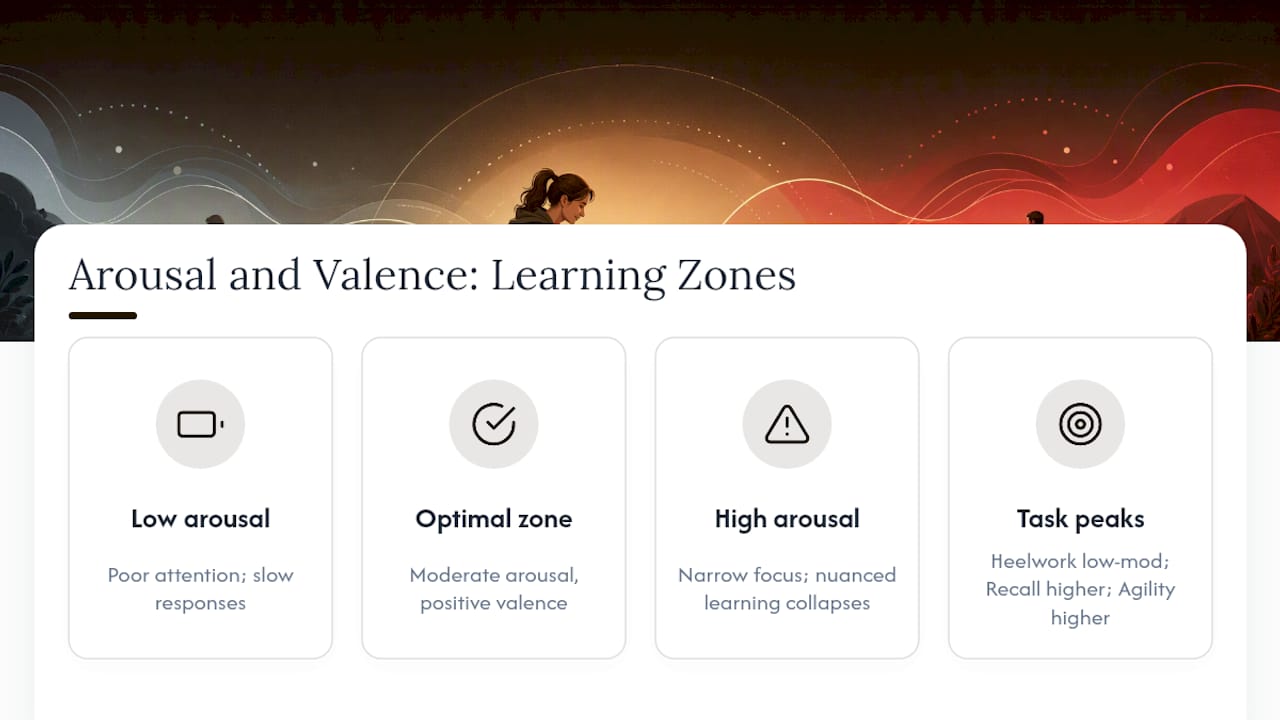
Arousal is the activation level of the nervous system, ranging from drowsy and disengaged at one end to frantic and overwhelmed at the other. Affective valence is the emotional colouring of that state — whether the dog’s experience feels broadly positive (curious, playful, confident) or negative (fearful, frustrated, anxious). These two dimensions interact, and the combination determines what kind of learning is even possible.
At very low arousal, a dog struggles to pay attention. Motivation drops, responses slow, and new information simply does not stick. At very high arousal, the dog’s focus narrows sharply onto the trigger or the excitement source, and the capacity for nuanced learning collapses. The sweet spot sits in the middle: moderate arousal with a positive valence. That is where attention is sharp, motivation is high, and memory consolidation works efficiently.
Different tasks need different points on this spectrum. Calm, precise heelwork benefits from moderate-to-low arousal — the dog needs to think, not react. A recall in a distracting environment needs slightly higher arousal to compete with the environment’s pull. Scentwork and nose work actually perform best at relatively low, focused arousal, because the dog needs to process subtle olfactory information rather than charge through it. Agility, by contrast, can tolerate higher arousal provided the dog has a solid foundation and the arousal stays positive.
The response-landscape concept captures this visually as a three-dimensional surface with peaks and valleys. Each training method has its own peak — the arousal and valence combination where it works best. Positive reinforcement peaks at moderate arousal with positive valence. Punitive methods, when they work at all, tend to require very specific and narrow conditions to avoid tipping the dog into fear or shutdown. Understanding where your chosen method sits on that landscape is what separates a productive session from a frustrating one.
What your dog’s brain and body do during stress
When a dog perceives a threat or feels uncertain, the hypothalamic-pituitary-adrenal axis releases cortisol, and the sympathetic nervous system floods the body with adrenaline. In the short term, this sharpens certain kinds of attention — the dog becomes hyper-vigilant to the source of stress. But it simultaneously narrows the focus away from you and away from the task, making new learning very difficult.
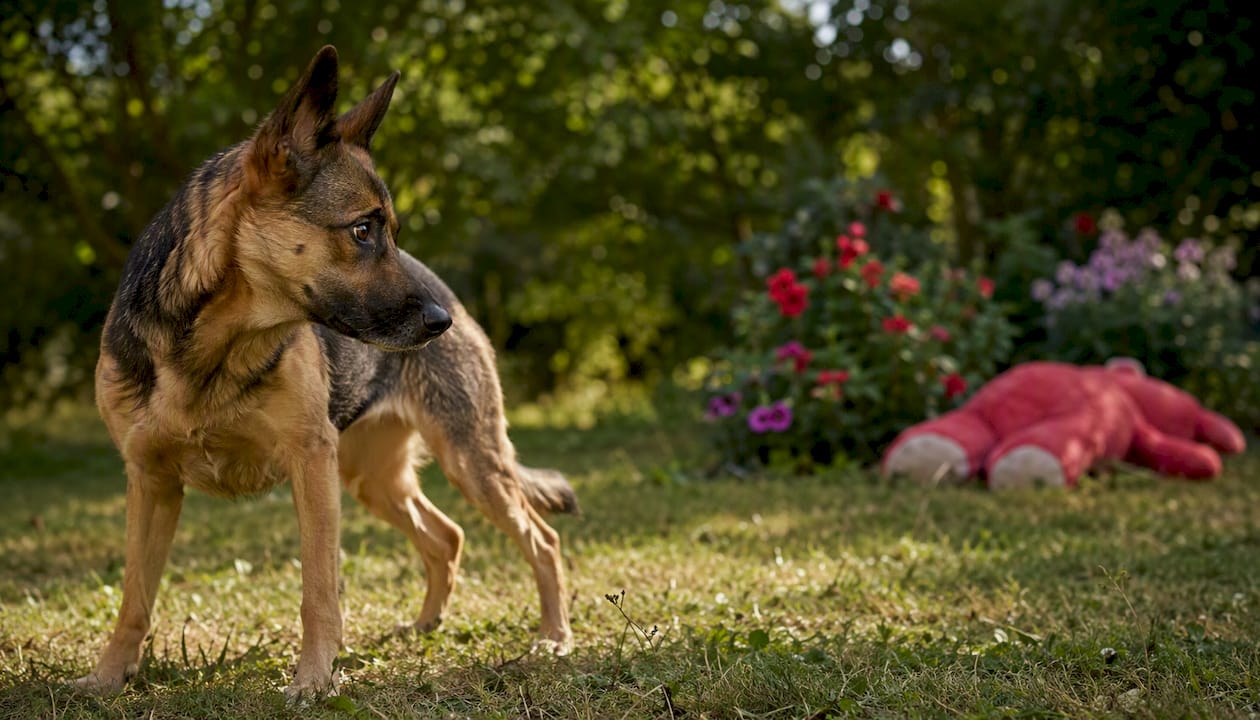
Cortisol also interferes with memory consolidation. The hippocampus, which is central to forming new memories, is sensitive to elevated cortisol. A dog trained repeatedly in a high-stress state may form memories, but they tend to be fear-linked rather than task-linked, focusing on negative feelings rather than the task itself.
Dopamine tells a different story. When a dog anticipates a reward, dopamine is released in the mesolimbic pathway, creating motivation and reinforcing the behaviours that led to the reward. This is the neurochemical engine behind positive reinforcement. A dog in a positive affective state has a well-primed dopamine system, which is why reward-based training works so efficiently when the dog is calm and happy. There is also emerging evidence of gut-brain signalling in canine stress responses, though the applied training implications of this pathway are still being studied.
The critical distinction is between acute arousal and chronic stress. A brief, moderate rise in arousal before a training session can actually aid memory consolidation in some dogs. Research on detection dogs found that the effect of arousal during and after learning on retention depends heavily on the dog’s baseline reward arousal: low-arousal dogs benefited from increased arousal during training, while high-arousal dogs performed worse when arousal rose further. Chronic stress, however, is a different matter entirely. A shelter study linked poor enrichment, crowding, and inadequate management to higher physiological stress markers and worse behavioural outcomes, showing that prolonged environmental stress degrades both welfare and the capacity to learn.
Key physiological points to keep in mind:
Cortisol narrows attention and disrupts hippocampal memory consolidation under sustained stress.
Dopamine drives motivation and reinforces learning when the dog anticipates a positive outcome.
Acute, moderate arousal can help some dogs consolidate memories; chronic elevation harms learning and welfare.
Individual baseline temperament determines whether a rise in arousal helps or hurts a given dog.
For a deeper look at the neurobiological basis of behaviour change, the neuroplasticity and dog training guide explains how the brain physically rewires through consistent, positive training.
How your emotional state changes your dog’s learning
Your dog is reading you constantly, and not just through your words. Three channels carry your emotional state directly to your dog: body language, vocal tone, and scent.
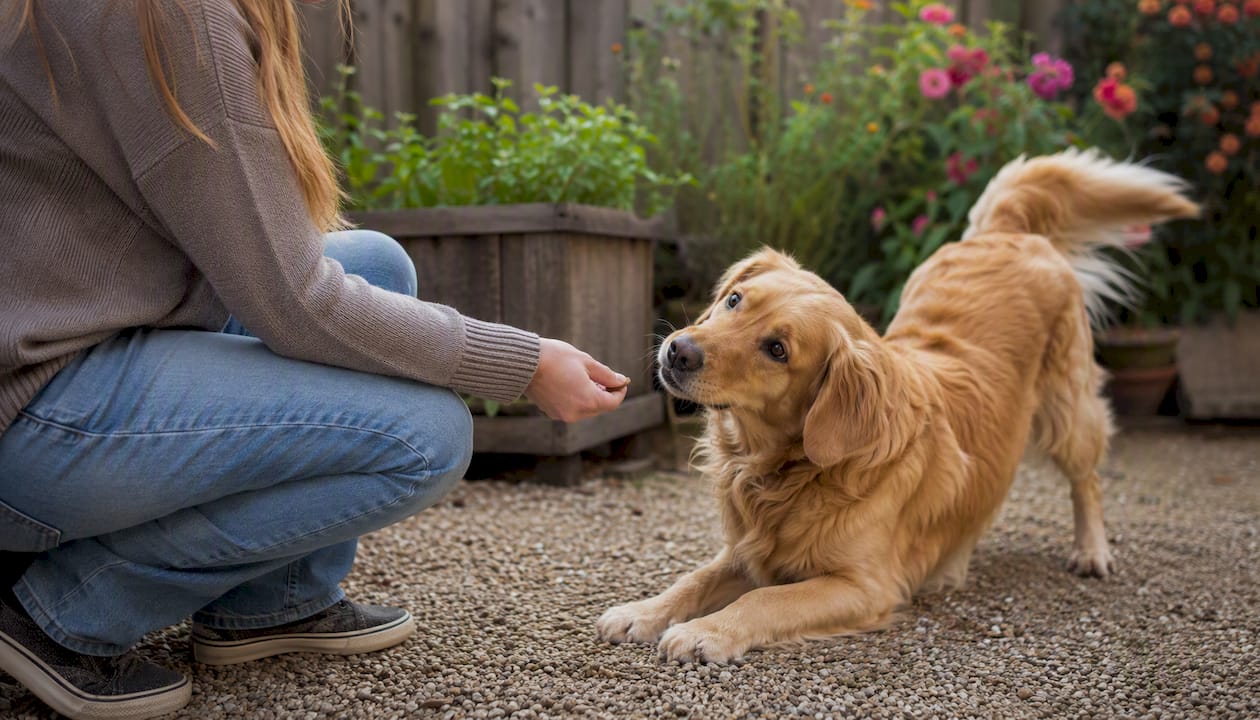
The olfactory channel is the most surprising and the most difficult to manage. An experimental study found that dogs exposed to human stress odour showed a more negative cognitive bias and were less likely to approach ambiguous rewards in a cognitive bias task. This means your dog can detect that you are stressed before you have said or done anything, and that detection shifts their emotional state toward caution and pessimism. You cannot fake calm through gritted teeth.
Dogs also use emotional information from human cues to guide their own behaviour, a process called social referencing. If you approach a novel object with hesitation, your dog is likely to hesitate too. If you move toward it with relaxed confidence, your dog is more likely to investigate. This is not disobedience — it is your dog doing exactly what social animals do: using your emotional signal as information about whether the situation is safe.
Specific handler behaviours that commonly raise dog arousal include a tight, jerky leash, a high-pitched or rapid voice, fast pacing, and visible facial tension. Behaviours that lower arousal include slow, deliberate movement, a calm and even vocal tone, loose leash pressure, and relaxed shoulders.
Before your next session, run through this three-point handler check:
Breathing: Take three slow, diaphragmatic breaths. This genuinely lowers your cortisol output and changes your scent profile.
Posture: Drop your shoulders, soften your jaw, and stand still for a moment before you begin.
Cue pacing: Slow down. Most handlers cue too fast when they are anxious, which raises dog arousal and reduces response accuracy.
How to tell when your dog is ready to learn
Knowing when not to train is as valuable as knowing how to train. VCA Animal Hospitals’ clinical guidance identifies a clear set of stress signals that indicate a dog is not in an optimal learning state.
Subtle stress signs to watch for:
Prolonged yawning (not after waking)
Lip-licking without food present
Panting when the dog is not hot or recently exercised
Whale eye (visible white of the eye)
Displacement behaviours: sniffing the ground suddenly, scratching, shaking off
Overt signs that mean stop now:
Cowering or body lowering
Freeze response
Active escape attempts
Trembling or excessive drooling
When you see any of these, two actions apply immediately. First, pause the session and give your dog a moment to decompress — move away from the trigger, sit quietly, and let the nervous system settle. Second, reduce arousal with something familiar and easy: a simple sit-stay the dog knows well, followed by a calm reward, can help reset the baseline before you try anything new.
Pro Tip: Never repeat a cue when stress signs are present. Each repetition without a response deepens the association between that cue and the feeling of pressure or confusion. Instead, simplify the task, increase distance from the stressor, or end the session. A short, successful session is always better than a long, stressful one.
If you are noticing these signs regularly, the troubleshooting dog training setbacks guide offers a structured framework for identifying what is driving the pattern.
Practical session templates for different arousal states
The theory becomes useful only when it shapes what you actually do in a session. Here are three repeatable templates matched to common arousal scenarios.
Calm recall practice (low-to-moderate arousal target). Warm up with two minutes of loose-leash walking in a quiet area. Keep your voice even and your movements slow. Ask for three or four easy behaviours the dog knows well — sit, down, touch — rewarding each with a calm verbal marker and a moderate-value treat. Then introduce the recall in a low-distraction environment, rewarding with a slightly higher-value treat and gentle praise. Keep the session to ten minutes. Cool down with another two minutes of calm walking before releasing the dog to sniff freely. Sniffing is genuinely decompressing for dogs and lowers arousal naturally.
High-energy cue work with impulse-control warm-up (moderate-to-high arousal, positive valence). Before asking for anything complex, spend two to three minutes on impulse-control exercises: leave-it, wait at a threshold, or a simple hand-target. These focus arousal without suppressing it. Then move into the higher-energy work — retrieve, agility foundation, or fast heelwork — keeping sessions short (five to seven minutes of active work) and interspersing brief pauses. End with a clear release cue and a play reward if the dog enjoys it.
Desensitisation under-threshold pairing (low arousal, positive valence). Identify the distance at which the dog notices the trigger but does not react. Work at or just below that threshold. Pair each exposure with a high-value food reward delivered calmly. Keep the session to five minutes maximum. The goal is zero stress signs throughout. If any appear, increase distance immediately. Research on reward schedules found that partial rewarding during clicker training did not improve learning speed and induced a more pessimistic affective state — so reward every correct response consistently during this phase.
Singapore-specific notes: Heat and humidity in Singapore raise physiological arousal independently of training stimuli. A dog that is warm is already partway up the arousal curve before you begin. Schedule sessions in the early morning or after sunset, carry water, and keep active work shorter than you would in a cooler climate. Urban environments here also present a dense, unpredictable stimulus environment — MRT stations, food courts, crowded pavements — which can push a dog’s arousal well above baseline. Use these as gradual exposure opportunities rather than full training venues until your dog is genuinely comfortable. For training methods matched to your dog’s temperament, the temperament guide offers a practical starting point.
Using the response-landscape framework to choose your training method
The response-landscape model gives trainers a practical decision tool: match the operant quadrant to the dog’s current arousal and affective state, rather than applying one preferred method regardless of context.
The four operant quadrants behave differently across the arousal-valence surface:
Quadrant | What it involves | Works best when | Risks at wrong arousal/valence |
Positive reinforcement (R+) | Adding something the dog wants | Moderate arousal, positive valence | Ineffective if arousal is too high (dog cannot focus on reward) |
Negative punishment (P-) | Removing something the dog wants | Low-to-moderate arousal, mild frustration tolerable | Can increase frustration and arousal if overused |
Negative reinforcement (R-) | Removing something aversive | Requires careful calibration; works at low-to-moderate arousal | Easily tips into fear at high arousal |
Positive punishment (P+) | Adding something aversive | Narrow, high-risk window; rarely optimal | High risk of fear, shutdown, and aggression at most arousal levels |
A simple decision flow for session moments:
Dog is calm and engaged (low-moderate arousal, positive valence): use R+ freely. Reward rate can be moderate, task difficulty can increase.
Dog is mildly distracted or slightly over-threshold (moderate-high arousal, positive valence): use R+ with higher-value rewards, reduce task difficulty, increase distance from distractors.
Dog is showing stress signs (any arousal, negative valence): pause. Do not apply any quadrant. Reset first.
Dog is frustrated but not fearful (moderate arousal, mild negative valence): brief P- (turn away, withhold reward) can be used, but only if the dog has a history of tolerating mild frustration without escalating.
Positive punishment sits in a narrow, high-risk window on the response landscape. At most arousal and valence combinations, it either suppresses behaviour without changing the underlying emotional state or tips the dog into fear — neither of which produces reliable, welfare-positive learning.
Common myths and the risks of getting this wrong
Myth: “My dog looks guilty, so they know what they did wrong.” The evidence points elsewhere. Dogs display appeasement behaviours — lowered body, averted gaze, tucked tail — in response to owner cues and body language, not in response to a recalled action. The “guilty look” is a stress response to your emotional state, not evidence of moral understanding. Punishing based on this misreading increases stress without teaching anything useful.
Myth: “A firm correction will snap them out of it.” Emotion systems in the brain are subcortical and automatic. You cannot override a fear or anxiety response with a correction — you can only suppress the visible behaviour while the underlying emotional state remains or worsens. The practical implication is to work below threshold and change the emotional association through counterconditioning, not to push through the emotion with force.
Myth: “Partial rewards keep dogs on their toes.” Research found that partial rewarding during clicker training did not improve acquisition speed and produced a more pessimistic affective state in dogs. Inconsistent reward delivery harms welfare without any performance benefit during the learning phase.
Practical alternatives that work:
Under-threshold exposure: Keep the dog below the point of reaction and pair the trigger with something genuinely good.
Counterconditioning: Change the emotional association with a stimulus by consistently pairing it with positive outcomes.
Predictable routines: Consistent structure reduces anticipatory anxiety and lowers baseline arousal before sessions even begin.
Two Singapore scenarios and what to do
Urban walk reactivity
Your dog walks calmly on quiet streets but lunges and barks at other dogs near Bishan Park or along the busy stretches of Orchard Road. The environment is pushing arousal above the threshold where learning is possible.
Four-step plan:
Assess the threshold distance. Find the distance at which your dog notices other dogs but does not react. This is your working distance.
Under-threshold pairing. At that distance, mark and reward every calm glance toward the trigger. Use high-value food — chicken, cheese, or whatever your dog finds genuinely exciting.
Manage distance actively. Cross the street, turn down a quieter path, or simply increase distance when a trigger appears unexpectedly. Distance is your most powerful tool.
Reinforce calm. When your dog disengages from the trigger voluntarily, reward immediately. That voluntary disengagement is the behaviour you want to grow.
Separation stress in a Singapore flat
Your dog becomes distressed when left alone in a small HDB flat or condominium unit — vocalising, destructive behaviour, or toileting despite being house-trained. This is a chronic stress pattern, not a training gap.
Four-step plan:
Build predictability. Consistent departure and arrival routines reduce anticipatory anxiety. Keep departures calm and brief. For detailed guidance on pre-departure signals, the pre-departure anxiety guide covers this step thoroughly.
Graduated alone time. Start with absences of seconds, not minutes. Build duration only when the dog is consistently calm at the current level. Track progress using the signs your dog’s separation anxiety is improving checklist.
Enrichment. Puzzle feeders, frozen Kongs, and sniff mats give the dog something absorbing to do and lower arousal during alone time.
Seek professional help early. If stress signs persist despite consistent effort, a behaviour consultation is the right next step — not more repetition of the same approach. Separation anxiety responds well to professional guidance when addressed early.
A trainer’s perspective on emotional-state checks
The single most consistent thing I see in new clients is that they arrive at a session already frustrated — and their dog arrives already anxious. The session has effectively started before the lead goes on. What I do in class, and what I encourage every owner to practise at home, is a two-minute check before any training begins.
Stand still. Watch your dog for thirty seconds without asking for anything. Are they scanning the environment restlessly? Yawning? Refusing to make eye contact? Those are signals to adjust before you begin, not after the session has gone sideways. If the dog is calm and orienting toward you with a soft body, you are ready.
The exercise I give owners to try at home: sit on the floor with your dog in a familiar room, no treats visible, no cues given. Just be present for sixty seconds. Notice where your dog chooses to be, how their body looks, and whether they settle or stay alert. That sixty seconds tells you more about your dog’s baseline emotional state than any formal assessment.
Professional support for emotional-state driven learning challenges
If your dog’s emotional state is consistently getting in the way of progress, structured professional support makes a real difference. Happy-dogtraining offers behaviour consultations and private obedience classes designed specifically for dogs whose learning is affected by anxiety, reactivity, or arousal dysregulation. For dogs that need an accredited, structured programme, the AVS-approved intensive obedience programme provides a science-based framework with clear milestones and lifetime support after training.
Mark’s approach starts with an emotional-state assessment before any obedience work begins, because a dog that is not in a learning-ready state cannot benefit from even the best training plan. Sessions are tailored to your dog’s baseline arousal and temperament, with adjustments made in real time as the session unfolds. To book a behaviour consultation or find out which programme fits your dog’s needs, visit Happy-dogtraining Singapore and get in touch directly.
Sources
The sources below were selected because they represent peer-reviewed experimental work, clinical guidance, and conceptual reviews directly relevant to the mechanisms discussed in this article. Together they cover the arousal-valence model, physiological stress markers, reward-schedule effects, and human-to-dog emotional transmission.
Recommended
Comments