AVS Trainer's Safety Plan for Introducing Dogs to Babies in Singapore
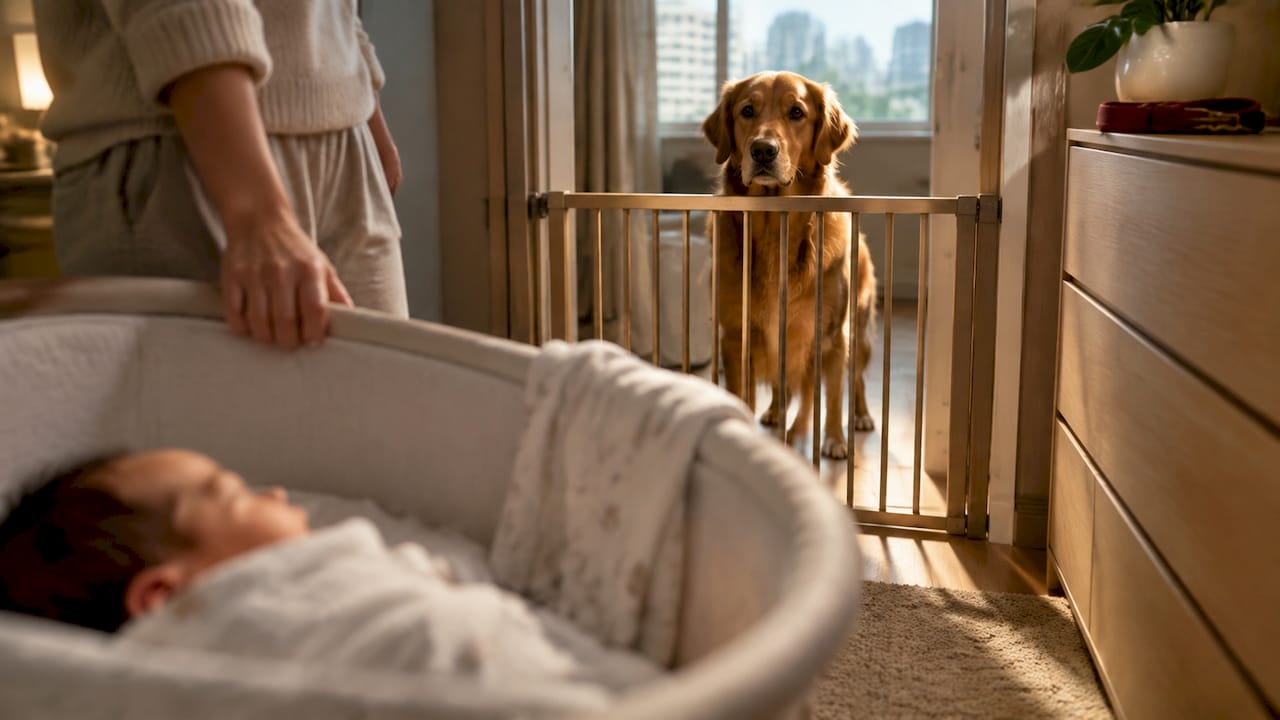
Start months before your due date, keep every introduction gradual and supervised, and never leave your dog and baby alone together, not even for a moment. That single rule, backed by guidance from Dogs Trust and VCA Animal Hospitals, prevents the vast majority of problems. Expect real settling in to take weeks, sometimes a few months, not days.
TL;DR:
Most dogs need several weeks to a few months to fully adjust to a new baby, requiring consistent routines and early preparation.
Building reliable obedience cues like sit, stay, and leave it before the due date is critical for control during stressful situations.
Introducing sounds and smells gradually, using reward-based desensitization, helps dogs tolerate baby noises and scents without stress or overreaction.
Never leave a dog and baby alone, and supervise all interactions actively to prevent bites, especially since children under five cannot recognize warning signals.
Early signs of stress, such as turning away or stiffening, require immediate separation and professional assessment to prevent escalation into aggression.
Table of Contents
How do you prepare your dog before the baby arrives?
You’ve got more time than you think, and that’s good news. The dogs who cope best with a new baby are the ones whose whole world hasn’t been turned upside down overnight. Preparation should begin months ahead, not in the final fortnight, because many difficult moments happen in the first hours or days after everyone comes home from hospital, when the dog is suddenly faced with a stranger, a changed schedule, and exhausted owners all at once, as UC Davis veterinary guidance points out.
Here’s a rough timeline that works for most families:
Around four to six months out: book a full veterinary check. Rule out pain, hearing loss, or vision problems that could make your dog more reactive or startle easily. Confirm vaccinations and flea and worm treatments are current.
Two to three months out: set up “success stations”, a crate, pen, or gated safe bed your dog already loves, stocked with enrichment toys, so it reads as a reward zone rather than a punishment. PetMD’s preparation guide recommends building this association well before you need to use it under pressure.
Six to eight weeks out: start adjusting routines. Practise shorter fuss and attention windows, walk with an empty pram so lead manners around wheels become automatic, and get your dog used to baby gates being closed at random times, not just when you need them.
Final weeks: bring the cot, pram, and baby toys into the house and let your dog sniff and settle around them calmly. Introduce baby lotion or powder smells on a cloth, always paired with something rewarding.
A few smaller habits make a big difference too:
Rotate who feeds and walks your dog, so the routine doesn’t collapse the moment one parent is busy with the baby.
Practise calm departures and arrivals now, so your dog isn’t overexcited at the door later.
If nappies, prams, or a newborn essentials checklist are already on your list, tick off dog preparation at the same time, not as an afterthought once the baby’s home.
Pro Tip: Fill a treat-dispensing toy and place it in the success station every single day for a fortnight before baby’s due date. By the time you actually need your dog settled there, it will already feel like the best seat in the house.
How do you get a dog used to baby sounds and smells?
Dogs meet the world nose and ears first, so this is where a huge amount of the groundwork happens, quietly, in the weeks before anyone new even arrives.
Start with sound. Play recordings of a crying baby at a very low volume while your dog is doing something pleasant, eating dinner, chewing a favourite toy, or lying in its success station. If your dog looks relaxed, gradually raise the volume over several sessions. If it flinches, backs away, or refuses food, drop the volume and go slower. University of Pennsylvania’s veterinary team recommends exactly this pairing of sound with reward as the safest way to desensitise a dog to newborn noise before it becomes a real, unpredictable event in the house.
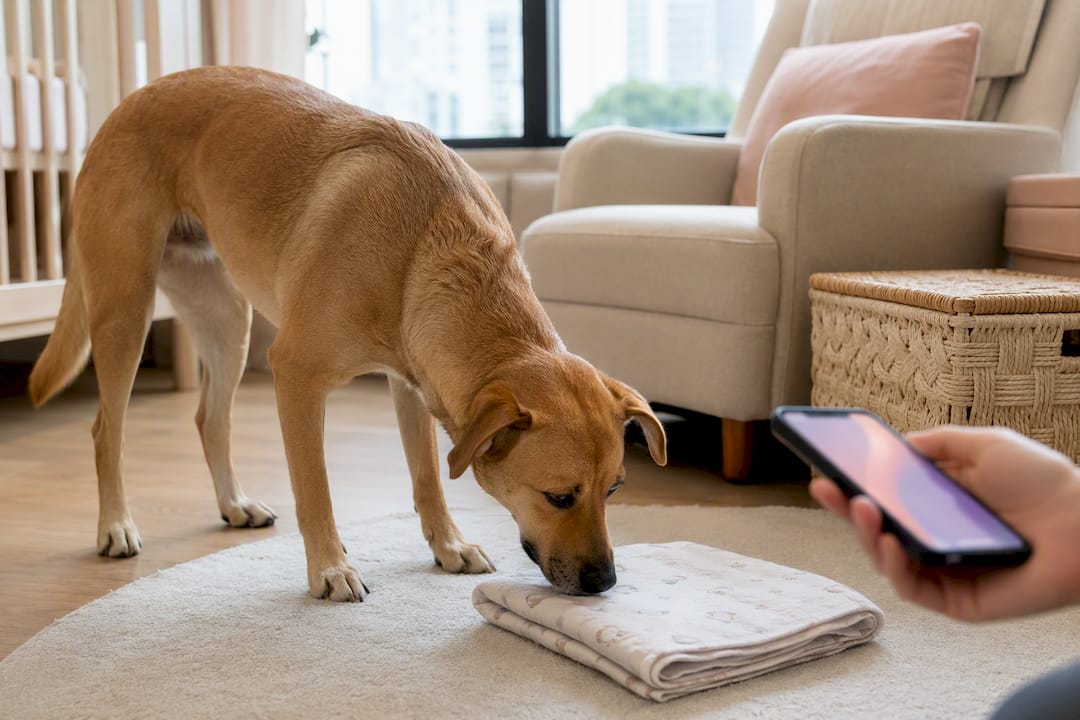
Scent works the same way. Ask a friend with a baby, or use baby lotion, powder, or a worn muslin cloth, and let your dog have a calm sniff, rewarded with a treat immediately after. Do this a handful of times a week rather than once and forgetting about it.
Bring home a hospital blanket or worn baby item before the baby itself, if your maternity unit allows it, so the very first proper introduction to that scent doesn’t coincide with a live, wriggling newborn.
Keep sessions short. Two or three minutes of calm exposure beats twenty minutes that ends in stress.
Watch for stillness, stiffening, or a fixed stare rather than relaxed curiosity, and end the session early if you see it.
A lifelike baby doll is worth the slightly odd experience of buying one. Practise carrying it, rocking it, and letting your dog observe from a distance, rewarding calm behaviour throughout. It gives you a genuine preview of how your dog is likely to react to a real infant, without any risk attached.
Pro Tip: Record actual newborn cries from a friend’s phone rather than relying on generic online clips. Real cries have odd pitches and pauses that generic recordings don’t quite capture, and your dog will notice the difference.
Which obedience skills does your dog need before baby arrives?
A dog that already has rock-solid basics gives you far more control on the days you’re running on no sleep and holding a baby with one arm. This is not the moment to be teaching a new cue from scratch; it’s the moment to make existing cues bulletproof under distraction.
Aim to have these five reliable before baby comes home:
Sit and down on the first ask, even with noise or movement nearby.
Stay, held for at least thirty seconds while you move around the room.
Recall, coming away from something interesting the instant you call.
“Place” or “go to your station”, sending your dog to its success station on command.
“Leave it”, dropping interest in an object or area immediately.
Short, frequent sessions work better than long ones. Brief sessions, repeated regularly through the day, build reliability faster than long, exhausting blocks and keep training realistic for busy final trimesters. University of Pennsylvania’s guidance backs exactly this approach, layering distraction gradually once the cue is solid in a quiet room.
Once the basics hold, add distraction on purpose:
Practise “stay” with the television or a baby monitor playing in the background.
Practise “place” while you walk past carrying a laundry basket or a bag of nappies.
Practise “leave it” with a dropped sock, then a dropped toy, then something more tempting.
If your dog struggles to hold any of these under mild distraction, or shows stiffening, growling, or snapping at any point during practice, that’s a clear signal to bring in a certified trainer rather than push through alone. Structured private obedience classes can get these cues solid far faster than trial and error at home, particularly if your dog is naturally anxious or has never needed this level of control before.
What is the safest way to introduce a dog to a newborn?
The first meeting deserves a proper plan, not an improvised moment on the doorstep with bags still in your hands.
Have two adults present if you possibly can. One handles the dog, calm and on a loose lead if there’s any doubt about excitement levels; the other holds the baby. Dogs Trust specifically recommends this two-person setup, because it means nobody is trying to manage an excited dog and a newborn single-handedly.
Let your dog greet the returning parent first, calmly, before the baby even enters the room. Dogs left alone for a hospital stay are often overexcited simply by everyone being home again.
Bring the baby in once your dog has settled. Keep your own body language loose and your breathing steady; dogs read tension in their people, and a relaxed tone genuinely helps lower a dog’s arousal, as noted by the American Kennel Club.
Let your dog approach at its own pace, on lead, for a brief sniff if it chooses to. Reward calm interest with a treat and a quiet “good”.
Never force it. Don’t hold the baby down towards the dog, don’t scold curiosity, and never prop a baby against a dog for a photo, a habit that PetMD explicitly warns against.
Keep the whole thing under a minute or two the first time. Short and calm beats long and tense.
If your dog turns away, tucks its tail, or won’t take treats, that’s your cue to end the session gently, no scolding, and try again later that day. A simple script helps in the moment: “That’s enough for now, good dog,” said in a warm, unhurried tone, followed by leading your dog to its success station for a chew or toy.
How should daily routines change once baby is home?
Your dog’s whole day has just been rearranged, whether it asked for that or not, so a deliberate new rhythm matters more than good intentions alone.
Walks are the easiest thing to lose and the first thing to protect. Even a shorter walk, scheduled at a consistent time, keeps your dog’s stress lower than an erratic routine where exercise happens only when you remember. Try to build in ten minutes of one-to-one time daily, even something as simple as a training refresh or a favourite game, so your dog doesn’t only experience you as “the person attached to the baby”.
Use the baby’s awake, alert periods deliberately. That’s often a good window to toss your dog a treat for staying settled nearby, building a genuine positive association between baby time and good things happening for the dog too, rather than baby time meaning being shut out entirely.
Gate the nursery so it stays a baby-only space, not a place your dog wanders into unsupervised.
Keep crate and pen rules consistent. If the success station means “settle here” at 7am, it should mean the same thing at 7pm.
Practise pram walks around the block before you actually need to manage one solo with a baby inside it.
Rotate two or three enrichment toys so your dog has something engaging during nappy changes or feeding, instead of learning that those moments mean being ignored.
Pro Tip: Keep a treat pot by the changing table. Every time you’re occupied with the baby, toss your dog a treat for lying calmly nearby. Within a couple of weeks, most dogs start settling there on their own, expecting the reward for calm rather than attention-seeking.
What supervision rules keep a baby and dog safe?
One rule sits above every other piece of advice in this guide: never, under any circumstances, leave your dog and baby alone together, even for the seconds it takes to answer the door or grab a nappy from another room.
“Active supervision” means more than being in the same room. Dogs Trust is clear that many incidents happen precisely when an adult is technically present but distracted, on the phone, half asleep, or absorbed in something else. Being mentally present, watching body language, and ready to step in within a second is the actual standard.
Fit stair gates at the nursery door and any room where the baby naps unattended.
Crate or pen your dog during nappy changes, feeding, or any moment your hands are fully occupied with the baby.
Answer the door with your dog already settled behind a gate, not loose and excitable while you’re distracted holding a newborn.
Never let your dog sleep in the same room as an unattended baby, even briefly.
Children under five are also at higher risk of serious dog bite injury than older children, largely because they cannot read canine warning signals the way an adult can, according to a parents’ guide on bite prevention. That’s precisely why the supervision burden sits entirely with you, not with the dog and not with the baby, right through toddlerhood.
What are the warning signs a dog is stressed around a baby?
Dogs rarely go from calm to snapping with no warning. They usually whisper first, and learning to hear those whispers is the single most useful skill in this whole process.
Early stress signals include:
Turning the head away or avoiding eye contact with the baby.
Lip-licking, yawning, or stiffening without an obvious reason.
Moving away repeatedly rather than choosing to stay nearby.
If those whispers are ignored, they can escalate into a low growl, a hard, fixed stare, or a snap. Every one of these deserves an immediate, calm response:
Separate dog and baby using a gate or door straight away, without shouting or scolding.
Secure the baby somewhere safe, then check your dog is genuinely calm before allowing any closer contact again.
Never punish growling or snapping itself. VCA Animal Hospitals warns that punishing these signals can suppress the warning without addressing the underlying stress, meaning the next escalation could come with no notice at all.
Book a professional assessment promptly, ideally with a trainer experienced in aggression and fear-based behaviour, rather than waiting to see if it resolves on its own.
If your dog has any history of resource guarding, fixating intensely on small moving things, or a previous bite, professional assessment isn’t optional; it needs to happen before any close contact resumes, as VCA’s guidance on infants and dogs makes clear. An aggressive behaviour consult gives you a structured, AVS-informed read on exactly what’s driving the behaviour rather than a guess. If growling around family members is a pattern you’ve noticed before baby even arrives, it’s worth reading up on why dogs growl at family members so you recognise the early signs long before there’s a baby in the room to worry about.
What does an AVS-accredited trainer actually recommend?
Twenty years of working with Singapore families and their dogs teaches you one thing above everything else: the dogs who struggle with a new baby are almost never “bad dogs”. They’re dogs whose owners ran out of time to prepare, or who missed the early whispers because nobody ever taught them what to look for.
Certain protocols come up again and again in successful households:
Build the success station habit at least two months early, using enrichment toys, never confinement as punishment.
Script your first-meeting phrases in advance: “Settle,” “That’s enough,” “Good dog,” said in the same calm tone every time, so your dog has predictable cues during an unpredictable week.
Treat any growl, stiffening, or avoidance as useful information, not defiance.
Consider board & train or an aggressive behaviour consult early if your dog has a bite history, guards resources, or shows fixation on movement, rather than waiting until the baby’s due date is close.
Patience matters more than perfection
Most families I’ve spoken with over the years expect the adjustment to happen in a weekend. It rarely does. Real settling in usually runs from a few weeks to a few months, and that’s normal, not a sign anything’s gone wrong.
What actually determines the outcome isn’t luck or a naturally “good” dog. It’s consistent supervision, early preparation, and a willingness to read your dog’s body language honestly rather than hopefully. Prevention sits with you, the adult in the room, every single time, not with the dog’s good nature and not with a baby too young to know any different.
If you’re seeing signs that worry you, growling, fixation, avoidance that doesn’t ease, don’t wait it out hoping it settles. A proper assessment early costs far less, in every sense, than a serious incident later.
— Mark
Get hands-on support before baby’s due date
Happy-dogtraining gives Singapore families a faster, more reliable route to a settled dog than working it out alone through trial and error, particularly when time before the due date is short. Where generic advice covers the basics, one-to-one sessions build the exact cues your household needs, sit, stay, place, leave it, until they hold under real distraction, not just in a quiet lounge room.
If your dog’s obedience already feels shaky, Private Obedience Dog Training Classes run at $200 per class and focus on exactly the reliability this guide describes. Families short on time before the due date sometimes prefer the immersive route instead: Board & Train starts from $700 per week and hands the groundwork over to a trainer entirely. If your dog has shown any growling, stiffening, or a bite history, an Aggressive Behaviour Consult, priced at $200 to $250 per session, gives you an AVS-informed assessment rather than a guess. Support is available after training to help with any follow-up questions. If you’re not sure which route fits, get in touch to book a consult and talk through your dog’s specific behaviour first.
Where this guidance comes from
Dogs Trust: behaviour charity guidance on preparing dogs for a new baby.
VCA Animal Hospitals: veterinary advice on infants and dogs.
PetMD: practical preparation steps reviewed by veterinary contributors.
Always check anything specific to your own dog’s health or behaviour with your vet.
Sources
FAQ
How long does it take for a dog to get used to a new baby?
Most dogs need somewhere between a few weeks and a few months to fully settle, depending on temperament, preparation, and how consistently routines are managed at home.
How soon should I introduce my dog to my baby?
Preparation should start months before the due date, with the actual first meeting happening calmly at homecoming, using two adults and a loose lead if there’s any uncertainty, as recommended by Dogs Trust.
At what age can babies interact with dogs?
There’s no fixed age when supervision can relax; children under five remain at higher risk of serious injury because they can’t yet read canine warning signs, so active adult supervision stays essential throughout early childhood.
What should I do if my dog snaps at my baby?
Separate them immediately with a secure barrier, keep the baby safe, and avoid punishing the growl or snap itself, then contact a vet or certified behaviourist for an assessment, as VCA Animal Hospitals advises. Happy-dogtraining’s aggressive behaviour consult offers exactly this kind of structured assessment if you need one quickly.
Recommended
Comments