Skip Off Leash Mistakes: AVS Aware, Force Free Recall for Singapore
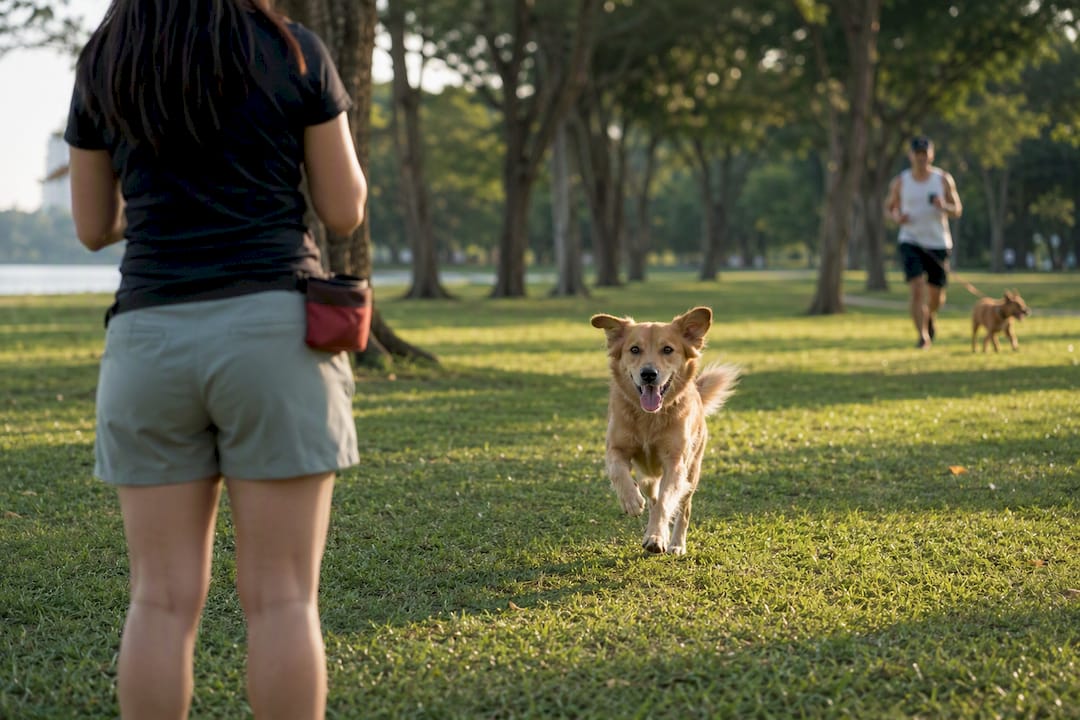
The safest way to enjoy off-leash time with your dog in Singapore is to build recall progressively, using a long line and contained spaces before ever unclipping the leash. Aim for high reliability, not perfection.
TL;DR:
Most dogs train reliable long-line recall within 4 to 8 weeks with consistent practice, but achieving off-leash confidence in busy areas can take several months.
Practice should start in low-distraction settings, gradually adding environmental challenges, and always in enclosed spaces to ensure safety.
Using a long line and rewards rotating between treats, toys, and praise helps reinforce recall; never call your dog for unpleasant reasons like ending playtime.
Choosing an accredited trainer through the AVS ACDT scheme or with recognized international credentials ensures humane and effective recall training.
Safe off-leash areas in Singapore include fenced dog runs and low-traffic parks, with site inspection and training during off-peak hours recommended for best results.
Table of Contents
What does reliable off-leash recall actually mean?
Reliable recall doesn’t mean your dog comes every single time, in every situation. It means your dog responds to your call in most everyday scenarios, including ones with real distractions like other dogs, joggers, or a stray chicken darting across the path at Pasir Ris Park.
Every recall attempt is a competition between two things: how rewarding you are and how rewarding the environment is. A dog that ignores you at the park hasn’t forgotten its training. The squirrel, the ball, or the other dog is simply winning that moment. This is why training that only happens in your living room falls apart the second you step outside.
Proofing is how you close that gap. It means practising recall around gradually harder distractions, always in a setup where you control the outcome. Instead of hoping your dog listens at the beach on day one, you build up through calmer, contained locations first. The RSPCA’s recall guidance frames this well: start low-distraction, then add difficulty in layers, never all at once.

How do you train off-leash recall step by step in Singapore?
You don’t need a large property or a rural training ground to build solid recall. You need consistency, the right equipment, and a realistic sequence. Here’s the plan we use as a foundation with clients across Singapore.
Start indoors with the follow-me game. Call your dog’s name, mark the moment they look at you, and reward at your legs. Keep sessions to 3 to 4 minutes so your dog stays engaged rather than bored.
Move to a 6-metre leash in a quiet outdoor spot. Void decks, quiet corridors, or your own garden work well. Reward generously every time your dog checks in or responds to their name.
Graduate to a long line, 15 to 30 metres. This gives your dog the feeling of freedom while you retain physical control. Practise in a fenced dog run or an enclosed field where the line can run freely without snagging.
Layer in proofing distractions gradually. Start with stationary distractions (a person sitting still), then novel scents, then moving stimuli like a jogger passing at a distance, then live play with another calm dog. Only move up a level once your dog is responding reliably most of the time at the current level. This benchmark comes from RSPCA best practice, and it’s a useful gut check before you even think about dropping the leash.
Practise the release ritual. Recall, reward, clip the leash back on, then release to play again. This stops your dog associating “coming when called” with the fun ending, which is one of the most common reasons recall quietly falls apart.
Rotate your rewards between food, toys, and praise so your dog doesn’t get bored of the same treat, and always use a well-fitted harness rather than a collar on the long line to avoid neck strain if they hit the end of it at speed.
Pro Tip: Never call your dog for something they dislike, such as ending a play session or a bath. If “come” always predicts something unpleasant, your dog learns to tune it out fast, and that’s incredibly hard to undo.
Where can you safely practise off-leash exercise in Singapore?
Site selection matters just as much as the training itself. A brilliant recall plan falls apart fast in the wrong environment.
Choose fenced dog runs or enclosed spaces first, such as designated dog runs within larger parks, where an escape route to a busy road simply doesn’t exist.
Walk the area before you bring your dog. Check fence lines for gaps, note any water features, and identify where cyclists or joggers are likely to appear.
Never practise near roads or car parks, however quiet they look. A single missed recall near traffic is not a risk worth taking.
Watch for wildlife triggers common in Singapore’s green spaces, including monkeys, monitor lizards, and other dogs off-leash nearby, all of which can spike arousal and tank your dog’s response rate.
Keep sessions short and frequent rather than long and infrequent. Ten focused minutes, three times a week, beats one exhausting hour-long session.
Train during off-peak times when parks are quieter. Early mornings on weekdays are usually your best window.
Always give your long line enough clearance to run without wrapping around legs, branches, or other dogs.
These principles line up closely with the Guidelines for Dog Training and Behaviour Rehabilitation developed by AVS and the Rehabilitation and Welfare Group, which encourage safe, low-stress environments as the foundation of good training rather than an afterthought.
How do you choose a qualified dog trainer in Singapore?
If recall training stalls, or your dog shows signs of fear or reactivity that make outdoor practice feel unsafe, bringing in a professional is the sensible next move. Not every trainer in Singapore works the same way, though, so it pays to check credentials before you book anything.
Look for accreditation under the AVS ACDT scheme, launched in December 2022 as a national competency benchmark, or recognised international certifications alongside a clear LIMA (least intrusive, minimally aversive) approach.
Ask for a written training plan, not just a verbal promise, along with evidence of the specific methods they’ll use for your dog’s issue.
Request references from past clients with similar recall or behaviour challenges.
Treat heavy reliance on aversive tools without explanation as a red flag, especially if the trainer can’t tell you why a method is being used or how progress will be measured.
Be wary of anyone offering no follow-up support once formal sessions end. Behaviour work, especially recall, needs maintenance.
Pro Tip: Ask a prospective trainer how they’d handle a dog that “shuts down” or becomes fearful mid-session. Their answer tells you more about their actual approach than any certificate on the wall.
Why does my dog’s recall keep failing?
When recall breaks down, it’s almost always one of four things: a motivation gap, a proofing gap, a change in environment, or the classic adolescent phase (roughly 6 to 18 months) where dogs test boundaries hard.
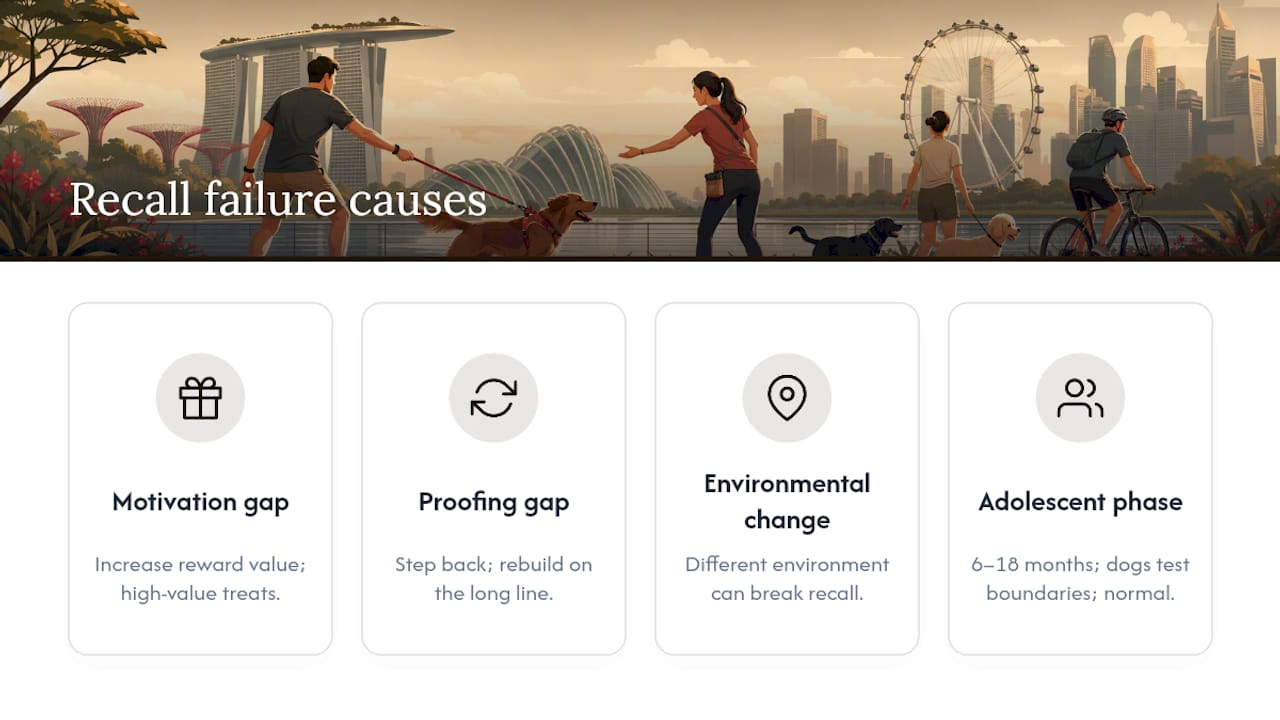
If your dog is ignoring you, increase your reward value before anything else. Boring treats lose to interesting smells every time. If the gap is proofing, step back a level and rebuild on the long line rather than pushing forward and hoping for the best.
Adolescent dogs often need a temporary return to earlier stages, even after strong recall as a puppy, and that’s normal rather than a sign you’ve failed. If recall failures come with growling, lunging, or signs of fear rather than simple distraction, that’s no longer a training gap. It’s a behavioural one, and it’s worth booking a proper consult before more off-leash attempts.
What we’ve learned training recall with Singapore dogs
Most dogs we work with reach dependable long-line recall within 4 to 8 weeks of consistent practice, though true off-leash confidence in busier spaces often takes a few months longer. Recall isn’t a skill you “finish”. It needs occasional top-ups for life, the same way your own driving skills would fade without practice.
The dogs that progress fastest are rarely the “easiest” ones. They’re the ones whose owners stay patient through the adolescent wobble and resist the urge to test off-leash freedom too soon in a high-risk spot.
— Mark
Get hands-on help building your dog’s off-leash confidence
If you’ve worked through the steps above and progress has stalled, or you’d rather skip straight to expert guidance, Happy-dogtraining offers what most owners can’t get from a park meetup or a video guide: a certified, AVS-accredited trainer with over 20 years of experience building a plan around your specific dog, backed by free lifetime support once training ends.
For most recall and obedience goals, private obedience dog training classes at $200 per class give you focused, one-to-one sessions tailored to your dog’s pace. If you want faster, more structured progress, Intensive Obedience Plus at $2,500 packs the proofing stages into a concentrated programme. Owners who prefer full immersion can consider Board & Train, from $700 per week. All training follows humane, science-based methods designed to build trust rather than fear. Book a consultation to talk through your dog’s specific recall challenges and find the right starting point.
Sources
FAQ
Is 100% off-leash recall realistic for any dog?
No. Even well-trained dogs are not guaranteed to respond every single time, which is why RSPCA guidance recommends aiming for strong reliability on a long line before attempting off-leash trials. Realistic expectations, paired with sensible site choices, matter more than chasing perfection.
How long does it take to train reliable recall?
Most dogs reach dependable long-line recall within 4 to 8 weeks of consistent, short practice sessions. Off-leash confidence in busier or more distracting spaces typically takes longer and needs ongoing reinforcement rather than a one-off course.
What is the AVS ACDT scheme and why does it matter?
The AVS ACDT scheme, launched in December 2022, is Singapore’s competency benchmark for dog trainers, recognising accreditation through established international bodies. Choosing an ACDT-recognised or similarly accredited trainer is one of the clearest ways to check a trainer’s standards before booking.
Where can I safely let my dog off-leash in Singapore?
Fenced dog runs and enclosed, low-traffic spaces are the safest options, ideally scouted in advance for escape routes and hazards. Avoid anywhere near roads, and choose off-peak times when parks are quieter.
How much does professional recall training cost with Happy-dogtraining?
Private obedience classes are $200 per class, while the more intensive Intensive Obedience Plus programme is $2,500 as a one-off package. Current pricing for all programmes, including Board & Train, is listed on the Happy-dogtraining website.
Recommended
Comments