1 Hour per Month Rule for Puppies: Apartment Toilet Training in Singapore
The winning approach is frequent, scheduled trips to one consistent toilet spot, paired with close supervision or crate management between outings. Use the age-based rule of one hour of bladder control per month of age as your timing guide, and never punish accidents. Happy-dogtraining has spent over 20 years refining this exact routine for Singapore’s flat and condo dwellers.
TL;DR:
Puppies need frequent toilet trips, with intervals increasing from about 1.5 hours at 8 weeks to around 4 hours after 5 months.
Always schedule trips immediately after waking, eating, drinking, or play to catch triggers, not waiting for signals.
Use indoor pads or turf near the door to reinforce the outdoor route, gradually moving them closer to remove dependence over time.
Confinement with a crate scaled to the puppy’s size and supervised space prevents indoor accidents and reinforces training routines.
Consistency in route, timing, and positive reinforcement significantly impact success, with most puppies house-trained between four and six months.
Table of Contents
Puppy toilet training apartment basics: timing and triggers
Your puppy’s bladder has a rough shelf life based on age, with a young puppy holding for shorter periods increasing gradually as they grow. However, apartment living constraints can make holding times effectively shorter.
Corridors, lifts, and stairwells add minutes your puppy’s bladder doesn’t have. Whole Dog Journal points out that the travel time between your door and an outdoor spot is often the single biggest obstacle in flat living, frequently longer than a young puppy’s warning window allows.
Watch for the moments that reliably trigger the urge, rather than waiting for a signal that may never come:
Right after waking up, even from a short nap
Within 10 to 15 minutes of eating or drinking
Immediately after a burst of play or excitement
Quick reference: Younger puppies need frequent toilet trips with intervals increasing as they age; design your schedule around this need rather than convenience.
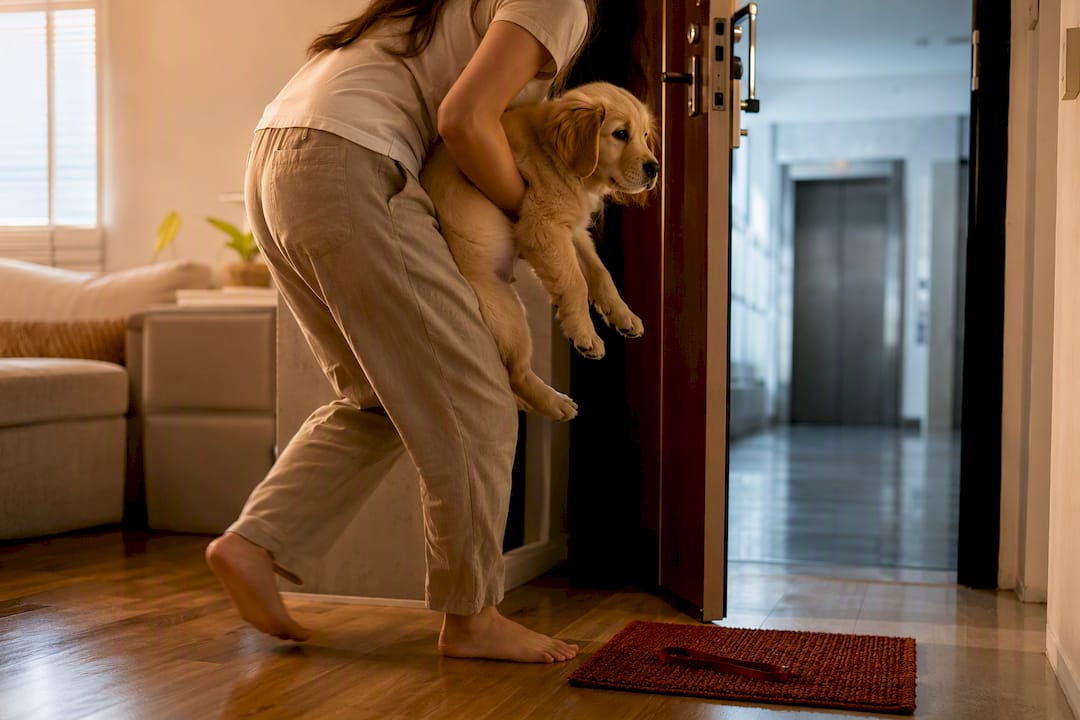
Because a lift ride can cost you two or three minutes you don’t have, carrying your puppy to the door the moment you spot a trigger is often the difference between success and a mopping session.
A realistic weekday and weekend routine
A schedule only works if it survives contact with real life, so build one around your puppy’s age first, then bend it around your job.
8 to 12 weeks: toilet trips every 1.5 to 2 hours while awake, plus straight after every nap, meal, and play session. That’s roughly eight to ten trips a day.
3 to 4 months: stretch to every 2.5 to 3 hours, with the same non-negotiable trips after sleeping, eating, and playing.
5 months and older: most puppies manage 4-hour gaps, dropping to five or six trips daily.
Night-time needs its own plan. Keep the crate in your bedroom for the first few weeks so whimpering wakes you before an accident happens, and take a final toilet trip right before lights out. Expect at least one night wake-up for puppies under 12 weeks.
Working full days is the real test of an apartment routine. If nobody can get home at lunchtime, arrange a dog walker or a trusted neighbour for a midday trip, or fall back on a temporary indoor pad as a bridge, never as a permanent fixture. Preventive Vet recommends planning these trips around predictable triggers rather than gambling on your puppy signalling in time, since young dogs often can’t hold on long enough to warn you.
Indoor potty options without creating permanent confusion
Pee pads, balcony grass patches, and artificial turf trays all solve the same short-term problem: your puppy needs somewhere to go when the lift is stuck or the weather turns. Used correctly, none of them derail outdoor training. Used carelessly, they can.
Pee pads: keep one pad in a fixed spot near your main exit door, never moved around, so the location itself becomes part of the cue.
Balcony or terrace turf: works well for taller buildings; hose it down daily and use a sealed waste bin to manage odour before it becomes a neighbour complaint.
Grass patches: AKC suggests real sod trays as a closer substitute for outdoor grass, which can make the eventual switch to pavement or park grass smoother.
Pro Tip: Place the indoor option directly on the route to your front door, so every trip, indoor or outdoor, reinforces the same path and habit.
If your goal is outdoor-only toileting, phase the indoor option out gradually: move the pad a little closer to the door each week, shrink the surface area, then remove it entirely once outdoor trips are consistent. Trainers often warn that pads left in place too long can slow this transition rather than speed it up.
Managing a small space: crates, pens and supervision
A crate sized so your puppy can stand, turn, and lie down, no more, prevents them from using one corner as a bathroom while sleeping in another. Use the divider panel most crates include to shrink the space as a young puppy grows, rather than buying a new crate every few months.
Crate sessions should roughly match your puppy’s current bladder capacity, never longer.
A playpen, baby gate, or a short lead tethered to you gives supervised freedom without the risk of them sneaking off to a hidden corner.
After every successful outdoor or designated-spot elimination, reward with supervised free roaming time for 15 to 20 minutes as reinforcement.
Confinement isn’t a punishment, it’s prevention. Pets Best notes that stopping a puppy from rehearsing indoor accidents is far easier than reversing a habit that’s already formed. A home training space set up properly with a crate, pen, and clear boundaries does most of this work for you before training even starts. If you’re still puppy proofing before pickup day, this puppy-proofing checklist covers the supply gaps most new owners miss.
Your week-by-week plan
Progress happens in stages, and each stage has a clear checkpoint before you move on.
Week 1: observe and record. Log every toilet trip and accident, run a strict schedule based on age, introduce the crate as a calm resting space, and reward within seconds every time your puppy finishes in the right spot.
Weeks 2 to 3: start stretching the interval between trips by 15 to 20 minutes at a time if two days pass without an accident. Introduce a cue word, like “toilet,” said calmly just before they go, so it becomes a request later on.
Week 4 and beyond: after two consecutive accident-free weeks, expand supervised indoor freedom room by room rather than all at once.
Checkpoints to track progress:
Fewer than one accident per week by the end of week 3 signals real progress.
No accidents for 14 straight days before removing the crate divider or extending free-roam time.
Repeated accidents in the same spot despite a consistent schedule, or sudden regression after weeks of success, are red flags worth raising with a vet to rule out a urinary infection.
Most puppies become reliably house-trained between four and six months with this kind of consistency, though smaller breeds often need longer.
Accidents, cleaning and correction
Catch your puppy mid-accident and interrupt with a calm, neutral sound, not a shout, then scoop them up and carry them straight to the correct spot. Praise warmly the moment they finish there, even if most of the accident already happened elsewhere.
Interrupt calmly, redirect immediately, praise only once they finish in the right place.
Clean with an enzymatic cleaner, never an ammonia-based one, since ordinary cleaners fail to break down the uric acid crystals that keep drawing your puppy back to the same spot.
Skip the scolding entirely. Pets Best is clear that punishment doesn’t teach where to go, it just teaches a puppy to hide when they need to.
Scolding after the fact rarely changes future behaviour and can make a puppy anxious about eliminating in front of you at all, which slows training rather than speeding it up.
Troubleshooting: marking, crying and small-breed pacing
Marking looks like house soiling but isn’t the same problem. Small, frequent squirts on vertical surfaces, especially in unneutered males, point to marking rather than a training gap, and usually respond better to management and, where appropriate, addressing the underlying trigger than to more toilet trips.
Night-time crying: check if it’s a genuine toilet need first, then resist rushing in with cuddles that reward the noise itself; a quiet, brief trip out and straight back to bed works better for neighbours and for training.
Small breeds: expect a longer timeline and smaller bladders relative to their size, meaning more frequent trips than a larger puppy the same age.
Slow progress overall: revisit whether the schedule matches current age, since a puppy’s capacity changes every few weeks.
Trainer tips from Happy-Dog Training
Route consistency matters more in high-rise living than almost anywhere else: the same door, same lift or stairwell, same outdoor spot every single time removes the guesswork your puppy would otherwise have to solve alone.
Reward within seconds of your puppy finishing, not after you’ve both walked back inside.
Keep a lead on young puppies even indoors during transition periods, so you can move them the instant you see a trigger.
If you’re booking professional help, ask about session format, how progress is measured, and what follow-up support looks like afterwards.
Pro Tip: Ask any trainer you’re considering whether they offer free lifetime support after the programme ends, not just during it. Happy-dogtraining’s AVS-accredited trainer has spent two decades building humane, reward-based programmes for exactly this kind of apartment household.
A trainer’s perspective on the setbacks
Patience matters more than any single technique here. Most puppies genuinely do respond within a few weeks once the schedule matches their age and the environment stays consistent, and a setback in week three doesn’t mean the plan has failed. If progress stalls for more than two or three weeks despite a solid routine, a session with a qualified trainer, ideally one running a structured, AVS-approved programme, usually uncovers the one small gap that’s been holding things back.
— Mark
Sources
Recommended
Comments