Weeks, Not Days: Manage Redirected Aggression in Dogs — Singapore Owners
Redirected aggression happens when your dog is highly aroused by something they can’t reach, so that frustration spills onto whoever or whatever is nearest, often you, another dog, or a lead. The single most important rule is simple: never reach in or grab a dog mid-arousal. Create distance, use a barrier, and let the emotional spike settle before you do anything else. Persistent cases usually need professional behaviour support and a veterinary check.
TL;DR:
Redirected aggression is often triggered by barriers or restraint that prevent a dog from reaching a target, causing frustration to spill onto nearby subjects.
Recognizing early warning signs such as yawning, stiffening, or intense staring allows owners to intervene safely before escalation.
Managing triggers through environment control, positive reinforcement, and professional desensitization reduces the risk of recurrence over time.
A veterinary check is crucial to rule out medical issues like pain or hormonal imbalances that could lower a dog’s threshold for aggressive responses.
Proper assessment by specialists involves history, video analysis, and threshold testing to develop a tailored and humane management plan.
Table of Contents
Common scenarios where redirected aggression in dogs shows up
The safe way to step in during a redirected aggression incident
Long-term training to prevent redirected aggression from recurring
What happens during a professional assessment for redirected aggression
How Happy-dogtraining helps you manage redirected aggression safely
Common scenarios where redirected aggression in dogs shows up
Redirected aggression rarely appears out of nowhere. It follows a build-up, and that build-up tends to happen in a handful of predictable situations. Once you know the patterns, you’ll start spotting the warning signs long before things boil over.
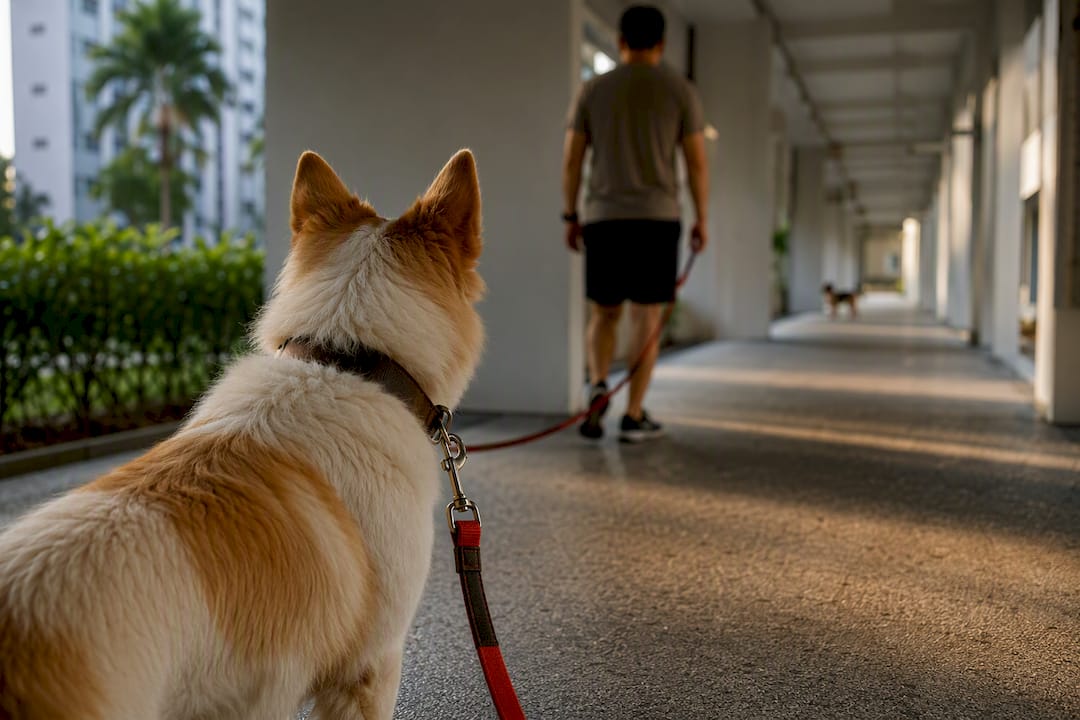
The classic trigger is an on-lead encounter with another dog. Your dog wants to greet, chase, or challenge the other animal, but the lead physically stops them getting there. That thwarted intent has to go somewhere, and it often lands on you, the nearest hand holding the lead.
Fence-line and barrier frustration works the same way. A dog pacing along a fence, barking at a passing dog or person, is building arousal with nowhere to release it. If another dog in the household wanders past at the wrong moment, the redirected snap can land on them instead.
Interrupted dog-on-dog interactions are another common flashpoint, particularly in multi-dog homes. Two dogs mid-play or mid-scuffle get physically separated by an owner, and one of them, still flooded with adrenaline, turns on the nearest body.
Resource interruptions belong on this list too, though they overlap with resource guarding. A dog fixated on a squirrel or a toy that gets snatched away can flip aggression onto a housemate who happens to be standing close by.
Two dogs barking at a passer-by through a fence, then turning on each other
A lead-reactive dog snapping at the owner’s hand after being blocked from approaching another dog
A dog interrupted mid-chase redirecting onto a nearby sibling dog
A dog fixated on wildlife through a window suddenly nipping a person who touches them
Each scenario shares the same shape: high arousal, blocked access to the real target, and a nearby substitute. Recognising your own dog’s specific triggers is the first real step towards prevention.
What actually causes a dog to redirect their aggression
Redirected aggression is a physiological event as much as a behavioural one. Think of arousal as building in a bucket. Stress, excitement, frustration, even joy, all add to the same pool, and once that bucket overflows, the response that comes out often has nothing to do with the thing that filled it. Redirected aggression occurs when a dog becomes highly aroused or frustrated by a target they cannot reach, and the aggression spills onto whatever is nearest. It’s widely considered one of the most common ways owners end up bitten by their own dogs, precisely because the dog isn’t targeting the person at all.
Several factors commonly tip a dog over that threshold:
Restraint: a lead, harness, or a hand holding the collar during a heated moment
Physical barriers: fences, doors, windows, or crates blocking access to a trigger
Sudden interference: an owner grabbing or pulling a dog away mid-reaction
High-value resources: food, toys, or a mate being contested or removed
Pain or illness: a sore joint or underlying medical issue lowering the threshold for tolerance
There’s a reinforcement trap hiding in all of this too. Every time a redirected outburst successfully ends the pressure, whether the trigger leaves, the lead goes slack, or the interruption stops, the dog’s brain quietly files that response as useful. Behaviour experts note that each successful redirected outburst reinforces the behaviour through exactly that kind of relief, which is why the same situation tends to produce the same reaction the next time round, and often with less provocation needed.
Pro Tip: Keep a simple log of when redirected reactions happen, noting the time of day, what your dog was watching, and how long the arousal had been building. Most owners find a clear pattern within a week or two.
How to spot the warning signs before things escalate
A dog rarely goes from calm to redirected aggression in a single leap. There’s almost always a sequence, and if you know what to watch for, you can step in early, safely, and without ever needing to touch your dog mid-reaction.
Calming signals appear first. Yawning, lip-licking, sniffing the ground, or turning the head away are your dog’s own attempts to defuse tension. These subtle signals typically precede escalation, so catching them early buys you time.
The body stiffens. Watch the tail, the shoulders, the weight distribution. A dog shifting their weight forward, tail held high and rigid, has moved past casual alertness.
The stare locks on. An intense, fixed gaze at the trigger, sometimes with the mouth closing and breathing slowing, signals the dog is nearing their limit.
Vocalisation intensifies. Barking shifts pitch, growling starts, or whining becomes frantic. This is close to the danger zone.
Redirection occurs. The nearest body, hand, or dog takes the hit.
Practical observation matters as much as theory. Stand slightly off to the side rather than directly behind your dog on a lead, keep your own posture low and relaxed rather than tense, and avoid crowding your dog’s space when you sense arousal climbing. A dog trainer once described it to me as reading the weather before the storm, and the analogy holds: by the time you hear thunder, it’s too late to change your plans.
The safe way to step in during a redirected aggression incident
Once arousal has tipped into redirected aggression, your job is damage limitation, not correction. This is not the moment for training. It’s the moment for distance, calm, and a clear head.
The golden rule is this: never reach in or grab a dog mid-outburst. Hands and faces are exactly what gets bitten in these moments, and the dog isn’t being deliberately aggressive towards you, they’re simply discharging arousal onto whatever’s closest. If a second handler is available, both people should step back and increase distance rather than physically separating the dogs by hand.
Increase distance immediately, using your body position or a lead to move away calmly
Use a physical barrier, a door, a gate, or even a jacket dropped between dogs, rather than hands
Try a sudden noise or visual interruption, such as a clap or stepping into the dog’s line of sight, to break focus without touching
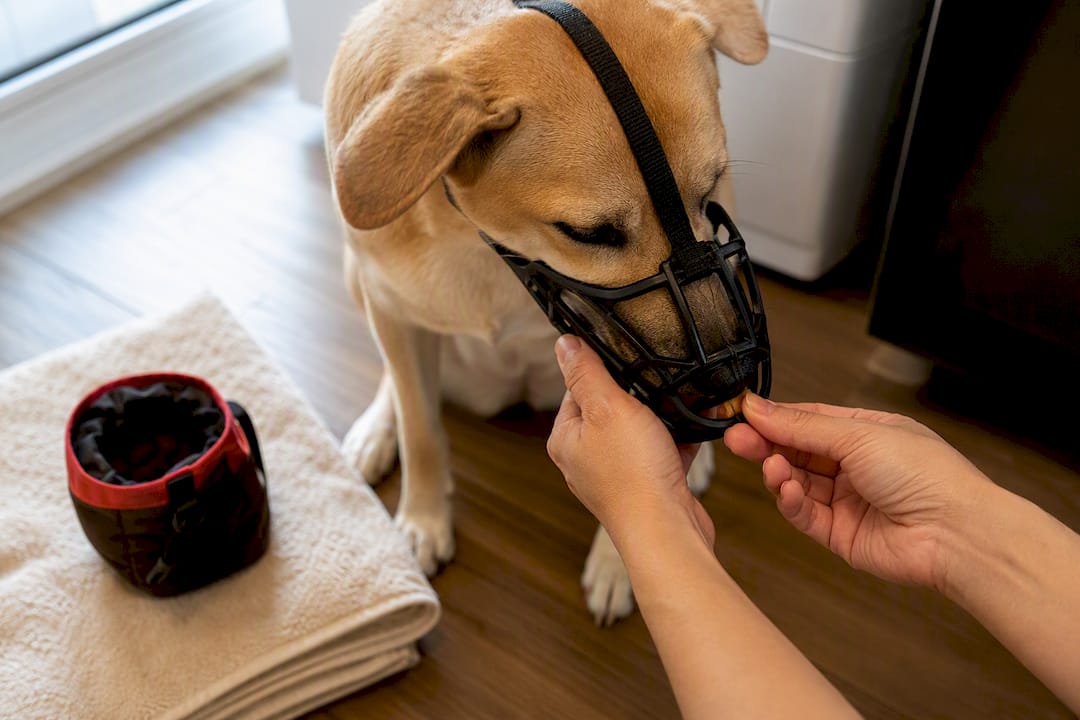
Consider a properly fitted basket muzzle for high-risk situations, introduced gradually through positive association well before it’s ever needed
Adjust your walking routes to avoid known trigger zones, particularly narrow paths or fence lines with reactive neighbours
Use visual barriers at home, such as frosted window film or repositioned furniture, to reduce fence-line and window-triggered arousal
Environment-first management, removing or controlling access to triggers, is the recommended foundation for any redirected aggression case, precisely because it stops the behaviour being rehearsed in the first place. Practitioners increasingly treat proactive muzzle training and gating not as punishment, but as tools that make safe assessment and training possible in the first place.
Pro Tip: Fit and reward the muzzle at home during calm, low-stakes moments, pairing it with treats and short wear times, well before you ever need it for a real trigger. A muzzle introduced only during a crisis will just add fear to an already tense situation.
If your household has more than one dog, separate them by room or crate immediately after any redirected incident, and keep them apart until everyone, dogs included, has genuinely settled. Reintroducing dogs too soon, while adrenaline is still high, is one of the most common ways a single incident turns into a repeated pattern.
Long-term training to prevent redirected aggression from recurring
Managing the environment stops the immediate risk, but it’s not a fix on its own. Long-term change comes from systematically lowering your dog’s arousal around specific triggers, and that work is genuinely well studied.
Desensitisation and counterconditioning form the backbone of most credible plans. Your dog is exposed to a controlled, low-intensity version of the trigger, far enough away that they stay calm, while something genuinely good happens, usually high-value food. Over repeated, carefully staged sessions, the trigger stops predicting frustration and starts predicting reward. The distance shrinks gradually, session by session, never in a rush.
Engagement-disengagement and BAT (Behaviour Adjustment Training) approaches build on the same principle but add a functional reward: the dog gets to look at the trigger, then look away, then move further from it, as the reinforcement. These constructional methods teach a replacement behaviour rather than simply suppressing the old one.
The concept holding all of this together is working below threshold. Practitioners warn that attempting to train while a dog is already over threshold is counterproductive; the dog physiologically cannot learn in that state. Every session needs to start at a distance or intensity where your dog can still notice the trigger and still take a treat calmly.
Start every session far enough away that your dog stays relaxed and responsive
Reward calm behaviour, not just the absence of reaction
Increase difficulty in small increments, never jumping straight to full exposure
Keep sessions short, ending before arousal starts climbing
Track a threshold management plan over weeks, not days
Punishment has no place in this process. Shouting, leash corrections, or physical punishment during a reactive moment adds stress on top of an already overloaded system, and stress is precisely what fuels redirected aggression in the first place. It tends to suppress the warning signs, too, the growl or stare that would otherwise give you fair notice, which makes the dog more unpredictable rather than less.
Pro Tip: If your dog can’t take a treat calmly, you’re too close to the trigger. That’s not a training failure, it’s useful information telling you exactly where to reset the distance for next time.
Getting this staging right without accidentally flooding your dog is genuinely difficult to judge alone, which is why most credible plans, ours included, involve professional guidance rather than a one-size-fits-all worksheet.
Why a veterinary check matters before you start training
Physical health shapes behaviour more than most owners expect. A dog in chronic pain, from arthritis, a slipped disc, or dental disease, has a permanently lower tolerance for stress, and that alone can turn an ordinary frustrating moment into a redirected outburst. A veterinary examination is essential to rule out medical drivers such as pain, neurological conditions, or hormonal imbalances before behaviour work begins in earnest.
Chronic pain conditions, including arthritis and dental disease
Neurological issues, such as certain seizure disorders
Hormonal imbalances, including thyroid dysfunction
Sensory decline, particularly reduced hearing or vision in older dogs
Vets and behaviourists typically work as a team on these cases. The vet rules out or treats underlying medical issues and may prescribe anti-anxiety medication where appropriate, while the behaviourist builds the desensitisation plan around that medical picture. Medication doesn’t replace training, but it can lower baseline arousal enough that a dog is actually capable of learning during sessions, rather than staying permanently over threshold. Any medication should be prescribed, dosed, and reviewed by a veterinary professional, never adjusted informally by an owner mid-programme.
Redirected aggression and reactivity are not the same thing
These two terms get used interchangeably, and that mix-up leads owners towards the wrong fix. Reactivity describes an exaggerated response, barking, lunging, growling, aimed directly at the actual trigger: the dog on the other side of the street, the visitor at the door. Redirected aggression is what happens when that same aroused dog can’t reach the real trigger and turns on something else entirely, often something completely unrelated to the original problem.
Reactivity: aimed at the real trigger, however excessive the response
Redirected aggression: aimed at a substitute target because the real one is inaccessible
Overlap: a highly reactive dog on a lead is at far greater risk of redirecting than a calm one
A reactive dog can absolutely become a redirected-aggression case the moment a barrier or lead blocks their path. That’s precisely why clinical behavioural guidance frames redirected aggression as a distinct displacement pattern rather than folding it into general reactivity. Treating the two as identical means a plan built purely around the visible trigger, when the actual fix needs to focus on lowering arousal and managing access, not just exposure to the thing your dog reacts to. Getting the diagnosis right changes where the training effort goes.
What happens during a professional assessment for redirected aggression
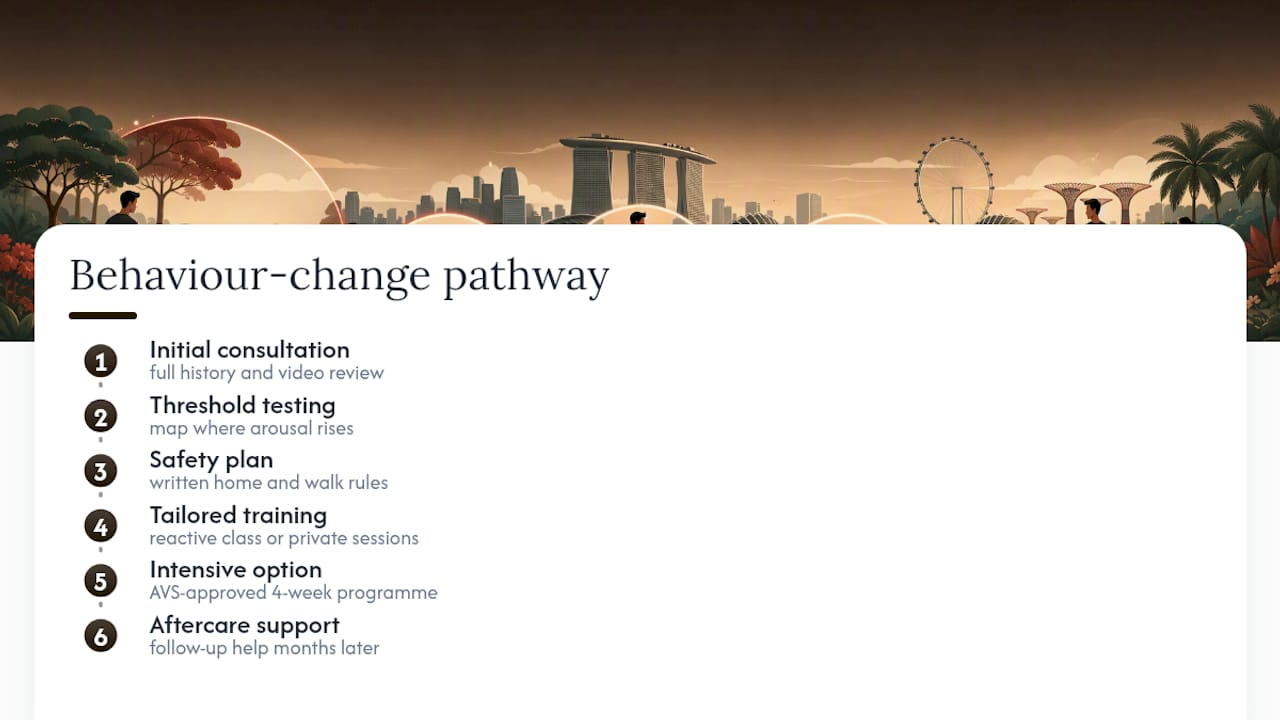
A proper assessment starts with history, not exercises. A trainer working through a genuine redirected aggression case will ask detailed questions about when incidents happen, what precedes them, and how your household is set up, before ever asking your dog to do anything.
Video review has become a standard part of this process. Clinicians increasingly recommend documenting incidents on video where safely possible, since body language in the seconds before an outburst tells a trainer far more than a verbal description after the fact. From there, practitioners often run controlled, incremental threshold tests, gradually reintroducing a known trigger at a safe distance to map exactly where your dog’s arousal starts climbing, then build a written safety plan around that specific number.
At a first appointment, it’s worth asking a trainer directly how they measure threshold, what their plan looks like if your dog has already bitten someone, and whether they’ll coordinate with your vet if pain or a medical cause seems plausible. A trainer with real experience in this area, drawing on decades working with aggressive and fearful dogs, should have clear, specific answers to all three, not vague reassurance.
What owners can realistically expect over the coming weeks
Safety comes first, always, before any training begins in earnest. Get the management right, distance, barriers, muzzle training if needed, then layer in structured desensitisation once your dog is no longer being put in situations that rehearse the old pattern.
Progress with redirected aggression tends to be gradual and genuinely non-linear, so set your expectations around weeks and months, not days. A setback after a good run doesn’t mean the plan has failed. Punitive corrections will only add stress to a dog whose system is already primed to overreact, which makes things worse, not better.
If incidents are frequent, if a bite has already happened, or if you’re simply unsure how to read your dog’s signals, that’s the point to bring in professional support and a veterinary review rather than pushing on alone.
— Mark
How Happy-dogtraining helps you manage redirected aggression safely
You don’t have to work this out from a blog post and a lot of hope. Specialist trainers have spent many years building behaviour plans for exactly this kind of case, using humane, science-based methods rather than quick-fix corrections that tend to backfire on an already stressed dog.
A behaviour consultation with an accredited trainer starts with the same groundwork described above: a full history, video review where relevant, and threshold testing to map precisely where your dog’s arousal starts to climb. From there, you’ll get a written safety plan for home and walks, plus a structured desensitisation programme paced to your dog specifically, whether that runs through our reactive dog class or a private behaviour consultation. Owners with more urgent cases, including dogs already assessed as high-risk, often benefit from our AVS-approved intensive programme, a structured four-week course designed to move faster while staying below threshold throughout. Clients often receive support after training, so questions that come up months later can be addressed.
If your dog has redirected aggression towards you, another dog, or a visitor, book a behaviour consultation through Happy-dogtraining and get a proper safety plan in place before the next incident happens.
Sources
For deeper reading, the Today’s Veterinary Practice clinical review covers management protocols in depth, AKC’s expert advice explains medical drivers and treatment options, and Dogster’s guide offers practical, vet-verified owner tips. Always consult a veterinary professional for an individual diagnosis.
Recommended
Comments