Resource guarding in dogs: what it means and what to do
- Mark McDade
- 3 hours ago
- 16 min read
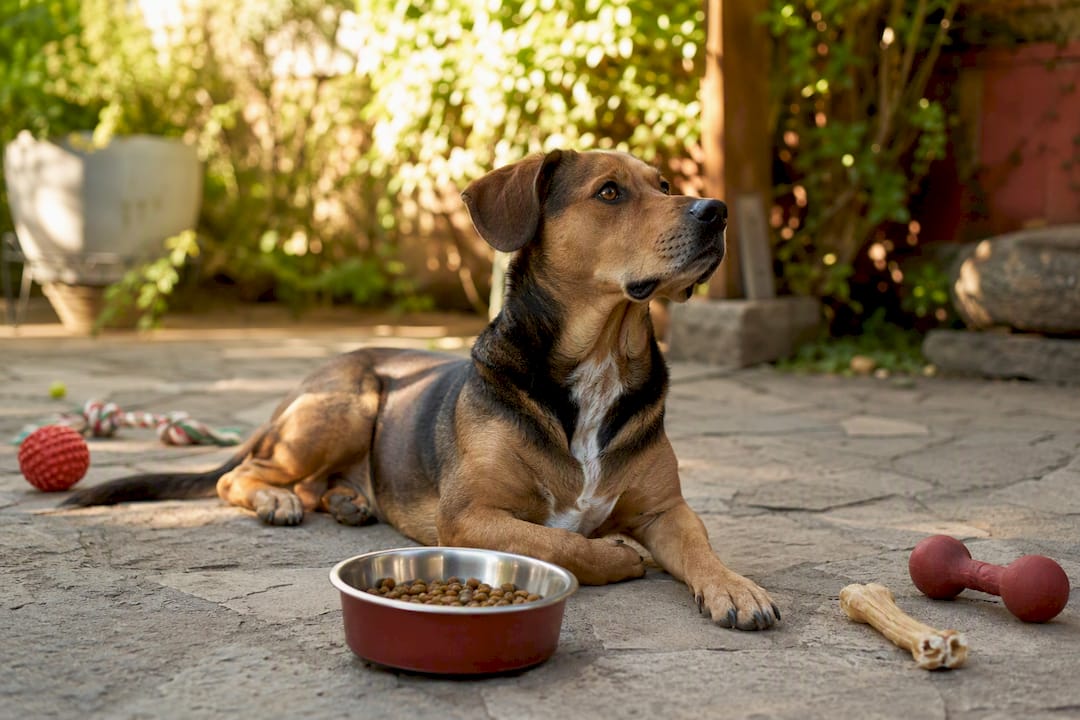
Resource guarding is a fear-driven habit where a dog uses stiffening, growling, or biting to protect food, toys, or space from a perceived threat. The moment you spot it, step back, don’t reach for the item, and stop confronting the dog. Put simple management in place today: separate feeding, remove obvious triggers, and keep children away from the dog when it has something valuable. From there, a mix of force-free training and, for anything serious, a vet or qualified behaviourist gets you to a safer household.
TL;DR:
Resource guarding is rooted in insecurity, often stemming from past experiences, and is typically a learned response rather than dominance.
Early warning signs include freezing, stiff body posture, whale eye, and rapid eating, which can escalate to bites if ignored.
Management strategies such as separate feeding, securing high-value items, and avoiding territorial triggers can significantly reduce risks immediately.
Training with desensitisation and counterconditioning, starting at the dog’s threshold distance, effectively rewires its response to approaching people or pets.
Professional help should be sought if the dog bites, guards a person, or if guarding escalates or appears suddenly, with vets ruling out medical causes first.
Table of Contents
What is resource guarding in a dog, and why does it happen?
A resource-guarding dog isn’t being naughty, stubborn, or “dominant” over you. It’s protecting something it genuinely believes it might lose, and that belief comes from insecurity, not a power struggle. This distinction matters because owners who treat guarding as defiance often reach for punishment, which tends to make the behaviour worse rather than better.
The instinct itself is ancient. Wild canids that failed to defend a meal from competitors didn’t survive to pass on their genes, so a baseline wariness around valuable items is baked into the species. Domestication has softened that instinct considerably, but it hasn’t erased it, and individual dogs vary enormously in how strongly it surfaces.
What tips a dog from “mild wariness” into full guarding is usually a combination of temperament and learning history. A dog that has genuinely gone hungry, competed with littermates for a food bowl, or had toys snatched away by a well-meaning owner as a puppy can learn that people approaching valuable items means loss is coming. Once that association forms, growling or snapping becomes a rational (if unwanted) strategy that works, because it usually makes the “threat” back off.
Food aggression in dogs is the most commonly reported form, but object guarding in dogs takes several distinct shapes:
Food guarding: tensing over the bowl, eating faster when approached, or growling if a hand comes near the dish.
Toy or chew guarding: dogs guard toys and chews with particular intensity because these items take effort to “win” and can’t simply be replaced from a cupboard.
Space guarding: some dogs defend a bed, crate, or favourite sofa spot, growling if a person or another animal comes too close.
People guarding: less common but serious. A dog treats a person as a resource and becomes tense or snappy when another dog or person approaches that person.
Scavenged-item guarding: a sock, a tissue, or a bit of rubbish pulled from the bin often triggers fiercer guarding than a normal toy, because the dog senses it’s about to be told off and removed.
Recognising which category (or categories) your dog falls into shapes the whole training approach later, because a dog that only guards chews needs a very different management plan from one that guards its person.
How do you recognise the signs, and how serious is it?
Resource guarding rarely starts with a bite. It starts small, and most owners miss the early warnings because they simply don’t look like aggression yet.
Early, subtle signals include:
Freezing over the item, going still and rigid rather than continuing to eat or chew.
A hard, sideways stare, sometimes called “whale eye,” where the whites of the eyes show.
A stiff body posture, with the head lowering slightly over the resource.
Eating faster or gulping when someone approaches.
Turning the body to block access to the item.
If those early signals are ignored, or if a person keeps approaching anyway, the escalation ladder typically climbs from a low growl, to a warning snap that doesn’t connect, to a lunge, and finally to a bite. Every dog’s ladder has different rungs, and some dogs skip several steps entirely, which is exactly why the subtle stage matters so much.
How to observe safely. Don’t test your dog to “see how bad it is.” Instead, watch from a normal distance during everyday moments and note four things: what the resource was, where it happened, how close anyone got before the reaction, and exactly what the dog did (freeze, growl, snap, or worse). A simple notebook entry after each incident, even a one-line one, builds a pattern a trainer or vet can actually use.
Why this record-keeping matters is worth spelling out: a professional assessment leans heavily on frequency and triggers, and “he guards food sometimes” tells them far less than “he stiffened and growled twice this week when the toddler walked past his bowl within two metres.” One useful frame from shelter behaviour work is that guarding sits on a spectrum, not a switch, and where your dog sits on it changes what a safe next step looks like.
Some situations skip the wait-and-watch approach entirely. Treat these as urgent:
Any incident where teeth made contact with skin, even if it didn’t break the skin.
Guarding directed at a person rather than an object, especially a child.
A sudden, unexplained increase in intensity or frequency.
Guarding that has spread from one resource to several different ones.
If your dog guards toys and you also have young children in the house, the maths changes. A snap that misses an adult’s hand by inches can connect with a toddler’s face, and that risk alone justifies calling in help sooner rather than later.
What triggers resource guarding, and where does it usually happen?
Guarding doesn’t appear at random. It clusters around specific items and specific rooms, and once you know your dog’s pattern, avoiding accidental triggers becomes far easier.
The resources that trigger guarding most often include:
Food bowls, particularly during free-feeding or when a bowl still has food in it.
High-value chews, such as rawhide, a pig’s ear, or a bully stick. These provoke stronger reactions than most toys because they take real effort to consume.
Toys, especially squeaky or stuffed toys the dog has claimed as favourites.
Beds and resting spots, including a specific corner of the sofa or a crate.
Items held in a human hand, from a sandwich to a phone, which some dogs treat as fair game to guard once they’ve decided it’s “theirs.”
Scavenged or forbidden items, like something fished out of the bin, which owners typically try to reclaim, teaching the dog that these items are especially worth defending.
Multi-dog households add another layer entirely. Competition between dogs sharing a household can turn an ordinary chew into a flashpoint, particularly if one dog is faster, larger, or simply more confident than the other. Scarcity makes this worse: if there’s only one comfortable bed or one favourite toy in the house, you’ve built the exact scenario that provokes guarding.
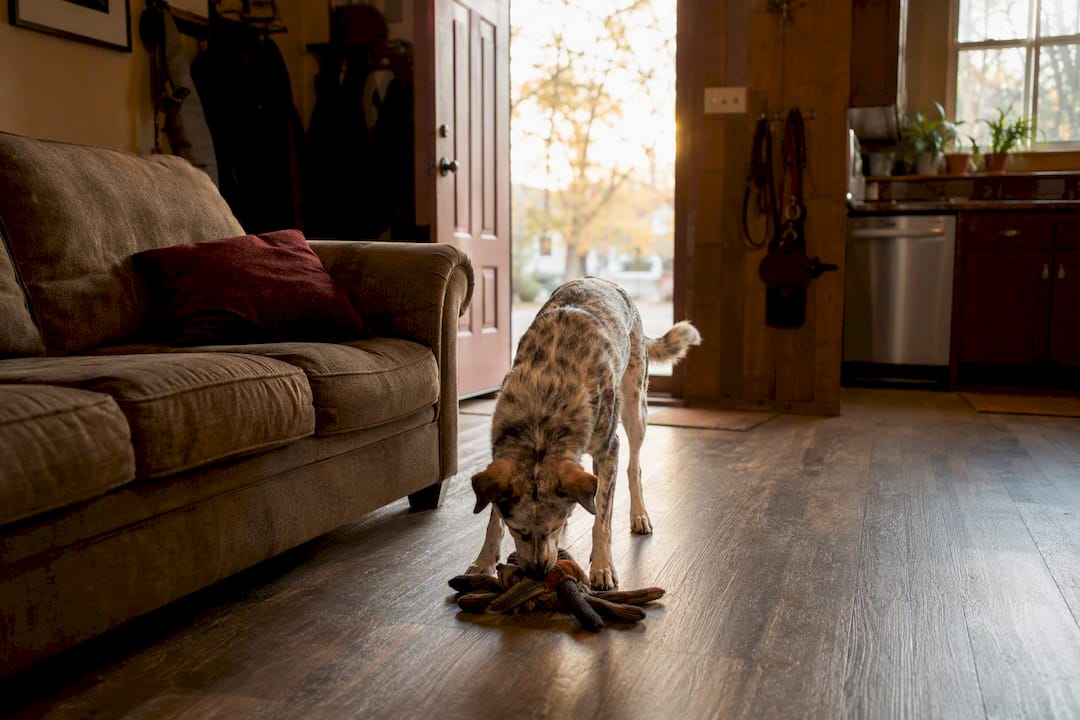
Certain rooms and moments come up again and again in behaviour case notes. The kitchen is an obvious hotspot, especially around the dishwasher, where a dog may guard the door while it’s being loaded. The sofa is another common flashpoint if a dog has claimed a seat as its own, so choosing the best rugs for dogs can help protect your household surfaces and create pet-friendly spaces. The front hall matters too, since dogs often intercept post, shoes, or bags dropped by the door and treat them as new possessions to defend. Recognising these patterns lets you rearrange the environment before a guarding incident happens rather than reacting after one.
What should you do right now to keep everyone safe?
Before any training begins, safety comes first. The good news is that most of the immediate steps cost nothing and take effect the same day.
Separate feeding times and spaces. Feed dogs in different rooms, behind a closed door, or with a baby gate between them if you have more than one dog. This single change removes the most common trigger for mealtime aggression almost overnight.
Switch from free-feeding to scheduled meals. A bowl left out all day invites guarding because the dog never knows when the “threat” of removal might come. Set meal times instead, and remove the bowl once the dog has finished.
Secure or remove high-value chews when you can’t supervise. A pig’s ear or bully stick left lying around is an invitation for conflict, particularly in multi-dog homes. Give these only in a crate or separate room.
Do a sweep for accidental triggers. Socks, food wrappers, and dropped snacks are among the most common items a resource-guarding dog will defend fiercely, precisely because they weren’t meant to be found.
Set firm rules for children and visitors. Children should never approach a dog that has food, a chew, or a toy, and should be taught this as a household rule, not a suggestion. Visitors should be told, calmly and clearly, not to reach for or admire anything the dog is holding.
Never test your dog’s tolerance. Reaching towards a growling dog “to show him who’s boss” is one of the most common ways owners get bitten, and it teaches the dog that warnings don’t work, which can push it straight to biting next time.
Use physical barriers during high-risk moments. A crate, a closed door, or a baby gate during dinner parties or when guests bring children keeps everyone safe while you work on the underlying issue.
This is genuinely the single most effective step you can take before formal training even starts. Management measures like separate feeding and secured high-value items reduce competition and stop the guarding behaviour from being rehearsed again and again, which matters because every rehearsed guarding episode makes the pattern more automatic.
Pro Tip: Keep a “trigger kit” by the door: a few boring chews, a spare lead, and a note of which rooms have baby gates. When visitors arrive unannounced, you can manage the situation in seconds rather than scrambling.
None of this fixes the underlying fear driving the behaviour, and it isn’t meant to. Think of management as the seatbelt while training does the actual steering.
How do you train a dog to stop guarding using desensitisation and counterconditioning?
The training method with genuine evidence behind it is desensitisation combined with counterconditioning, sometimes shortened to “trading up” or the “all good things” approach. Pairing a person’s approach with something the dog values more than what it’s already got gradually rewires the association from “someone’s coming to take my stuff” to “someone approaching means something even better is about to happen.” That’s a genuine change in how the dog feels, not just a suppressed reaction.
Here’s how the exercises build, step by step:
Find your dog’s threshold distance. This is the closest a person can get to the dog and its resource while the dog stays relaxed, not stiff or staring. For some dogs that’s three metres away; for others it’s across the room. Identifying this comfortable distance is the starting line for every session that follows, and guessing wrong by pushing too close undoes the whole exercise.
Reward calm at that safe distance. Stand at the threshold and toss a high-value treat, something far better than the item being guarded, towards the dog without approaching further. Repeat this over several short sessions until the dog’s body language stays loose and relaxed every time.
Close the distance in tiny increments. Move a small step closer only once the dog shows relaxed body language reliably at the previous distance, tossing a treat each time you appear. The pace is set by the dog’s comfort, not by a fixed schedule.
Add duration once distance is solid. Once the dog is comfortable with a person nearby, start pausing briefly before tossing the treat, gradually building up how long a person can stand near the resource.
Teach a rock-solid “leave it” and “drop it” away from any guarding context first. Practise these cues with low-value items during calm, everyday moments, so the dog already understands them before you ever need them near something it values.
Practise recall away from resources. A dog that reliably comes when called, even with a chew nearby, gives you a safe way to interrupt a situation without ever reaching towards the guarded item.
Only progress when the dog shows relaxed signals, not just tolerance. A dog that stops eating or stiffens slightly but doesn’t growl hasn’t relaxed, it’s coping, and pushing further at that point risks a setback.
Pro Tip: Use pea-sized pieces of something the dog rarely gets, like cooked chicken or cheese, rather than its everyday kibble. The bigger the gap in value between the guarded item and the reward, the faster the new association sticks.
Watch closely for signs that a session needs to stop rather than continue. If a dog refuses to eat during a step it previously managed fine, or shows rising stress signals like panting, pacing, or whale eye, that’s your cue to end the session there and reassess, not push through. Continuing past that point can undo weeks of progress and, in some cases, make the guarding worse than when you started.
One thing this training method is not: punishment. Telling a dog off for growling suppresses the warning signal itself rather than the underlying fear, and a dog that’s learned growling gets punished may skip straight to biting next time, with no warning at all. If you find yourself wanting to scold a growl, that’s the moment to step back and reread your dog’s threshold distance instead.
When should you call in professional help?
Some situations are genuinely beyond what a home programme should try to fix alone, and recognising that early protects both your dog and your family.
Get professional support without delay if any of the following apply:
Your dog has bitten a person, even if the bite didn’t break skin.
The guarding is directed at people rather than objects, particularly if children are in the house.
Your dog guards multiple different resources rather than just one.
The behaviour has suddenly worsened or appeared out of nowhere in an adult dog.
The first call should go to your vet, because pain, illness, and certain metabolic conditions can genuinely increase irritability and guarding behaviour, and no training plan works well against an undiagnosed medical issue. Once medical causes are ruled out, the right specialist is a Certified Applied Animal Behaviorist, a board-certified veterinary behaviourist, or an experienced CPDT trainer who specifically handles aggression cases, not a general obedience instructor.
A proper assessment looks quite different from a standard training session. Expect detailed history taking about when and how the guarding started, a threshold management plan tailored to your specific home layout, individualised exercises rather than generic advice, a clear safety protocol for children and visitors, and scheduled follow-up to adjust the plan as your dog progresses. Dogs Trust notes that mild guarding often responds well to prevention and management, but cases involving children, repeated escalation, or an actual bite call for a qualified behaviourist rather than a wait-and-see approach.
At Happy-Dog Training, this level of case is exactly what an Aggressive Behaviour Consult is built for, with an AVS-accredited trainer assessing the specific triggers, history, and household risks before building a plan. Understanding what a certified animal behaviourist’s role actually involves helps set realistic expectations for what that first consult will cover.
How can you prevent resource guarding before it starts?
Puppies and newly adopted dogs give you a genuine head start, because most guarding habits form through repeated learning experiences rather than being fixed at birth.
Teach sharing as a positive experience from the earliest weeks. Practise gentle exchanges where you offer a better treat in return for a toy, so giving something up predicts good things rather than loss. Play low-stakes “leave it” games with items your puppy doesn’t care much about, building the skill before it’s ever tested against something valuable. Reward calm behaviour near food bowls and chews rather than only reacting when guarding appears.
In multi-dog households, feed each dog separately from day one, even if they’ve never shown any competition over food. Provide several low-value chews scattered around rather than one prized item that two dogs might both want, since scarcity is very often what turns ordinary possessiveness into real guarding.
One habit to avoid entirely: repeatedly snatching items away from a young dog “to show them who’s boss.” This teaches the opposite lesson to the one you intend, since the puppy learns that people approaching means losing things, which is precisely the belief that drives guarding later. Supervise toy play between dogs and remove genuinely high-risk chews, like rawhide, when you can’t watch closely.
Why do some dogs guard and others don’t?
Not every dog develops resource guarding, even within the same household, and the reasons come down to a mix of biology and life experience rather than any single cause.
Genetics can create a predisposition toward guarding in some individuals and lines, but genetics alone rarely explains a specific dog’s behaviour. Environmental factors usually do more of the work: a dog that experienced genuine food scarcity, competed hard with littermates, or came from an unpredictable early environment often carries that insecurity forward even once its circumstances improve dramatically.
Inconsistent routines play a role too. A dog fed at random times, with food bowls sometimes left out and sometimes removed unpredictably, has less reason to trust that resources are reliable. Prior punishment compounds this: a dog scolded or physically corrected for guarding in the past often becomes more anxious about resources, not less, because the punishment confirms its fear that people approaching means trouble.
Anxious or insecure temperaments generally show guarding more readily than confident ones, simply because the underlying fear response sits closer to the surface. This is why two puppies from the same litter, raised in the same house, can end up in completely different places. One reads a hand reaching toward its bowl as neutral; the other reads it as a threat worth defending against. Recognising your own dog’s temperament, rather than comparing it to a neighbour’s dog or a previous pet, is the honest starting point for any training plan.
What does a long-term plan for resource guarding actually look like?
A realistic behaviour modification plan runs in phases rather than a single fix, and knowing the shape of it in advance helps you judge whether progress is on track.
The first phase is pure management, typically lasting a few weeks: separate feeding, secured high-value items, and household rules for children and visitors, all in place before any formal training exercises begin. The second phase introduces desensitisation and counterconditioning exercises in short, structured sessions, generally several times a week rather than daily marathon sessions, since consistency beats intensity here.
Progress should be tracked against specific criteria, not vague impressions. A trainer or behaviourist will usually want to see the dog holding relaxed body language at a given distance for several consecutive sessions before advancing the exercise, rather than moving the goalposts based on a single good day.
Follow-up matters more than owners expect. Behaviour rarely stays static, and a household change (a new baby, a house move, a second dog) can reawaken old patterns even after months of solid progress. Scheduled check-ins, whether informal self-assessment using the same notebook approach from earlier or a formal follow-up session with a professional, catch regressions early, while they’re still small and manageable rather than after a second bite has already happened.
How do you safely introduce resource-sharing exercises?
Resource-sharing exercises should only begin once basic management is solid and your dog has shown consistent relaxed behaviour during the desensitisation steps covered earlier. Rushing this stage is one of the more common mistakes owners make, usually out of eagerness to “test” progress.
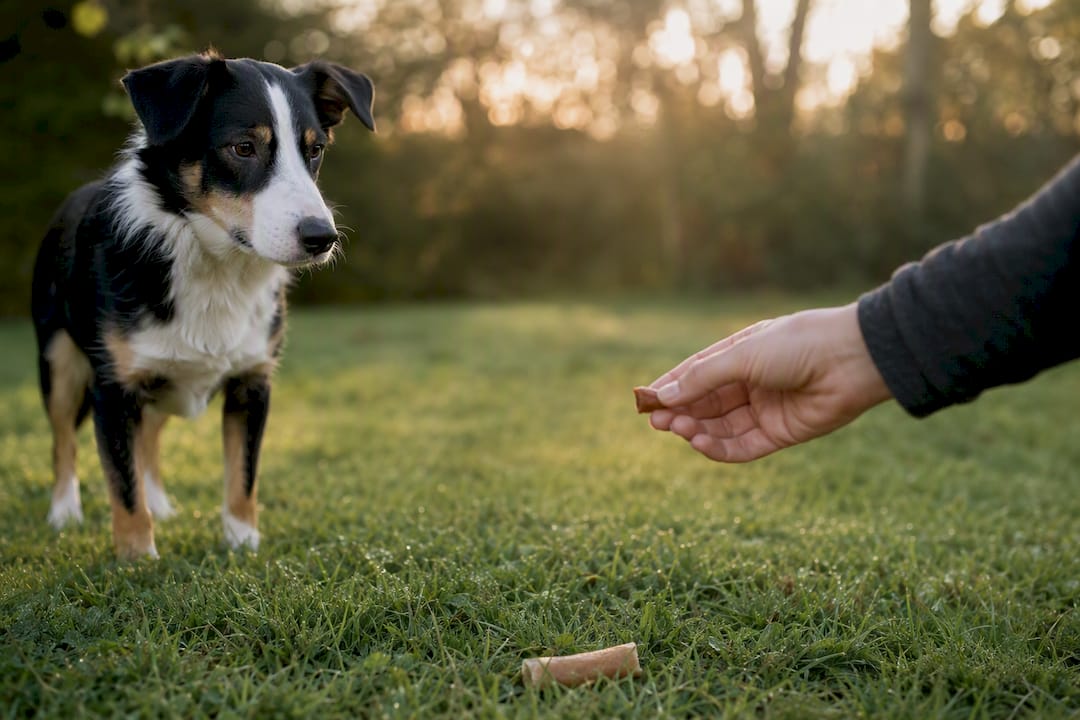
Start with the lowest-value item your dog owns, something it barely notices being near, rather than the resource it guards most fiercely. Approach to a safe distance, well within the threshold established earlier, and practise a calm “leave it” or a simple exchange for a better treat. Only once this feels genuinely easy and relaxed should you introduce a slightly higher-value item.
Never jump straight to the dog’s most guarded resource to “see if the training worked.” That’s testing, not training, and a setback at that stage can undo weeks of careful progress. Keep sessions short, end on a success, and resist the urge to push for one more repetition once the dog has done well.
If you have multiple dogs, introduce sharing exercises with each dog separately before ever attempting a joint session. Combining two dogs around a shared resource before either one is ready is one of the more common ways a manageable habit turns into a serious multi-dog conflict.
Do all breeds and ages guard resources the same way?
Resource guarding shows up across every breed and age, but the shape it takes varies enough that a one-size-fits-all approach rarely works well.
Breeds developed for guarding, herding, or working roles, including several terrier and livestock guardian breeds, often show a stronger baseline tendency toward possessiveness, simply because vigilance and protectiveness were selected for over generations. That said, individual temperament matters more than breed generalisations, and plenty of retrievers and spaniels, breeds with reputations for being easygoing, guard resources just as intensely as any working breed.
Age changes the picture too. Puppies often show mild, exploratory guarding, a stiffen or a quick grab, that responds well to early positive training precisely because the pattern hasn’t had time to become entrenched. Adolescent dogs, roughly six months to two years old, sometimes show a noticeable uptick in guarding as confidence and hormones shift, which is exactly why consistent management during this stage matters so much. Older dogs that develop sudden guarding, having shown none before, deserve a vet visit before anything else, since new-onset guarding in a previously easygoing senior dog often points toward pain or a medical issue rather than a behavioural one.
How do household changes affect resource guarding?
Dogs are creatures of routine, and almost any disruption to that routine can nudge a mild guarding tendency into something more visible.
A new baby in the house changes feeding schedules, supervision levels, and the amount of one-to-one attention a dog receives, all at once. A second dog or a foster animal introduces direct competition for resources that simply didn’t exist before. Even a house move, with unfamiliar rooms and a different feeding spot, can unsettle a dog enough to make it more protective of the few familiar items it still has.
Guests and holiday periods deserve particular attention, since a dog that’s normally relaxed can become noticeably more guarded when the household is fuller and noisier than usual, with children visiting and food more freely available around the house. The safest response to any of these changes is to reinstate stricter management temporarily (separate feeding, secured chews, closer supervision) rather than assuming the dog will simply cope the way it always has.
Trainer perspective: what real progress looks like
Realistic progress with a resource-guarding dog looks like fewer, milder incidents and a genuinely safer household, not a dog that’s magically “cured” after a fortnight. Most cases show meaningful change within several weeks of consistent management and training, though dogs with a long guarding history, prior bites, or overlapping anxiety issues take longer and need patience alongside the plan. What actually moves the needle is less about any single clever exercise and more about steady, boring consistency, plus a willingness to call in coaching when progress stalls rather than pushing through alone.
— Mark
How can professional training help with resource guarding?
Working through desensitisation exercises on your own is entirely possible for mild cases, but guarding that involves biting, multiple resources, or children in the house benefits from a trained eye watching your dog’s body language in real time, catching the subtle signals you might miss.
Happy-Dog Training built its Aggressive Behaviour Consult specifically for cases like this, with an AVS-accredited trainer assessing your dog’s specific triggers and history before designing a plan tailored to your household, rather than handing you a generic printed sheet. For dogs that also react to other dogs or unfamiliar people, the reactive dog class offers structured group support alongside individual coaching, and every client gets free lifetime support after training finishes, so questions that come up months later don’t go unanswered. If your dog needs a more structured foundation first, the 4-week AVS-approved intensive obedience programme builds the reliable “leave it,” “drop it,” and recall skills that make guarding work far easier. Book an initial assessment through Happy-Dog Training to get a clear, honest read on where your dog stands and what the safest next step looks like.
Sources
Recommended
Comments