Training senior dogs: gentle routines and nose games
Yes, you can absolutely teach an older dog new skills. Senior dogs retain the ability to learn when you adapt the pace, protect their joints, and check with your vet first. The plan is simple: book a vet check, run short sessions of five to twenty minutes, and make scent work the centrepiece of daily enrichment.
That single sentence is the whole strategy, but here’s what it looks like in practice:
Book a veterinary check before you start anything new, especially if your dog has slowed down recently.
Keep sessions to 5–20 minutes, ideally at the same time each day.
Prioritise scent games over anything that demands sharp hearing, vision, or high joint flexibility.
Quick fact: short, repeated smell-based tasks have been shown to improve olfactory function and support certain cognitive measures in older adults, which is part of why nose work has become such a trusted tool for older dogs too.
Key Takeaways
Training senior dogs works best when short daily sessions, a veterinary health check, and scent-based enrichment are combined into one consistent, low-impact routine.
Point | Details |
Get a vet check first | Rule out arthritis, pain, hearing or vision loss, and cognitive decline before starting any new plan. |
Keep sessions short | Train for five to twenty minutes daily, ideally at the same time, to build routine without overtiring your dog. |
Lead with scent work | Daily five to ten minute nose games build cognitive engagement without straining joints. |
Adapt cues, not expectations | Swap voice cues for hand signals or tactile taps and allow extra response time for sensory or mobility loss. |
Escalate when needed | Happy-dogtraining’s AVS-accredited programmes offer tailored, vet-informed plans with lifetime support for owners who need extra guidance. |
Table of Contents
Start with a health check: what to ask your vet before you begin
Practical session design: timing, duration and rewards for seniors
Low-impact enrichment: simple scent work and nose games to start today
Adapting cues and techniques for hearing, vision and mobility loss
Troubleshooting: why seniors refuse, regress or show new behaviours
When to hire a professional and what to expect from senior programmes
Training techniques for cognitive decline and canine dementia
Nutrition considerations that support cognitive and physical health
Why training still matters for senior dogs
Retirement from training is one of the kindest-sounding mistakes an owner can make. Dogs who keep working their brains tend to stay more alert, more settled, and less prone to the restlessness that owners often mistake for “just getting old”. Structured sessions give a senior dog something trainers often call “a job” — a reason to focus, and a source of pride even at fourteen or fifteen.
The physical case is just as strong. Gentle, consistent movement supports joint mobility and keeps weight in check, which matters enormously for a dog whose arthritis worsens with every extra kilogram. And training time is bonding time. You’re not just teaching a cue, you’re reinforcing trust at a stage of life when your dog may be feeling more vulnerable and dependent on you.
Mental stimulation supports mood and cognitive sharpness, which is often enhanced through pet ownership and senior mental health benefits.
Gentle routine exercise helps manage weight and joint stiffness.
Shared training strengthens the bond between you and your ageing companion.
Start with a health check: what to ask your vet before you begin
Every senior training plan should begin at the vet’s, not on the living room floor. A dog who suddenly refuses to sit isn’t necessarily being difficult. Pain, stiffness, or a cognitive shift are often the real cause, and ruling out medical issues first prevents you from accidentally punishing a dog who simply can’t comply.
Ask for a full assessment of arthritis, joint pain, hearing, and vision.
Ask whether your dog shows early signs of canine cognitive dysfunction (CCD).
Confirm safe exercise limits and check for any medication interactions that might affect energy or focus.
Discuss pain management options if arthritis or stiffness is already present.
Flag any sudden behavioural change immediately. It’s a medical signal until proven otherwise.
Once you have that green light, you can build a plan that suits the dog in front of you, not the dog you remember from five years ago.
Practical session design: timing, duration and rewards for seniors
Consistency does more heavy lifting than intensity ever will. Purina’s guidance for older dogs echoes what most experienced trainers already know: short, daily sessions with simplified tasks beat occasional long ones every time.
Train for five to twenty minutes, at roughly the same time each day, so your dog anticipates and settles into the routine.
Set up on soft, non-slip surfaces with bright, glare-free lighting, and clear the room of distractions.
Reward with small portions of high-value treats, a sniff break, gentle play, or affectionate touch, whichever motivates your particular dog.
Watch total daily calories carefully. Older dogs often need fewer, not more, and appetite changes are common with age.
Older dogs sometimes need more repetitions than puppies to master a new behaviour, but a University of Vienna study found they retain what they learn just as reliably. Patience isn’t a nice extra here; it’s the method.
Pro Tip: If your dog seems to “forget” a cue overnight, don’t assume regression. Check for new stiffness or a change in routine first. Memory in senior dogs is often intact; comfort is what’s missing.
Low-impact enrichment: simple scent work and nose games to start today
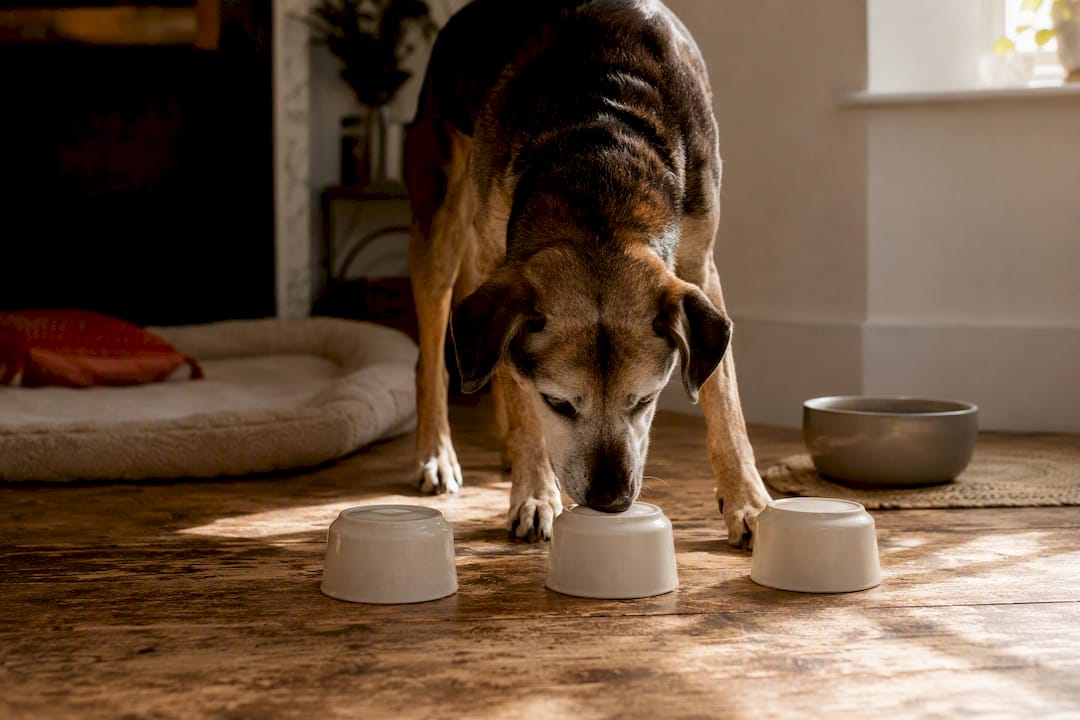
Scent work is the single best return on effort you’ll get from senior dog training. It asks nothing of ageing joints and almost everything of a brain that’s still hungry for a challenge.
Start with “find it” games: scatter a few treats across the floor and let your dog hunt them out.
Progress to scatter feeding at mealtimes instead of a bowl, turning dinner into a five-minute enrichment task.
Build towards simple scent trails, hiding treats in slightly harder spots as confidence grows.
Watch for fatigue or frustration (sitting down mid-search, walking away, or excessive sniffing without engagement) and end the session on a win before that point.
Quick fact: daily five to ten minute nose sessions are enough to deliver meaningful mental enrichment, and some dogs who remain physically comfortable can happily stretch to twenty or thirty minutes.
Adapting cues and techniques for hearing, vision and mobility loss
Sensory decline doesn’t end learning, it just changes the language you use to teach. A dog who’s lost most of his hearing hasn’t lost his intelligence; he’s simply waiting for a signal he can actually perceive.
Switch to hand signals or tactile taps as hearing fades, and keep any remaining voice cues short and single-syllable.
Use high-contrast targets (a bright toy against a dark floor, for instance) and avoid training in glare or harsh backlighting for vision-impaired dogs.
Give five to ten seconds after a cue before repeating it. Stiff joints and slower processing both need extra time, and rushing a response can turn training into a source of stress.
Never force a position that causes visible discomfort. Adjust the goal instead of pushing through the pain.
Environmental tweaks such as non-slip mats, raised food bowls, and ramps often make more difference to a senior dog’s willingness to train than any correction ever could.
Troubleshooting: why seniors refuse, regress or show new behaviours
A dog who suddenly won’t sit, won’t come, or growls at a cue that used to be easy is telling you something. Refusal in older dogs is commonly pain or sensory driven rather than stubbornness, and treating it as defiance usually makes things worse.
Watch for red flags: yelping, stiffening, reluctance to rise, or sudden aggression around a specific movement.
Break tasks into smaller steps, swap a physical cue for a scent-based one, and reduce repetitions rather than pushing through.
Stop before frustration sets in. A session that ends badly creates a negative association that’s hard to undo.
Keep a simple log of new or changed behaviours and bring it to your vet, particularly if the change was sudden or severe.
When to hire a professional and what to expect from senior programmes
Home training covers most everyday challenges, but some situations call for outside help sooner rather than later.
Seek a professional for aggression, sudden personality changes, or when consistent home practice isn’t moving the needle.
Choose a trainer who liaises with your vet, adapts drills for reduced mobility, and documents progress using humane, positive methods.
Happy-dogtraining’s certified, AVS-accredited trainer builds tailored plans around exactly these constraints, with free lifetime support once a programme ends, so guidance doesn’t stop the day the sessions do.
Training techniques for cognitive decline and canine dementia
Canine cognitive dysfunction changes the rules of engagement, but it doesn’t mean training stops working; it means the goals shift from teaching new skills to preserving the ones your dog already has. A dog with CCD often does better with familiar routines repeated at the same time each day, since predictability reduces the confusion and anxiety that come with a fading sense of time and place.
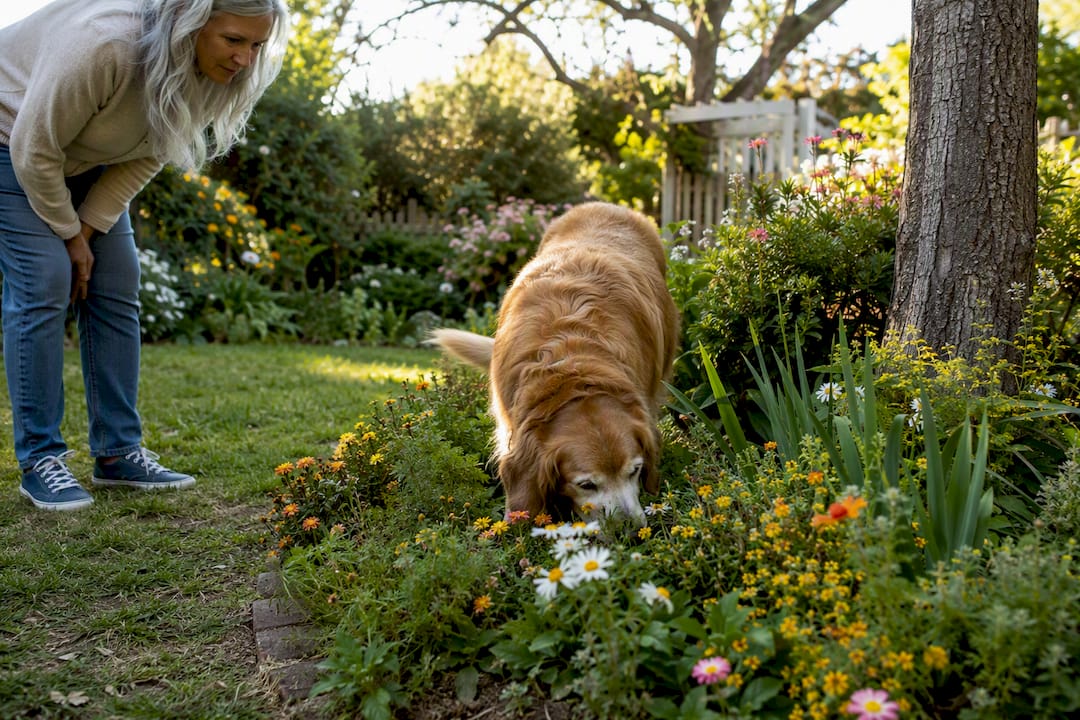
Keep tasks extremely simple: a single cue, a single expected response, repeated in the same location. Novel environments and unfamiliar people tend to overwhelm a dog with declining cognition, so training at home, in a quiet, well-lit room, usually works better than a park or class setting. Scent-based tasks are particularly valuable here, since the olfactory system tends to hold up better than hearing or vision as dementia progresses, and simple sniff games can keep a dog engaged even when more structured obedience work has become too demanding.
Watch for signs the task has become too hard: pacing, staring blankly, or wandering off mid-exercise. These aren’t failures to correct, they’re signals to simplify further or stop for the day. Night-time restlessness and disorientation, both common with CCD, mean training sessions are often best scheduled earlier in the day when your dog is calmer and more alert. If you notice a rapid decline, loop your vet back in. Some medications and dietary changes can meaningfully slow the progression and make training sessions more productive.
Nutrition considerations that support cognitive and physical health
What your senior dog eats shapes how well he learns, moves, and recovers between sessions. Diets formulated for cognitive support often include antioxidants and specific fatty acids intended to support brain health, and pairing that kind of diet with daily mental enrichment gives you a more complete approach than training alone.
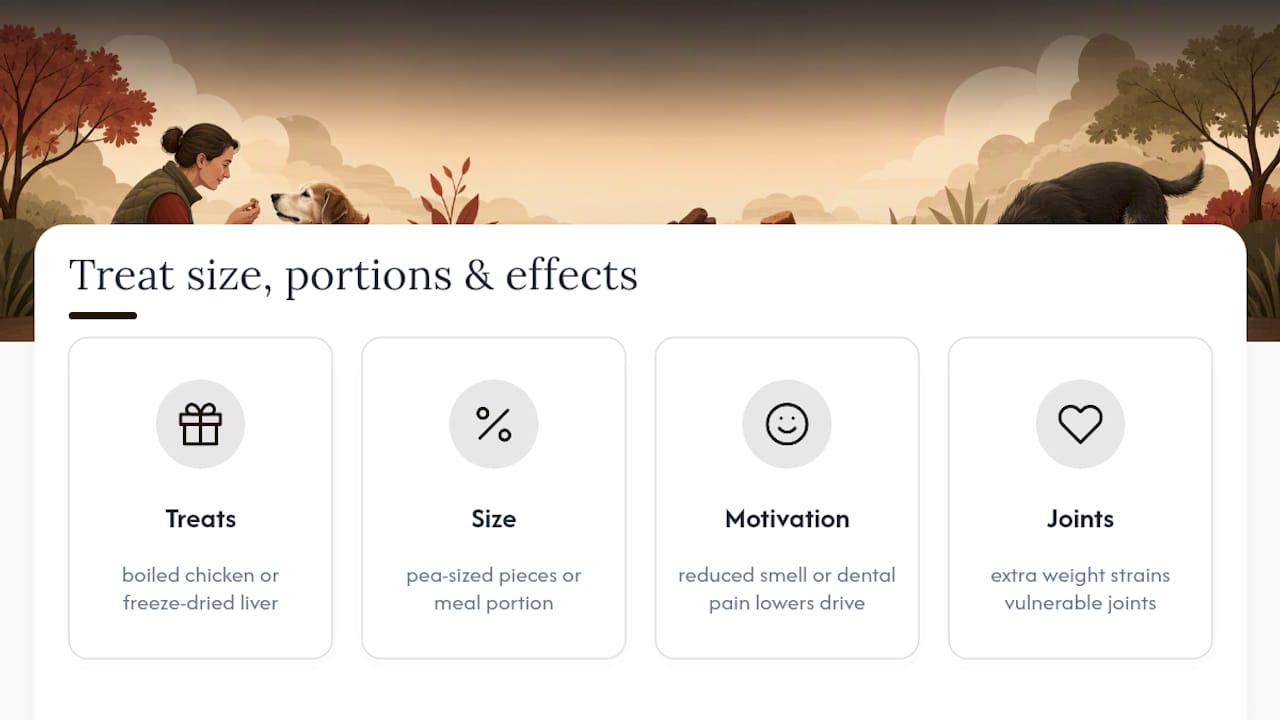
Appetite itself often becomes a training variable in older dogs. Reduced smell sensitivity, dental discomfort, or a general dip in food drive can make standard treats far less motivating than they used to be. If your dog seems unmoved by the treats that worked last year, try softer, more aromatic options such as small pieces of boiled chicken or freeze-dried liver, both of which tend to cut through a duller sense of smell more effectively than dry biscuits.
Dental pain deserves particular attention, since a sore mouth can make even soft treats unappealing and get misread as a training problem rather than a physical one. If chewing seems hesitant or slow, mention it at your next vet visit rather than assuming it’s just fussiness.
Portion control matters just as much as flavour. Training treats add up quickly, and a senior dog carrying extra weight faces more strain on already vulnerable joints. Splitting treats into pea-sized pieces, or using a portion of the daily meal as training rewards, keeps motivation high without pushing calorie intake past what your vet recommends.
Strategies to manage pain or arthritis during training
Arthritis is probably the single biggest hidden obstacle in senior dog training, and it’s often invisible until you know what to look for. A dog who hesitates before sitting, shifts weight awkwardly, or avoids certain positions altogether may be managing pain rather than ignoring a cue.
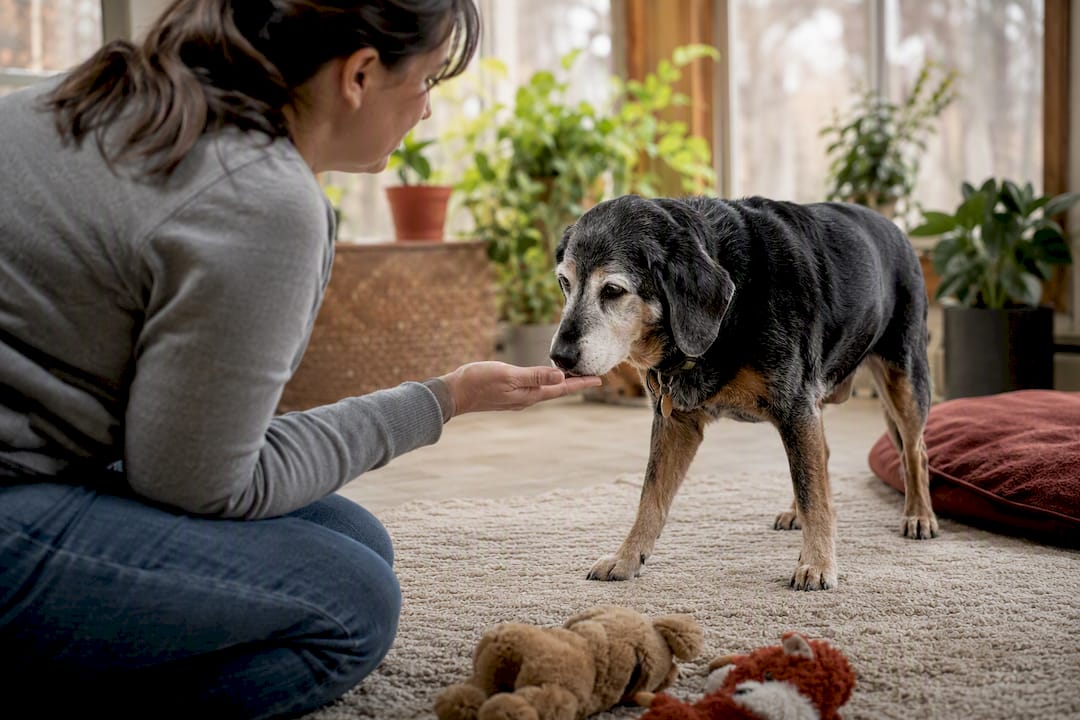
Adjust the physical demands of training before you adjust anything else. Replace “sit” with “stand” or “touch” if sitting is genuinely uncomfortable, and never insist on a full range-of-motion position simply because it’s the traditional cue. A modified behaviour that doesn’t hurt is far more useful than a textbook-perfect one that does.
Surface matters enormously. Training on hardwood or tile can make an arthritic dog reluctant to move at all, while a non-slip mat or rug gives enough grip to reduce the fear of slipping, which is often as limiting as the pain itself. Keep sessions short and end while your dog is still comfortable, rather than pushing for one more repetition once you notice stiffness setting in.
Work with your vet on a pain management plan that runs alongside training, whether that’s medication, joint supplements, or physiotherapy. A dog whose pain is properly managed learns faster and more willingly than one who’s quietly enduring discomfort through every session. Gentle warm-up movement, a short, easy walk before training begins, can also loosen stiff joints enough to make the session itself more productive and considerably kinder.
Practical lessons from years of senior-dog work
The biggest misconception owners bring to senior dog training is that improvement has to look dramatic to count. It doesn’t. Most progress with older dogs shows up in small increments: a dog who used to bolt at the doorbell now merely startles, or a dog who refused all cues after being diagnosed with arthritis is now happily doing scent searches twice a day.
Timelines vary enormously depending on the underlying issue, but owners who commit to short, consistent daily sessions typically see meaningful shifts within a few weeks rather than months. What separates the plans that work from the ones that stall isn’t intensity, it’s whether the owner adjusted the method to the dog rather than expecting the dog to adjust to the method. That single mindset shift, more than any specific technique, tends to be what makes trainer-supported programmes succeed where solo attempts have quietly failed.
— Mark
Ready to start? Happy-dogtraining’s senior programmes
Happy-dogtraining gives senior dog owners something a generic training article can’t: a certified, AVS-accredited trainer who adapts every plan around your dog’s actual health, not a one-size-fits-all curriculum built for young, able-bodied dogs. Where DIY sessions rely on you correctly reading pain, fatigue, and cognitive signs on your own, our approach pairs humane, science-based methods with a trainer who works alongside your vet’s recommendations from day one.

If your senior dog is struggling with confusion, mobility issues, or behaviours that changed suddenly, the 4-week AVS-approved intensive programme gives you a structured, trainer-led path forward, with free lifetime support once the programme ends. Get in touch through the Happy-dogtraining site to discuss your dog’s specific needs and book an assessment.
Sources
Recommended
Comments