Clicker training explained for dog owners
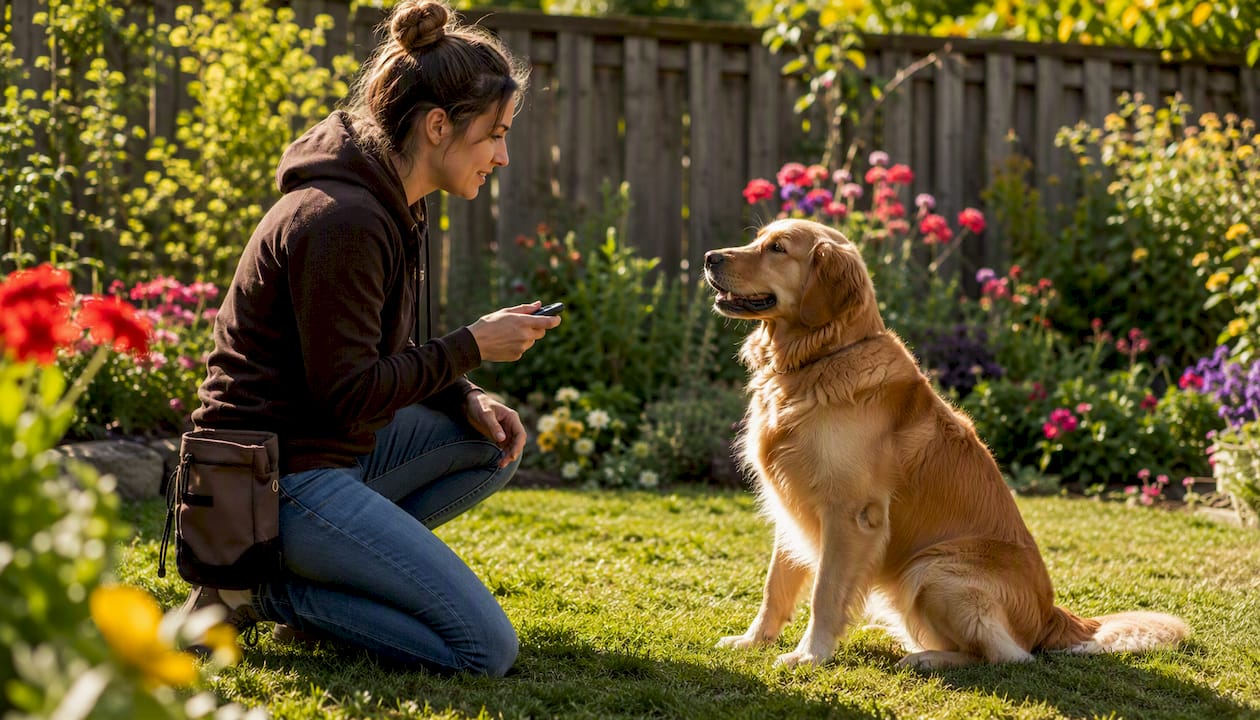
Clicker training is a marker-based positive reinforcement method that uses a distinct sound to mark the exact moment your dog does something right, then predicts a reward. That precision is what sets it apart from most other training approaches. For many dogs, it is considered a highly humane and effective way to teach new behaviours, build confidence, and strengthen the bond between you. Organisations including the RSPCA, Karen Pryor Clicker Training, and the American Veterinary Society of Animal Behavior (AVSAB) all endorse reward-based methods as the gold standard for companion animal training. At Happy-dogtraining, this same science-backed, force-free philosophy underpins every programme we offer.
Quick takeaways:
Clicker training works for everyday exercises: teaching sit, building a reliable recall, and shaping entirely new behaviours.
The click is not the reward. It marks the behaviour and predicts the reward.
A consistent marker word such as “yes” works just as well as a mechanical clicker.
Short, frequent sessions produce faster results than long, infrequent ones.
Table of Contents
What is clicker training and how does the science work?
Clicker training is rooted in operant conditioning, the branch of learning theory developed by B.F. Skinner that explains how behaviour is shaped by its consequences. When a behaviour produces something pleasant, the dog is more likely to repeat it. The clicker slots into this process as a conditioned reinforcer, also called a bridging stimulus or marker.
Here is the sequence in plain terms:
The click itself has no natural value to your dog. Through repeated pairing with food or play, it acquires meaning: “that exact thing you just did has earned you a reward.” Because the sound is consistent and instantaneous, it communicates far more precisely than a verbal “good dog” delivered half a second late.
Key terms worth knowing:
Positive reinforcement — adding something the dog values (a treat, a game) to increase the likelihood of a behaviour recurring. “Positive” means adding, not “nice.”
Karen Pryor Clicker Training notes that the term “clicker training” refers to any positive reinforcement training that uses a marker signal. The mechanical clicker is popular because its sound is sharp and consistent, but it is not the only option. For a deeper look at how marker training works and the alternatives available, that guide covers the concept in full.
How to get started: a step-by-step clicker training guide
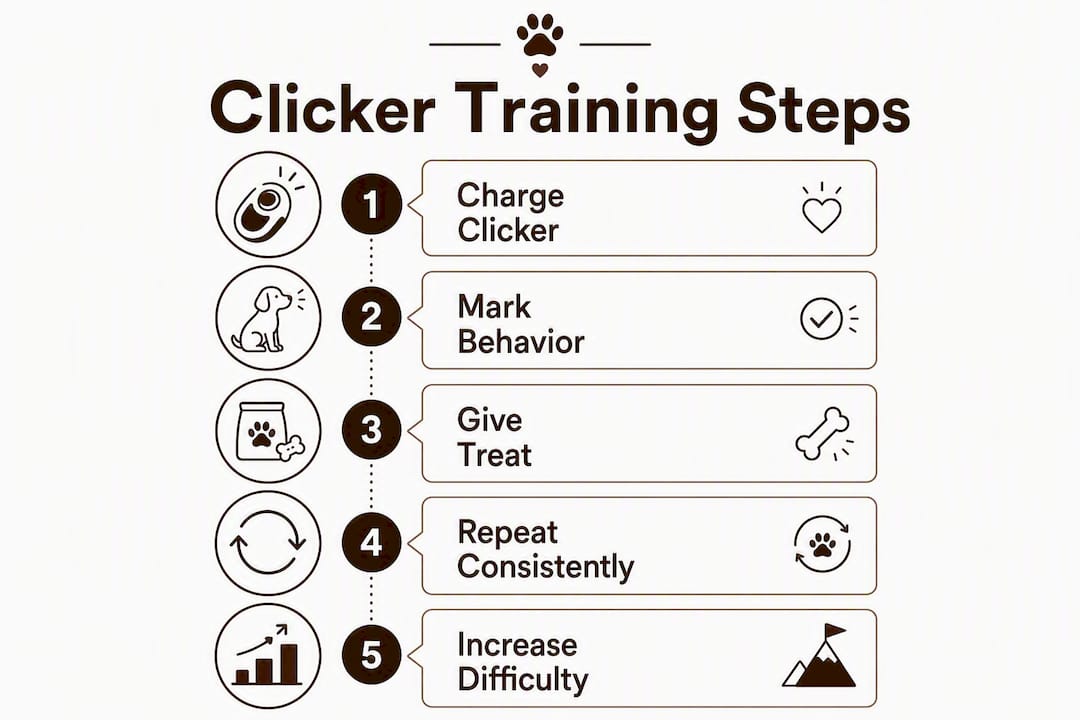
The method follows a clear sequence. Stick to it and your dog will begin making the connection within a single session.
Charge the clicker. Before you ask for any behaviour, pair the click with a treat roughly 10–15 times in a row. Click once, then immediately drop a small treat. Repeat. VCA Animal Hospitals describes this as “charging” the clicker — the dog learns that the sound reliably predicts something good.
Prompt or wait for the behaviour. Lure your dog into a sit, or simply wait for them to offer a behaviour naturally. Do not click yet.
Click the instant the behaviour occurs. Timing is everything. PetMD recommends clicking within 0–2 seconds of the desired behaviour. A late click marks the wrong moment and confuses your dog.
Deliver the reward immediately after the click. The click tells your dog they have earned a reward; the treat fulfils that promise. Never click without following through.
Repeat in short sessions. Three to ten minutes is plenty, especially for puppies or dogs new to the method. End on a success.
Add a verbal cue once the behaviour is consistent. Say “sit” just before the dog performs it, then click and reward. Over time, the cue predicts the behaviour.
Fade the clicker and treats gradually. Once the behaviour is reliable on cue, begin rewarding intermittently. Variable reinforcement schedules maintain behaviour without creating a permanent treat dependency.
Pro Tip: Start every new behaviour in a quiet room with no distractions. Once your dog responds reliably at home, practise in the garden, then on a quiet street. Gradually increasing difficulty is what builds a behaviour that holds up anywhere.
Practical exercises you can try today
These three beginner exercises give you a feel for the method and build your dog’s confidence quickly.
Teaching sit
Hold a treat just above your dog’s nose and move it slowly back over their head.
The moment their bottom touches the floor, click and reward.
Repeat five to eight times per session.
Once the sit is reliable, add the verbal cue “sit” just before they perform it.
Building a recall
Start with your dog just a metre away. Say their name, and the moment they turn towards you, click.
Reward enthusiastically when they reach you — this is one of the highest-value behaviours you can teach, so use your dog’s favourite treat.
Gradually increase the distance over several sessions.
Never call your dog to you for something unpleasant (a bath, nail trim). That erodes the recall fast.
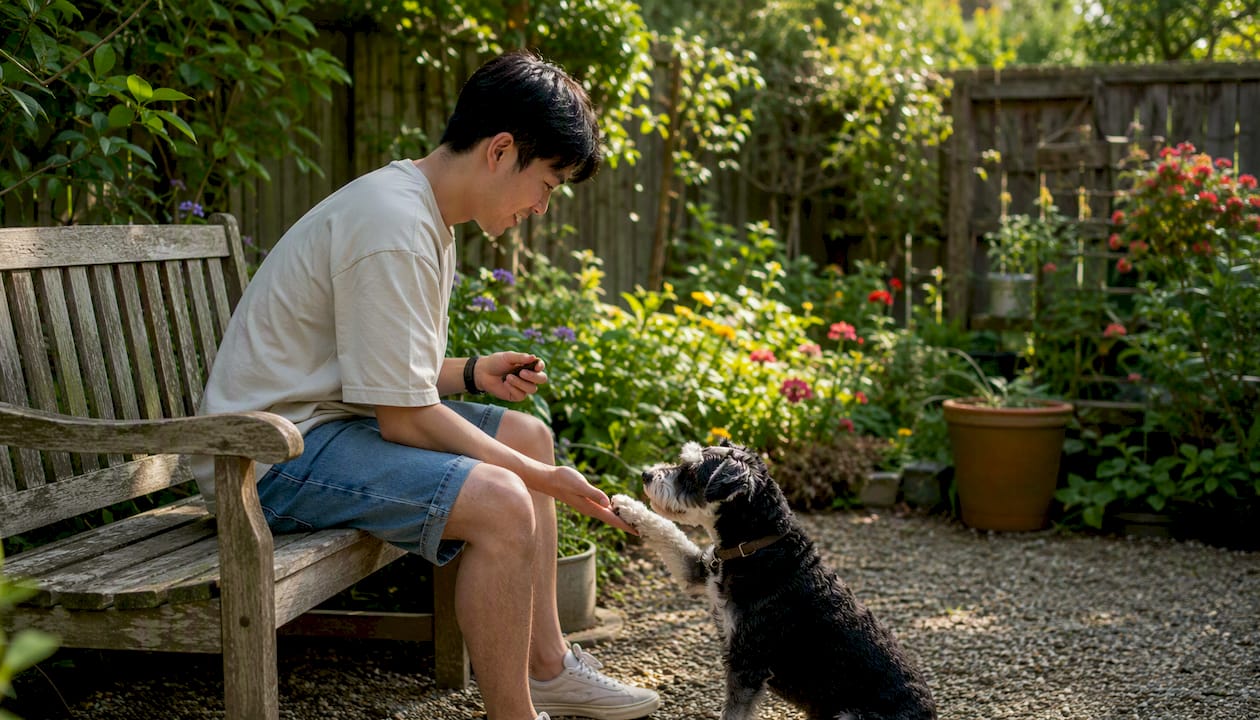
Shaping a paw target
Shaping means rewarding successive approximations of a behaviour rather than waiting for the finished version. Place your hand flat on the floor. Click any time your dog sniffs or nudges it. Then raise the criteria: click only when they make contact with a paw. Within a few sessions, most dogs will confidently place a paw on your hand on cue. This exercise is a brilliant introduction to shaping because the steps are small and progress is visible.
Pro Tip: Aim for five to ten successful repetitions before increasing difficulty. If your dog gets it wrong three times in a row, you have moved too fast. Drop back a step.
What tools and rewards do you actually need?
The good news: the kit list is short and inexpensive.
Mechanical clicker — a small plastic box with a metal strip that makes a consistent “click” sound. Available from most UK pet shops and online retailers for under £5. The box clicker and the i-Click (a thumb-press version) are both widely available.
Marker word — a short, sharp word such as “yes” or “good” delivered in a consistent, upbeat tone. Karen Pryor Clicker Training confirms that a marker word is functionally equivalent to a mechanical clicker, provided you use it consistently and always follow it with a reward.
High-value treats — small, soft pieces of chicken, cheese, or commercial training treats. Small means pea-sized; you may go through 20–30 in a session, so keep them tiny.
Play or praise — for dogs less motivated by food, a short tug game or enthusiastic praise can serve as the primary reinforcer. The marker still works the same way.
The marker is not the reward. That distinction matters. The click communicates; the treat (or game) motivates. Dogs that understand this distinction learn faster because the click carries clear information rather than just excitement.
For noise-sensitive dogs, Dog’s Trust recommends muffling the clicker in a pocket, switching to a soft tongue click, or using a marker word entirely. There is no welfare reason to persist with a sound that startles your dog.
What are the real benefits and limitations of clicker training?
Benefits:
Precision — the marker communicates the exact behaviour that earned the reward, reducing confusion and speeding up learning.
Engagement — AVSAB notes that reward-based methods motivate dogs to participate actively in learning and reduce stress compared with aversive approaches.
Bond-building — training sessions become a positive shared activity rather than a confrontation.
Versatility — the method works for basic obedience, trick training, sports, and complex behaviour shaping.
Limitations:
Clicker training is not a quick fix for deeply rooted behaviour problems such as severe aggression, extreme fear, or separation anxiety. These require a structured programme and, often, professional support.
Consistency is non-negotiable. Inconsistent clicking or forgetting to reward devalues the marker and slows progress.
Some dogs need different motivators. If your dog is not food-motivated, you will need to experiment with play, toys, or life rewards (access to a favourite spot, a sniff on a walk).
Common myths:
“Treats are bribes.” The AKC explains that positive reinforcement is based on the science of animal learning, not bribery. A bribe is offered before a behaviour to coax compliance; a reward follows the behaviour to reinforce it.
“The clicker is a magic device.” The clicker is a communication tool. The learning happens through consistent pairing with rewards.
“You will always need treats.” Treats are faded once a behaviour is reliable. Variable reinforcement then maintains it.
Why does training stall and how do you fix it?
Most problems come down to timing, reward delivery, or environment. Here is how to diagnose and correct the most common issues.
Clicking too late — if you click after the behaviour has ended, you are marking the wrong thing. Practise clicking a pen while watching TV to sharpen your reflexes before your next session.
Forgetting to reward after the click — this is the single most damaging error. VCA Animal Hospitals notes that clicking without delivering a reward devalues the marker and stalls learning. Always follow the click with a treat, every time, especially during early training.
Training in a distracting environment too soon — a dog that sits reliably in the kitchen may fall apart at the park. That is normal. Go back to basics in the new environment and rebuild from there.
Over-relying on lures — if you always hold a treat in your hand to prompt the behaviour, your dog is following the food, not responding to a cue. Fade the lure within three to five sessions by moving the treat to your other hand or pocket.
Sessions that are too long — a tired or frustrated dog stops learning. Keep sessions to five to ten minutes and always end before your dog loses interest.
Pro Tip: Film a short training session on your phone and watch it back. You will spot timing errors and unintentional cues you cannot see in the moment. It is one of the fastest ways to improve.
When progress plateaus, change one variable at a time: the environment, the treat value, or the criteria. Changing everything at once makes it impossible to know what helped.
Is clicker training safe and ethical?
Reward-based training is the approach recommended by the AVSAB and the RSPCA precisely because it avoids the welfare risks associated with aversive methods, including fear, anxiety, and increased aggression. The RSPCA endorses positive reinforcement as a humane, evidence-based approach to companion animal training.
A few safety points worth keeping in mind:
Avoid startling a noise-sensitive dog with a sharp mechanical click. Use a muffled clicker, a tongue click, or a marker word instead.
Never use the clicker as a recall signal or an attention-getter. It marks behaviour; it does not summon your dog.
Manage the environment to prevent unwanted behaviours from being accidentally reinforced. If your dog jumps up and gets attention, the jumping is being rewarded regardless of your intentions.
For dogs showing fear, aggression, or severe reactivity, reward-based training remains the right framework, but the complexity of these issues means professional guidance is strongly advisable. Happy-dogtraining’s force-free approach and evidence-based methods for reactive dogs offer structured support for owners in exactly this position.
How long does clicker training take to work?
Progress varies by dog, but here is a realistic picture of what to expect.
Within a single session — most dogs begin to associate the click with a reward after 10–15 pairings. You may see the first glimmer of a trained behaviour (a sit, a hand touch) within 15–20 minutes.
After one week of daily practice — a simple behaviour like sit or down should be reliable in a low-distraction environment.
After one month — behaviours should begin to generalise across different rooms, people, and mild distractions. You can start fading the clicker for well-established cues.
For complex behaviours — shaping a recall that holds at the park, or a reliable “leave it” around high-value distractions, typically takes several weeks to months of consistent practice.
Individual variation is real. Puppies learn quickly but have short attention spans. Rescue dogs with limited prior training may take longer to trust the process. Older dogs can absolutely learn new behaviours; the pace may simply be a little slower. Matching your approach to your dog’s temperament makes a measurable difference to how quickly progress comes.
Research-backed tips from expert trainers
The professional consensus on reward-based training is clear and consistent.
AVSAB and the RSPCA both recommend reward-based methods on welfare grounds, citing evidence that aversive approaches increase fear and anxiety without producing better long-term results.
Karen Pryor Clicker Training emphasises that the tool matters less than the philosophy: a consistent marker word is functionally equivalent to a mechanical clicker when paired reliably with reward.
The AKC describes the clicker as a conditioned reinforcer that makes positive reinforcement training more efficient by giving handlers a precise communication tool.
PMC research on training methods notes that reward-based approaches are supported by the existing scientific literature on both welfare and efficacy grounds.
“Clicker training is not about the clicker. It is about the precise communication of information to the learner — and that communication is what accelerates learning.” — Karen Pryor Clicker Training
Practical takeaways from the research:
Charge the clicker before every new training context, not just at the very start.
Never let the marker lose its value by clicking without rewarding.
Once a behaviour is reliable on cue, shift to a variable reinforcement schedule to maintain it without permanent treat dependency.
Key takeaways
Clicker training works because the marker gives your dog precise, timely information about which behaviour earned the reward, making learning faster, clearer, and more enjoyable for both of you.
Point | Details |
Charge the clicker first | Pair the click with a treat 10–15 times before asking for any behaviour. |
Timing is everything | Click within 0–2 seconds of the desired behaviour; always follow the click with a reward. |
Short sessions work best | Keep sessions to 3–10 minutes and end before your dog loses focus. |
Fade rewards gradually | Once a behaviour is reliable on cue, shift to variable reinforcement to maintain it. |
Seek professional help when needed | Fear, aggression, and severe reactivity need structured professional support, not just clicker work. |
A trainer’s perspective on clicker training
There is a tendency to treat clicker training as a beginner’s trick, something you use to teach sit and then put away. That undersells it considerably.
The real value of a marker is not the sound itself. It is the clarity it gives your dog about what they are doing right, at the exact moment they are doing it. Most training frustration, on both ends of the lead, comes from ambiguity. The dog does not know which part of their behaviour earned the reward. The owner does not know why the behaviour is inconsistent. A well-timed marker resolves both problems at once.
Humane training methods consistently outperform aversive approaches not just on welfare measures but on reliability and generalisation. Dogs trained with reward-based methods tend to be more confident, more engaged, and more willing to try new things. That willingness is what makes complex training possible.
One thing worth saying plainly: the clicker does not do the training. Consistency, patience, and good timing do. The clicker just makes your timing visible to your dog. If you are struggling with a behaviour that is not coming together, the answer is rarely a different tool. It is usually a smaller step, a higher-value reward, or a quieter environment to practise in.
Useful sources and further reading
These resources will take your understanding further, whether you want the science, the practical steps, or UK-specific welfare guidance.
Karen Pryor Clicker Training — the definitive resource on marker-based training, with free tutorials, articles, and a directory of certified trainers.
AVSAB (American Veterinary Society of Animal Behavior) — position statements and guidance on reward-based methods and the welfare risks of aversive training.
Dog’s Trust — UK charity with clear, accessible advice on positive reinforcement training, including alternatives for noise-sensitive dogs.
VCA Animal Hospitals — veterinary-backed explanation of clicker and target training, including how to charge the clicker.
AKC — Clicker Training — practical guide to mark-and-reward training with clear explanations of conditioned reinforcers.
PMC — Reward vs mixed training methods — peer-reviewed research on the efficacy and welfare outcomes of different training approaches.
Happy-dogtraining: marker training guide — a practical deep dive into marker concepts, alternatives, and how to apply them at home.
Recommended
Comments