LIMA principle dog training explained for dog owners

The LIMA principle is the professional standard that requires trainers to choose the least intrusive, minimally aversive method that is likely to succeed before considering anything more forceful. In plain terms: always try the kindest, gentlest option first, and only move to something stronger if it genuinely cannot work. Three things to hold in mind straight away:
The Humane Hierarchy gives trainers a clear, ordered checklist of interventions, from health checks right through to last-resort aversives.
LIMA is competence-based, meaning a trainer must have the skill and knowledge to judge which option is truly the least intrusive for this dog in this situation.
The central question is always: “What do you want the animal to do?” Teaching a replacement behaviour comes before any attempt to suppress an unwanted one.
The APDT, the CCPDT, and the IAABC all formally endorse LIMA as the ethical standard for professional dog trainers and behaviour consultants.
Table of Contents
What does LIMA mean, and which bodies officially endorse it?
LIMA stands for Least Intrusive, Minimally Aversive. The APDT position statement defines it as selecting “the least intrusive, minimally aversive strategy out of a set of humane and effective tactics likely to succeed in achieving a training or behaviour change objective.” That is not a vague aspiration. It is a professional competence criterion.
The CCPDT, which administers the CPDT-KA and CPDT-KSA certifications, has its own LIMA policy that all certificants must follow. The IAABC similarly places LIMA and the Humane Hierarchy at the heart of its practice standards. In the UK, the Animal Behaviour and Training Council (ABTC) does not use the LIMA acronym explicitly, but its competency framework for registered trainers aligns closely with the same welfare principles.
What “competence-based” means in practice is significant. A technique that is genuinely the least intrusive option for a confident, food-motivated Labrador may be entirely wrong for a fearful rescue terrier. The trainer’s skill in reading the individual dog, not just following a rule, is what makes LIMA real rather than a label.
How does the Humane Hierarchy work in practice?
The Humane Hierarchy is the decision-making framework that sits at the heart of LIMA. Think of it as a ladder: you start at the bottom rung and only move up when the lower option cannot do the job. The CCPDT LIMA policy sets out six levels.
Health, nutritional, and physical factors. Before any training begins, rule out pain, illness, or nutritional deficiency as the cause of the behaviour. A dog snapping at its owner may be in pain, not being “dominant.” Your vet should clear any medical concerns first.
Antecedent modification. Change the environment or the triggers before the problem behaviour can occur. A dog that lunges at cyclists is managed on quieter routes while a training plan is built. Management is not a cure, but it prevents rehearsal of the unwanted behaviour.
Positive reinforcement. Reward the behaviour you want. This is the first line of teaching and is associated with the lowest rates of aggression, fear, and avoidance in learners. Treats, praise, play, and life rewards all count.
Differential reinforcement of an alternative behaviour (DRA). Reinforce a replacement behaviour and remove the reinforcer that was maintaining the problem. A dog that jumps for attention learns to sit instead, because sitting earns the greeting and jumping earns nothing.
Negative punishment, negative reinforcement, or extinction. These are not ranked against each other, but all involve removing something to change behaviour. Withdrawing attention when a dog barks (negative punishment) or removing a mild pressure when the dog relaxes on a lead (negative reinforcement) both sit here. Extinction, permanently removing the reinforcer, can cause a temporary burst of the unwanted behaviour before it fades, so it needs careful handling.
Positive punishment. Delivering an aversive consequence to reduce a behaviour. This is the last resort, used only when all other options have genuinely failed or are unsuitable, and only by a trainer with the skill to apply it safely and humanely.
Pro Tip: The hierarchy is a decision tool, not a rigid checklist. The most common misapplication is skipping straight to level six because “it worked last time.” Every dog is an individual case, and what worked previously is not a justification for bypassing the earlier rungs.
How do trainers actually apply LIMA, step by step?
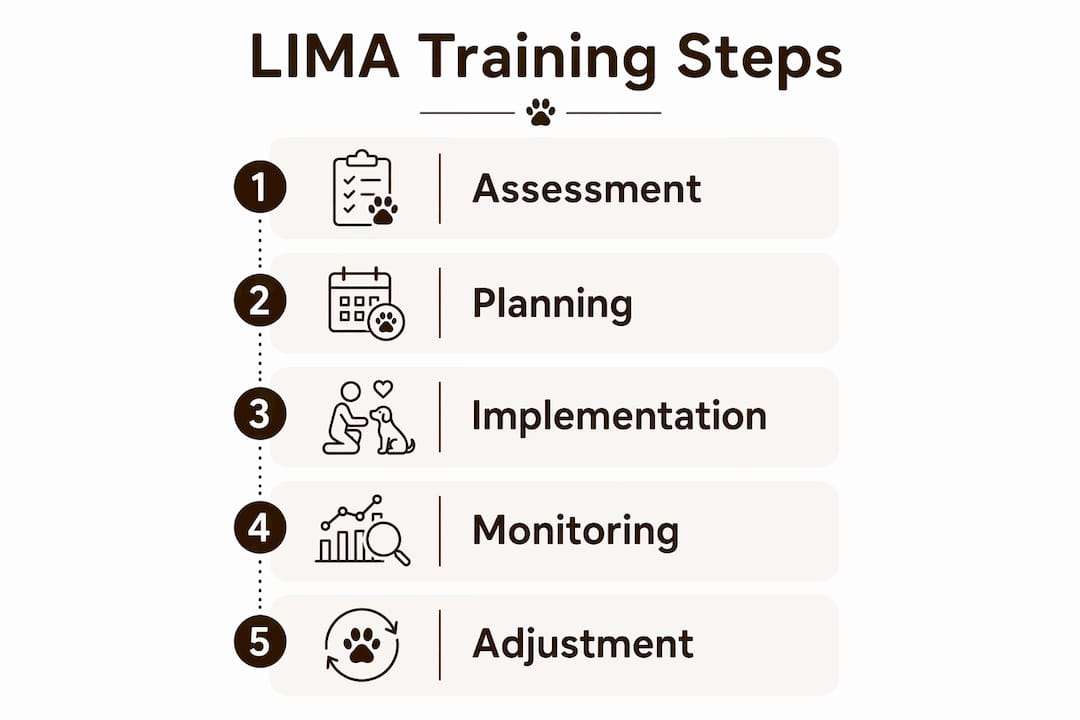
A well-run LIMA-based programme follows a clear sequence, and understanding it helps you judge whether a trainer is genuinely following the framework or just using the name.
Assessment phase. A thorough intake covers the dog’s health history, diet, daily routine, and the specific contexts in which the problem behaviour occurs. A functional assessment asks: what triggers the behaviour, what does the dog gain from it, and what environmental factors are maintaining it? Crucially, the trainer should ask you to get a veterinary check if there is any possibility of pain or illness driving the behaviour. Skipping this step is one of the most common, and most avoidable, failures in behaviour work.

Planning phase. With assessment data in hand, the trainer selects the lowest rung of the Humane Hierarchy that is genuinely likely to succeed. For most everyday issues, that means a combination of antecedent modification and positive reinforcement. The plan specifies which replacement behaviour the dog will learn, what the reinforcement schedule looks like, and what the owner needs to do between sessions.
A practical example: reactive leash behaviour. A dog that lunges and barks at other dogs on lead is a common concern. A LIMA-based plan might look like this: vet check to rule out pain; management by crossing the road or using quieter routes; teaching a “look at me” cue rewarded with high-value treats; gradually reducing distance to other dogs only as the dog stays calm; monitoring the dog’s body language at every session. If progress stalls after consistent effort, the trainer reassesses before considering any more intrusive tool.
Monitoring and escalation. Good LIMA practice includes data collection: noting the dog’s response, the distance at which reactions occur, and any signs of stress. If welfare indicators worsen, the trainer de-escalates, not escalates. Escalation to a more intrusive intervention only happens when there is clear evidence the current approach cannot succeed and the welfare cost of continuing outweighs the risk of moving up the hierarchy. For complex cases, particularly aggression with a bite history, referral to a veterinary behaviourist is the responsible next step. You can also explore how acupuncture for anxious dogs can support the physiological side of stress reduction alongside behaviour work.

What are the most common misconceptions about LIMA?
LIMA is probably the most misunderstood term in professional dog training. Here are the myths worth correcting.
“LIMA means force-free.” It does not. LIMA is a risk-based, judgement-driven framework. It permits more intrusive interventions when they are genuinely the least intrusive option that will succeed. The CCPDT guidance is explicit: LIMA does not justify replacing effective non-aversive strategies with punishment, but it does not categorically ban all aversives either.
“LIMA means positive-only.” Again, no. Positive-only is a philosophical position. LIMA is a procedural standard. A trainer who uses only positive reinforcement may be following LIMA in most cases, but LIMA itself is a broader framework that includes the full Humane Hierarchy.
“Any trainer can claim to follow LIMA.” The competence requirement means this claim needs scrutiny. LIMA requires adequate education, supervised experience, and ongoing professional development. A trainer who cannot explain the Humane Hierarchy or who reaches for punitive tools without documented assessment is not genuinely applying LIMA.
“LIMA is just a marketing label.” Steven Lindsay, who framed the concept in applied dog behaviour literature, grounded it in a specific competence criterion and a systematic approach to risk minimisation. It has a defined structure, not a slogan.
On ethical limits: the APDT warns that poorly applied punishment can cause aggression, suppressed behaviour, increased anxiety, physical harm, and a damaged bond between dog and owner. These are not theoretical risks. The “dead-dog rule” is a useful ethical check: if a behaviour plan only stops a behaviour without teaching an alternative, it is not a complete plan. In the UK, the Animal Welfare Act 2006 requires owners and those responsible for animals to meet their welfare needs, which includes protecting them from unnecessary suffering. LIMA’s framework aligns directly with that legal duty.
For complex cases, particularly those involving aggression, fear, or separation anxiety, the right escalation path in the UK is a referral to an ABTC-registered clinical animal behaviourist or a veterinary behaviourist, not simply a stronger training tool.
How do you find a trainer who genuinely follows LIMA?
Asking the right questions makes all the difference. Here is what to look for and what to avoid.
Questions to ask a prospective trainer:
“What does your initial assessment cover, and do you require a vet check before starting behaviour work?”
“Can you walk me through the Humane Hierarchy and how you apply it?”
“How do you decide when to escalate to a more intrusive intervention?”
“What does owner training look like, and how do you support me between sessions?”
“How do you monitor my dog’s welfare during the programme?”
Credentials and trust signals to look for:
CCPDT certification (CPDT-KA or CPDT-KSA) or IAABC membership (CDBC, CABC)
APDT membership with a commitment to the LIMA position statement
ABTC registration in the UK (look for the letters ABTC after their name)
Documented case studies, ongoing CPD, and willingness to liaise with your vet
Trust signal | Red flag |
Thorough written assessment before training begins | Vague or no intake process |
Explains the Humane Hierarchy clearly | Recommends punitive tools as the first option |
Monitors welfare and adjusts the plan | No data collection or welfare checks |
Encourages vet liaison for health concerns | Dismisses medical causes without investigation |
Holds CCPDT, IAABC, or ABTC credentials | Cannot name or explain their professional body |
Teaches you as the owner, not just the dog | Works only with the dog, leaves you out |
Clear escalation and referral policy | Refuses to refer to a vet or specialist |
For more on humane training methods and how they compare, it is worth reading around the broader range of science-based approaches before booking anyone.
Key takeaways
LIMA is the professional standard that requires trainers to select the least intrusive, minimally aversive intervention likely to succeed, working through the Humane Hierarchy before considering any more forceful approach.
Point | Details |
LIMA defined | Least Intrusive, Minimally Aversive: always use the gentlest effective method first. |
Humane Hierarchy | Six ordered levels from health checks to positive punishment; start at the bottom every time. |
Competence requirement | LIMA demands real skill; ask for CCPDT, IAABC, or ABTC credentials before hiring. |
Not force-free | LIMA is a risk-based framework, not a ban on all aversives; the distinction matters. |
Happy-dogtraining | Applies humane, science-based methods aligned with LIMA principles for personalised dog training. |
Why LIMA matters more than most trainers admit
There is a gap between what LIMA promises and how it is often presented. Too many trainers use it as a badge without doing the hard work the framework actually demands: thorough assessment, documented criteria for escalation, genuine owner education, and the humility to refer on when a case exceeds their competence.
The part that gets glossed over most often is the competence requirement. LIMA is not a set of techniques. It is a standard of professional judgement. A trainer who cannot explain why they are choosing a particular intervention, or who cannot articulate what evidence would lead them to change course, is not applying LIMA. They are applying habit.
The other underappreciated point is the welfare cost of getting it wrong in either direction. Jumping to aversives too quickly causes real harm: anxiety, suppressed behaviour, and a dog that stops communicating distress because it has learned that signals do not help. But staying too long with an approach that is not working, out of ideological commitment to a single method, also costs the dog. LIMA’s value is precisely that it asks you to keep asking the question: is this the least intrusive option that will actually work for this individual animal?
For owners, the practical takeaway is straightforward. Ask your trainer to explain their decision-making process, not just their methods. A good LIMA practitioner welcomes that conversation. If they cannot have it, keep looking.
Happy-dogtraining: personalised, humane training built on these principles
If you have read this far, you already know what good dog training looks like. Happy-dogtraining puts every one of these principles into practice, with over 20 years of experience in humane, science-based behaviour work. Whether your dog is struggling with reactivity, fearfulness, or basic obedience, every programme starts with a thorough assessment, a clear plan built around the Humane Hierarchy, and ongoing support so you and your dog keep making progress long after the sessions end.
The intensive obedience programme is a strong starting point for owners who want structured, fast-track results with a trainer who can explain every decision they make. For dogs with anxiety or fear, the fearful dog programme follows the same welfare-first approach. Free lifetime support is included with every programme, because the relationship between you and your dog does not end when the classes do.
Get in touch with Happy-dogtraining to book an assessment and take the first step towards a calmer, happier dog.
Useful sources and further reading
The sources below are the primary documents behind the LIMA framework. Reading the original position statements is the best way to verify a trainer’s claims.
Source | What it covers | Why it is useful |
APDT LIMA Position Statement | Full definition, competence requirement, Humane Hierarchy, and ethical limits | The primary professional standard document; cite this when evaluating a trainer’s claims |
CCPDT LIMA Policy | Certificant obligations, Humane Hierarchy detail, and examples of prohibited tools | Binding on all CPDT-KA and CPDT-KSA holders; useful for checking certification standards |
IAABC LIMA page | IAABC’s adoption of LIMA and the Humane Hierarchy | Confirms IAABC alignment; useful for verifying CDBC/CABC credential holders |
IAABC Humane Hierarchy | Detailed breakdown of each Humane Hierarchy level | Clear reference for owners who want to understand each rung in depth |
Happy-dogtraining humane methods blog | Overview of humane training approaches and how they compare | Practical reading for owners deciding which training style suits their dog |
This article is general information about LIMA principles and is not a substitute for professional advice. For complex behaviour issues, consult a qualified veterinary behaviourist or an ABTC-registered clinical animal behaviourist for guidance specific to your dog’s situation.
Recommended
Comments