Why does your dog ignore commands it clearly knows?
- Mark McDade
- 3 hours ago
- 9 min read
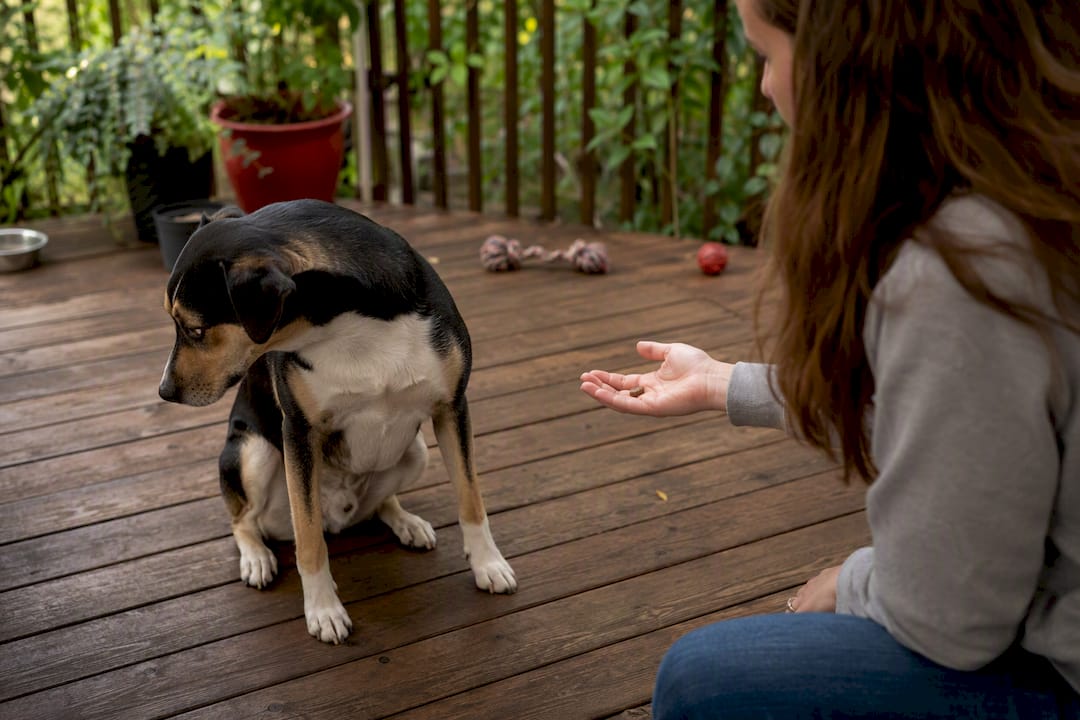
Dogs usually don’t generalise commands automatically. They learn a cue inside one training picture, complete with a location, your posture, and the smells in the room, and then need deliberate proofing to perform that same cue anywhere else. This is normal dog behaviour, not stubbornness or a training failure on your part.
Generalisation is the ability to perform a known behaviour across different contexts. Fluency is different: it means your dog responds instantly and correctly in one specific setting, every single time. A dog can be fluent at home and still have zero generalisation outdoors. The fix starts with an honest baseline check:
Test “sit” in your living room, ten times, with no lure or hand signal.
Count how many times your dog gets it right first time.
Anything below 8 out of 10 means you’re not ready to proof in a new context yet.
Key Takeaways
Reliable commands come from deliberate proofing across contexts, not from more repetition inside the same familiar setting.
Point | Details |
Generalisation isn’t automatic | Dogs learn cues inside a specific “picture” and need proofing to respond elsewhere. |
Check baseline fluency first | Aim for a high level of reliability in a quiet setting before adding new variables. |
Change one variable at a time | Move through posture, location, surface, distance, duration, then distractions in order. |
Avoid mixing methods | Combining reward-based and aversive techniques is linked to less reliable outcomes. |
Stalls often mean “go back a step” | Reduce criteria, rebuild confidence, and rule out stress or pain before pushing forward. |
Table of Contents
Why dogs struggle generalizing commands across new places and situations
Owners often assume a dog who sits perfectly in the kitchen understands “sit” as an abstract instruction. It doesn’t work that way. Dogs build associations from everything present during learning, not just the word you say.
Context dependency is the biggest factor. Your dog’s brain links the cue to the floor texture, your standing position, the time of day, and even which door you walked through. Change one of those variables and the cue can lose its meaning entirely, at least until it’s been practised there too.
Cue contamination compounds the problem. If you always lure with a treat held above the nose, or always say “sit” while leaning forward, that gesture or lean becomes part of the cue. Drop the lure or stand upright and some dogs genuinely can’t work out what you want.
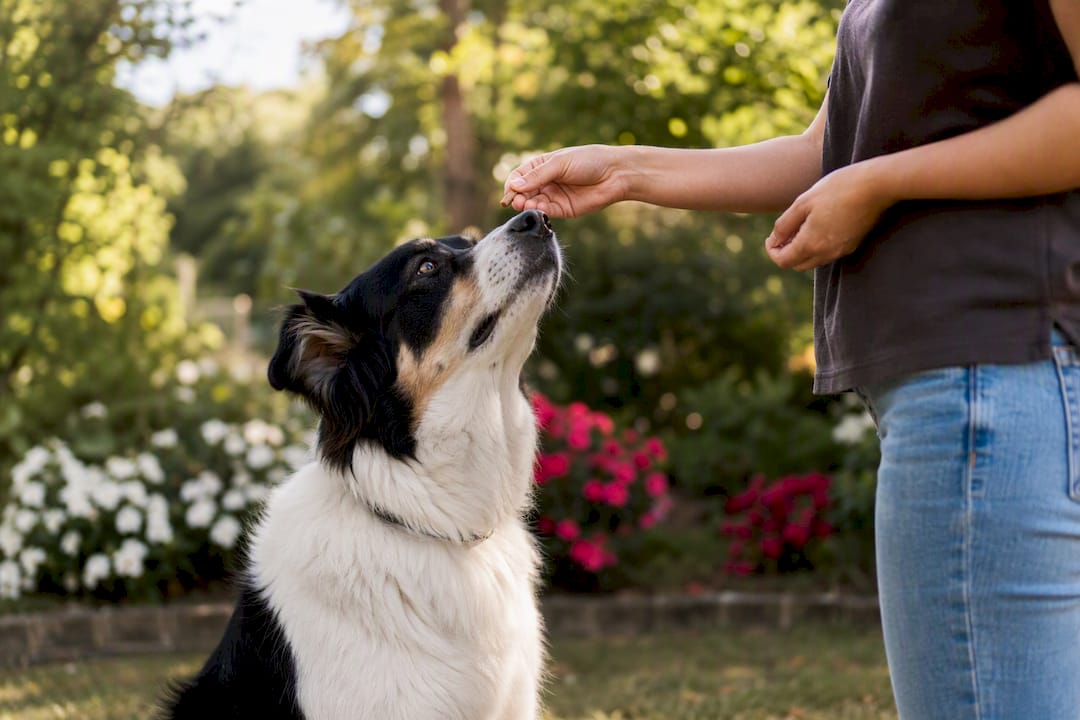
Distraction and stress matter enormously. A dog that’s mildly aroused by a squirrel, another dog, or unfamiliar noise has far less spare attention for processing a verbal cue. Recent findings on training methods and performance show that stress measurably impairs concentration and slows response times, and handler tone and consistency directly shape how reliably a dog answers a cue.
Owner inconsistency does real damage too. If one household member says “down” and another says “lie down,” or if the family mixes reward-based training with the occasional leash correction, the dog receives conflicting signals about what actually earns success.
Different family members using different words for the same behaviour
Switching between reward-based and aversive methods depending on mood
Skipping structured practice and relying on repetition alone
Under-socialising a puppy so new environments feel overwhelming
Ignoring breed tendencies or an individual dog’s temperament under pressure
Owners who skip structured classes are far more likely to fall into this trap. Research on the Generation Pup cohort found that owners who hadn’t attended a class recently were more likely to mix reward and aversive methods, a combination linked to less reliable outcomes. Life history plays its part as well: dogs with patchy early exposure or a history of rehoming often need more careful, incremental proofing than a dog raised in one stable environment.
How dogs actually learn: stimulus control and fluency explained
Every reliable behaviour starts with operant conditioning: your dog performs an action, a consequence follows, and the likelihood of repeating that action shifts accordingly. Reward the sit, and sitting becomes more frequent. This is the mechanism behind every command your dog knows, whether you taught it deliberately or not.
Stimulus control is what you’re really building when you train a cue. It means the behaviour happens reliably when the cue is given, rarely happens without it, and doesn’t happen in response to a different cue. Getting there takes a specific reinforcement history, built through repeated, successful pairings of cue and behaviour.
Here’s the part most owners miss: stimulus control built in one “picture” doesn’t transfer to a different picture by default.
Think of every training context as a photograph: the room, your posture, the leash, the background noise. Your dog may recognise the cue perfectly inside that one photograph and fail to recognise it the moment any detail changes. Generalisation means teaching the dog to respond to the cue itself, across dozens of different photographs, rather than to the photograph it first learned in.
That’s the core insight behind proofing, and it’s backed by practical fluency research from Whole Dog Journal: fluency in a single context is a milestone, not a finish line. A dog that sits instantly in your hallway ninety-five percent of the time has excellent fluency there. That figure tells you almost nothing about what happens at the vet’s waiting room or the local park. Reliability and generalisation are separate skills, and both need to be trained on purpose.
Common training mistakes that block generalisation
Most stalled progress traces back to one of four habits, and the good news is each one is fixable within a session or two.
Leaning on lures too long. A treat held at nose height, or a pointed finger, becomes part of the cue if you never fade it out.
Adding too many variables at once. Changing location, distance, and duration in the same session overwhelms most dogs and produces inconsistent results.
Letting household members use different words or gestures. Every inconsistency slows down stimulus control.
Reaching for corrections when a dog “ignores” a cue. This usually raises stress rather than improving understanding, and research on training methods and welfare links aversive approaches to reduced learning and poorer performance over time.
Pro Tip: If your dog stops responding in a new environment, that’s a training gap, not defiance. Go back one step, reward generously, and rebuild from there rather than repeating the cue louder.
A step-by-step proofing plan to teach real generalisation
Proofing means introducing new variables one at a time, in a sequence your dog can actually keep up with. Rushing this is the single most common reason progress stalls.
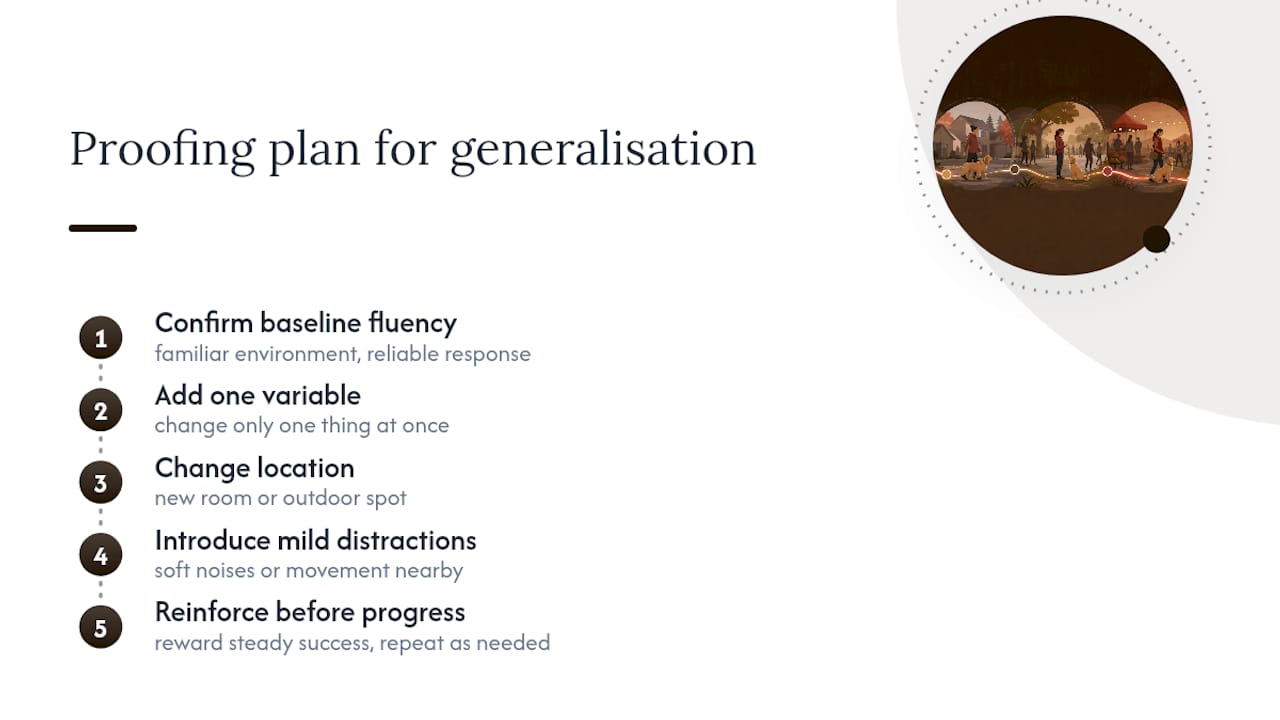
Step 1: Confirm baseline fluency
Before touching a new environment, your dog needs to hit roughly 80% reliability or higher on the cue in a quiet, familiar room, with no lure and no repeated cues. If you’re below that, spend a few more sessions building fluency where you are before moving anywhere else.
Step 2: Change one variable at a time
Work through variables in a deliberate order, and only move to the next once your dog holds that 80% benchmark:
Your posture — sit down, kneel, or turn side-on instead of always facing the dog squarely.
The room — hallway, garden, then a different room in the house.
The surface — carpet to tile to grass to pavement.
Distance — cue from two metres away, then five, then across a room.
Duration — extend how long a “stay” or “down” is held before release.
Controlled distractions — a second person walking past, then a toy on the floor, then a calm dog at a distance.
Step 3: Fade lures and thin reinforcement
Once the behaviour is reliable with a lure, remove the lure but keep the reward. Once it’s reliable without a lure every time, start rewarding every other correct response rather than every single one. This variable schedule actually strengthens the behaviour rather than weakening it, provided you don’t thin it too quickly.
Step 4: Structure your sessions
Run 3 to 5 short sessions a day, each lasting 3 to 5 minutes.
End on a success, not on a struggle.
Track your dog’s response rate each session, aiming to hold 80% before adding difficulty.
Set a weekly target: one new variable mastered per week is realistic for most healthy adult dogs.
Pro Tip: Keep a simple tally on your phone: correct responses out of ten attempts, per session. Numbers don’t lie, and they’ll show you progress on days when it doesn’t feel like anything’s changing.
Here’s how that looks for three common commands. For recall, proof it first in the garden, then a quiet park at 6am, then a busier park with the dog on a long line for safety. For stay, extend duration in the lounge first, then add distance, then move to the front garden with the door open. For sit, drop the hand lure first, then practise with you sitting on a chair instead of standing, then ask for it from across the kitchen. Reviewing how location itself shapes reliability is worthwhile if you want the full mechanics behind why training environment matters for command retention. Fading prompts correctly also matters enormously here, and home obedience best practices cover the fading sequence in more detail than fits here.
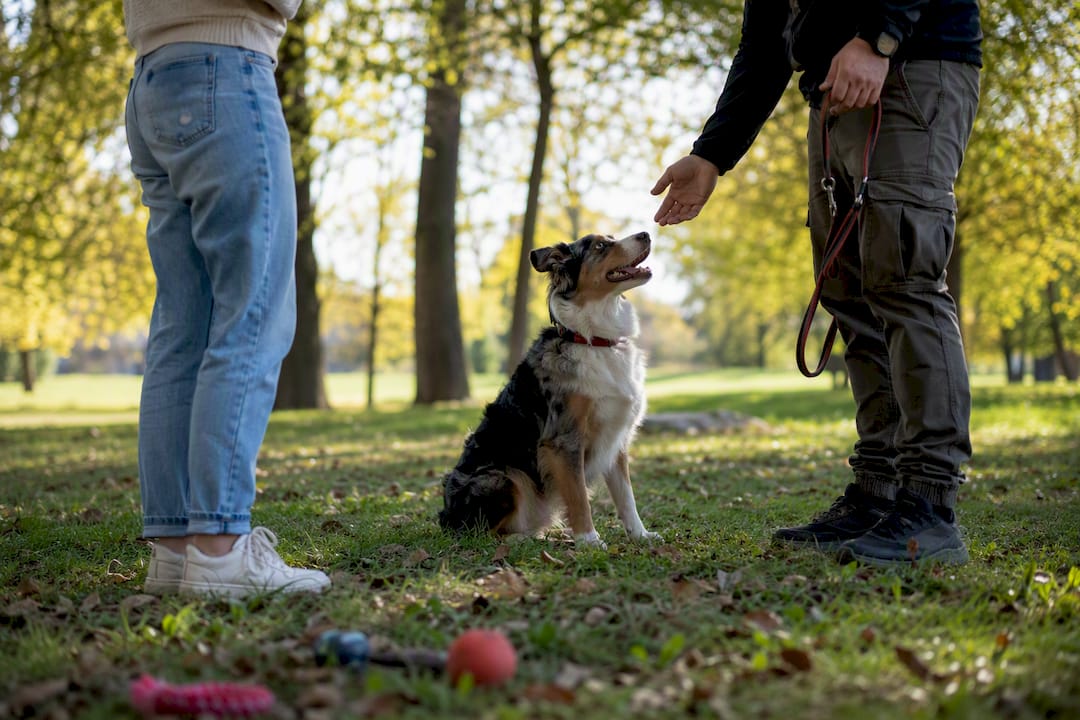
Troubleshooting stalls, regressions, and realistic timelines
A dog that suddenly stops responding somewhere it used to succeed isn’t necessarily forgetting the cue. Rule out pain, fatigue, illness, or a genuinely stressful environment before assuming it’s a training issue. A dog favouring a leg, panting heavily with no exertion, or showing whale eye and a tucked tail needs a vet check, not more repetitions.
If progress has genuinely stalled on a training variable, drop back a step and rebuild confidence there before pushing forward again. Holding a step for an extra two or three sessions costs you nothing; skipping ahead when the dog isn’t ready costs you weeks.
Realistic timelines vary by dog:
Puppies often generalise basic cues within a few weeks, since they’re absorbing new pictures constantly anyway.
Adult companion dogs with an established routine typically need several weeks to a few months to proof commands across multiple environments.
Anxious or rescue dogs may need months, with slower increases in distraction and distance, and extra patience around new locations.
Before escalating to a trainer, check the basics: is the environment too distracting for the current step, is the reward valuable enough, and has criteria crept up too fast? If all three check out and progress still isn’t moving, that’s the point to bring in professional support.
How Happy-dogtraining builds generalisation into every programme
Happy-dogtraining has spent over 20 years working through exactly this problem with families across a huge range of dogs, from confident puppies to dogs with genuine fear or aggression histories. The approach stays firmly evidence-based: reward-driven methods, AVS-accredited standards, and proofing built into the structure of every session rather than left to chance.
Personalised obedience programmes that proof commands across real locations, not just the training room.
Behaviour modification support for fearfulness, reactivity, and aggression, where generalisation failures often show up as inconsistency between “good at home, difficult outside.”
An AVS-approved intensive programme for owners who need faster, structured progress.
Free lifetime support after training completes, so proofing questions that come up months later still get answered.
Assessment matters more than most owners expect. A trainer watching your dog’s specific stress signals and life history can build a proofing sequence tailored to that dog, which speeds up progress considerably for harder cases. The humane training methods Happy-dogtraining relies on are the same reward-based approaches the research above consistently favours over aversive alternatives.
A note on patience and small wins
Struggling with generalisation doesn’t mean you’ve done anything wrong. Every dog I’ve read about, worked with, or heard described by trainers hits this wall at some point, usually right when the owner feels most confident. One class example that stuck with me: a nervous rescue dog who took nearly three months just to hold a “stay” reliably with a stranger in the room, then generalised the next four environments in barely two weeks. Progress compounds once the picture starts to click.
Track small wins rather than chasing perfection. Ten short, successful sessions across a week beat one long, frustrating one. Short sessions, honest tracking, and a bit of patience get you there.
Sources
FAQ
Why does my dog obey at home but not outside? Your dog learned the cue inside a specific context: your home’s layout, your posture, and the absence of distractions. Outside introduces new variables the behaviour hasn’t been proofed against yet, so it isn’t reliable there without additional practice.
How long does it take to generalise a command? It depends on the dog. Puppies often generalise basic cues within weeks, adult companion dogs typically need several weeks to a few months, and anxious or rescue dogs may need months of gradual, careful proofing.
Is my dog being stubborn if it ignores a known command? Almost never. What looks like stubbornness is usually a gap in stimulus control caused by a new environment, too much distraction, or an inconsistent cue. Dropping back a step in difficulty and rewarding success usually resolves it faster than repeating the command.
Can I fix command confusion myself, or do I need a trainer? Many owners can proof commands successfully using a structured, one-variable-at-a-time approach. If progress stalls despite consistent practice, or if fear or aggression is involved, a personalised assessment speeds things up considerably and helps rule out underlying stress or medical causes.
Recommended
Comments