Why home distractions affect dog training in Singapore
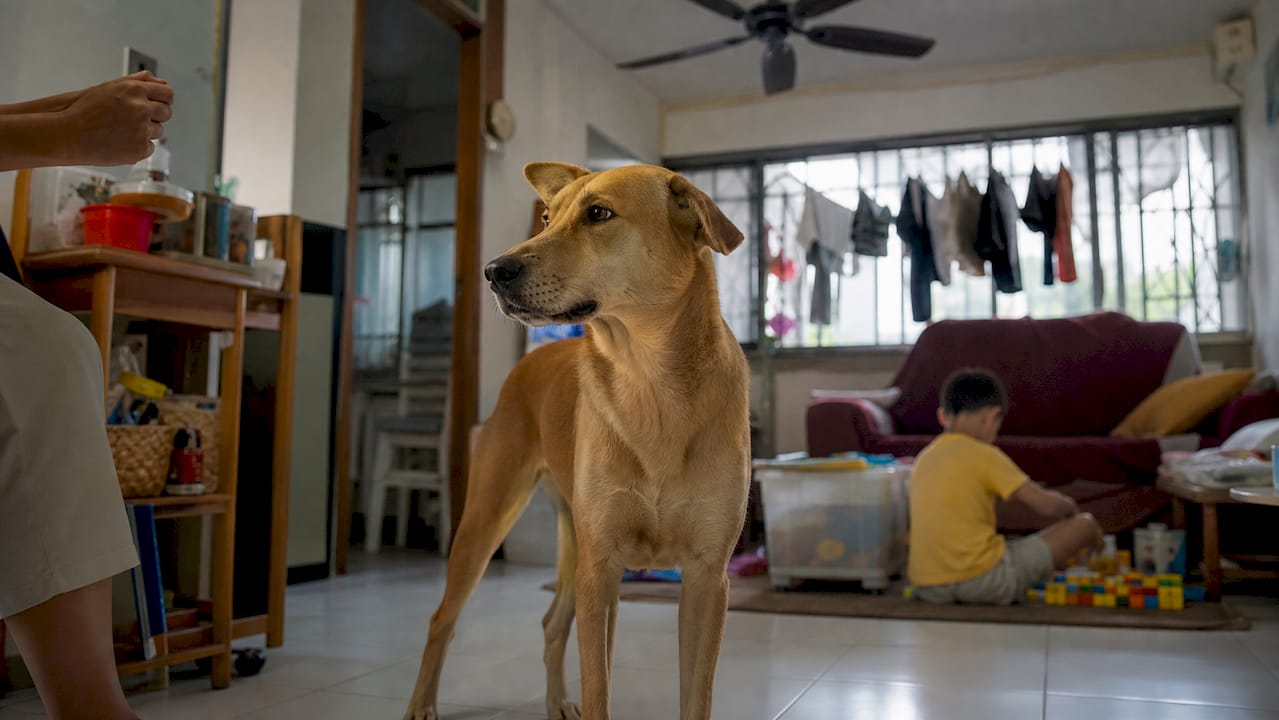
Home distractions break training because your dog cannot yet process a familiar cue when competing stimuli are louder, smellier, or more exciting than your reward. The behaviour hasn’t failed — it simply hasn’t been taught in that context yet. The good news is that a structured, one-distraction-at-a-time approach, grounded in the LIMA (Least Intrusive, Minimally Aversive) principles recommended by Singapore’s Animal and Veterinary Service (AVS), can fix this reliably.
Start here, right now:
Reduce the environment. Move to the quietest room in your flat, close the door, and turn off the television.
Raise the reward. Swap dry kibble for a small piece of chicken or cheese — something your dog rarely gets elsewhere.
Step back in difficulty. Ask for a behaviour your dog gets right nine times out of ten in a calm setting before adding any distraction.
Key takeaways
Home distractions break training because dogs do not automatically generalise behaviours across contexts, and household rewards routinely outcompete low-value training treats.
Point | Details |
Generalisation must be taught | A behaviour learned in one room is not automatically available in another — proof it in every relevant context. |
One distraction at a time | Add a single new distraction per session and advance only after 8/10 correct responses across two sessions. |
Raise rewards as difficulty rises | Use your dog’s highest-value treat when introducing a new distraction, not a standard kibble reward. |
Singapore heat and HDB specifics | Train outdoors before 08:00 or after 19:00; run indoor AC sessions during peak heat; desensitise to lifts gradually. |
Happy-dogtraining for expert support | AVS-aligned, LIMA-based programmes with 20+ years of Singapore HDB experience and free lifetime support. |
Table of Contents
Why do home distractions affect training so much?
Three things happen simultaneously when your home is busy, and each one chips away at your dog’s ability to respond.
Environmental overload occurs when the number of stimuli exceeds what your dog can filter. A ringing doorbell, a child running past, and the smell of dinner cooking are each manageable alone. Together, they push your dog past the threshold where learning is possible. The training environment itself shapes how well a dog retains and applies skills, which is why the same dog who sits perfectly in a quiet bedroom may look completely blank at the front door.
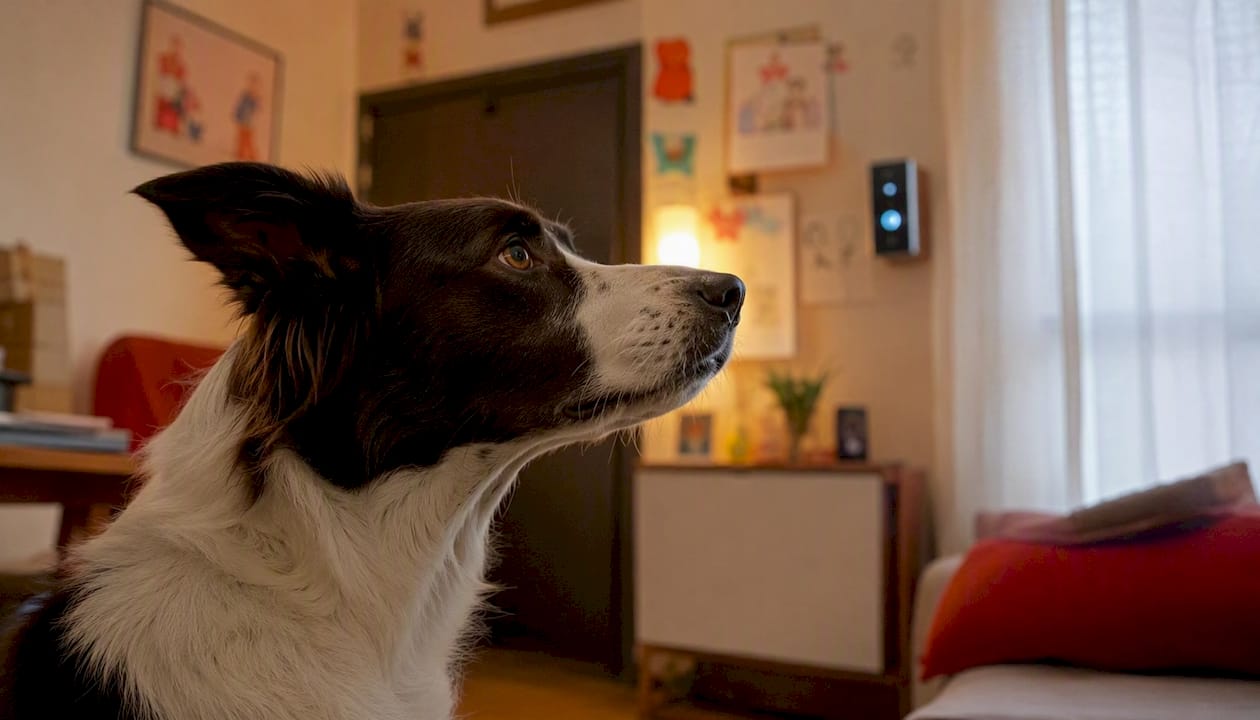
Lack of generalisation is the technical term for what owners often describe as selective listening. As the AKC explains, dogs do not automatically transfer a behaviour learned in one setting to a different one. A “sit” practised only in the living room is, from your dog’s perspective, a living-room behaviour. The front corridor is a different world.
Reinforcement history is the third factor. At home, your dog has learned that the sofa, the food bowl, the family members, and the front door all deliver rewards without any cue from you. Your training treat competes against all of that. When the competing rewards win consistently, the cue loses its meaning.
Consider a common pattern: a dog who sits reliably in a training class but ignores the same cue the moment a visitor rings the doorbell. The class environment was structured and low-distraction. The doorbell context was never trained. The dog isn’t being stubborn — the behaviour simply hasn’t been proofed in that setting.
Competing rewards at home (food smells, door excitement, family movement) routinely outvalue a standard training treat.
Owners often accidentally teach delay by repeating a cue until the dog responds, which trains the dog that the first cue is optional.
Inconsistent cues across family members compound the problem quickly.
The one-distraction-at-a-time progression that actually works
Structured progression is the method trainers use to close the gap between a quiet-room success and a busy-home success. The AKC recommends starting in low-distraction environments and advancing stepwise, and the logic is simple: each new distraction is a new test, and your dog needs to pass the easy test before sitting the hard one.
Choose a single, low-distraction room. No television, no other pets, no family traffic. Ask for your target behaviour ten times.
Add one predictable distraction. Turn on the television at low volume, or place a toy on the floor two metres away. Keep everything else the same.
Apply a pass criterion. Eight correct responses out of ten, across two separate sessions, counts as mastery. If your dog scores below that, the distraction is too intense — reduce it.
Advance only after mastery. Move the toy closer, raise the television volume, or introduce a second distraction. Never combine two new variables in the same session.
Track the three Ds separately. Distance, duration, and distraction are three independent axes. Increasing all three at once is the most common reason progress stalls.
Pro Tip: Reserve your highest-value reward — the one your dog goes absolutely wild for — exclusively for the moment a new distraction appears. This teaches your dog that harder situations predict better outcomes, which builds confidence rather than anxiety.
Practical indoor drills to build focus at home
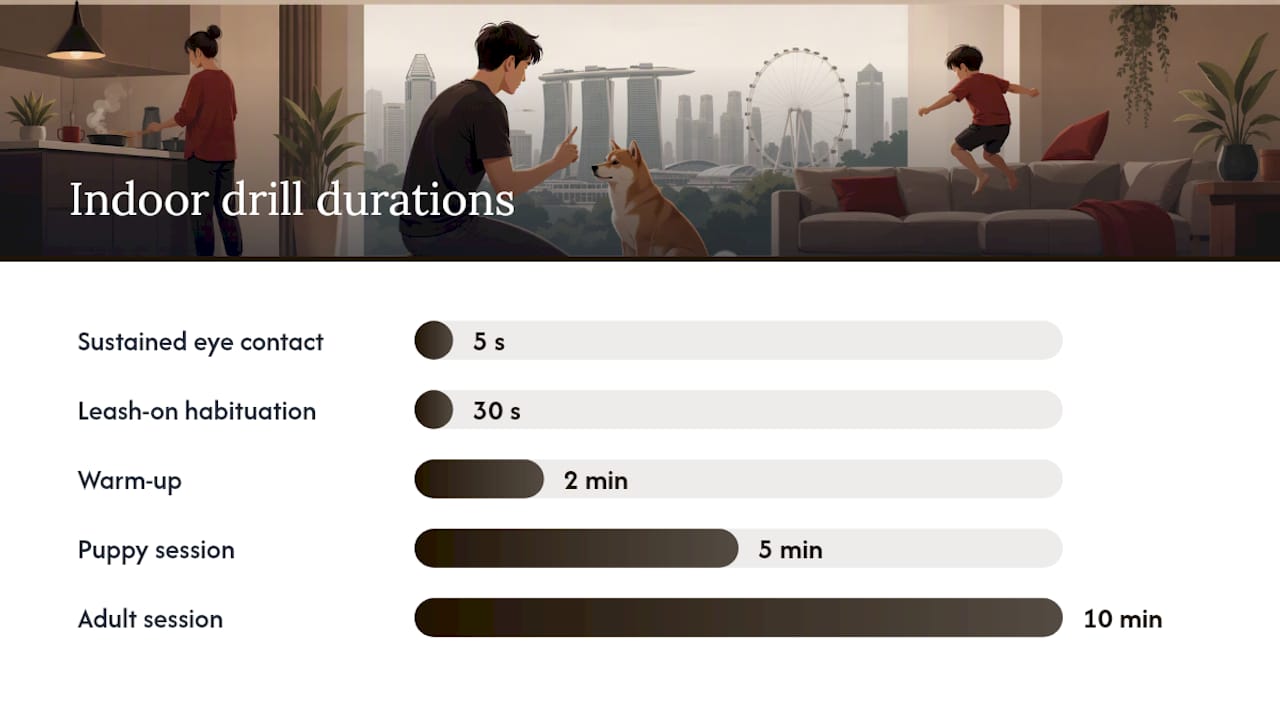
Varied indoor distractions, introduced progressively, build general distraction tolerance even when they don’t perfectly mirror outdoor triggers. Here is a simple session structure you can run in your HDB flat.
Warm-up (2 minutes): Ask for three or four behaviours your dog knows well and reward generously. This signals that training is starting and gets your dog’s focus on you.
Leash-on habituation. Clip the harness and leash, then simply stand still for thirty seconds before asking for anything. Many dogs become aroused the moment equipment appears — this step teaches calm before the session begins.
“Watch me” with static distraction. Place a toy on the floor. Ask for eye contact. Reward the moment your dog looks at you rather than the toy. Build to five seconds of sustained eye contact.
“Watch me” with moving distraction. Have a family member walk slowly across the room while you ask for eye contact. Start at the far end of the room and gradually reduce the distance over multiple sessions.
Food competition drill. Place a treat on the floor and cover it with your foot. Wait. The moment your dog stops trying to get it and looks at you, mark and reward with a different, higher-value treat from your pouch.
Cool-down signal. Use a consistent phrase such as “all done” and scatter a few treats on the floor. This tells your dog the session is over and prevents them from pestering you for more.
Keep sessions to five minutes maximum for puppies, ten minutes for adult dogs.
Two short sessions per day outperform one long one.
End every session before your dog loses interest — a clean finish builds positive associations with training.
Pro Tip: Always train with the harness and leash already on, even indoors. If your dog only wears equipment outdoors, the equipment itself becomes a distraction trigger. Wearing it at home normalises it.
Small home changes that make training sessions work
Structuring the environment is often the missing ingredient in domestic training success. These adjustments take minutes and make a measurable difference.
Remove competing rewards before you start. Put the food bowl away, close the kitchen door, and ask family members to sit quietly or leave the room.
Set a training zone. A consistent spot — a mat, a corner of the living room — helps your dog understand that this space means focus. A dedicated home training space doesn’t need to be large; a two-metre-square area is enough.
Standardise cues across the family. If you say “sit” and your partner says “sit down,” your dog is learning two different cues. Pick one word per behaviour and stick to it.
Stop accidental reinforcement. If your dog jumps up and you push them away, that physical contact is often rewarding. Turn your back, cross your arms, and wait for four paws on the floor before giving any attention.
Check readiness before starting. A dog that is hungry, over-tired, or bursting with unspent energy will struggle to focus. A short walk or play session before training often improves responsiveness noticeably.
Keep a treat pouch ready so rewards are immediate — a two-second delay between behaviour and reward is long enough to confuse the association.
How to recognise overload and when to stop
Knowing when to pause is as important as knowing how to progress. Watch for these red flags during any session.
Freezing or shutting down: your dog stops responding entirely and looks away or lies flat.
Repeated stress signals: yawning, lip-licking, shaking off, or excessive sniffing when there is nothing to sniff.
Sudden aggression or snapping: a dog that has never snapped before doing so during training needs an immediate session stop and a vet check to rule out pain.
Repeated urination indoors during a session can indicate extreme stress rather than a housetraining lapse.
If you see any of these, stop the session, reduce the distraction level at the next attempt, and shorten the session length. If the signs persist across multiple sessions, consult your vet first to rule out a medical cause, then contact a professional trainer. Avoid the urge to push through — paced, choice-based exposure prevents flooding, which can set progress back significantly.
Singapore specifics: HDB lifts, heat, and NParks guidance
Living in an HDB estate means your dog encounters lifts, corridors, trolleys, and neighbours at close range every single day. These are not optional distractions — they need to be trained for specifically.
Lift desensitisation: begin at a distance where your dog notices the lift but remains calm. Reward calm behaviour, then gradually move closer over several sessions. Never force your dog into a lift when they are showing stress signals.
Corridor etiquette: practise a default “sit and wait” at your flat door before stepping out. This prevents door-bolting and sets a calm tone for the whole walk.
Heat management: Singapore’s midday heat is genuinely dangerous for dogs on hot pavement. Schedule outdoor sessions before 08:00 or after 19:00, and run skill-building drills indoors in air conditioning during peak hours.
NParks dog runs offer a controlled space to practise generalisation with other dogs and people present — use them as a mid-level distraction environment once your dog is solid indoors.
AVS recommends humane, science-based methods and the LIMA hierarchy for all training and behaviour change in Singapore. Choosing a trainer who follows these guidelines protects your dog’s welfare and ensures the methods are legally and ethically sound.
A compact 4-week plan you can start this week
This plan follows a consistent home training routine and builds distraction tolerance gradually.
Week 1 — Low-distraction mastery. Train in the quietest room. Target two behaviours (sit, eye contact). Pass criterion: 8/10 correct across two sessions before moving on.
Week 2 — Single indoor distraction. Add one distraction per session (toy on floor, television on low, family member in the room). Keep the same two behaviours. Same pass criterion applies.
Week 3 — Short outdoor exposure. Move one session per day to the corridor or void deck, before 08:00 or after 19:00. Ask only for well-established behaviours. Reward generously.
Week 4 — Maintain and generalise. Vary the location within the home and outside. Introduce the lift desensitisation protocol. If your dog passes 8/10 in three different locations, the behaviour is beginning to generalise.
Session template: 2-minute warm-up, 3–5 focused reps of the target behaviour, a 1-minute mini-break (free sniff or play), then 3–5 more reps, cool-down signal.
Two sessions daily, five days per week.
If your dog fails the pass criterion two weeks in a row, repeat the previous week rather than advancing.
What an accredited trainer does differently
A professional assessment goes well beyond watching your dog sit and stay. Here is what a structured intake looks like.
History review: age, breed, previous training, any medical conditions, and the specific contexts where behaviour breaks down.
Medical triage: ruling out pain, hearing loss, or anxiety as a root cause before any training begins.
Threshold mapping: identifying exactly how close or how intense a distraction needs to be before your dog loses focus.
Reinforcement inventory: finding out what your dog actually values most, because the best reward is the one your dog chooses, not the one you assume they like.
A private session then builds a staged plan around those findings, with clear behaviour goals and session cadence.
An AVS-approved programme adds a structured curriculum with measurable milestones and official recognition.
Progress is reviewed at each session and the plan is adjusted in real time.
Happy-dogtraining’s AVS-aligned, LIMA-based approach means every technique used is the least intrusive option that will achieve the goal. With over 20 years of experience working in Singapore homes, the team understands HDB-specific challenges — lifts, corridors, heat, and close-quarter neighbours — and builds those into the plan from day one. Free lifetime support after training means you are never left to figure out a new challenge alone. Explore humane training methods to understand why this approach produces lasting results.
A trainer’s honest note on HDB homes
Working in HDB flats across Singapore, the pattern I see most often is this: a dog who is genuinely trying, and an owner who is genuinely trying, but the environment is working against both of them. The lift dings, a neighbour’s door slams, and suddenly the “sit” that worked beautifully in the living room disappears completely. That is not failure — it is simply a behaviour that hasn’t been proofed in that context yet.
Progress in a busy home environment is real, but it is measured in weeks, not days. If you work through the four-week plan above and still feel stuck, that is the right moment to bring in a professional. You don’t have to solve this alone.
Happy-dogtraining can help you get there faster
Consistent progress at home is absolutely achievable — and when you want expert guidance alongside your own efforts, Happy-dogtraining offers a clear path forward.
The 4-week AVS-approved intensive programme is built precisely for Singapore dog owners dealing with home obedience challenges. It covers distraction proofing, HDB-specific generalisation, and behaviour modification — all using LIMA-based, humane methods that AVS endorses. Services include home obedience classes, behaviour consultations, board and train, and fearfulness or aggression programmes. Every booking starts with a thorough assessment so the plan fits your dog, your flat, and your family’s routine. Free lifetime support is included after training, so you have a trusted resource whenever a new challenge comes up. To take the next step, visit Happy-dogtraining and book your assessment today.
Sources
These sources are worth bookmarking whether you are working through the plan yourself or preparing to speak with a trainer.
Recommended
Comments