Why socialisation matters for your puppy's future
Updated: Aug 14
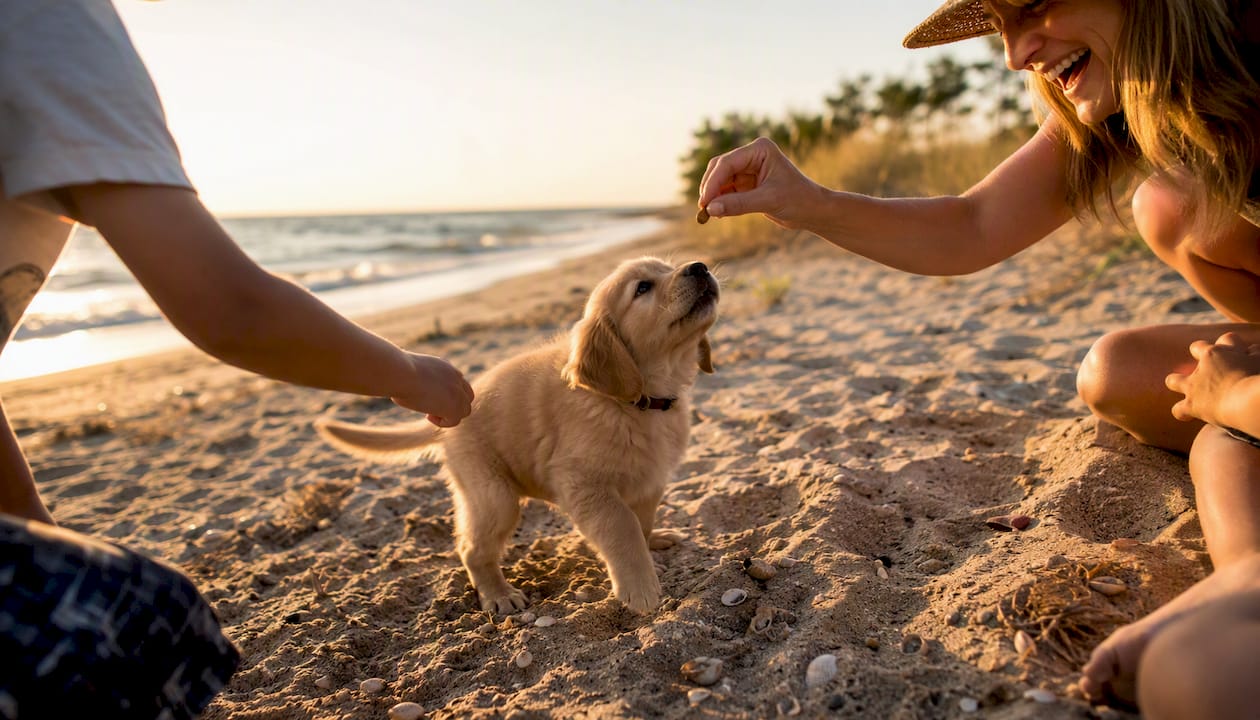
Early socialisation is the single most powerful influence on a puppy’s long-term confidence and behaviour. The AVSAB position statement identifies the first three months of life as the primary window, and both the Kennel Club and RSPCA echo that guidance for UK owners. Miss it, and you risk a dog who finds the world frightening rather than fascinating.
Three things you can do today:
Begin gentle handling — pick up your puppy, touch their paws, ears and mouth calmly, and reward with a small treat each time.
Write a short exposure checklist — list multiple sights, sounds or surfaces your puppy has not yet encountered and plan regular new experiences.
Call your vet — ask about your puppy’s current vaccination status and which low-risk outings are safe right now.
Key takeaways
Early socialisation during the three-to-twelve-week sensitive period is the most effective way to reduce fear-based behaviour and build a confident, trainable dog.
Point | Details |
Start immediately | Begin gentle handling and home exposures from day one; the window opens at three weeks. |
The critical window is narrow | The sensitive period typically runs from 3–12 or 3–14 weeks; missing it increases the risk of fear and aggression in adulthood. |
Balance vaccination and socialisation | Indoor classes from one week after first vaccination and visits with known vaccinated dogs are low-risk options during the window. |
Read body language | Whale eye, tucked tail and avoidance mean stop; calm interest and loose body mean continue. |
Keep going after puppyhood | Monthly new environments, varied handling and continued exposure through adolescence maintain the gains made early on. |
Table of Contents
Why socialisation matters so much for puppies
Puppy socialisation is the process of introducing your puppy, in a calm and controlled way, to the people, animals, sounds, surfaces and handling they will encounter throughout their life. The goal is not simply exposure; it is positive exposure, so the puppy learns that new things are safe rather than threatening.
The core aims are clear:
Reduced fearfulness and anxiety around strangers, children and other animals.
Relaxed behaviour at the vet and groomer, where handling is unavoidable.
Easier training, because a confident puppy pays attention rather than scanning for threats.
Safer interactions in public, reducing the risk of reactive or aggressive responses.
Resilience to novelty, so an unexpected sound or surface does not derail your dog’s day.
Research confirms that puppies socialised in controlled settings are less likely to develop fear responses to common household stimuli, and that early positive handling supports later training success.
Pro Tip: Ask at least five different people, including a child and someone wearing a hat or glasses, to offer your puppy a treat in the first two weeks at home. Variety in the people your puppy meets is just as important as the number of encounters.
The Kennel Club, RSPCA and Blue Cross all publish free guidance on socialisation for UK owners and are worth bookmarking as ongoing references.
When does the critical window open and close?
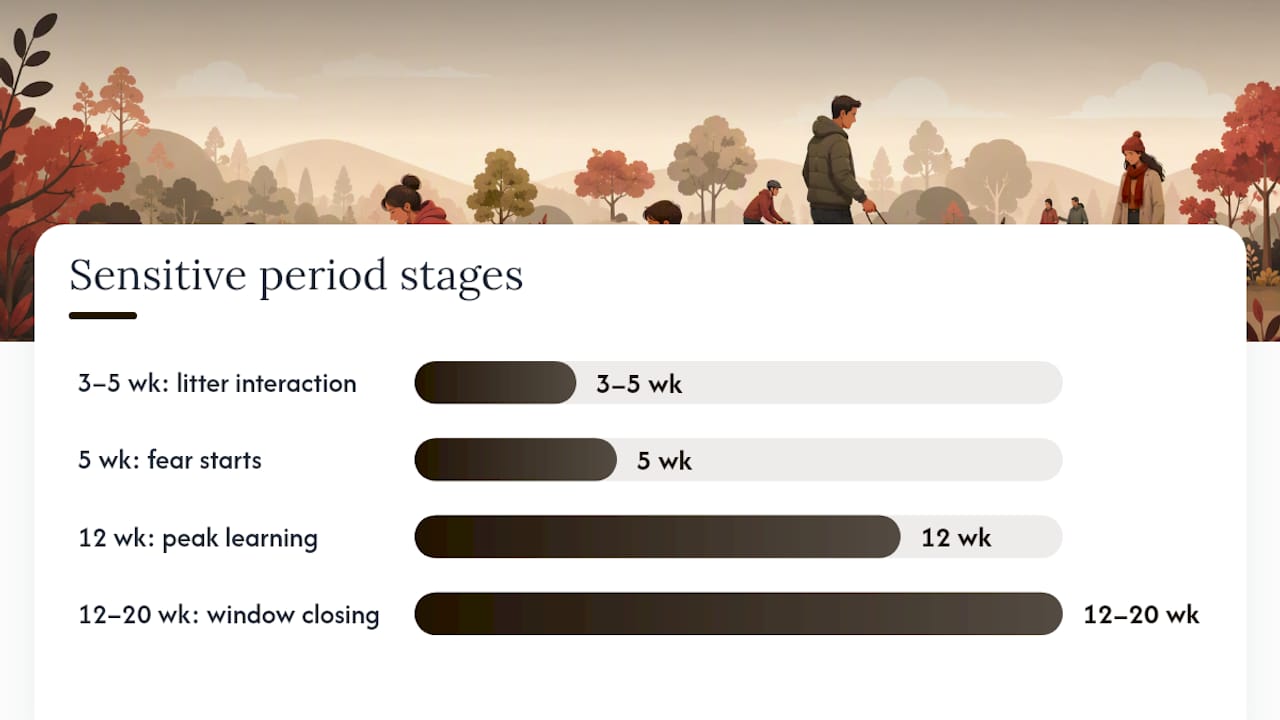
The sensitive period for socialisation typically runs from around three weeks to about twelve weeks of age. During this time, a puppy’s brain is primed to accept new experiences with relatively little fear. After the window closes, the same exposures are still possible but require considerably more effort and patience.
Age | What is happening | What to prioritise |
3–5 weeks | Puppy begins interacting with littermates and dam | Breeder-led gentle handling, household sounds |
5 weeks | Fear responses start to develop; learning accelerates | Varied handling by different people, surfaces, mild sounds |
12 weeks | Peak learning window; puppy arrives in new home | Broad, positive exposures daily; vet visit; car travel |
12–20 weeks | Window closing; fear responses strengthen | Consolidate gains; introduce classes; continue variety |
A narrative systematic review of 29 studies concluded that early exposure during the sensitive period is crucial to preventing later fear and aggression, while noting that many existing studies are retrospective and that more experimental research is needed. The evidence base is strong enough to act on, even if it is not yet complete.
Breed and individual variation matter here. Larger breeds often mature more slowly, and some individuals within a litter are naturally bolder or more cautious. Watch your puppy’s body language rather than relying on age alone to judge readiness. Understanding how puppy learning works can help you read those signals accurately.
What should you actually expose your puppy to?
The breadth of exposure during the peak window directly affects how well your puppy generalises those experiences to unfamiliar situations as an adult. ASPCApro’s guidance is clear: the more bases you cover between three and twelve weeks, the more confident your adult dog will be.
A practical UK checklist:
People: adults, children, elderly people, people in hats, glasses, high-visibility jackets, people with pushchairs or walking aids.
Handling: paws, ears, mouth, tail, body; being lifted, held still, examined on a table.
Surfaces: carpet, tiles, grass, gravel, metal grids, wooden decking, wet ground.
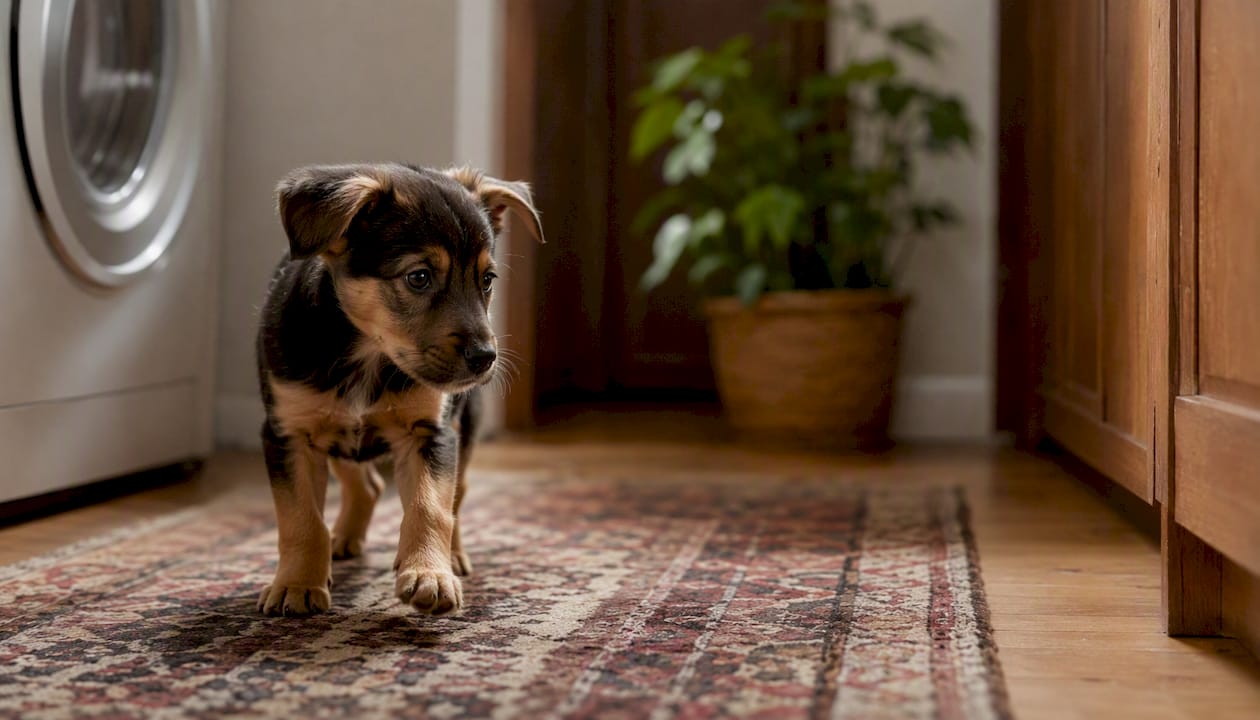
Sounds: hoover, doorbell, washing machine, traffic, thunder recordings, children playing.
Transport: car journeys, bus stops (even just sitting nearby), lifts and escalators.
Environments: town centres, parks, pet-friendly shops, railway stations, rural footpaths.
Urban vs rural note: If your puppy will live in a city, prioritise traffic noise, crowds and lifts early. Rural puppies need early exposure to farm machinery, livestock sounds and open spaces. Think about your dog’s actual future life and plan accordingly.
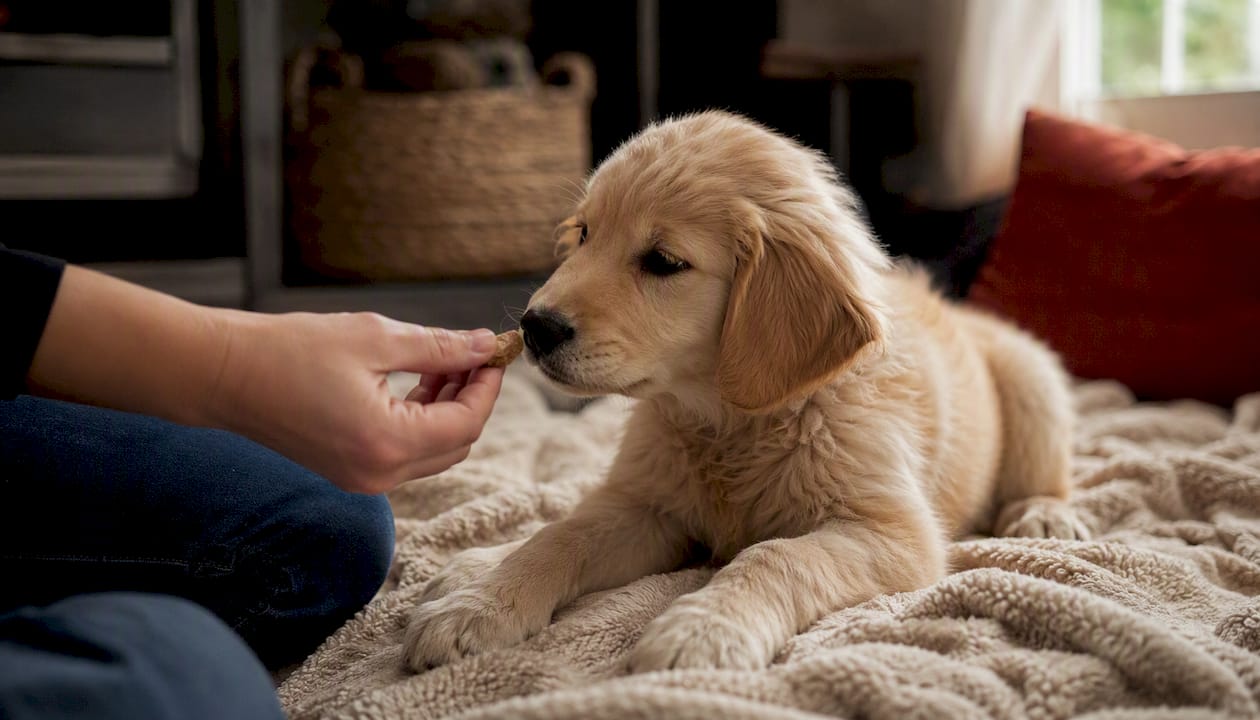
Pro Tip: Pair every new experience with a high-value treat the moment your puppy notices the stimulus calmly. You are not rewarding the stimulus itself; you are rewarding the puppy’s relaxed response to it. This builds a positive association quickly and reliably.
How to socialise your puppy safely, step by step
Safe socialisation follows a graded approach. Flooding a puppy with intense stimuli does not build confidence; it builds fear. The process below keeps experiences positive and your puppy in control.
Set up the environment. Choose a quiet moment and a manageable setting. Remove competing distractions.
Start at low intensity. Introduce the stimulus at a distance or low volume. A hoover switched off in the corner is less threatening than one running at full power two metres away.
Reward calm interest. The moment your puppy looks at the stimulus without retreating, mark the behaviour with a cheerful “yes” or a clicker and offer a treat.
Repeat before increasing. Only move closer or raise the intensity once your puppy is consistently relaxed at the current level.
Keep sessions short. Five to ten minutes is plenty for a young puppy. End on a positive response, not a fearful one.
Reading your puppy’s body language
Knowing what your puppy is telling you is the most important skill in socialisation:
Calm interest: soft body, loose tail wag, forward ears, sniffing. Keep going.
Mild uncertainty: tail lowered, body slightly crouched, lip lick. Slow down; do not push further.
Fear signals: whale eye (whites of eyes visible), tucked tail, cowering, trembling, attempting to flee. Stop immediately.
Avoidance: turning away, hiding behind your legs, refusing treats. The puppy is over threshold.
If your puppy shows fear, back off, reduce the intensity of the stimulus and use your highest-value reward to rebuild confidence at a comfortable distance. Professional trainers advise that continuing an exposure when a puppy is frightened can turn a learning opportunity into a negative experience that is much harder to undo. If fear persists across multiple sessions, seek help from a qualified trainer or veterinary behaviourist sooner rather than later.
Pro Tip: In a multi-puppy household, socialise each puppy individually for at least part of every session. Puppies that only ever experience the world as a pair can become anxious when separated.
Should you take your puppy to classes and playgroups?
Structured puppy classes offer something home socialisation cannot: a trainer-mediated environment where your puppy meets other dogs and people under supervision, learns basic manners and practises focus around distractions. Puppies attending classes before twenty weeks show measurably less fear to common stimuli such as thunder and vacuum cleaners, according to VCA Animal Hospitals.
What a well-run class looks like:
Clean, indoor surface (reduces infectious-disease risk before full vaccination).
Vaccination checks for all attending puppies.
Small group size, typically no more than six to eight puppies.
Positive-reinforcement methods only; no punishment or forced interaction.
A qualified trainer who can read group dynamics and intervene quickly.
When choosing a class or playgroup in the UK, ask:
What is the vaccination policy, and is proof required?
Are sessions held indoors on a cleanable surface?
What qualifications does the trainer hold (e.g., APDT membership, IMDT certification)?
How are fearful or boisterous puppies managed?
On timing: most vets recommend waiting until at least one week after the first vaccination before attending indoor classes. Discuss your puppy’s specific protocol with your vet, because local disease prevalence affects the risk calculation. The puppy class benefits guide from Happy-dogtraining covers what families should expect in more detail.
What happens when socialisation is inadequate?
Poor or absent socialisation during the sensitive period is one of the most common roots of serious behavioural problems in adult dogs. The likely outcomes include:
Fearfulness and avoidance of strangers, children, other dogs or everyday environments.
Reactivity on the lead, including barking, lunging or growling at triggers.
Aggression rooted in fear, particularly when a dog feels cornered or cannot escape.
Separation anxiety, often linked to insufficient early independence training.
Higher risk of rehoming or relinquishment to shelters.
The AVSAB notes that behavioural problems are a leading cause of dogs being surrendered to shelters, and that controlled socialisation before full vaccination is recommended precisely because the behavioural risk of missing the window often outweighs the infectious-disease risk posed by managed, low-risk outings.
If your puppy is already showing persistent fear or reactivity, a behaviour modification plan tailored to their specific triggers is the right next step. A veterinary behaviourist or certified trainer can assess whether the response is within normal range or needs structured intervention.
How to balance vaccination and socialisation safely
The tension is real: the sensitive window closes before many standard UK vaccination protocols are complete. Waiting until full protection is achieved means missing the most receptive weeks. Veterinary guidance from Ohio State University recommends an individualised, low-risk exposure plan that weighs local disease prevalence and vaccination timing rather than a blanket rule.
A practical plan for UK owners:
Start at home immediately. Household sounds, surfaces, handling and visitors carry no infectious-disease risk and can begin on day one.
Attend indoor, sanitised puppy classes from one week after the first vaccination. Indoor surfaces that are cleaned between sessions significantly reduce parvovirus risk.
Visit known, vaccinated dogs in private gardens before public outings. This gives social experience with other dogs at low risk.
Use a sling or carry bag for brief outings to busy environments (town centres, markets) before the vaccination course is complete. Your puppy experiences the sights and sounds without touching potentially contaminated ground.
Progress to ground-level public outings once your vet confirms adequate protection, typically one to two weeks after the final puppy vaccination.
Wash hands after outings and avoid areas with unknown dog traffic until the course is complete.
Socialisation before full vaccination should be standard care in many cases, because the risks of a dog developing serious behavioural problems from a lack of socialisation are often greater than the risks of socialisation done in a controlled, safe way. Discuss the right balance for your puppy’s specific situation with your vet. Adapted from the AVSAB position statement on puppy socialisation (2024)
Check your puppy’s vaccination schedule and socialisation plan together so the two timelines work in parallel rather than against each other.
The Rule of 7 and common myths, cleared up
The Rule of 7 is a practical memory aid, not a scientific prescription. It suggests that by seven weeks of age, a puppy should have experienced seven different surfaces, seven different locations, seven different people and seven different handling events. Used flexibly, it is a helpful prompt to keep variety on your radar. Used rigidly, it can lead owners to rush exposures or tick boxes without noticing whether the puppy is actually comfortable.
Common myths worth correcting:
Myth: “Wait until all vaccinations are complete before going anywhere.” The sensitive window closes before full protection is achieved. Managed, low-risk outings during this period are recommended by veterinary bodies precisely because the behavioural cost of waiting is high.
Myth: “More exposure is always better.” Quality and the puppy’s emotional state during exposure matter far more than quantity. One calm, positive encounter is worth more than ten rushed or frightening ones.
Myth: “Force the puppy to face their fear and they’ll get over it.” Forced exposure without the puppy’s ability to retreat reliably creates trauma, not resilience. Always let the puppy set the pace.
Myth: “Socialisation is just about other dogs.” It covers people, environments, sounds, handling and transport just as much as canine company.
Pro Tip: Use the Rule of 7 as a weekly planning tool rather than a one-off checklist. Ask yourself each Sunday: “What new surface, sound or person will my puppy meet this week?” That habit keeps socialisation active throughout the critical months.
Keeping socialisation going beyond the puppy stage
The sensitive window closing does not mean socialisation stops. Dogs who receive ongoing, varied exposure throughout adolescence and into adulthood maintain their confidence and social skills far better than those whose owners stop after the puppy months.
A practical monthly checklist for the first year:
Introduce at least one new environment per month (a different park, a market, a friend’s home).
Practise handling: paws, ears, mouth and body, so vet and grooming visits stay calm.
Arrange play sessions with a variety of dog sizes and play styles, supervised by an adult.
Expose your dog to seasonal sounds: fireworks recordings in October, garden machinery in spring.
Take at least one car journey per week to keep travel relaxed.
Adolescence, roughly six to eighteen months depending on breed, brings a second period of heightened reactivity as hormones shift and the brain continues to develop. Owners often notice their previously confident puppy becoming more cautious or reactive around this time. Consistency is the answer: keep exposures positive, keep training sessions short and rewarding, and do not interpret a temporary wobble as permanent regression.
Dogs who miss early socialisation are not beyond help. With a tailored, paced programme and professional support, many fearful adult dogs make significant progress. The earlier you seek help, the faster the improvement tends to be.
Some fearfulness that emerges or persists into adulthood responds well to structured behaviour modification. Training methods matched to your dog’s temperament make a real difference to how quickly progress happens.
A trainer’s perspective on why early socialisation changes everything
After more than 20 years working with dogs and their families at Happy-dogtraining, the pattern is consistent: the dogs who arrive for fearfulness or aggression consultations almost always have a socialisation gap somewhere in their early weeks. It is rarely the owner’s fault; most simply were not told how narrow the window is or how much variety matters.
The good news is that even dogs who missed the critical period can improve substantially with the right approach. A puppy who learns that strangers, traffic and handling are safe grows into a dog who is genuinely easy to live with. That confidence does not happen by accident; it is built, one calm and positive experience at a time.
If your puppy is showing persistent fear or your older dog is reactive in situations that should feel ordinary, bespoke help makes a measurable difference. Every dog is different, and a programme tailored to their specific triggers and temperament will always outperform a generic approach.
Ready to give your puppy the best possible start?
Happy-dogtraining offers structured puppy socialisation classes designed around positive-reinforcement methods, with qualified trainers who can guide you through every stage of the critical window. For puppies or dogs already showing fear or reactivity, the AVS-accredited intensive programme provides a structured, science-based path forward. Get in touch to find the right programme for your puppy.
Sources
Recommended
Comments