Fear-free boarding explained: calm stays for anxious dogs
- Mark McDade
- 11 minutes ago
- 12 min read

Fear Free boarding is a structured, certification-backed approach to pet care that prioritises your dog’s emotional wellbeing alongside physical health, using gentle handling, tailored enrichment, and low-stress environments to reduce fear, anxiety, and stress (FAS) during every moment of a stay. Rather than simply keeping pets safe and fed, it actively works to prevent the biological triggers that cause distress in the first place.
Here is what that means for you as an owner:
Calmer stays: quiet zones, soft lighting, and considerate handling reduce the stress your dog experiences from arrival to collection.
Personalised care plans: staff create a written, individual plan for your pet based on a temperament evaluation, not a one-size-fits-all routine.
Gentler handling: the Fear Free Boarding & Daycare Individual Certification Program trains staff in considerate approach, body-language reading, and non-coercive control.
Clearer communication: a Fear Free Certified Professional keeps you updated with photos and honest progress notes throughout the stay.
Table of Contents
What do Fear Free principles actually look like in practice?
What are the real benefits, and when is Fear Free boarding not enough?
What does Fear Free boarding cost, and what communication should you expect?
Practical tips from certified practitioners you can use straight away
A practitioner’s perspective on what makes Fear Free boarding work
What do Fear Free principles actually look like in practice?
The term “Fear Free” refers to a specific, evidence-based philosophy built around one central idea: proactively reducing the environmental and handling triggers that cause fear and anxiety, rather than reacting to behaviour once it has already escalated. That shift in mindset is what distinguishes a genuinely Fear Free facility from one that is simply calm by accident.
FAS stands for fear, anxiety, and stress. These are not just emotional states; they have measurable physical consequences, including suppressed immunity, digestive upset, and increased aggression risk. Fear Free methods aim to interrupt the cycle before it starts.
The core principles staff apply include:
Considerate approach: moving slowly, crouching to the dog’s level, and allowing the dog to initiate contact rather than reaching over the head.
Gentle control: using the minimum restraint necessary and choosing body positioning over physical force when guiding a dog.
Body language literacy: recognising early stress signals such as lip licking, yawning, whale eye, and weight shifting, then adjusting the interaction accordingly.
Sensory management: reducing noise, harsh lighting, and unfamiliar smells that can overwhelm a dog in a new space.
Enrichment and positive association: puzzle feeders, calm play, and scent activities that give dogs something rewarding to focus on.
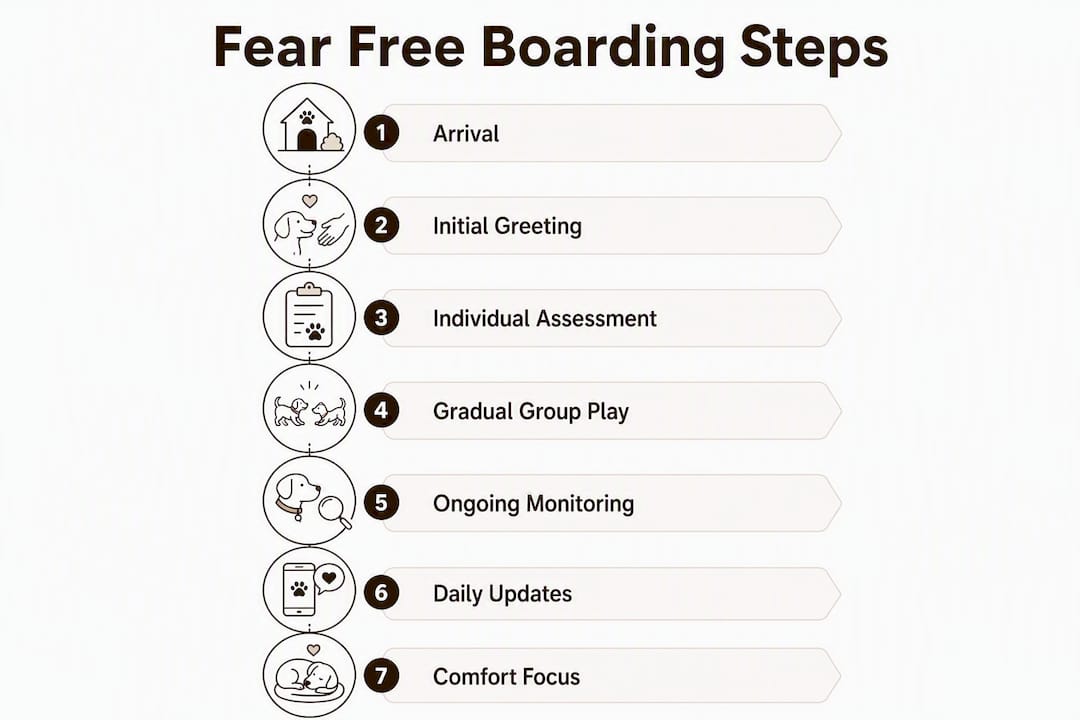
In practice, this looks like a staff member kneeling quietly at the kennel door during a first greeting rather than pulling a nervous dog out. During medication time, it means pairing the experience with high-value treats and using the gentlest possible restraint. When introducing a dog to a playgroup, it means a slow, supervised introduction with an easy exit option rather than a straight drop into a group of unfamiliar dogs.
Pro Tip: During a meet-and-greet, watch how staff respond when your dog shows hesitation. A genuinely Fear Free-trained handler will pause, give the dog space, and let it re-approach at its own pace. If a staff member pushes through the dog’s reluctance or uses physical guidance to move things along, that is a clear sign the training has not translated into daily practice.
What does Fear Free certification actually mean?
There is an important distinction owners often miss: a facility can claim to be Fear Free without every staff member holding a verified credential. Knowing what the certification actually involves helps you ask the right questions.
The Fear Free Boarding & Daycare Individual Certification Program is designed for boarding and daycare professionals, not just vets or trainers. It covers five modules: Fear Free fundamentals, reading body language, considerate approach and gentle control, enrichment planning, and in-the-moment crisis handling. Completing the programme and passing the assessments earns the individual the designation of Fear Free Certified Professional.
Fear Free has trained a large number of professionals since 2016, across veterinary, grooming, training, and boarding settings. That reach matters because it means the standard is widely recognised, and you can reasonably expect a certified professional to share a common framework with others in the field.
Certification is not a one-time achievement. The programme requires annual renewal and continuing education credits to keep staff current with behavioural research and safe handling techniques. A staff member who completed the course three years ago and has not renewed is not current.
How to verify a Fear Free claim
Use this checklist before you book:
Ask the facility which staff members hold the Fear Free Boarding & Daycare Individual Certification and request to see their certificates.
Check the Fear Free certifications directory to confirm the individual’s listing.
Ask when the certification was last renewed and whether the staff member has completed continuing education credits.
Enquire whether the facility itself holds any PACCC (Professional Animal Care Certification Council, paccert.org) accreditation, which adds a facility-level standard on top of individual credentials.
Ask how many staff members on a typical shift are Fear Free certified, not just the manager or lead trainer.
Certification type | What it covers | Who holds it |
Fear Free Boarding & Daycare Individual Certification | Body language, gentle control, enrichment, crisis handling | Individual staff member |
Fear Free Certified Professional designation | Completion of all modules and passing assessments | Individual staff member |
PACCC facility accreditation | Facility-wide operational standards | The boarding facility |
What does a typical Fear Free boarding stay look like?
A Fear Free stay is structured around your dog’s comfort from the moment you arrive, not just during the pleasant parts of the day.
Arrival and intake begin with a meet-and-greet or temperament evaluation. Some facilities run these over approximately two hours, observing how your dog responds to the space, other animals, and staff before making decisions about housing, group play, or one-to-one time. The outcome is a written, individualised care plan that travels with your dog throughout the stay.
Daily routine in a Fear Free facility is built around reducing sensory overload. That means:
Quiet zones separated from high-traffic areas.
Soft lighting in rest spaces rather than bright overhead fluorescents.
Species separation so dogs are not stressed by the sight or smell of cats in adjacent areas.
Scheduled enrichment sessions using puzzle feeders, sniff mats, or calm play rather than continuous stimulation.
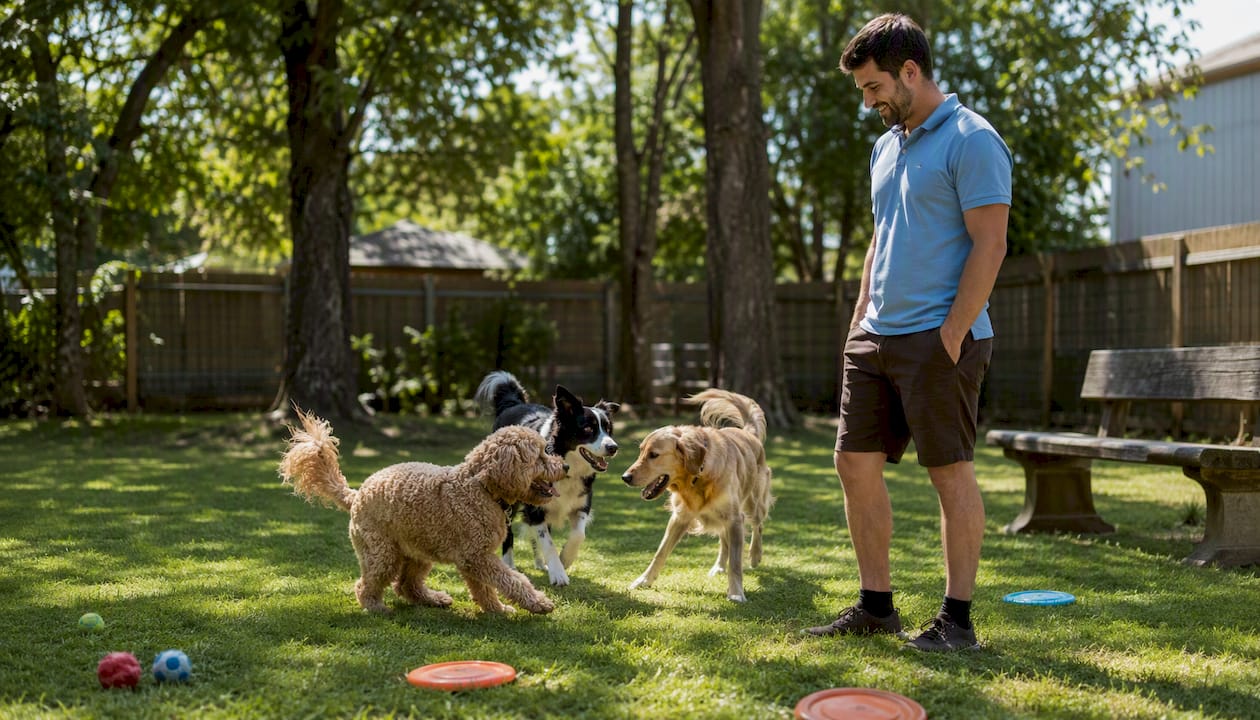
Group play is introduced gradually. A Fear Free-trained team will observe body language carefully during initial introductions and will not force a dog into a group if it shows reluctance. If your dog prefers individual time, a quality facility will offer that as an alternative rather than insisting on compliance.
Medication and illness handling follow a clear protocol. Staff trained in the Fear Free approach use de-escalation techniques when a dog resists medication, pairing the experience with positive reinforcement and using the gentlest possible restraint. If a dog becomes unwell, the facility should have a documented escalation policy that includes contacting you promptly and, where necessary, arranging veterinary care.
A quick checklist for what to expect during a stay:
Written care plan created at intake.
Quiet, species-separated rest areas.
Gradual, supervised group introductions.
Enrichment activities scheduled daily.
Clear medication administration records.
Regular photo or written updates to you.
For a detailed look at daily boarding schedules and what a structured routine looks like hour by hour, that resource is worth reading before you book.
How do you prepare your dog for a Fear Free boarding stay?
Good preparation at home makes a genuine difference to how your dog settles. Start at least two weeks before the stay if you can.
Book the meet-and-greet early. Do not leave this until the day before. A proper temperament evaluation takes time, and it gives your dog a chance to form a positive association with the space before the actual stay.
Practice short separations. Leave your dog with a trusted person or in a familiar room for gradually increasing periods. This builds confidence and reduces the shock of a longer absence.
Pack familiar bedding and toys. An unwashed blanket or a worn T-shirt carries your scent and provides a powerful comfort cue in an unfamiliar space.
Maintain your dog’s routine. Keep feeding times, walk times, and sleep times consistent in the days before boarding. Disruption to routine is itself a stress trigger.
Prepare paperwork in advance. Bring up-to-date vaccination records, a list of current medications with clear dosage instructions, and an emergency contact number that will be answered.
Pro Tip: A day or two before the stay, rub a soft cloth on your dog’s face and cheeks (where scent glands are concentrated) and leave it with the boarding facility at drop-off. This familiar scent in the sleeping area can help a nervous dog settle far more quickly than a new blanket from home.
For a full packing checklist, the Happy-dogtraining guide on what to pack for dog boarding covers everything from food portions to comfort items in practical detail. If your dog already shows anxiety signals before departure, it is worth reading that resource too, so you can address those cues before they intensify at drop-off.

Questions to ask a facility and red flags to watch for
Not every facility that uses the words “Fear Free” has earned the right to them. These questions will help you tell the difference quickly.
Ask at enquiry:
Which staff members hold the Fear Free Boarding & Daycare Individual Certification, and when was it last renewed?
Do you conduct a meet-and-greet or temperament evaluation before every stay?
Will my dog have a written care plan, and can I see a sample?
What is your typical staff-to-dog ratio during the day and overnight?
How do you communicate with owners during a stay, and what triggers an emergency call?
Red flags to watch for:
Vague or inconsistent answers about which staff are certified.
No meet-and-greet offered, or one that lasts only a few minutes.
No written care plan, or a plan that is identical for every dog.
Handling that involves pulling, dragging, or raised voices during your visit.
Group-only routines with no individual option for anxious or shy dogs.
Reluctance to let you see the sleeping areas or daily spaces.
Trust signals that confirm a genuine approach:
Certificates visible or readily produced on request.
Staff listed in the Fear Free certifications directory.
A published or clearly explained temperament evaluation process.
Transparent communication policy with a named escalation contact.
Willingness to adapt the care plan if your dog refuses group activities.
A trainer assessment before boarding is one of the clearest signals that a facility takes welfare seriously. If a facility skips this step, ask why.
What are the real benefits, and when is Fear Free boarding not enough?
Fear Free boarding delivers genuine, practical benefits. Certified facilities report reduced stress-induced illnesses and fewer behaviour incidents, and staff experience safer, calmer interactions with pets. For most dogs, a well-run Fear Free stay means a quicker return to normal behaviour after collection, less post-boarding shutdown, and fewer stress-related digestive issues during the stay itself.
Fear Free is also distinct from simply being cage-free. The focus is on handling technique and staff behaviour, not on whether containment is used. A dog can be housed in a kennel and still have a genuinely low-stress experience if the staff approach is right.
That said, Fear Free boarding has real limits:
It reduces stress during a stay but does not treat underlying anxiety disorders. A dog with severe separation anxiety needs a behaviour modification programme before boarding, not instead of it.
It is not a substitute for veterinary care. A dog with a medical condition causing pain or anxiety needs a vet’s assessment first.
For dogs with serious aggression histories, Fear Free handling reduces risk but does not replace a structured behaviour plan.
A simple decision guide:
Choose Fear Free boarding if your dog is generally healthy, has mild to moderate anxiety, and has not shown serious aggression.
Consult a behaviourist first if your dog has significant separation anxiety, fear-based reactivity, or a history of aggression. Happy-dogtraining offers separation anxiety support and personalised behaviour consultations to help you prepare.
See a vet first if your dog has an undiagnosed medical issue, is on complex medication, or has shown sudden behaviour changes.
What does Fear Free boarding cost, and what communication should you expect?
Fear Free boarding typically costs more than standard kennels, and that premium reflects real operational differences. Understanding what drives the cost helps you judge whether a higher price represents genuine value.
Cost driver | What it reflects | Question to ask |
Staff certification and renewal | Time and fees for Fear Free training and annual CE credits | How many certified staff are on shift at any time? |
Private or species-separated suites | Higher space costs per pet | Can I see the sleeping area before I book? |
Enrichment activities | Staff time for puzzle feeders, sniff sessions, calm play | What enrichment is included in the daily rate? |
Temperament evaluation | Staff time for a multi-hour initial assessment | Is the meet-and-greet included in the boarding fee? |
Medication administration | Additional handling time and documentation | Is there a separate fee for medication? |
On communication, a quality Fear Free facility will send you at least one photo or written update per day. You should receive a named emergency contact, a clear policy on when they will call you (rather than wait for your check-in), and a discharge summary noting how your dog ate, slept, and engaged during the stay.
If a facility cannot tell you their communication policy clearly at enquiry, that is itself a red flag.
Practical tips from certified practitioners you can use straight away
The most effective preparation happens in the days before the stay, not on the morning of drop-off. Here is what experienced Fear Free practitioners recommend:
Condition your dog to the carrier or travel crate at least a week before the stay. Leave it open at home with a treat or favourite toy inside so it becomes a neutral, even positive, space.
Use a calming scent transfer. Rub a cloth on your dog’s cheeks and leave it with the facility at drop-off. This is one of the simplest and most effective ways to reduce initial settling time.
Keep your departure calm and brief. Long, emotional goodbyes raise your dog’s arousal level and make settling harder. A short, cheerful farewell followed by a confident exit is kinder than a drawn-out goodbye.
Ask the facility to feed your dog’s first meal from their hand rather than from a bowl. This builds a positive association with the new person quickly and is a technique Fear Free-trained staff will already know.
Share your dog’s micro-signals with staff in writing. Note the specific early stress signals your dog shows (ear position, tail carriage, panting pattern) so staff can recognise them before they escalate.
Pro Tip: For shy or senior dogs, ask the facility to keep the first day entirely low-key: no group introductions, no new enrichment challenges, just quiet time in the sleeping area with familiar scents. Older dogs and nervous dogs need longer to acclimatise, and a gentle first 24 hours sets a much better tone for the rest of the stay.
Key takeaways
Fear Free boarding works because it combines certified staff training, individualised care plans, and proactive environmental management to reduce FAS before it escalates, giving your dog a genuinely calmer and safer stay.
Point | Details |
Verify certification individually | Ask which named staff members hold the Fear Free Boarding & Daycare Individual Certification, not just whether the facility claims it. |
Book the meet-and-greet early | A temperament evaluation creates the written care plan your dog’s stay depends on; do not skip it. |
Pack familiar scent items | An unwashed blanket or worn clothing reduces settling time by giving your dog a comfort anchor in an unfamiliar space. |
Know the limits | Fear Free boarding reduces stress but does not replace behaviour modification for serious anxiety or veterinary care for medical issues. |
Expect daily communication | A quality facility sends at least one photo or update per day and has a named escalation contact for emergencies. |
A practitioner’s perspective on what makes Fear Free boarding work
The most common misconception I encounter is that Fear Free boarding is simply about being “nice” to dogs. It is far more specific than that. What the certification actually teaches is how to read the earliest, subtlest signals of discomfort and adjust your approach before the dog ever reaches a state of distress. That is a skill, and it takes deliberate practice to develop.
When a nervous dog arrives, the instinct for many people is to reassure it with touch and talk. Fear Free training teaches you to do the opposite: be quiet, be still, and let the dog set the pace. The difference in outcome is striking. A dog that is allowed to approach on its own terms will often be eating from a staff member’s hand within an hour. A dog that has been “comforted” through its anxiety can take days to settle.
What I find most rewarding is the collection moment. Owners who were genuinely worried at drop-off arrive to find a dog that is calm, engaged, and not frantically pulling towards the exit. That is not luck. It is the result of consistent, trained, deliberate care from the first greeting to the last.
The certification matters because it creates a shared language across the whole team. When every person on shift reads body language the same way and responds with the same considerate approach, the dog experiences consistency, and consistency is what builds trust in an unfamiliar place.
Useful sources and further reading
These are the primary sources and programme pages worth bookmarking if you want to verify credentials or explore Fear Free methods further:
Fear Free certifications directory — search for certified individuals and explore the full range of Fear Free programmes.
IBPSA — Fear Free certifications overview — a clear industry summary of what Fear Free certification involves and why it matters for boarding facilities.
Happy-dogtraining — for personalised behaviour consultations, board-and-train programmes, and expert support before or after a boarding stay.
Recommended
Comments