Classical vs operant conditioning: what's the real difference?
- Mark McDade
- 11 minutes ago
- 10 min read
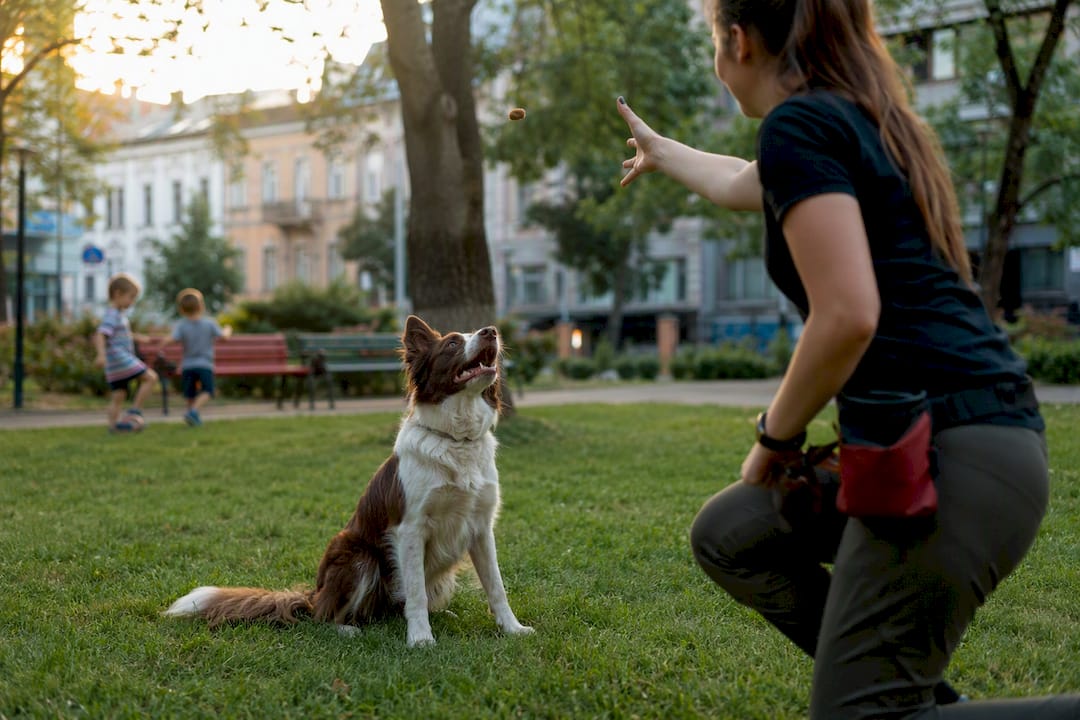
Classical conditioning links a signal that comes before a response, so the body reacts automatically. Operant conditioning links a voluntary action to what happens after it, so the behaviour changes because of its consequence. That single distinction, timing and voluntariness, tells you almost everything you need to know before choosing a training or teaching approach.
The practical upshot is simple: if you’re dealing with an emotion or a reflex (fear, salivation, a racing heart), you’re working with classical conditioning. If you’re shaping a deliberate action (sitting, raising a hand, completing a task), you’re working with operant conditioning. Ivan Pavlov mapped the first process with his famous dogs; B.F. Skinner mapped the second with rats, pigeons, and levers. You’ll see both processes threaded through the examples below, and, if you train dogs or simply live with one, you’ll recognise them the moment you see them.
Classical conditioning: stimulus first, automatic response follows.
Operant conditioning: behaviour first, consequence follows and shapes future behaviour.
Both mechanisms often operate together in real situations, including dog training.
Key Takeaways
Classical conditioning changes emotional and reflexive responses by pairing stimuli, while operant conditioning changes voluntary behaviour through its consequences, and lasting results depend on applying each in the right order.
Point | Details |
Know which system you’re targeting | Emotions and reflexes need classical tools; voluntary actions need operant tools. |
Sequence matters in animal training | Address fear with desensitisation and counterconditioning before shaping behaviour with rewards. |
Variable rewards build persistence | Unpredictable reinforcement schedules create behaviour that resists fading more than fixed schedules. |
Extinction isn’t always permanent | Spontaneous recovery and renewal can bring “extinct” responses back without warning. |
Gradual beats forceful | Systematic desensitisation is safer and more effective than flooding for reducing fear. |
Table of Contents
What is conditioning, really?
Conditioning is learning through repeated association, full stop. Your brain (or your dog’s) notices that two things keep happening together, or that an action keeps producing a particular result, and it adjusts future behaviour accordingly. That’s the whole engine behind two learning theories that get talked about as if they’re rivals when they’re actually teammates.
Classical and operant conditioning both fall under this umbrella, but they slice the learning process differently. Classical conditioning deals with what comes before a response, pairing a neutral cue with something that already triggers a reaction. Operant conditioning deals with what comes after a response, using consequences to make a voluntary behaviour more or less likely to happen again.
In real life, these two rarely operate in isolation. A dog that feels anxious about the vet (classical) might also learn that struggling gets it out of the exam room faster (operant). Untangling which process is driving a behaviour, before you try to change it, is often the difference between a training plan that works and one that quietly backfires.
Conditioning = learning through repeated association between events or between actions and outcomes.
Classical conditioning governs involuntary, reflexive responses.
Operant conditioning governs voluntary behaviour and its consequences.
The two frequently overlap in the same real-world scenario.
How does classical conditioning actually work?
Classical conditioning happens when a neutral stimulus gets paired repeatedly with something that already produces a reaction, until the neutral stimulus starts producing that reaction on its own. Pavlov noticed his dogs salivating not just at food, but at the sound of the assistant’s footsteps that reliably preceded feeding. He then paired a bell with food often enough that the bell alone triggered salivation. The dogs weren’t “deciding” to salivate. Their bodies simply learned the pattern.
The mechanics have proper names worth knowing:
Acquisition – the learning phase, where repeated pairings build the association.
Generalisation – once conditioned, similar stimuli (a doorbell instead of a specific bell) can trigger the same response.
Discrimination – with enough practice, the subject learns to respond only to the exact stimulus, not similar ones.
Spontaneous recovery – a conditioned response that seemed extinct can briefly reappear after a rest period, even without retraining.
Everyday classical conditioning is everywhere once you know what to look for. A person who was once badly bitten may flinch at the mere sight of a dog’s lead. Supermarkets pair pleasant music with browsing so shopping feels good. Advertisers pair a soft drink with sunshine and laughter until the drink itself feels celebratory. None of these responses are chosen; they’re triggered.
Statistic callout: Classical conditioning research since Pavlov’s original trials has consistently shown the process is passive for the learner, meaning no decision-making is required for the response to occur, which is precisely why fear and phobia responses can form so quickly and stubbornly.
How does operant conditioning shape voluntary behaviour?
Operant conditioning works on a completely different lever: it’s the consequence that follows a voluntary action that determines whether that action happens again. Skinner formalised this with his “operant chamber”, where a rat learned to press a lever because pressing it produced food. No pairing of stimuli was involved; the rat’s own behaviour did the work.
Behaviourists typically describe four “quadrants” of consequence, and each one either increases or decreases the behaviour it follows, using Pearson’s framework as a helpful reference point:
Positive reinforcement – adding something pleasant increases the behaviour (a dog sits, gets a treat, sits more often).
Negative reinforcement – removing something unpleasant increases the behaviour (releasing pressure on a lead the moment a dog stops pulling).
Positive punishment – adding something unpleasant decreases the behaviour.
Negative punishment – removing something desirable decreases the behaviour (a toy is taken away after jumping up).
Reinforcement schedules matter just as much as the consequence itself. Fixed schedules (reward every third repetition, or every ten seconds) produce predictable, steady responding. Variable schedules, where the reward arrives unpredictably, tend to produce far more persistent, harder-to-extinguish behaviour. It’s the same mechanism that keeps people checking a slot machine or refreshing a notifications feed.
You’ll spot operant conditioning in classroom token economies, workplace bonus schemes, and the humble dog treat. A child who earns a sticker for finishing homework, a salesperson chasing a commission, a dog offering a paw for a piece of chicken. All voluntary. All shaped by what happens next.

Pro Tip: If a trained behaviour keeps fading despite regular rewards, switch from a fixed reward pattern to a variable one. Unpredictability, used kindly, tends to make a behaviour stickier, not shakier.
What’s the real difference between classical and operant conditioning?
Put the two side by side and the contrasts become obvious fast.
What’s linked: classical pairs two stimuli; operant links a behaviour to its consequence.
Voluntariness: classical produces involuntary, reflexive responses; operant shapes voluntary, deliberate actions.
Timing: in classical conditioning, the trigger comes before the response; in operant conditioning, the consequence comes after the behaviour.
Who’s active: the learner is largely passive in classical conditioning (the response just happens) and active in operant conditioning (the behaviour is chosen).
Where you intervene: to change a classical response, you manage the antecedent, the cue itself. To change an operant behaviour, you manage the consequence.
That last point has enormous practical weight. If you try to punish a dog for a fear-based reaction, you’re attacking the wrong end of the process, because fear isn’t a choice the dog is making. You’d get further by changing what the trigger predicts.
Here’s where it gets genuinely interesting: both processes often run at once in the same moment. A dog that hears keys jingle and races to the door has learned, classically, that keys predict an outing, an automatic surge of excitement. If that same dog also learns that sitting calmly by the door (rather than jumping) gets the door opened faster, that’s operant learning layered on top. Two different mechanisms, one everyday scene, and missing the distinction is exactly how well-meaning owners end up rewarding the wrong half of the behaviour.
Why do trained behaviours fade, and what stops that happening?
Both learning types can weaken, but they weaken through different routes. Classical extinction happens when the conditioned stimulus keeps appearing without the original trigger, the bell rings repeatedly with no food, until salivation fades. Operant extinction happens when a previously rewarded behaviour stops earning its reward, a lever press that no longer produces food, or a demand-barking dog that no longer gets attention.
Neither form of extinction is necessarily permanent. Spontaneous recovery can bring a “forgotten” response briefly back, and renewal can reintroduce it in a new context entirely, which is precisely why relapse after training can feel confusing rather than a sign of failure.
Generalisation and discrimination shape how broadly a learned response spreads. A dog conditioned to fear one man in a hat may generalise that fear to all men in hats, or, with the right discrimination training, learn to fear only the specific individual. Biology also imposes limits. Not every association forms equally easily. Taste aversion can form after a single bad meal, because survival has wired that link to be fast and durable, while other associations need dozens of repetitions.
This biological reality is also why gradual, structured methods beat forceful ones. Flooding, forcing prolonged exposure to a fear trigger at full intensity, was historically used but is now widely discouraged, because systematic desensitisation tends to be both safer and more effective at reducing fear responses over time.
Classical extinction: conditioned stimulus repeated without the unconditioned stimulus.
Operant extinction: reinforced behaviour stops receiving reinforcement.
Spontaneous recovery and renewal can both bring an “extinct” response back.
Preparedness means some associations (like taste aversion) form faster than others.
Where do these methods actually get used?
Clinical psychology leans heavily on classical conditioning’s roots through systematic desensitisation and exposure therapy, developed by Joseph Wolpe, where a feared stimulus is introduced gradually alongside relaxation until the fear response fades. Classrooms lean on operant conditioning through token economies, where points or stickers accumulate toward a reward, reshaping voluntary participation and effort over weeks rather than days.
Animal training is where the two theories genuinely collide, and where getting the sequence right matters most. The accepted approach:
Desensitisation – expose the animal to a weakened version of the trigger, staying below the threshold that provokes a fear reaction.
Counterconditioning – pair that same weakened trigger with something the animal already loves, rewriting the emotional association from dread to anticipation.
Operant shaping – only once the emotional response is under control, layer in reinforcement for specific voluntary behaviours (sitting, checking in, walking past calmly).
Skipping straight to step three, asking for calm behaviour before the underlying fear is addressed, is one of the most common mistakes in reactive-dog work. Counterconditioning and desensitisation have to come first, because a frightened animal can’t learn new voluntary behaviour while its stress response is running the show.
Picture a child terrified of dogs, gradually introduced to a calm dog from across a room, then closer, paired each time with a favourite game (classical). Picture a reactive dog on a lead, kept far enough from a trigger to stay relaxed, rewarded generously for glancing at its owner instead of lunging (classical plus operant, working in sequence). Same underlying science, two very different species.
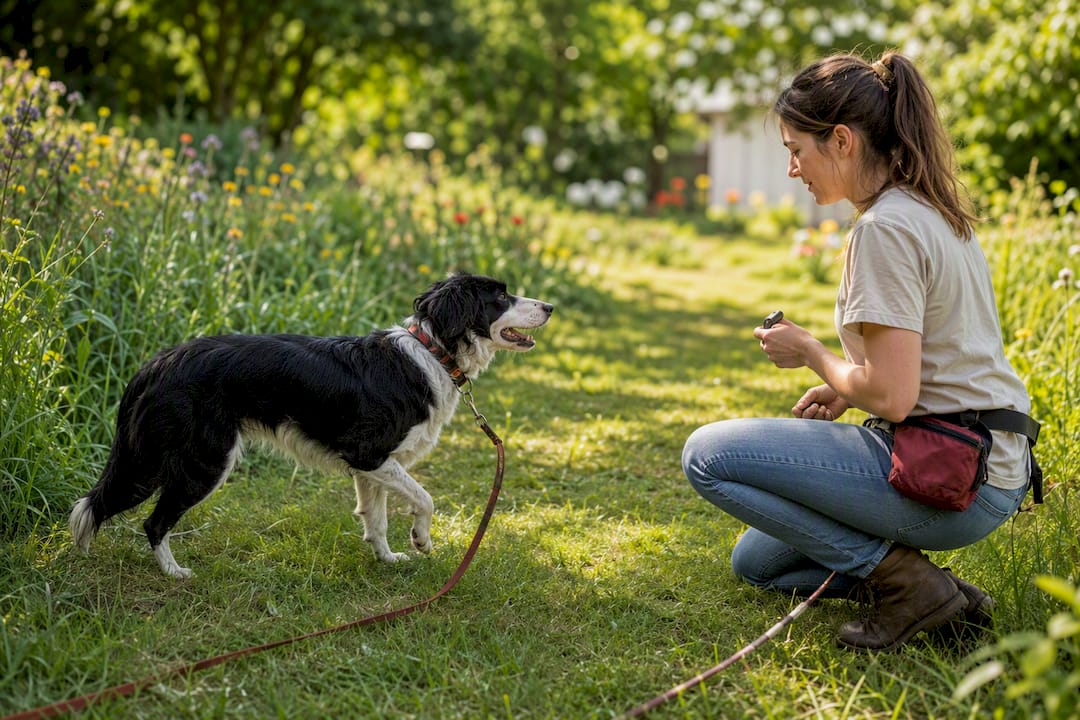
Pro Tip: Never try to reward your way out of a fear response. Address the emotion first with desensitisation and counterconditioning, then shape the behaviour you actually want.
Which method should you use, and how do you start?
Work out what you’re actually dealing with before choosing a technique.
Identify the target. Is this an emotion or reflex (fear, arousal, anxiety) or a voluntary action (sitting, staying, coming when called)? Emotions need classical tools; actions need operant tools.
Check safety first. Never push a frightened animal or person past their comfort threshold to “get it over with.” Gradual exposure wins every time.
Choose your reinforcer. For operant work, pick something genuinely motivating, food, play, praise, and reserve the highest value reward for the hardest moments.
Keep sessions short. Five to fifteen minutes is often plenty; stopping while things are still going well beats pushing until frustration sets in.
Watch for extinction and adjust. If a behaviour starts fading, check whether the reward has become predictable or simply stopped altogether.
The most common mistake beginners make is rushing the sequence, trying to reinforce a calm sit while the trigger is still close enough to cause stress underneath the surface. If progress stalls, back up a step rather than pushing forward.
Pro Tip: If your dog won’t take treats during a training session, that’s not stubbornness. It’s a sign the environment is too intense right now, so create more distance from the trigger and try again.
How Happy-dogtraining puts this into practice
At Happy-dogtraining, every behaviour case starts with the same question this article has been asking: is this fear, or is this a learned voluntary habit? Get that wrong, and even the kindest reward-based plan won’t stick.
Our approach sequences desensitisation and counterconditioning first for fearful or reactive dogs, only introducing operant shaping once the dog can stay relaxed near its trigger. Sessions typically run short and frequent, in line with veterinary behavioural guidance recommending brief, consistent practice over long, infrequent ones. Owners are taught to read subtle threshold signals, lip licking, yawning, stiffening, so training never tips into flooding.
Fear-based cases: desensitisation and counterconditioning before any shaping begins.
Voluntary behaviour cases: operant reinforcement, timed and scheduled carefully.
Every client gets free lifetime support after completing a programme.
Techniques are tailored using humane, science-based methods suited to each dog.
Our certified, AVS-accredited trainer has built this sequencing into two decades of casework across fearfulness, aggression, and everyday obedience.
Ready to put this into practice with your dog?
Reading about classical and operant conditioning is one thing. Applying it correctly, especially with a fearful or reactive dog, is where most owners get stuck, because reading a dog’s threshold in the moment takes practised eyes. If your dog struggles with fear, reactivity, or basic obedience, Happy-dogtraining’s AVS-approved intensive obedience programme walks you through exactly this sequence, desensitisation, counterconditioning, and operant shaping, under professional guidance, with free lifetime support once training ends. You can also explore Happy-dogtraining’s full range of services to find the right starting point for your dog’s specific needs.
What conditioning theory still gets wrong in practice
The textbook version of this comparison treats classical and operant conditioning as two separate boxes, and most articles leave it there. That’s the gap I’d push back on. In real training rooms, and in real therapy sessions, the two are almost never cleanly separated, and treating them as independent choices is where well-intentioned plans go wrong.
The conventional advice tells owners to “just reinforce good behaviour.” Fine, until the behaviour they’re trying to reinforce is being smothered by an unaddressed fear response underneath it. No amount of chicken fixes an emotional problem, because chicken is an operant tool being aimed at a classical issue.
If there’s one thing worth prioritising, it’s sequencing over technique. Work out whether you’re managing an emotion or a choice first. Handle the emotion with patient, gradual exposure. Only then start shaping the behaviour you actually want to see. Skip that order, and you’re not training faster, you’re just building on a shakier foundation.
— Mark
Sources
Recommended
Comments