Dog independence training step by step: a complete guide
Updated: Sep 14
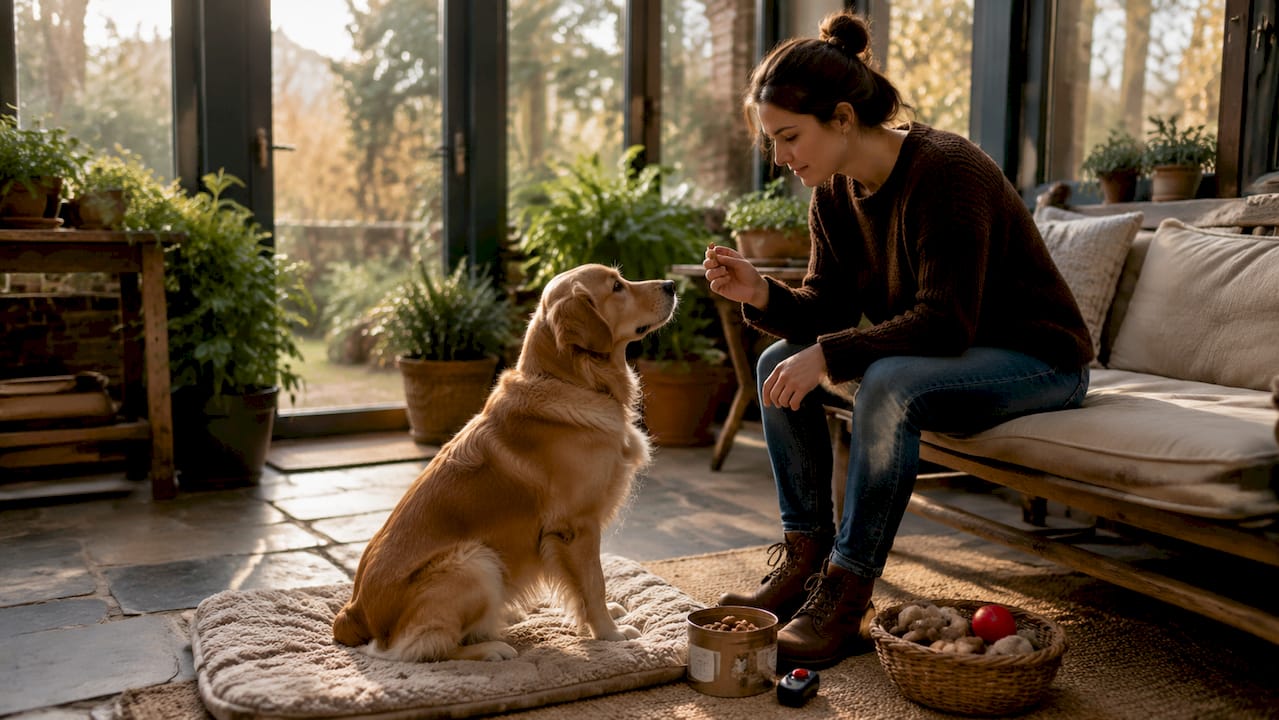
Dog independence training is the process of gradually teaching your dog to feel calm and self-reliant, both when you are present and when you leave the room or home, using force-free, reward-based techniques that build genuine confidence. The formal term for this work is separation anxiety training or graduated desensitisation, and it sits at the heart of any well-rounded dog training programme. Done correctly, dog independence training step by step produces a dog who settles happily on their own, without distress, destructive behaviour, or excessive vocalisation. The benefits extend beyond your absence: a dog with strong self-regulation is calmer, more focused, and easier to live with every single day.
What do you need before starting independence training?
The right setup makes the difference between fast progress and frustrating setbacks. Before your first session, gather your tools and prepare your environment.
Essential supplies and spaces:
A designated safe space for your dog: a crate, a comfortable bed, or a gated area they already associate with rest
High-value treats your dog finds genuinely exciting, such as small pieces of cooked chicken or cheese
A clicker or a clear marker word such as “yes” to mark correct behaviour precisely
A baby gate or interior door to create controlled physical separation
A phone or tablet with a camera app, or a dedicated pet camera, to monitor your dog remotely
Reward timing must be within 0.25–1 second of the desired behaviour for the dog to make the correct association. A marker makes this precision far easier than reaching for a treat bag alone.
Keep sessions short. Training sessions of 5–10 minutes repeated multiple times throughout the day produce better results than one long session. Your dog’s brain consolidates learning during rest, so frequent short sessions with breaks in between accelerate progress considerably.
Pro Tip: Start every session when your dog is calm and has had a toilet break. A dog that is bursting with energy or desperate to go outside cannot focus, and you will waste both your time and your treats.
Your mindset matters as much as your tools. Patience, consistency, and a genuine commitment to gradual progression are the three qualities that separate owners who succeed from those who stall. Rushing is the single most common cause of setbacks.
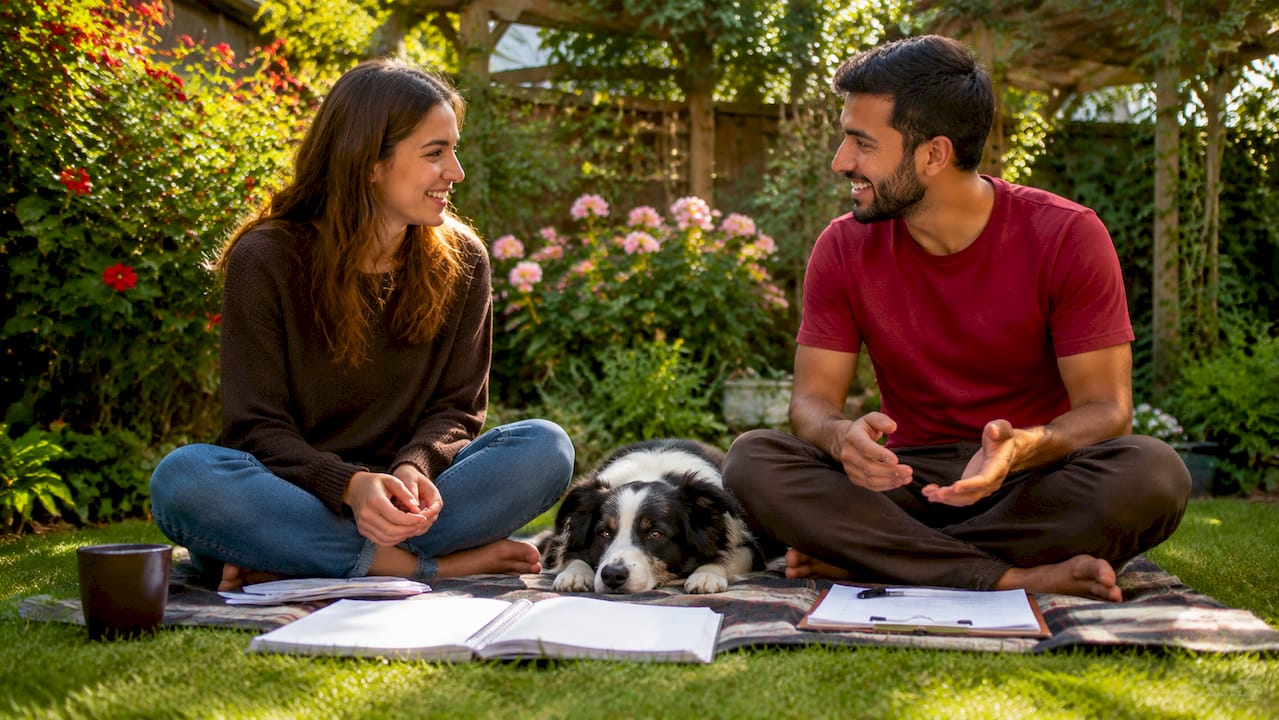
How to teach calmness and spatial separation at home
Spatial separation exercises must be mastered before any actual departures take place. Skipping this foundation causes many training failures, because the dog has never learnt to tolerate distance from you in a low-stakes context.
The goal of this phase is simple: your dog learns that being in a different part of the room, or behind a closed door, is safe and unremarkable.
Teach the “place” command. Point your dog to their bed or mat and reward them for lying down and staying there. A “place” command builds foundational calmness that transfers directly to independence work. Practise this with you sitting nearby first, then gradually increase your distance from the mat across multiple sessions.
Practise door desensitisation. Walk to an interior door, touch the handle, and return to your dog without opening it. Reward calm behaviour. Next, open the door slightly, close it, and return. Build up until you can step through the door and come straight back, all without your dog showing any anxiety.
Introduce baby gates. Place a baby gate in a doorway and ask your dog to stay on their side while you move to the other side briefly. Return before your dog shows any distress. This is the key rule of this entire phase: always return before the dog reaches their anxiety threshold.
Vary your position. Move around the room, go to the kitchen, sit in a different chair. Your dog should learn that your movement is not always a signal that something significant is about to happen.
“The goal is not to trick your dog. The goal is to make your presence and absence so unremarkable that neither one triggers a strong emotional response.” This is the foundation of genuine independence, not obedience.
Reward calm sits and stays consistently. Reinforcing calm behaviour rather than punishing anxious actions is the only approach that produces lasting change. Punishment increases anxiety and breaks trust, which is the opposite of what you need here.
Step-by-step graduated departure exercises
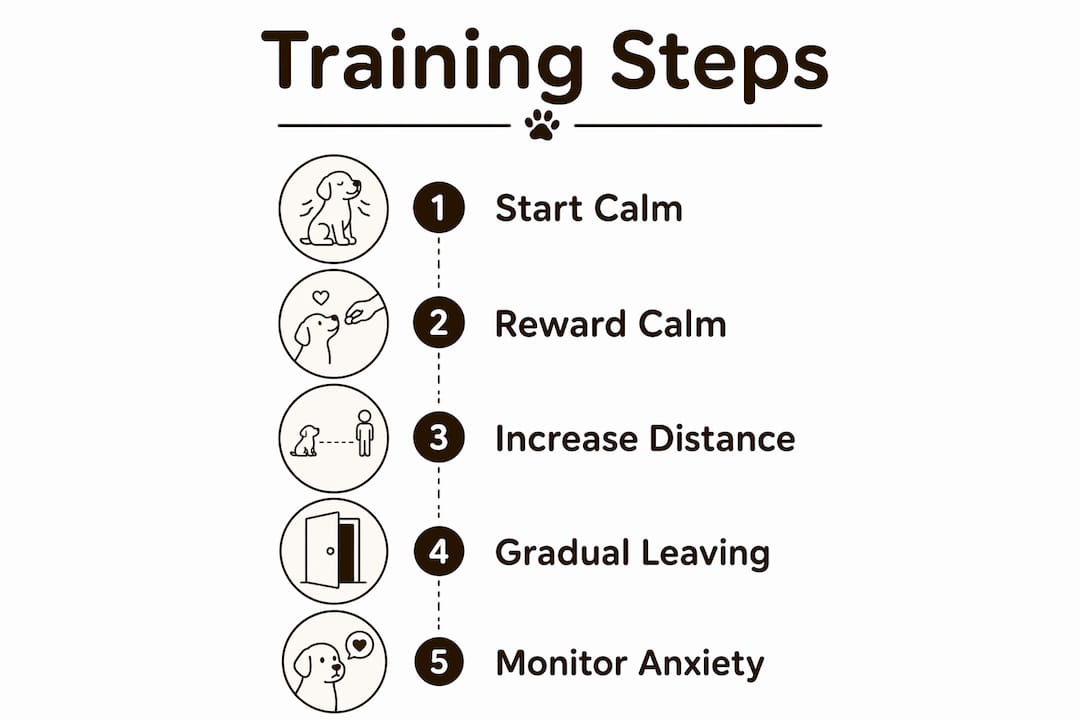
Once your dog is comfortable with spatial separation inside the home, you are ready to practise actual departures. This is where step by step dog training becomes most precise.
Start with three to five second exits. Step outside your front door, close it, and return immediately. Keep your return calm and neutral. Do not make a fuss of your dog when you come back in.
Build duration very gradually. Increase your time outside by small increments: 10 seconds, 30 seconds, one minute. Early absence moments carry the highest risk of distress, so progress slowly and celebrate every calm return.
Neutralise your departure cues. Pick up your keys and put them down again without leaving. Put on your shoes and sit back down. Grab your bag and then unpack it. Repeated non-departure exposure removes the predictive value of these cues, so your dog stops associating them with your absence.
Vary your departure routine. Leave through different doors. Depart at different times of day. Wear different clothes. Predictability breeds anticipatory anxiety, so mixing up your routine keeps your dog from building a stress response to any single cue.
Use video monitoring. Set up a camera before you leave and review the footage afterwards. Video monitoring reveals subtle anxiety behaviours such as pacing, whining, or door-scratching that are invisible to you when you are outside. These behaviours tell you whether your last step was too large.
Scale back immediately if anxiety appears. If your dog shows distress, return to the last duration where they were fully calm. Never push through visible anxiety.
Departure stage | Duration target | Key focus |
Stage 1: Door touch | 0 seconds | No anxiety at door approach |
Stage 2: Step outside | 3–10 seconds | Calm return, neutral greeting |
Stage 3: Short absence | 1–5 minutes | Video monitoring, no distress signals |
Stage 4: Building duration | 5–30 minutes | Gradual increase, varied cues |
Stage 5: Extended alone time | 30+ minutes | Consistent calm, enrichment provided |
Most dogs show significant improvement within a 4–8 week structured training period with consistent desensitisation. That timeline assumes daily practice and careful progression through each stage.
Pro Tip: Never leave your dog for longer than they can currently handle just because you have to. If you need to be out for two hours but your dog is only comfortable with 10 minutes, arrange a dog sitter or a friend to cover the gap. Forced overexposure undoes weeks of careful work.
How to troubleshoot setbacks and anxiety during training
Setbacks are a normal part of independent dog training. The key is recognising them early and responding correctly.
Signs your dog has gone over their anxiety threshold:
Panting, pacing, or whining during your absence
Scratching at doors or attempting to escape
Destructive behaviour focused near exits
Refusing food or treats they would normally take eagerly
Excessive greeting behaviour when you return, such as jumping or barking
Impulsive progression is the leading cause of setbacks in independence training. When you see any of the signs above, the correct response is to return to the last duration where your dog was fully calm and rebuild from there.
Never punish anxious behaviour. Anxiety is not disobedience. Punishment increases stress and makes the problem worse.
Avoid rushing to comfort a distressed dog the moment you return, as this can inadvertently reward the anxious state. Wait for a few seconds of calm before greeting.
Check whether you have been consistent with your session timing. Irregular practice slows progress significantly.
“Patience is not passive. It is the active choice to prioritise your dog’s comfort over your own timeline.”
When owner impatience drives the pace of training, the dog pays the price. If you find yourself frustrated, end the session and try again later. A short, successful session is always better than a long, stressful one. If anxiety is severe or persistent, professional guidance from a certified trainer is the most effective path forward. You can also track your dog’s progress by watching for signs your dog’s anxiety is improving between sessions.
Additional strategies to support your dog’s confidence
Independence training works best when it is supported by a broader approach to your dog’s daily life. These complementary strategies reinforce the work you are doing in formal sessions.
Puzzle toys and safe chews. Provide a Kong filled with frozen food, a lick mat, or a snuffle mat before you leave. Environmental enrichment such as puzzle toys reduces distress during training stages by giving your dog a positive, absorbing activity to focus on.
Consistent daily routines. Dogs are creatures of habit. A predictable schedule for meals, walks, and rest reduces background anxiety and makes your departures feel less significant.
Dog-appeasing pheromone (DAP). Products such as Adaptil diffusers release a synthetic version of the calming pheromone produced by nursing mothers. Music and dog-appeasing pheromone have measurable calming effects during alone time, making them a useful addition to your training toolkit.
Short, planned alone times throughout the day. Even when you are at home, give your dog regular periods of quiet time in their safe space. This builds the habit of self-settling and prevents over-attachment to your constant presence.
Nutrition as a foundation. A well-nourished dog is a calmer dog. If you are reviewing your dog’s diet alongside training, a vet-backed homemade food guide can help you make confident choices about what goes in the bowl.
Key takeaways
Successful dog independence training requires mastering spatial separation before departures, using precise reward timing, and progressing gradually to keep your dog below their anxiety threshold at every stage.
Point | Details |
Build foundations first | Teach the “place” command and door desensitisation before any real departures. |
Time your rewards precisely | Mark and reward calm behaviour within 0.25–1 second for clear learning. |
Progress in tiny steps | Start with 3–5 second exits and increase duration only when your dog is fully calm. |
Use video monitoring | Camera footage reveals anxiety behaviours you cannot see from outside the door. |
Enrich the environment | Puzzle toys, DAP diffusers, and consistent routines all reduce background stress. |
Why I think most owners start independence training backwards
After working with dogs and their families for many years, the pattern I see most often is this: owners try to train independence by leaving the dog alone and hoping for the best. They interpret a quiet house as success, when in reality the dog may be silently distressed, or simply exhausted from anxiety.
The most important shift in my thinking has been understanding that independence training gives the dog power and choice, rather than simply teaching obedience to a command. A dog who settles on their mat because they genuinely feel safe there is fundamentally different from a dog who stays because they have been told to. The first dog is resilient. The second is compliant until the pressure exceeds their tolerance.
What I have also noticed is that owners who rush this process almost always do so out of love. They want their dog to be fine. They want to believe the problem is solved. But inconsistent reinforcement greatly reduces training effectiveness and increases confusion for the dog, which means well-intentioned shortcuts often create more work in the long run.
My honest advice: trust the process, watch your dog closely, and let their behaviour tell you when they are ready to move forward. The wagging tail and relaxed body when you return from a five-minute absence is worth more than any shortcut.
— Mark
Ready to build your dog’s confidence with expert support?
If your dog is struggling with separation anxiety or you want a structured, science-backed programme to build genuine independence, Happy-dogtraining is here to help. With over 20 years of experience and AVS accreditation, Happy-dogtraining offers personalised training programmes tailored to your dog’s specific needs, whether that is fearfulness, over-attachment, or obedience foundations. Every client receives free lifetime support after training, so you are never left to figure things out alone. Explore the full range of expert training programmes and take the first step towards a calmer, more confident dog today.
FAQ
What is dog independence training?
Dog independence training is the process of teaching your dog to feel calm and settled when alone, using graduated desensitisation and positive reinforcement. The formal term is separation anxiety training, and it builds self-regulation rather than simple obedience.
How long does independence training take?
Most dogs show significant improvement within a 4–8 week structured training period with consistent daily practice. Progress depends on the dog’s starting anxiety level and how carefully the owner follows a graduated protocol.
Should I comfort my dog if they show anxiety during training?
Return to a shorter, easier step rather than comforting the anxious behaviour directly. Rewarding distress can reinforce it; instead, set up the next session so your dog succeeds and receives a reward for genuine calm.
What are departure cues and why do they matter?
Departure cues are actions like picking up keys or putting on shoes that signal to your dog you are about to leave. Repeating these actions without actually departing removes their predictive value and reduces anticipatory anxiety before you even open the door.
When should I seek professional help for my dog’s separation anxiety?
Seek professional guidance if your dog shows severe distress such as self-injury, prolonged vocalisations, or destructive behaviour that does not improve after several weeks of consistent training. A certified trainer can assess your dog’s threshold and design a programme that keeps progress safe and steady.
Recommended
Comments