Dog training plan structure: a 2026 owner's guide

A dog training plan structure is an organised schedule of targeted training sessions designed to improve obedience, socialisation, and behaviour through scientifically backed methods and progressive challenges. Understanding what is dog training plan structure means knowing its core components: session frequency, session length, specific goals, reward timing, and a clear progression system. Recognised frameworks like the 5 D’s (Distance, Duration, Distraction, Direction, and Disappearing) and the 3-3-3 rule give both new and experienced owners a reliable foundation. Add a clicker or verbal marker, a well-matched reward hierarchy, and consistent daily practice, and you have the building blocks of a plan that genuinely works.
What is dog training plan structure and how does it work?
A dog training plan structure is the professional term for what trainers call a structured behaviour programme: a repeatable system that organises when, how, and what you teach your dog each day. Without this structure, training becomes reactive and inconsistent, which confuses dogs and slows progress. The structure itself does not need to be complicated. It simply needs to be deliberate.
The core components of any effective plan are:
Clear, measurable goals (for example, a reliable “sit” at the front door within two weeks)
Scheduled sessions with defined length and frequency
A progression system that increases difficulty gradually
A reward and marker system that communicates success instantly
A review process to adjust the plan when progress stalls
These components work together. Remove one and the others lose their effectiveness. A goal without a progression system leads to frustration. A reward system without precise timing fails to communicate what the dog did correctly. Think of the structure as a recipe: each ingredient matters, and the order in which you add them matters too.
How to structure daily dog training sessions

The most effective daily training approach uses 3–5 short sessions of 5–10 minutes each rather than one long session. Dogs, especially puppies, have short attention spans. Concentrated short sessions produce better learning than a single 45-minute block that exhausts both dog and owner.
Here is a practical way to build those sessions into your day:
Morning session (5–7 minutes): Start with a known behaviour your dog already knows well, such as “sit” or “down.” This warms up your dog’s focus before introducing anything new.
Midday session (5–10 minutes): Introduce or practise the target behaviour for the week. Keep the environment calm and free from distractions at this stage.
Afternoon session (5 minutes): Run a short refresher on the new behaviour, then return to a familiar command to close on a confident note.
Evening session (optional, 5 minutes): Use this for light socialisation practice or calm reinforcement of the day’s learning.
Consistency in timing matters as much as session length. Dogs thrive on routine, and training at roughly the same times each day helps them arrive mentally ready. Avoid long gaps between sessions across several days. Daily consistency outperforms infrequent marathon sessions every time.
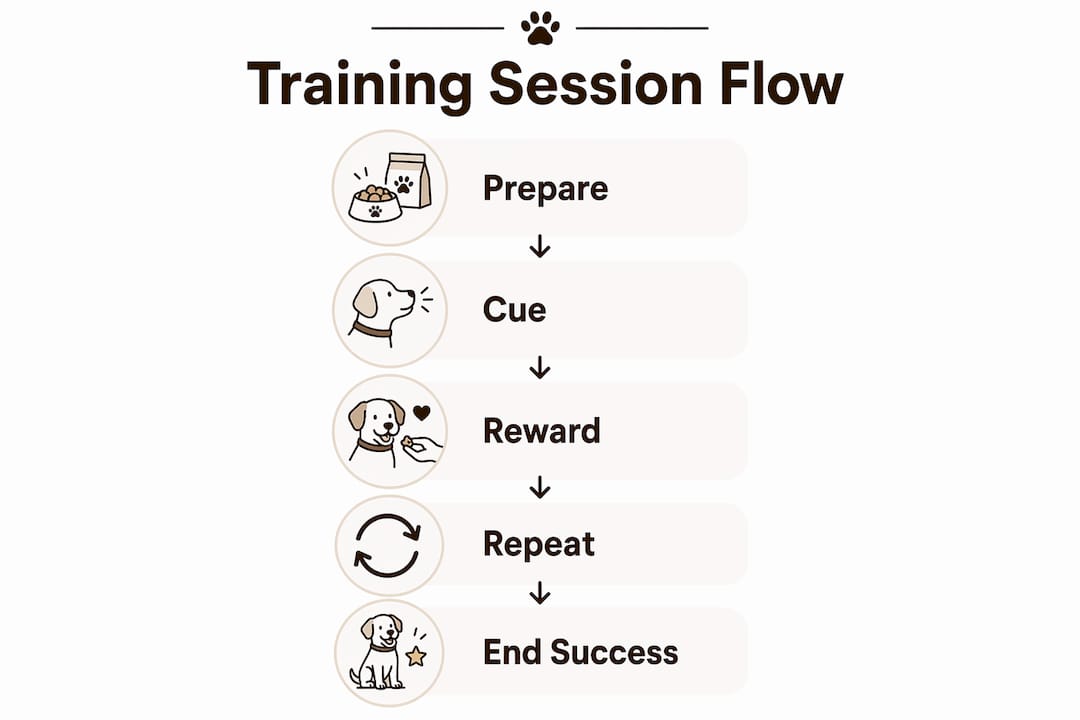
Pro Tip: Always end each session on a clean success. Ask for a behaviour your dog knows confidently, reward it warmly, and stop there. Forcing continuation until your dog fails creates negative associations with training and slows long-term progress.
What goals and rewards should your training plan include?
Every effective training plan begins with specific, measurable goals rather than vague intentions like “be better behaved.” Concrete goals give you a clear target and tell you when to move forward.
Strong examples of training goals include:
Obedience commands: Reliable “sit,” “stay,” “come,” and “leave it” in low-distraction environments within the first three weeks
Socialisation milestones: Calm greetings with three new people or dogs per week during the first month
Behaviour correction targets: Reducing jumping at the door to zero occurrences within four weeks using a consistent “four paws on the floor” reward protocol
Your reward hierarchy should match the difficulty of what you are asking. A simple “sit” in the kitchen earns a small treat. A reliable recall in a busy park earns your dog’s highest-value reward, such as a piece of chicken or an enthusiastic game of tug.
Marker training is the most precise way to communicate success. Rewards delivered within 1–2 seconds of the target behaviour reinforce learning most effectively. Delays beyond this window confuse dogs about what they are being rewarded for. A clicker or a clear verbal marker like “yes!” bridges the gap between the behaviour and the reward, giving your dog instant, unambiguous feedback.
Pro Tip: Mix familiar commands with new exercises in every session. Starting with a behaviour your dog already knows builds confidence and keeps motivation high before you introduce something more challenging.
How does the 5 d’s framework increase training difficulty?
The 5 D’s framework is used by professionals to increase training difficulty by modifying one variable at a time. This is the most reliable method for building behaviours that hold up in real-world situations, not just in your living room.
The critical rule is this: change only one D at a time. Increasing distance and adding distraction simultaneously overwhelms most dogs and causes the behaviour to break down. Progress feels slower this way, but the results are far more reliable.
D | What It Means | Example Progression |
Distance | How far you are from your dog when giving a cue | Start at 1 metre, build to 10 metres over several weeks |
Duration | How long your dog holds a behaviour | Begin with a 3-second “stay,” extend to 60 seconds gradually |
Distraction | The level of environmental noise or activity | Practise in a quiet room first, then a garden, then a park |
Direction | The angle or position from which you give a cue | Cue from in front, then from the side, then from behind |
Disappearing | Moving out of your dog’s sight during a behaviour | Step behind a door briefly during a “stay,” then return |
This framework prevents the common mistake of rushing ahead. When your dog struggles, the 5 D’s tell you exactly which variable to reduce. If your dog cannot hold a “stay” with you 5 metres away, reduce the distance to 2 metres and rebuild. You can also find a practical application of this approach in Happy-dogtraining’s HDB living training guide, which shows how the 5 D’s apply in compact, real-world environments.
Common mistakes that undermine your training plan
Even a well-designed plan fails when common errors creep in. Recognising these pitfalls early saves weeks of frustration.
Repeating cues without a marker. Saying a cue multiple times without a reward marker signals to your dog that compliance is optional. One clear cue, followed immediately by a marker if the dog responds, is the correct approach. This is sometimes called avoiding “training noise.”
Using punishment instead of positive reinforcement. Punishment-based methods harm the owner-dog bond and often fail in the long term. Removing a reward for unwanted behaviour is far more effective than adding a correction. You can read more about why this matters in Happy-dogtraining’s guide to humane training methods.
Training through fatigue. A dog that is yawning, sniffing the ground excessively, or turning away is showing signs of mental fatigue. Pushing through these signals creates negative associations. Recognise the signs early and end the session positively. Happy-dogtraining’s training fatigue guide covers this in detail.
Skipping environment management. When progress stalls, the answer is almost always to simplify the environment rather than repeat the same exercise in the same difficult context. Move back to a quieter space and rebuild.
Inconsistent reward timing. Rewarding 5 seconds after a behaviour teaches your dog nothing useful. Precision matters more than the size of the reward.
How to personalise your training plan for your dog
No two dogs learn at the same pace, and a good training plan reflects that. Creating a dog training schedule that fits your dog’s age, breed, and personality is what separates a plan that works from one that sits unused.
Puppies under 16 weeks are in a critical socialisation window. Their plans should prioritise positive exposure to people, sounds, surfaces, and other animals over formal obedience commands. Sessions for young puppies should stay at the shorter end, around 3–5 minutes, because their attention spans are genuinely brief. Adult dogs can handle slightly longer sessions but may need more repetitions to unlearn existing habits.
The 3-3-3 rule offers a realistic timeline for newly adopted dogs: 3 days to decompress, 3 weeks to learn the household routine, and 3 months to settle in comfortably. This matters because training a dog that is still decompressing produces poor results. Patience during this window is not wasted time. It is preparation.
Breed characteristics also shape your plan. High-energy working breeds like Border Collies or Belgian Malinois need more mental stimulation built into sessions. Brachycephalic breeds like French Bulldogs tire physically faster and need shorter, cooler sessions. Tailor your plan to the dog in front of you, not the dog in a training manual.
Pro Tip: If you are unsure how to adapt your plan, Happy-dogtraining’s guide on customising a training plan walks through the process step by step, covering age, breed, and lifestyle factors in practical detail.
Key takeaways
A dog training plan structure works because it combines consistent short sessions, clear goals, precise reward timing, and a progressive difficulty framework to build reliable, generalised behaviours.
Point | Details |
Session frequency and length | Use 3–5 daily sessions of 5–10 minutes each for the best learning outcomes. |
Reward timing is critical | Deliver markers and rewards within 1–2 seconds of the target behaviour to reinforce correctly. |
Apply the 5 D’s one at a time | Change only one variable (Distance, Duration, Distraction, Direction, Disappearing) per progression step. |
Avoid training noise | Give each cue once only; repeating cues without a marker teaches optional compliance. |
Personalise for your dog | Adjust session length, content, and goals based on age, breed, and the 3-3-3 adjustment timeline. |
What 20 years of training has taught me about structure
Most owners come to me believing that more training time equals faster results. The opposite is almost always true. The dogs that progress fastest belong to owners who do five focused minutes three times a day, not owners who spend an hour on a Sunday afternoon trying to cram in a week’s worth of work.
The insight that surprises people most is this: the structure of a session matters more than its content. A dog that ends every session feeling successful will arrive at the next one with enthusiasm. A dog that ends confused or frustrated starts to associate training with discomfort. That association is genuinely hard to reverse, and I have seen it set back otherwise talented dogs by months.
The other misconception I encounter constantly is that positive reinforcement means being permissive. It does not. Precise, well-timed rewards are more demanding to deliver correctly than a correction. They require you to observe your dog closely, mark the exact moment of success, and match the reward to the effort. That precision is what makes the method work. Done well, reward-based training builds a dog that chooses to cooperate rather than one that complies out of fear.
My honest advice: write your plan down. A written plan forces clarity about what you are teaching, when, and how you will know it is working. Owners who train from memory tend to drift. Owners with a written schedule stay consistent, and consistency is the single variable that predicts success more reliably than any technique.
— Mark
Ready to build a plan that gets real results?
Knowing the theory behind a structured training plan is a strong start. Putting it into practice with expert guidance makes the difference between slow progress and genuine transformation.

Happy-dogtraining has over 20 years of experience helping dog owners in Singapore build personalised, science-based training programmes for obedience, socialisation, fearfulness, and aggression. Every programme is tailored to your dog’s specific needs, and all clients receive free lifetime support after training. Whether you are starting from scratch with a new puppy or working through a specific behaviour challenge, Happy-dogtraining’s expert training services are designed to support you at every stage. For dogs with more complex needs, the 4-week intensive obedience programme offers structured, AVS-approved support that delivers lasting results.
FAQ
What is the ideal length for a dog training session?
The ideal session length is 5–10 minutes, repeated 3–5 times daily. Short, focused sessions maintain your dog’s attention and prevent the mental fatigue that longer sessions cause.
How do the 5 d’s help structure dog training progression?
The 5 D’s (Distance, Duration, Distraction, Direction, and Disappearing) are a professional framework for increasing training difficulty one variable at a time. Changing only one D per step prevents confusion and builds reliable behaviour across different environments.
What is the 3-3-3 rule in dog training?
The 3-3-3 rule describes the adjustment timeline for newly adopted dogs: 3 days to decompress, 3 weeks to learn the household routine, and 3 months to settle in fully. Starting formal training before this window closes often produces poor results.
Why should you never repeat a training cue multiple times?
Repeating a cue without a reward marker teaches your dog that compliance is optional. One clear cue followed immediately by a marker when the dog responds correctly builds far more reliable behaviour.
How does positive reinforcement differ from permissive training?
Positive reinforcement requires precise timing and deliberate reward delivery, making it a disciplined and demanding method. It builds a dog that chooses to cooperate, which is more durable than compliance based on fear or correction.
Recommended
Comments