Pre-departure anxiety in dogs: what owners must know
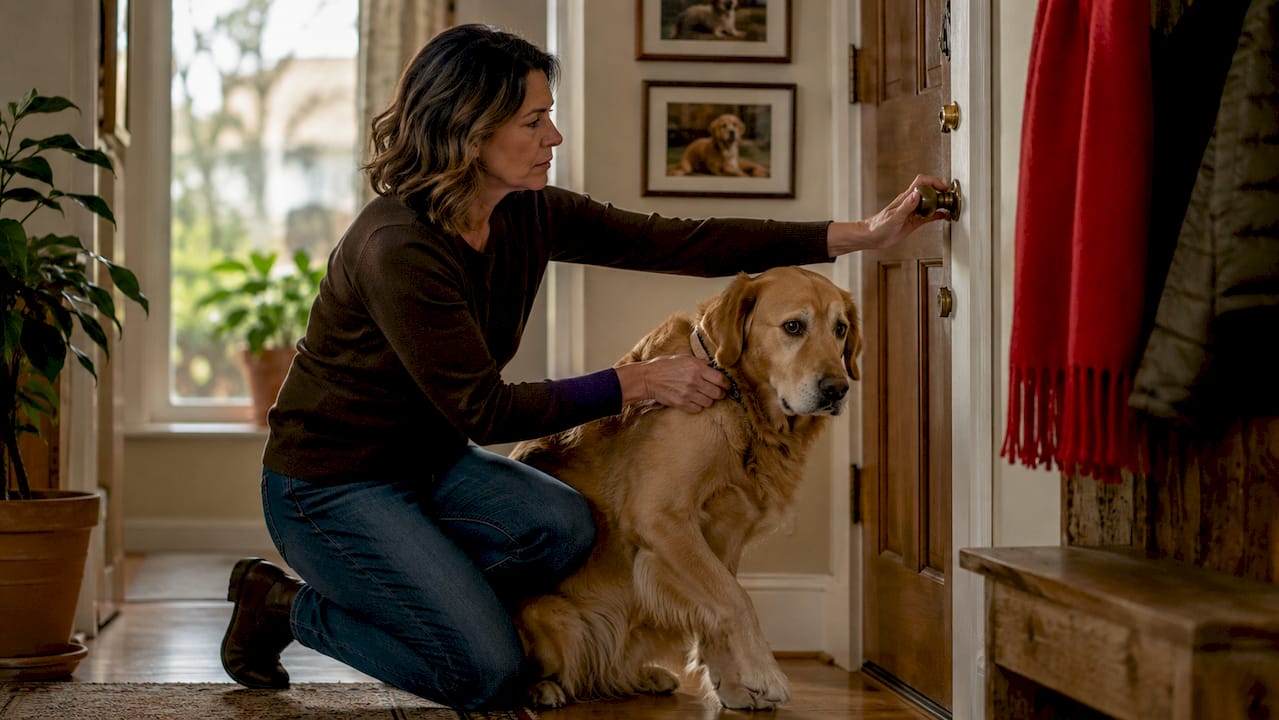
Pre-departure anxiety in dogs is defined as anticipatory distress triggered by environmental cues that signal an imminent departure, occurring before the owner has even left the home. The clinical term used by veterinary behaviourists is “pre-departure anxiety,” and it sits within the broader category of separation-related disorders. Unlike general boredom or post-departure distress, this condition causes your dog to begin panicking the moment you pick up your keys or reach for your coat. Organisations such as the MSPCA and ASPCA recognise it as a genuine panic response, not a behaviour problem rooted in spite or disobedience. Understanding what is pre-departure anxiety in dogs is the first step towards helping your companion feel safe and calm.
What is pre-departure anxiety in dogs?
Pre-departure anxiety is a conditioned panic response. Your dog has learned, through repeated experience, that certain actions predict your absence. Picking up keys, putting on shoes, or lifting a bag become alarm signals. The anxiety begins at that moment, not when the door closes behind you.
This is what separates pre-departure anxiety from other separation-related issues. A dog that is simply bored after you leave will not tremble when you reach for your jacket. A dog with pre-departure anxiety will. The MSPCA confirms that this is an uncontrollable panic response, not spite, and that punishment makes it significantly worse.
Separation-related distress affects 14–20% of domestic dogs, with symptoms appearing rapidly after departure cues are detected. That figure represents millions of dogs worldwide living in a state of daily anticipatory fear. Recognising this early gives you the best chance of intervening before the anxiety becomes entrenched.
What causes pre-departure anxiety in dogs?
Several factors combine to create this condition. Understanding the root causes helps you tailor your approach rather than applying a one-size-fits-all solution.
Learned associative cues are the primary driver. Dogs are exceptional observers of human routine. Over time, they associate specific actions with your departure. These associations form quickly and are difficult to break without deliberate training.
Key risk factors include:
Previous trauma or shelter history. Adopted shelter dogs show high rates of separation-related problems, with 79–88% of shelter dogs displaying signs. Past instability makes them hypervigilant to any cue that signals abandonment.
Sudden routine changes. A shift in your work schedule, a house move, or the loss of another pet can destabilise a dog’s sense of security and trigger anxiety.
Breed and personality. Velcro breeds such as Border Collies, Vizslas, and Labrador Retrievers are more prone to attachment-related anxiety. Highly sensitive dogs of any breed are also at greater risk.
Inconsistent owner departures. Unpredictable leaving patterns prevent dogs from forming a stable expectation, which increases vigilance and stress.
Up to 70% of dogs experience some form of travel or separation anxiety, often with measurable cortisol elevation lasting for days. That physiological reality means this is not a minor inconvenience. It is a genuine welfare concern that deserves a thoughtful, patient response.
The distinction between anticipatory anxiety and post-departure panic matters here. Pre-departure anxiety peaks during the departure ritual itself. Post-departure panic peaks in the minutes after you leave. Many dogs experience both, but the triggers and treatment approaches differ in important ways.
How do you recognise symptoms of pre-departure anxiety?
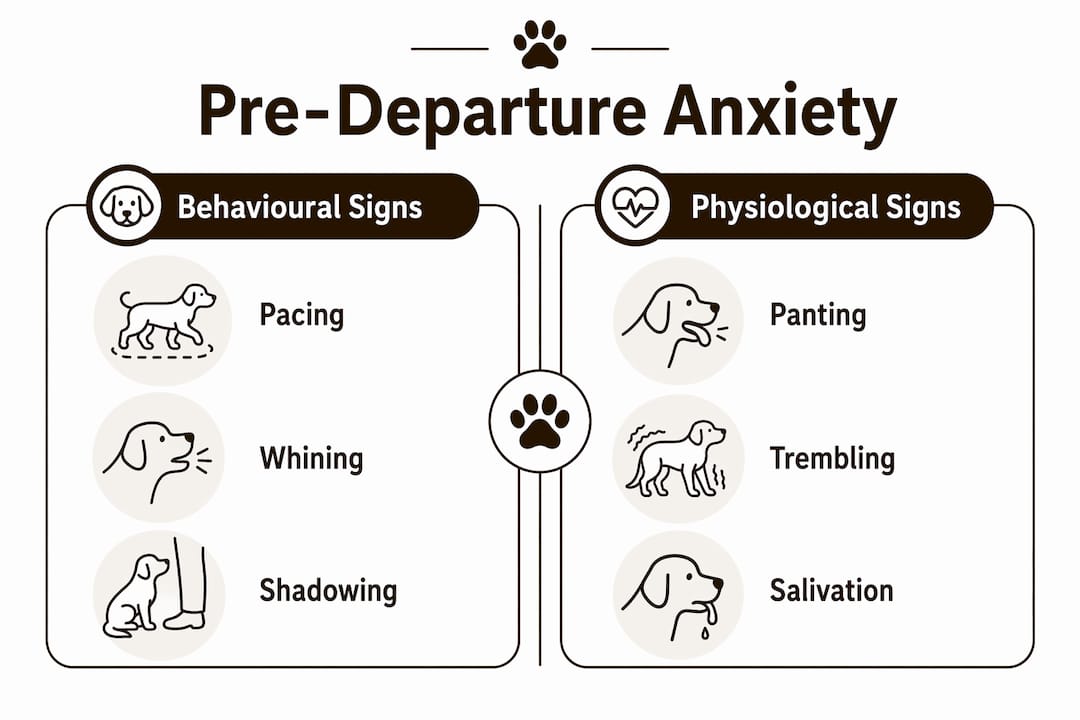
Spotting the signs early makes a significant difference to how quickly your dog can improve. The symptoms of pre-departure anxiety are tied to specific cues and timing, which is what makes them identifiable.
Behavioural signs to watch for
Common behavioural indicators include pacing near the door, whining or vocalising, shadowing you from room to room, refusing food or treats, and attempting to block your exit. Some dogs will carry objects such as shoes or leads as a displacement behaviour. Others will yawn repeatedly, a classic sign of stress in dogs.
Physiological signs
Physical signs include panting without heat or exercise, trembling, excessive salivation, and dilated pupils. These are all markers of sympathetic nervous system activation. Your dog is not being dramatic. Their body is genuinely in a stress response.
Pro Tip: Film your dog during your departure routine using your phone propped against a wall. Reviewing the footage often reveals subtle signs, such as lip licking or freezing, that are easy to miss in the moment.
The table below helps you distinguish pre-departure anxiety from separation anxiety and boredom, three conditions that are often confused.
Behaviour | Pre-Departure Anxiety | Separation Anxiety | Boredom |
When it starts | Before owner leaves | After owner leaves | Variable, often gradual |
Key trigger | Departure cues (keys, coat) | Physical absence of owner | Lack of stimulation |
Physiological signs | Panting, trembling, salivation | Panting, pacing, vocalising | Minimal |
Destructive behaviour | Rare at this stage | Common | Common |
Responds to owner return | Immediate relief | Immediate relief | Minimal change |
Early recognition matters because anxiety produces measurable cortisol elevation that can persist for days. The longer the pattern continues without intervention, the more deeply conditioned the response becomes. Acting early is always easier than reversing a long-established fear.
How to calm anxious dogs before you leave
Managing pre-departure anxiety requires a structured, consistent approach. The goal is to break the association between departure cues and panic, and to replace it with calm or even positive anticipation.
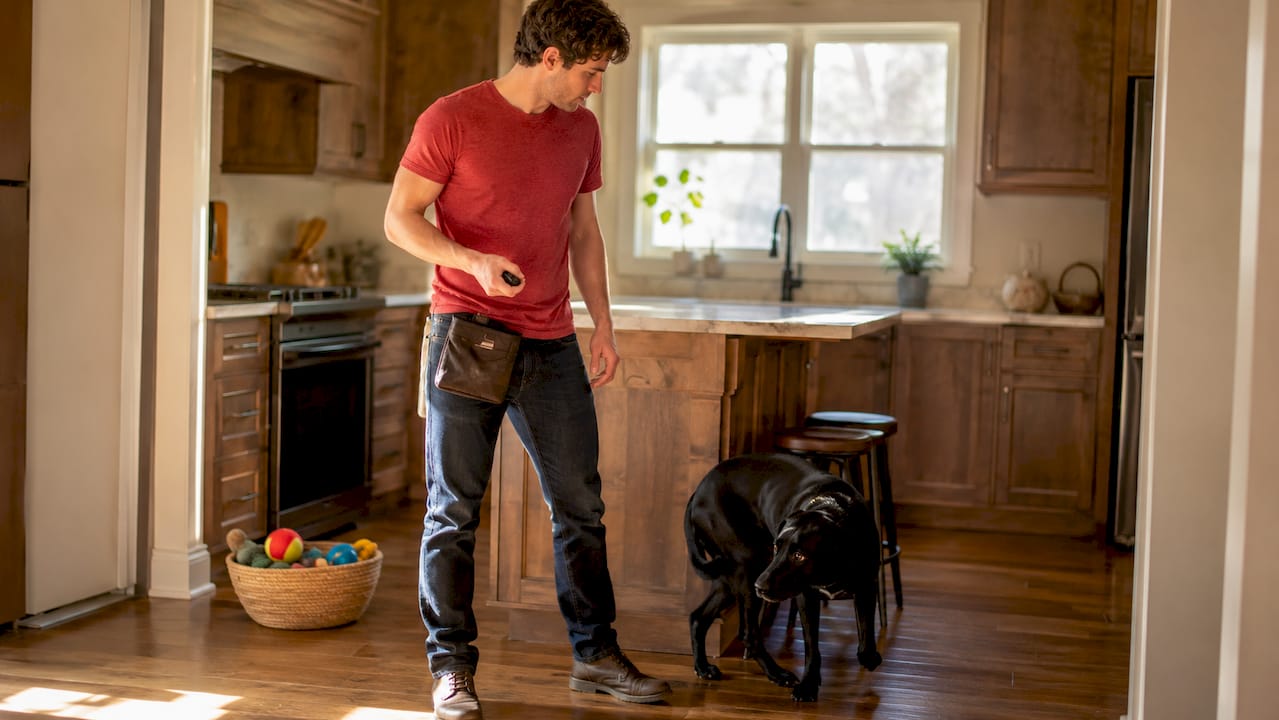
Desensitise departure cues individually. Pick up your keys, then sit back down and watch television. Put on your coat, then make a cup of tea. Practising departure cues independently, without actually leaving, breaks the predictive association your dog has formed. Repeat each cue dozens of times until your dog shows no reaction.
Randomise your cue practice. This is where many owners go wrong. If you always pick up your keys and then go to the letterbox, your dog quickly learns that pattern. Partial cue practice still reinforces anxiety if it consistently ends in some form of departure. Mix up the sequence and the outcome every single time.
Create a calm, neutral departure routine. Avoid long, emotional goodbyes. Withdrawing dramatic farewell rituals reduces cortisol levels in anxious dogs. A quiet, matter-of-fact exit is far kinder than a drawn-out goodbye that amplifies your dog’s distress.
Use positive enrichment at departure time. Give your dog a frozen Kong or a long-lasting chew just before you leave. This creates a positive association with your departure and gives your dog something absorbing to focus on. The treat should only appear at departure time to preserve its value.
Exercise your dog before leaving. A well-exercised dog has lower baseline arousal. A 30-minute walk or play session before your departure reduces the physiological readiness for a stress response.
Consider behavioural medication as an adjunct. For dogs with severe anxiety, medication such as Trazodone or Gabapentin can lower arousal enough to allow learning to occur. Behaviour modification must accompany medication. Medication alone is not a cure. Always consult your vet before starting any anxiolytic treatment.
Pro Tip: Never scold your dog for anxious behaviour during your departure routine. Punishment increases arousal and fear, making the anxiety worse. Reward calm behaviour instead, even if it is just a moment of stillness.
You can also explore proven calming techniques recommended by veterinary behaviourists to complement your training programme at home.
How to prepare your dog for travel or extended separation
Travel adds an extra layer of complexity to dog anxiety before owner leaves. The unfamiliar environment, vehicle movement, and disrupted routine can amplify existing pre-departure anxiety significantly.
Desensitisation training should start at least 6 weeks before travel, with 12 weeks being the preferred timeframe for dogs with severe anxiety. Starting early gives you time to work gradually without rushing the process.
Your preparation checklist should include:
Crate training well in advance. Crate-trained dogs show significantly lower stress during travel. Sudden confinement without prior training triggers a sympathetic nervous system response that worsens anxiety. Introduce the crate as a positive, safe space months before travel.
Medication trials at home first. Home trials with medication are essential to monitor effects and avoid paradoxical reactions. Around 5% of dogs react paradoxically to calming supplements, becoming more restless rather than calmer. You do not want to discover this on travel day.
Timing medication correctly. Medication should be administered 1–2 hours before the stressor to achieve optimal effect. Giving it too late means your dog is already in a panic state before the medication takes hold.
Packing familiar items. Bring your dog’s usual bedding, a worn item of your clothing, and their regular food. Familiar scents reduce novelty stress in an unfamiliar environment.
Maintaining routine as much as possible. Feed, walk, and settle your dog at the usual times even when travelling. Predictability is calming for anxious dogs.
For detailed guidance on preparing your dog for boarding, the Happy-dogtraining resource covers research-backed timelines and practical steps that complement everything covered here.
If your dog’s anxiety is severe, consult a veterinary behaviourist or a certified trainer before travel. Some dogs need professional support to make meaningful progress, and there is no shame in asking for it.
Key takeaways
Pre-departure anxiety in dogs is a conditioned panic response to departure cues that requires consistent desensitisation, neutral departure routines, and professional support for severe cases.
Point | Details |
Pre-departure anxiety is anticipatory | Distress begins before you leave, triggered by cues like keys or coats. |
Shelter dogs carry higher risk | 79–88% of adopted dogs show separation-related problems due to past trauma. |
Desensitise cues independently | Practise departure cues without leaving to break the anxiety association. |
Start travel prep early | Begin desensitisation 6–12 weeks before travel for meaningful results. |
Medication supports but does not replace training | Behavioural modification must accompany any anxiolytic treatment. |
What i have learned after years of working with anxious dogs
The most common mistake I see owners make is interpreting pre-departure anxiety as their dog being manipulative or attention-seeking. It is neither. What you are witnessing is a genuine fear response, as real and involuntary as a person’s panic attack. Your dog is not choosing to behave this way.
The second mistake is inconsistency. Owners will practise departure cues diligently for two weeks, see improvement, and then stop. Anxiety conditioning is stubborn. It takes months of consistent work to fully restructure, and it can return if you stop reinforcing calm behaviour.
What I find most rewarding in this work is watching the relationship between dog and owner shift. When owners stop feeling guilty and start feeling capable, their dogs respond to that calm confidence. The training process itself builds trust. Your dog learns that your departures are predictable, manageable, and always followed by your return.
If your dog’s anxiety is severe, please do not try to manage it alone. A qualified trainer working alongside your vet will get you to a resolution far faster than trial and error at home. The investment in professional support pays back in years of wagging tails and peaceful mornings.
— Mark
How Happy-dogtraining can help your anxious dog
If your dog’s pre-departure anxiety is affecting your daily life, professional support makes a measurable difference.

Happy-dogtraining has over 20 years of experience helping dogs in Singapore overcome fear and anxiety using humane, science-based methods. Every programme is personalised to your dog’s specific triggers and history, so you are never working from a generic template. The AVS-accredited trainers work alongside your veterinary guidance, not against it. For dogs with significant anxiety, the fearful dog class provides structured desensitisation and counter-conditioning in a supportive environment. For owners who want a thorough, intensive approach, the 4-week obedience and behaviour programme addresses anxiety at its root. Free lifetime support is included after training.
FAQ
What is pre-departure anxiety in dogs?
Pre-departure anxiety is anticipatory distress triggered by departure cues such as keys or coats, occurring before the owner leaves. It is a conditioned panic response recognised by veterinary behaviourists as distinct from post-departure separation anxiety.
How is pre-departure anxiety different from separation anxiety?
Pre-departure anxiety starts before the owner leaves, triggered by specific cues. Separation anxiety peaks after departure. Both can occur in the same dog, but they require slightly different management approaches.
Can pre-departure anxiety be cured?
With consistent desensitisation, counter-conditioning, and in some cases veterinary medication, most dogs show significant improvement. Severe cases benefit from professional trainer and veterinary behaviourist support alongside behaviour modification.
How long does it take to treat pre-departure anxiety?
Desensitisation training takes at least 6 weeks for mild cases and up to 12 weeks or longer for severe anxiety. Consistency and patience are the most important factors in achieving lasting results.
Should i use medication to treat my dog’s anxiety before leaving?
Medication can reduce arousal enough to allow learning to occur, but behaviour modification must accompany it. Always trial any medication at home first and consult your vet for appropriate timing and dosage.
Recommended
Comments