What is immersive training for dogs: a complete guide
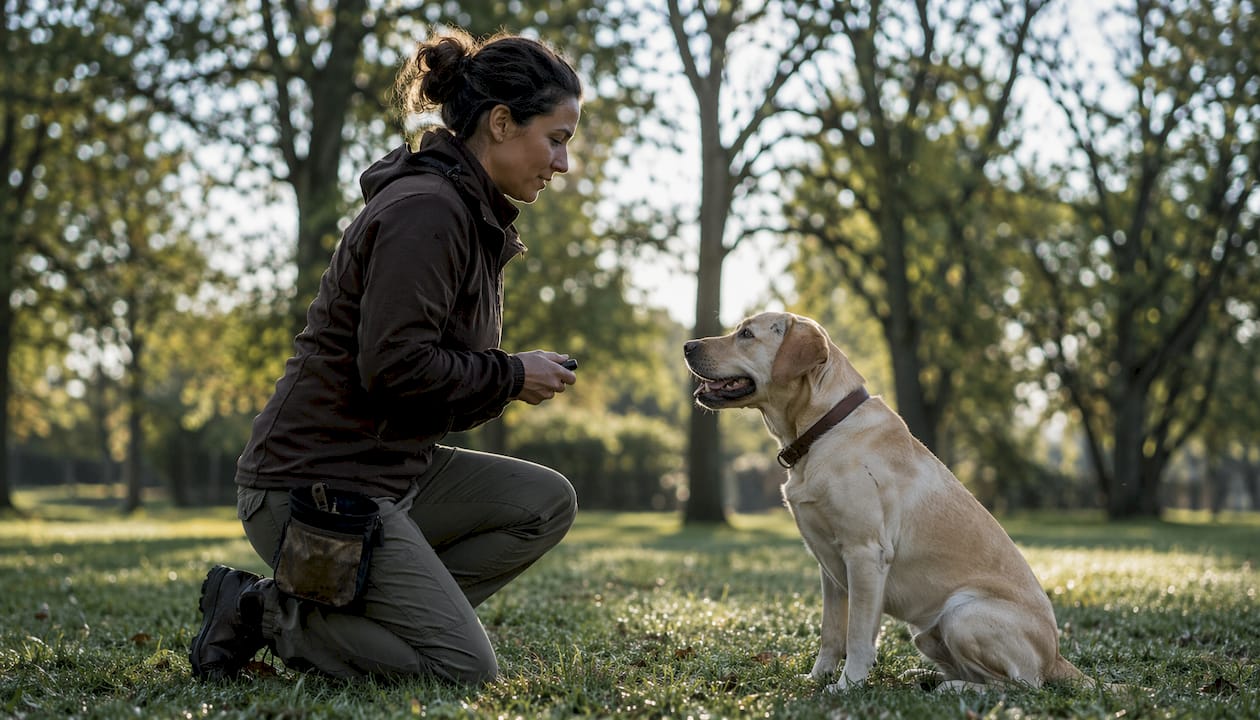
Immersive training for dogs is defined as a structured, round-the-clock programme in which your dog lives with a professional trainer and receives consistent, high-repetition learning every single day. Known in the industry as “board and train,” this method replaces the fragmented repetition of weekly classes with a 24/7 structured schedule that targets core obedience commands and specific behavioural problems simultaneously. The Big Six commands, Sit, Down, Stay, Come, Leave It, and Place, form the foundation of most programmes. Happy-dogtraining has built its approach on these same principles, combining science-based methods with humane, reward-based training to deliver lasting results. For dog owners who want real change without waiting months, this method is the most direct route.
What is immersive training for dogs and how does it work daily?
Immersive training places your dog in a professional environment where every hour of the day contributes to learning. There are no gaps between sessions where bad habits creep back in. The trainer controls feeding, potty breaks, rest, and play, weaving short training sessions throughout the entire day.
A typical daily structure looks like this:
Morning routine: Feeding, potty break, and a short focus session on a foundational command such as Sit or Down.
Mid-morning session: Leash manners and impulse control work, including Leave It and Come.
Afternoon session: Place command practice, duration building, and distraction proofing in a controlled space.
Evening session: Consolidation of the day’s learning with reward-based reinforcement and calm settling exercises.
Throughout the day: Real-life corrections for jumping, mouthing, and counter-surfing as they naturally occur.
This structure matters because muscle memory builds faster with thousands of repetitions across a day than with one hourly session per week. Your dog is not just practising commands. Your dog is learning a new way of living.
Pro Tip: Short, frequent sessions of 5–10 minutes are far more effective than one long session. Immersive programmes use this principle all day, every day, which is why progress feels rapid.
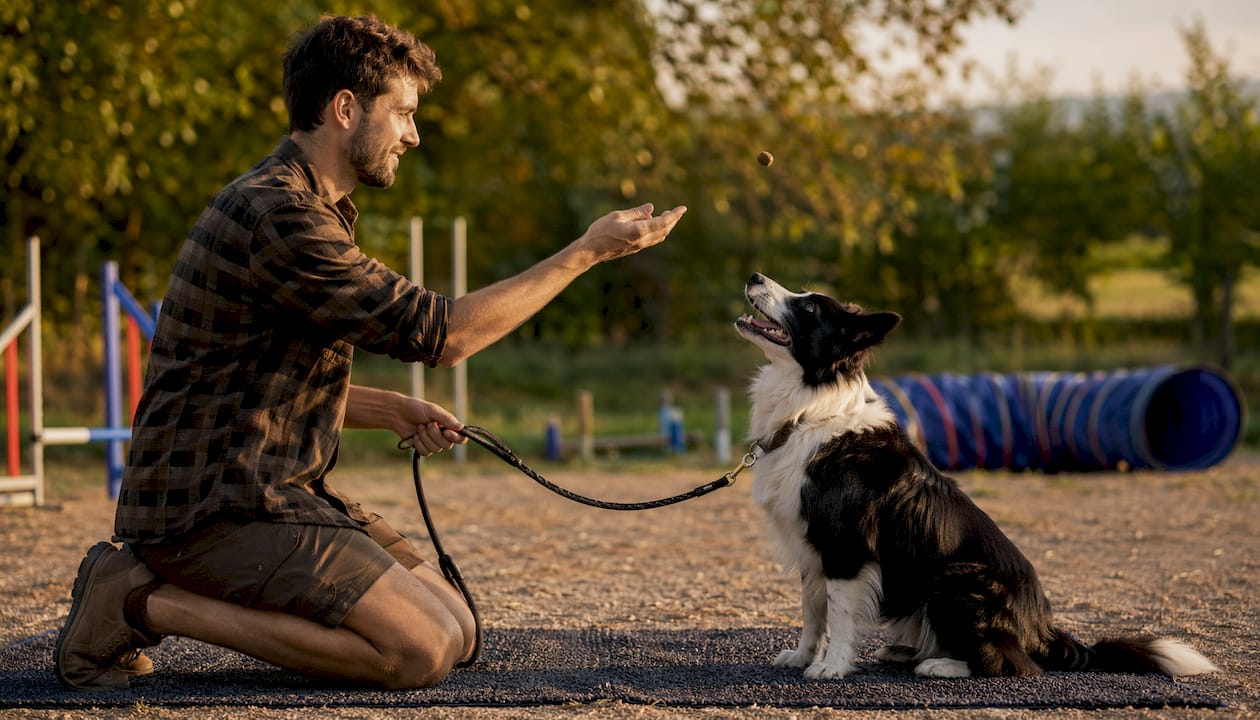
Behavioural issues like jumping on guests, mouthing, and counter-surfing are addressed the moment they happen. This real-time correction is the single biggest advantage over any class-based format. Your dog cannot practise the wrong behaviour when a skilled trainer is present around the clock.
How does immersive training differ from traditional weekly classes?
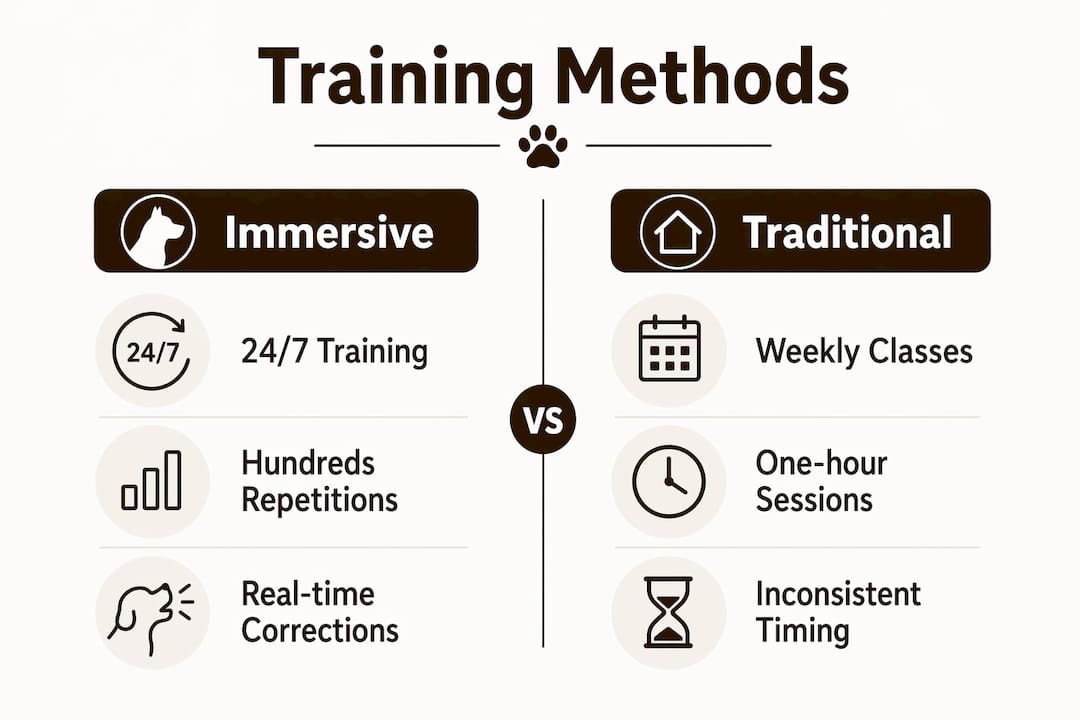
Weekly group classes give your dog roughly one hour of structured learning every seven days. Between sessions, inconsistent owner timing and household distractions allow bad habits to continue unchecked. The result is slow progress and what many owners describe as “selective hearing.”
Immersive training solves this by replacing inconsistent owner timing with neutral, timely trainer corrections that dramatically improve learning speed. The trainer never misses the critical window between a behaviour and its consequence. That precision is very difficult for most owners to replicate at home, especially in the early stages.
Feature | Immersive training | Traditional weekly classes |
Daily repetitions | Hundreds per day | Roughly 20–30 per session |
Real-time correction | Yes, throughout the day | Limited to class time only |
Habit prevention | Continuous | Gaps allow bad habits to persist |
Distraction proofing | Gradual, controlled progression | Rarely addressed systematically |
Owner involvement | Transfer session plus coaching | Owner present throughout |
Typical duration | 2–3 weeks | 6–8 weeks or longer |
Immersive programmes also include gradual exposure to real-world distractions, moving from quiet indoor spaces to busy public environments. This process, called proofing, makes commands reliable under pressure. A dog that only practises Sit in your living room will not reliably Sit outside a coffee shop. Proofing closes that gap.
The training environment itself plays a significant role in how quickly your dog generalises new behaviours. Immersive settings give trainers full control over that environment in a way no weekly class can match.
What types of immersive training exist and which suits your dog?
Two main formats exist: kennel-based board and train, and home immersion. Each suits different dogs depending on temperament, anxiety levels, and the specific behavioural goals you have.
Kennel-based board and train:
Your dog stays at a professional training facility with other dogs present.
Socialisation opportunities are built into the programme.
Best suited to confident, sociable dogs who settle well in new environments.
Structured kennel routines provide clear boundaries and consistent daily rhythm.
Home immersion:
Your dog lives in the trainer’s home rather than a kennel.
Home immersion reduces anxiety in sensitive dogs by replicating a quiet domestic environment.
Emotional regulation improves faster when a dog feels safe and calm.
Retention of new behaviours is stronger when stress levels are low.
Best suited to anxious, fearful, or reactive dogs who would find a kennel setting overwhelming.
The right choice depends entirely on your dog’s individual temperament. A bold, confident Labrador may thrive in a kennel setting. A nervous rescue dog may shut down in that same environment and learn very little. Choosing the wrong format wastes time and money.
Pro Tip: Ask any programme provider whether they assess your dog’s temperament before placement. A reputable trainer will always match the environment to the dog, not the other way around.
Happy-dogtraining tailors every programme to the individual dog’s needs, which is why a thorough assessment comes before any placement decision. You can read more about home obedience training practices to understand which foundational skills translate best from an immersive setting back to your home.
What role does owner involvement play before, during, and after training?
Owner involvement is not optional. It is the difference between a dog that holds its new behaviour for life and one that regresses within a fortnight of coming home.
Before the programme:
Provide up-to-date vaccination records as required by the facility.
Share a full history of your dog’s behavioural issues, triggers, and daily routine.
Prepare your home environment to support the new rules your dog will learn.
During the programme:
Maintain regular communication with the trainer to track progress.
Avoid unplanned visits that may disrupt your dog’s focus and routine.
Begin learning the commands and handling techniques your dog is practising.
After the programme:
Attend the go-home or transfer session where the trainer hands over skills directly to you.
Practise the Big Six commands daily using the same timing and reward system the trainer used.
Follow the daily training schedule your trainer recommends for the weeks following the programme.
Address setbacks calmly and consistently rather than reverting to old responses.
Use post-training coaching sessions to refine your handling as your dog settles back home.
The transfer session is the most underestimated part of the entire process. Your dog has learned new behaviours with a professional. You now need to learn how to maintain them. Skipping or rushing this step is the most common reason results fade. If you encounter difficulties after the programme ends, guidance on troubleshooting training setbacks can help you get back on track quickly.
How effective is immersive training for addressing behavioural issues?
Immersive training is the most effective format for resolving deeply ingrained behavioural problems quickly. Issues like aggression, reactivity, impulse control failures, and fearfulness all respond faster when a dog cannot practise the unwanted behaviour between sessions.
Immersive training stops bad habits from being practised continuously, which creates muscle memory for the correct behaviour far faster than hourly sessions ever could. The 24/7 environment removes the gaps where old patterns reinforce themselves, giving the trainer full control over what the dog learns and rehearses each day.
Socialisation within immersive programmes follows a carefully controlled approach. Rather than flooding a dog with stimulation, exposure focuses on neutrality, teaching your dog to remain calm around other dogs, people, and environments rather than becoming excited or reactive. This distinction matters enormously for dogs with a history of fearfulness or aggression.
A typical programme lasting 2–3 weeks delivers thousands of repetitions across multiple commands and real-life scenarios. That volume simply cannot be replicated in weekly classes over the same period. The time saving alone makes immersive training cost-effective when you factor in the months of weekly classes it replaces, plus the cost of damage, stress, and lost confidence in the meantime.
Professional trainers also use tools such as remote training collars as gentle communication tools rather than punishment devices. Used correctly, these provide a clear, timely signal that bridges the gap between command and compliance, particularly in off-leash situations where voice alone is insufficient.
Key takeaways
Immersive training for dogs is the most effective method for building reliable obedience and resolving behavioural issues because it combines 24/7 repetition, real-time correction, and structured proofing in a way no weekly class can replicate.
Point | Details |
24/7 structure accelerates learning | Thousands of daily repetitions build muscle memory far faster than weekly sessions. |
Big Six commands form the core | Sit, Down, Stay, Come, Leave It, and Place are the foundation of every immersive programme. |
Programme type must match the dog | Anxious dogs benefit from home immersion; confident dogs often thrive in kennel settings. |
Owner follow-through is non-negotiable | The transfer session and daily home practice determine whether results last long-term. |
Proofing makes commands reliable | Gradual exposure to real-world distractions ensures your dog responds under pressure. |
Why I believe immersive training changes everything for dog owners
Having observed dogs go through immersive programmes, the speed of change is genuinely striking. A dog that was pulling on the lead, jumping at visitors, and ignoring every recall command can look like a completely different animal after two to three weeks. Not because of magic, but because the maths of repetition finally works in the dog’s favour.
What most owners do not realise is that their own inconsistency is often the biggest barrier to progress. That is not a criticism. Life is busy, timing is hard, and dogs are opportunistic learners. Immersive training removes that variable entirely during the critical learning phase. The trainer is consistent in a way that is almost impossible to sustain at home without professional guidance.
The part I find most rewarding to witness is the transfer session. Watching an owner reconnect with their dog and immediately feel the difference in responsiveness is genuinely moving. The dog is calm, attentive, and willing. The owner is confident for the first time. That moment is where the real relationship begins.
My honest view is that immersive training is not a shortcut. It is a head start. The owner still has to maintain the work, practise the commands, and stay consistent. But starting from a place of success rather than frustration makes all the difference to how both dog and owner feel about training going forward.
— Mark
Professional immersive training programmes with Happy-dogtraining
Happy-dogtraining brings over 20 years of experience to every programme it delivers in Singapore. The 4-week AVS-approved intensive programme is built around the same principles covered in this article: structured daily sessions, the Big Six commands, real-life proofing, and a thorough transfer session so you leave confident and capable.

Every programme begins with a full assessment of your dog’s temperament and your household goals. Post-training support does not end at the gate. Happy-dogtraining provides free lifetime support after the programme completes, so you always have expert guidance when you need it. Whether your dog struggles with reactivity, aggression, or basic obedience, the team at Happy-dogtraining will match the right programme to your dog’s specific needs.
FAQ
What is immersive training for dogs?
Immersive training is a board-and-train programme where your dog lives with a professional trainer and receives consistent, round-the-clock obedience and behaviour work. It targets core commands and specific behavioural issues through thousands of daily repetitions.
How long does an immersive training programme typically last?
Most programmes run for 2–3 weeks, though some extend from 10 days to 16 weeks depending on the dog’s needs and the goals of the programme.
Is immersive training suitable for anxious or fearful dogs?
Yes, provided the right format is chosen. Home immersion, where the dog stays in a trainer’s home rather than a kennel, reduces stress and supports faster emotional regulation and skill retention for sensitive dogs.
What commands does immersive training teach?
Most immersive programmes focus on the Big Six: Sit, Down, Stay, Come, Leave It, and Place. These commands form the foundation for impulse control, safety, and reliable off-leash behaviour.
What happens after the immersive programme ends?
Owners attend a transfer session where the trainer hands over the commands and handling techniques directly. Daily home practice and post-training coaching sessions maintain and build on the progress made during the programme.
Recommended
Comments