Dog temperament evaluation: what owners need to know

A dog temperament evaluation is a structured, observation-based assessment that measures how your dog responds to everyday stimuli, revealing traits such as sociability, stability, fearfulness, and aggression thresholds. Think of it as a behavioural snapshot, not a permanent label.
At a glance:
Who orders them: rescue organisations, breeders, therapy dog programmes, and individual owners working with a trainer or behaviourist
Primary reasons: rehoming suitability, therapy or assistance work selection, breeder screening, and building a personalised training plan
Typical duration: 30 minutes to a full day, depending on purpose and provider
Immediate outcome: a written summary, trait scores, and recommended next steps
Key caveat: results reflect your dog’s behaviour on that day, in that environment, not a fixed prediction of future conduct
Table of Contents
Why do organisations and owners use temperament evaluations?
The AKC Temperament Test describes the core objective clearly: to assess emotional stability, curiosity, cooperation, and recovery from startle, while noting fear, shyness, and unprovoked aggression as negative indicators. Each use case leads to a genuinely different decision.
Rehoming and adoption suitability. A rescue assessor uses the evaluation to match a dog to the right household, whether that means a family with children, an experienced single owner, or a quieter adult-only home.
Therapy and assistance work. Organisations such as Therapy Dog Training UK use structured assessments to determine whether a dog has the calm, stable temperament needed to visit hospitals or care homes. A dog that recovers quickly from sudden noise and accepts handling from strangers is far more likely to thrive in that role.
Breeder screening. Responsible breeders assess parent dogs and litters to understand genetic predispositions, helping prospective owners find a puppy temperament match suited to their lifestyle.
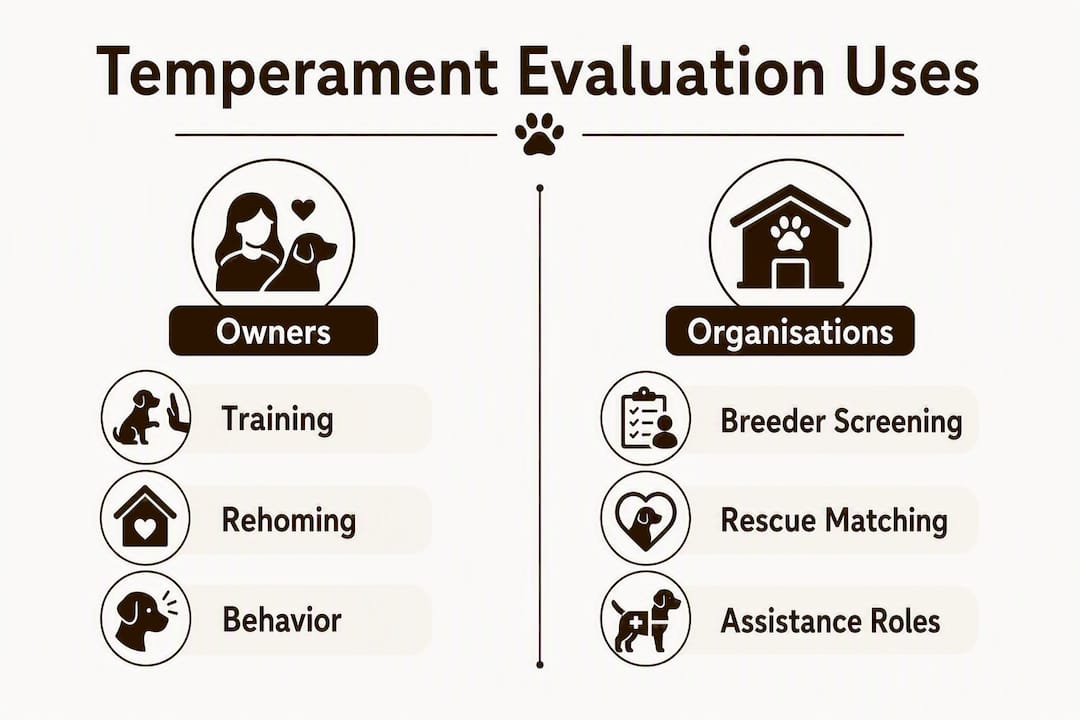
Tailored training programmes. When a trainer understands your dog’s natural tendencies, whether bold and curious or cautious and sensitive, they can design a programme that works with those traits rather than against them.
Temperament reflects both genetics and lived experience. A good evaluation identifies the “goodness-of-fit” between your dog’s tendencies and your circumstances, which is far more useful than a simple pass or fail.
What actually happens during a dog temperament assessment?
Most UK assessments follow a test battery format: a series of controlled, repeatable scenarios that expose your dog to standard stimuli and allow the assessor to compare responses. The AKC Temperament Test uses 18 items across six categories, and the American Temperament Test Society structures its evaluation around ten subtests covering stability, shyness, aggressiveness, friendliness, and protective instinct.
Common stimuli and what they reveal:
Stranger approach and interaction: tests sociability and whether the dog can accept neutral or friendly contact without anxiety or aggression
Sudden auditory stimuli (e.g. a dropped object or sharp noise): reveals startle response and recovery speed, a key indicator of emotional stability
Handling (ears, paws, body): shows tolerance of physical contact, relevant for veterinary care and family life
Novel or uneven surfaces: assesses confidence and willingness to explore, which reflects curiosity and adaptability
Resource handling (food bowl, toy): identifies guarding behaviours around high-value items
Crowding and unexpected movement: tests how the dog manages mild social pressure
Props used during assessments often include a lead, food bowl, dog treats, toys, a lifelike doll, and sometimes a fake arm to test bite inhibition in a controlled way.
Assessors record results on a marking sheet with scoring bands, and reputable services keep written notes or video evidence. Documented records matter because they allow a second assessor, trainer, or behaviourist to review the session and support any follow-up recommendations.

Test category | What is observed | Why it matters |
Social interaction | Response to strangers, neutral and friendly | Sociability and bite risk |
Auditory stimuli | Startle and recovery from sudden noise | Emotional stability |
Handling | Tolerance of touch on body, ears, paws | Safety with family and vets |
Novel surfaces | Willingness to step onto unfamiliar ground | Confidence and curiosity |
Resource handling | Reaction when food or toys are approached | Guarding thresholds |
Crowding | Response to mild social pressure | Stress tolerance |
Who runs assessments, and when should you request one?
Several types of professionals carry out temperament evaluations in the UK. Rescue and charity assessors work within organisations and typically follow an in-house protocol. Certified trainers and behaviourists offer independent assessments, often in a home or neutral environment. Therapy dog organisations, including Therapy Dog Training UK and Wag & Company, run their own structured evaluations as part of their registration process.
When credentials matter, look for membership of recognised bodies such as the Animal Behaviour and Training Council (ABTC) or the Association of Pet Behaviour Counsellors (APBC). A certified animal behaviourist brings a higher level of clinical knowledge, particularly when behaviour concerns are complex.
Common situations to request an assessment:
Before or after adopting a rescue dog
When a puppy is approaching adolescence and showing unexpected behaviours
As a prerequisite for therapy or assistance dog training
On referral from a vet or trainer following a behaviour incident
Pro Tip: Before booking, ask the assessor directly about their qualifications, how long they have been practising, and whether they use force-free, humane methods. Any reputable assessor will welcome those questions.
How long do assessments take, and what do they cost in the UK?
Duration varies considerably. Assessment durations vary widely, from brief screenings to extended evaluations designed to observe behaviour across multiple contexts. Providers such as Wag & Company offer structured assessment programmes that give dogs time to relax before observations begin, which tends to produce more reliable results.
Cost in the UK varies depending on organisation and services included; some assessments are free within adoption processes, while others charge fees
Before booking, ask specifically what the fee covers: trainer time, a written report, video documentation, and follow-up recommendations are not always bundled together. Knowing what you are paying for helps you compare providers fairly.
What do the results look like, and what happens next?
Assessor feedback usually arrives as a summary statement accompanied by trait scores or suitability notes. You might receive a written report describing your dog’s responses category by category, with a clear recommendation at the end.
Realistic outcomes include:
Suitable for family life, with recommended socialisation work. The dog is broadly stable but would benefit from structured exposure to children, other dogs, or busy environments before settling in.
Unsuitable for therapy work at this stage. The dog shows anxiety around strangers or recovers slowly from startle, making a therapy role inappropriate without significant behaviour modification first.
Resource guarding identified, targeted training advised. The assessor flags a specific trigger and recommends a specialist programme rather than a general obedience class.
Restricted adoption placement recommended. The dog is rehomeable but needs an experienced owner, a single-dog household, or a home without young children.
After receiving results, the typical sequence of next steps is: agree a training plan by temperament type, seek a specialist referral if the assessor flags complex behaviour, make any environmental adjustments recommended, and schedule a reassessment after a defined period of training.
How accurate are temperament evaluations?
Honest answer: useful, but imperfect. Research reviewed by Maddie’s Fund shows that shelter stress and elevated cortisol at intake can significantly skew a dog’s displayed behaviour, meaning a dog assessed shortly after arriving at a rescue centre may appear far more fearful or reactive than it actually is in a settled home.
Puppy assessments carry a further caveat. Temperament typically stabilises as dogs mature, so traits observed in a young puppy can shift considerably as the dog matures. Experts consistently caution that puppy tests have limited predictive power for this reason.
Assessor variability is another factor. Without a standardised, accredited protocol, two assessors observing the same dog may reach different conclusions. Experienced professionals combine structured test scores with qualitative notes and other information to form a more complete evaluation. Treating an evaluation as one important data point, rather than a verdict, is the most responsible approach.
How to prepare your dog for an assessment
A little preparation genuinely improves the quality of observations. When your dog arrives calm and comfortable, the assessor sees closer to their true temperament rather than stress-driven behaviour.
Feed your dog at their normal time beforehand, but avoid a heavy meal immediately before the session
Give a moderate walk to take the edge off excess energy, without over-tiring them
Avoid busy, overstimulating environments on the morning of the assessment
Bring familiar treats and a favourite toy, as these help your dog settle and give the assessor useful information about motivation
Bring any relevant paperwork: vaccination records, a note of known triggers, details of recent behaviour incidents, and foster or carer notes if applicable
Questions worth asking your assessor: How is each category scored? Will I receive a written report? Is a home visit or longer observation available if results are inconclusive? What follow-up support is included?
Legal and ethical considerations in the UK
No single piece of UK legislation governs how temperament evaluations must be conducted, but several legal frameworks are relevant. The Animal Welfare Act 2006 requires that any assessment is carried out in a way that avoids unnecessary suffering, which rules out aversive or fear-inducing methods. Where a dog is subject to a court-ordered assessment under the Dangerous Dogs Act 1991, the process is more formal and the assessor’s report may carry legal weight.
Ethically, reputable assessors in the UK follow welfare-centred principles: no physical punishment, no deliberate provocation beyond what the test protocol requires, and full transparency with the owner about methods used. Owners have the right to ask for the assessment to stop if they believe their dog is in distress. Keeping documented records, including the marking sheet and any video, protects both the assessor and the owner if results are later disputed.
How temperament evaluations differ from behavioural assessments and medical exams
These three types of assessment serve different purposes and should not be confused.
A temperament evaluation measures stable, trait-level tendencies: how your dog typically responds to novelty, social contact, and stress. It is forward-looking, used to inform placement or training decisions.
A behavioural assessment focuses on a specific problem behaviour, such as aggression toward visitors or separation anxiety, and aims to identify the function and triggers of that behaviour. It is usually conducted by a behaviourist and results in a targeted behaviour modification plan. Behaviour analysis in dog training goes deeper into how this process works.
A medical examination by a vet rules out physical causes for behavioural changes, such as pain, thyroid dysfunction, or neurological conditions. Many experienced professionals recommend a veterinary check before or alongside any behavioural or temperament assessment, because health issues can mimic or exacerbate behavioural problems.
Are temperament evaluation methods standardised in the UK?
Not uniformly. Unlike some countries where a single national protocol is widely adopted, the UK has no mandatory, government-mandated standard for temperament evaluations outside of specific legal contexts. Different organisations use different frameworks: rescue charities often develop in-house protocols, therapy dog organisations such as Therapy Dog Training UK and Wag & Company apply their own assessment criteria, and independent trainers may follow formats derived from the ATTS or AKC models.
The AKC Temperament Test and the ATTS framework are internationally recognised reference points, and some UK assessors align their practice with these. Accreditation through bodies such as the ABTC provides a degree of professional standardisation, as members are required to follow evidence-based, welfare-positive methods. When choosing a provider, asking which framework they follow and whether they are accredited is a straightforward way to gauge consistency and quality.
Key takeaways
A dog temperament evaluation is a structured behavioural snapshot that informs placement, training, and welfare decisions, but it works best when combined with history, veterinary checks, and skilled follow-up.
Point | Details |
Evaluations are snapshots | Results reflect behaviour on the day; stress, environment, and age all affect what is observed. |
Multiple purposes, one tool | The same assessment informs rehoming, therapy selection, breeder screening, and training plans. |
Check assessor credentials | Look for ABTC membership or equivalent; ask about methods before booking. |
Prepare your dog | A calm, familiar routine before the session helps produce more accurate observations. |
Results guide next steps | Use findings to build a tailored training plan or seek a specialist referral, not as a final verdict. |
Why humane use of temperament testing matters most
Temperament testing is genuinely useful, but only when it is treated as a starting point rather than a sentence. What concerns me most is the tendency to use a single assessment result to close doors on a dog permanently, particularly in shelter environments where stress can distort behaviour significantly. A dog that scores poorly on resource guarding during a 45-minute shelter assessment may respond completely differently after two weeks in a calm foster home.
The most responsible approach combines a structured evaluation with real-world observation, owner or carer history, and a clear, humane plan for what comes next. At Happy-dogtraining, every assessment outcome we work with feeds directly into a personalised, science-based programme, because the evaluation is only as valuable as the training that follows it. If your dog’s results have flagged a concern, that is not the end of the story. It is the beginning of a much more targeted conversation about how to help them thrive.
Useful sources for further reading
AKC Temperament Test guidelines: the full AKC ATT protocol, useful for owners and trainers wanting to understand a widely referenced standardised format
American Temperament Test Society: test description: detailed breakdown of the ten ATTS subtests; best for trainers and breeders seeking an internationally recognised reference
Maddie’s Fund: temperament testing presentation notes: research-grounded review of shelter testing limitations; essential reading for rescue workers and policy-focused readers
Whole Dog Journal: understanding dog temperament: accessible overview of temperament concepts for general dog owners, including puppy testing caveats
AKC expert advice: temperament in dogs: practical guidance on interpreting temperament and combining assessments with real-world observation
PMC: temperament and developmental psychopathology: peer-reviewed academic source on the stability and genetic basis of temperament traits; most relevant for trainers and researchers wanting scientific grounding

If your dog’s assessment has flagged a behaviour concern, or you simply want a clearer picture of their personality before starting training, Happy-dogtraining’s structured obedience programme offers a science-based, humane pathway from evaluation to real, lasting change.
Recommended
Comments