Behaviour analysis in dog training: a practical guide
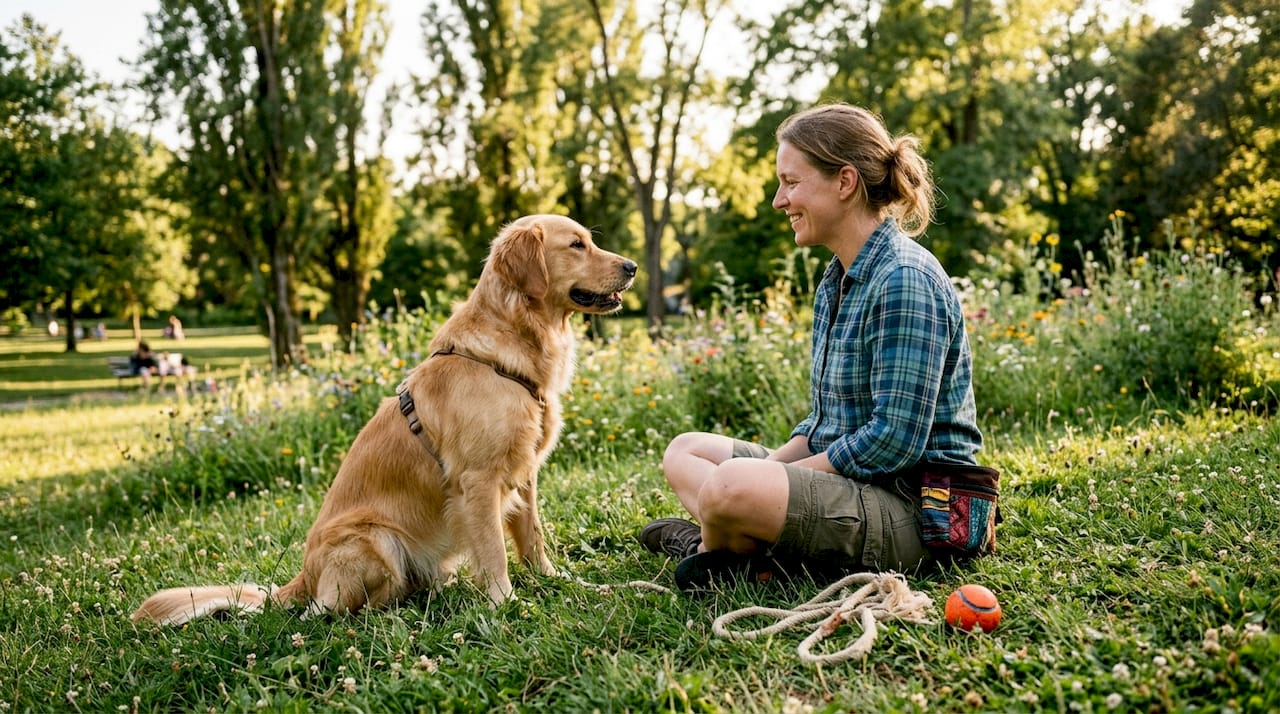
Behaviour analysis in dog training is the systematic application of learning theory to understand, assess, and change how a dog acts. The formal industry term is applied behaviour analysis (ABA), and it draws on decades of research into how animals learn. At its core, it uses principles like operant conditioning, classical conditioning, and reinforcement to explain why dogs do what they do and how to shift those patterns. Understanding canine behaviour analysis is what separates guesswork from a training plan that actually works. Happy-dogtraining has applied these science-based methods for over 20 years to help dogs and their owners build lasting, joyful relationships.
What is behaviour analysis in dog training?
Behaviour analysis is defined as the scientific study of how consequences shape behaviour over time. In dog training, it means observing what a dog does, identifying what triggers and maintains that behaviour, and then applying the right learning principles to change it. The goal is always to understand the “why” before reaching for a solution.
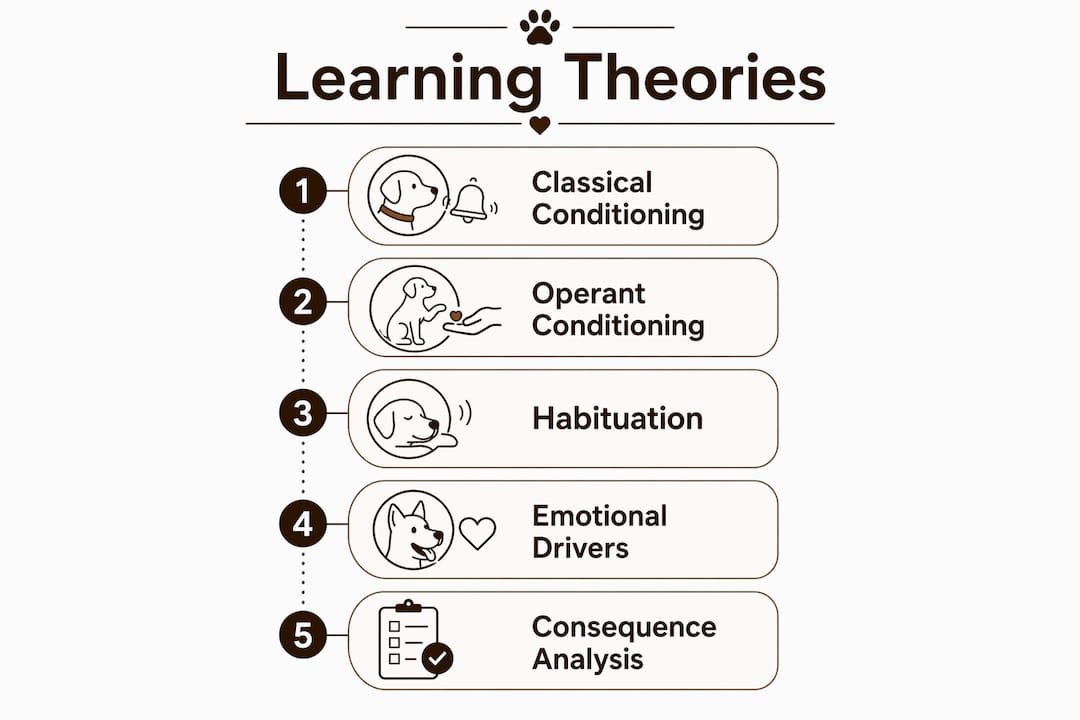
Applied behaviour analysis sits within a broader framework that includes operant and classical conditioning, both of which are essential tools for any trainer. Operant conditioning explains voluntary behaviours: a dog sits because sitting has been rewarded. Classical conditioning explains emotional reactions: a dog trembles at the vet because the clinic has been associated with discomfort. Knowing which process is driving a behaviour tells you which technique to use.
The importance of behaviour analysis lies in its precision. Without it, training becomes reactive and inconsistent. With it, you can build a structured plan that addresses the root cause of a problem rather than just suppressing the symptom.
What are the fundamental learning theories behind behaviour analysis in dogs?
Four core processes explain how dogs learn, and every effective training technique maps back to at least one of them.
Positive reinforcement: Adding something pleasant (a treat, praise, play) to increase the likelihood a behaviour repeats. This is the foundation of reward-based training and the most widely recommended approach for humane dog training.
Negative reinforcement: Removing something unpleasant when the dog performs the desired behaviour. The dog learns to act in order to escape or avoid discomfort.
Positive punishment: Adding something unpleasant to reduce a behaviour. This approach carries significant welfare risks and is avoided in modern, science-based programmes.
Negative punishment: Removing something pleasant to reduce a behaviour. For example, turning away and ignoring a dog that jumps up removes the attention it was seeking.
Dogs learn both voluntary and involuntary responses, which means trainers must account for both operant and classical conditioning in any behaviour modification plan. A dog that barks at strangers may be performing a voluntary, operant behaviour (barking works to make the stranger go away) while simultaneously experiencing an involuntary, classical fear response. Treating only one side of that equation rarely produces lasting change.
Two additional processes complete the picture. Habituation occurs when a dog stops reacting to a repeated, neutral stimulus. Sensitisation is the opposite: repeated exposure to a stimulus actually increases the dog’s reaction. Both are non-associative learning processes, and both matter enormously when you are working with a fearful or reactive dog.
Pro Tip: Before starting any training plan, identify whether the behaviour is driven by emotion (classical) or consequence (operant). The answer shapes everything that follows.
How is canine body language interpreted in behaviour analysis?
Accurate canine behaviour assessment starts with reading the whole dog, not just one body part. Ears, tail, eyes, posture, and muscle tension all communicate the dog’s emotional state simultaneously. Focusing only on the tail wag, for example, misses the stiff body and hard stare that signal tension.
Canine body signals are classified into three zones: Green, Yellow, and Red. This framework gives trainers and owners a shared language for assessing a dog’s state in real time.
Zone | Signals | What to do |
Green | Loose body, soft eyes, relaxed tail | Continue training; dog is ready to learn |
Yellow | Lip licking, yawning, looking away, whale eye | Reduce pressure; give the dog space |
Red | Freezing, stiff posture, growling, snapping | Stop immediately; remove the trigger |
Common stress signals such as lip licking, yawning, and freezing are often the earliest warnings before a behaviour escalates. Ignoring these signals is one of the most frequent causes of training failure. When a dog in the Yellow zone is pushed further, it skips straight to Red, and trust erodes quickly.
Misreading signals also leads to mislabelled behaviour. A dog that “suddenly” bites was almost certainly communicating discomfort for some time beforehand. Skilled trainers read those early signals and adjust the session before the dog reaches its threshold. This is why training methods by dog temperament matter so much: the same trigger can produce very different responses depending on the individual dog’s history and arousal baseline.
Pro Tip: Film a short video of your dog during a situation that concerns you. Watching it back at half speed reveals stress signals you almost certainly missed in the moment.
What are the key dog training techniques derived from behaviour analysis?
Behaviour analysis does not stay in the classroom. It translates directly into the techniques you use every day with your dog.
Positive reinforcement as the primary tool
Force-free training protects the dog’s emotional state, reduces stress, and builds cooperation without fear or intimidation. Positive reinforcement is the preferred method in modern, evidence-based programmes because it works with the dog’s natural motivation rather than against it. The dog chooses to engage because engagement pays off.
Marker training for clear communication
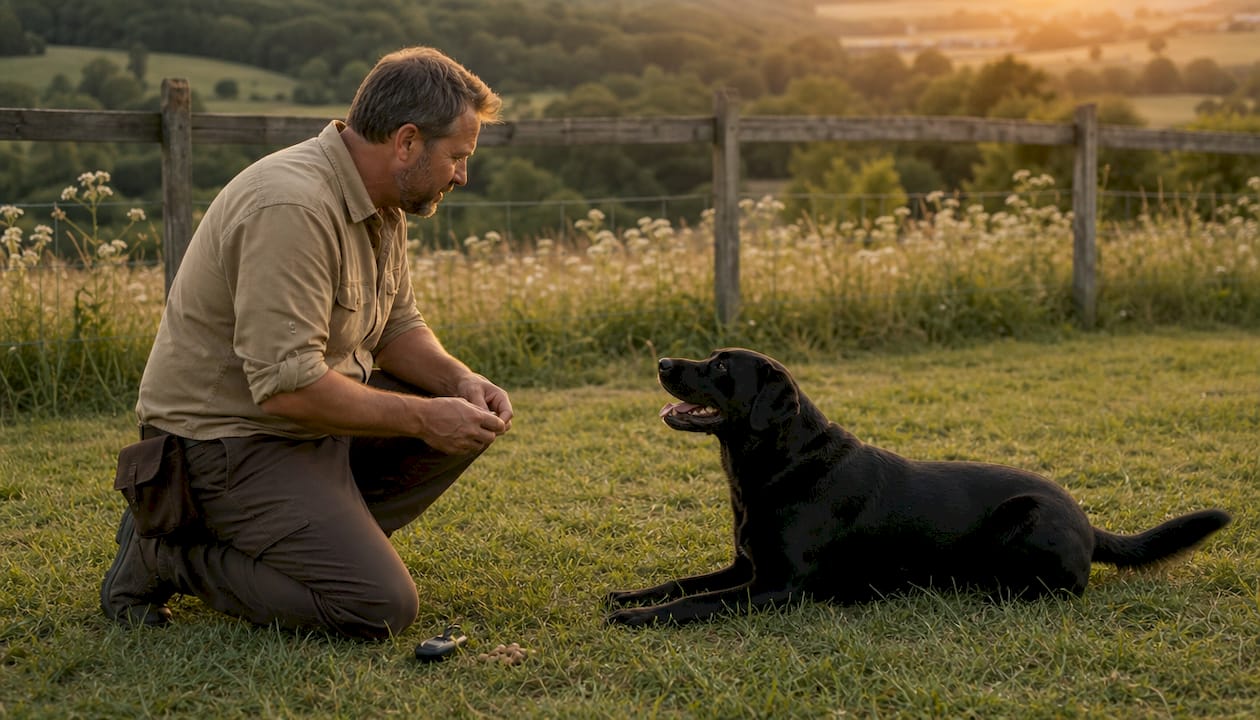
Marker training uses a conditioned stimulus, typically a clicker or a short verbal cue like “yes,” to mark the exact moment a desired behaviour occurs. The marker acts as a bridge between the behaviour and the reward. Delays or unclear markers reduce training effectiveness significantly, because the dog cannot identify which action earned the reward.
Rewards must arrive within 1–2 seconds of the desired behaviour for the correct association to form. That tight timing window is what makes marker training so powerful: it removes ambiguity entirely.
A structured approach to behaviour modification
Assess the baseline. Identify the specific behaviour, its triggers, its frequency, and any potential medical causes. A professional behaviour assessment typically begins with a 30–90 minute consultation.
Set a clear goal. Define what the desired behaviour looks like in concrete terms. “Calm on the lead” is measurable. “Better behaved” is not.
Manage the environment. Prevent the unwanted behaviour from being practised while the new skill is being built. Management is not training, but it stops the problem from getting worse.
Teach a replacement behaviour. Give the dog something specific to do instead of the unwanted behaviour. A dog that sits cannot simultaneously jump up.
Reinforce consistently. Reward the replacement behaviour every time during the learning phase. Consistency is what builds the new habit.
Gradually reduce management. As the new behaviour becomes reliable, reduce environmental controls and test the dog in progressively more challenging situations.
Professional behaviour modification programmes typically run over 4–8 weeks following the initial consultation. That structure exists because lasting behaviour change takes time and repetition, not a single session.
What are common challenges and mistakes in applying behaviour analysis to dog training?
Even well-intentioned training goes wrong when the principles are applied carelessly. These are the most common pitfalls.
Mistimed rewards. Rewarding even a fraction too late can reinforce the wrong action. If your dog sits and then stands up before you deliver the treat, you have just rewarded standing, not sitting. This is why marker training exists: it closes that timing gap.
Ignoring emotional context. Behaviour analysis alone is incomplete without considering the dog’s emotional state, arousal level, and social bonds. A dog in a high state of fear cannot learn new behaviours effectively. The emotional state must be addressed first.
Skipping the medical check. Pain, hormonal imbalances, and neurological issues can all produce or worsen behavioural problems. A dog that has suddenly become aggressive may be in pain. Ruling out medical causes before starting a behaviour programme is not optional.
Relying on quadrant mechanics alone. Knowing that positive reinforcement increases behaviour frequency is useful. Knowing which reinforcer motivates this particular dog in this particular context is what actually produces results. Generic plans fail because dogs are individuals.
Expecting instant results. Behaviour change follows a learning curve. Owners who expect a single session to resolve a deeply ingrained habit often give up too early or switch methods before any approach has had time to work.
The most effective response to complex behavioural issues is a structured, professionally guided plan that accounts for the dog’s history, emotional state, and individual learning style.
Key takeaways
Behaviour analysis in dog training works because it identifies the specific learning processes driving each behaviour and applies the right technique to change it at the root.
Point | Details |
Applied behaviour analysis | The formal framework behind effective dog training, combining operant and classical conditioning. |
Body language reading | Classify signals into Green, Yellow, and Red zones to assess the dog’s state before and during training. |
Marker training timing | Rewards must arrive within 1–2 seconds of the desired behaviour to build the correct association. |
Emotional state matters | A dog in fear or high arousal cannot learn effectively; address the emotional state before the behaviour. |
Structured programmes work | Professional behaviour modification typically runs 4–8 weeks and begins with a thorough trigger assessment. |
Why I think most dog training problems come down to one overlooked skill
After years of working with dogs across a wide range of behavioural issues, I have come to believe that the single most underrated skill in dog training is observation. Not technique. Not timing. Observation.
Most owners arrive with a behaviour problem they want to fix. What they have not yet done is watch their dog carefully enough to understand what that behaviour is actually communicating. A dog that pulls on the lead is not being stubborn. A dog that growls at visitors is not being dominant. Both are communicating something specific about their emotional state, and that communication is written clearly in their body language if you know how to read it.
The science of behaviour analysis gives you the vocabulary to read it. Operant conditioning tells you what consequences are maintaining the behaviour. Classical conditioning tells you what emotional associations are driving it. Body language classification tells you how close the dog is to its threshold. Put those three together and the training plan almost writes itself.
What I have found, time and again, is that small adjustments in timing and observation produce far bigger results than switching to a completely different method. A reward delivered one second earlier. A session ended before the dog reaches Yellow. A trigger identified that the owner had never noticed. These are the moments where real progress happens.
The owner-dog relationship is the medium through which all of this works. A dog that trusts its owner is a dog that is willing to try new things, tolerate new situations, and recover quickly from mistakes. Build that relationship first, and the behaviour mechanics will follow far more easily than you expect.
— Mark
Personalised behaviour training with Happy-dogtraining
If you have read this far, you already understand that effective dog training is built on observation, timing, and the right application of learning principles. Putting that into practice with your own dog is a different matter entirely, and that is where professional guidance makes a genuine difference.

Happy-dogtraining brings over 20 years of experience and AVS-accredited expertise to every dog it works with. Whether your dog is struggling with reactivity, fear, aggression, or basic obedience, the team builds a personalised behaviour programme around your dog’s specific triggers, temperament, and learning style. For dogs with more complex needs, the aggressive behaviour consult provides a structured, specialist assessment as the starting point. Every programme includes free lifetime support, so you and your dog are never left without guidance after training ends.
FAQ
What is applied behaviour analysis in dog training?
Applied behaviour analysis (ABA) is the scientific application of learning theory principles to understand and change canine behaviour. It uses operant conditioning, classical conditioning, and reinforcement strategies to build a structured, evidence-based training plan.
How does positive reinforcement differ from other training methods?
Positive reinforcement adds a reward immediately after a desired behaviour to increase the chance it repeats. Unlike punishment-based methods, it protects the dog’s emotional state and builds cooperation through trust rather than fear.
Why does timing matter so much in dog training?
Rewards must arrive within 1–2 seconds of the desired behaviour for the dog to form the correct association. A reward delivered even a few seconds late can accidentally reinforce a different, unwanted action.
How do I know if my dog is stressed during training?
Watch for Yellow zone signals: lip licking, yawning, looking away, or a tucked tail. These indicate the dog needs space or a reduction in pressure before the session continues.
When should I seek professional help for my dog’s behaviour?
Seek professional help when a behaviour is persistent, escalating, or involves aggression or fear. A qualified behaviourist will assess triggers, rule out medical causes, and build a structured 4–8 week modification programme tailored to your dog.
Recommended
Comments