Dog Jumping on Guests: How to Teach a Calm Greeting
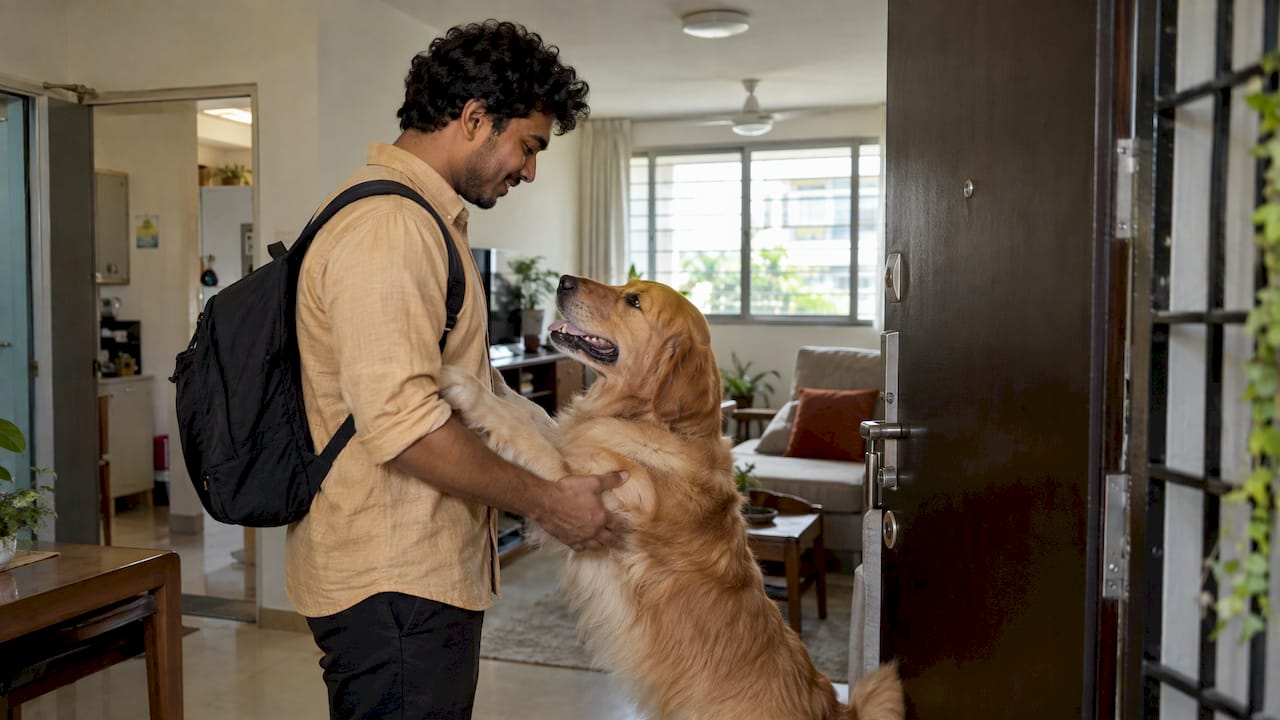
Your dog jumps on guests because it works: the jump brings a face closer, and almost every visitor responds with a laugh, a pat or a “get down”. The fix is to prevent the rehearsal, then teach your dog what to do instead, such as sitting or keeping four paws on the floor, and reward it every time. That is a short list, but the details decide whether it works. Doorbell timing, who greets first and how family members respond all matter, and a trainer can set them up in your own home. At Happy-Dog Training, our private obedience classes are $200 per class and are built around your dog and your front door.
TL;DR
Dogs jump to get close to faces, and attention of any kind, even scolding, keeps the habit alive.
Manage first: use a gate, lead or separate room so your dog cannot practise jumping while you train.
Teach one clear greeting (sit, or all four paws down) and reward it before the jump happens.
Everyone in the home and every visitor must respond the same way, or the habit gets stronger.
If the jumping comes with fear, growling or lunging, treat it as a behaviour issue and get professional help.
Table of Contents
Why your dog jumps on guests
Veterinary behaviourists at VCA explain that social dogs jump up to greet people because most dogs are shorter than humans, and jumping brings them to face level, much as dogs greet each other. The behaviour repeats because it is usually rewarded with attention.
That last part catches out kind, well-meaning people. A guest who pushes your dog away, says its name or laughs has just paid it. PetMD’s veterinary author notes that any attention, even negative, can reinforce jumping, and that a habit which seems harmless in a small dog becomes risky as the dog grows bigger and stronger. A Poodle puppy who jumps at a toddler is one thing. A 25 kg Labrador doing the same to your grandmother is another.
Not every jumper is simply happy. Dogs Trust describes several different reasons:
Excitement: a loose, wiggly body and a fast, relaxed tail wag.
Frustration: whining, barking or grabbing at clothes because the dog cannot get what it wants.
Stress: jumping releases tension.
Anxiety: a tense body, ears back, tail tucked, sometimes vocalising to make the visitor move away.
A learned habit: even “get down” counts as attention.
Work out which one you are looking at, because the plan changes. An excited dog needs better impulse control and a job to do at the door. An anxious dog needs space, calm and distance from the visitor, which we cover below.
Jumping is also very common. In an article on SPCA Singapore’s shelter work, the IAABC Foundation Journal reported jumping among the concerns for 17 of 59 dogs in one mentoring group. You are not alone, and it is very trainable.
Start with the right kind of training
Before any steps, choose your approach. Singapore’s Animal & Veterinary Service (AVS) says that dogs learn through association and consequences, and that science-based training uses positive reinforcement: rewarding the behaviour you want straight away with treats, praise or play.
AVS also publishes a Humane Hierarchy on the same page. In short, it asks you to:
Check health, nutrition and physical factors.
Change the environment to remove triggers.
Use positive reinforcement to teach what you want.
Teach alternative behaviours and stop rewarding the unwanted one.
Consider more intrusive methods only as a last resort, with professional guidance.
For jumping, that hierarchy translates neatly: a gate or lead is step two, a rewarded sit is steps three and four. SPCA Singapore states that trainers should avoid methods that cause pain, fear or distress, and that electric or prong collars are a no-no. A knee to the chest or a leash jerk belongs in the same bin. It can hurt your dog, and it does not teach the dog what to do. If you want to understand why gentle methods hold up better over time, our guide on why humane training methods work better goes into it.
In October 2026, AVS launched a new Code of Animal Welfare for Dog Trainers. CNA’s report on the launch says it adopts the Least Intrusive, Minimally Aversive approach, with positive reinforcement as the foundation of behaviour change. That is the direction good training in Singapore is heading, and it is the way we have always worked.
Step 1: Manage the doorway so jumping stops paying
Training takes weeks. Guests turn up this weekend. So the first job is to stop your dog rehearsing the jump while you build the new habit. Best Friends Animal Society advises that you keep the dog in a separate room or behind a barrier until everyone is settled, so it gets no attention for jumping.
The AKC lists several workable set-ups, including sending the dog to a mat or crate when the bell rings, placing a gate at the entrance, keeping the dog on lead, or throwing treats away from the door. In a Singapore flat, here is how that looks in practice:
HDB or condo with a short hallway: a freestanding gate across the hallway or the living room entrance. If you are weighing up pedestrian gate options, pick one tall enough that your dog cannot clear it and sturdy enough to lean on.
Open-plan flats: a lead clipped to a sturdy point, or a crate or mat in a corner that is away from the door but where your dog can still see the room.
Landed homes: the same gate indoors, with the front gate closed before the front door opens.
Give your dog something to do while you manage it: a lick mat, a stuffed toy or another long-lasting chew. Practise the set-up once or twice with nobody at the door, so it feels like a normal routine and not a punishment. Management is not the whole answer, but it gives you calm doorways while the training catches up.
Step 2: Make the doorbell boring
For many dogs the knock or bell is the starting gun. Dogs Trust suggests you first desensitise your dog to knocks: start with quiet knocks on a table, build the volume gradually, add a doorbell sound, then a real door with a helper, rewarding with treats throughout. Then teach a “bed” cue, so your dog settles in its own space with a long-lasting treat while guests come in. Keep one of those treats near the door so the same routine works for surprise visitors and delivery riders.
VCA makes the key point about timing: decide what you want your dog to do when a visitor arrives, and train it while the dog is calm, meaning when nobody is at the door. Practising mid-excitement is the most common reason that people say training “works in the kitchen but not at the door”.
A simple practice plan, five minutes at a time:
Tap the table. Treat your dog for staying relaxed.
Ring the bell once from your phone or a helper. Treat for staying relaxed, or for going to the bed.
Open the door with nobody there. Treat.
Have a family member come in. Treat on the mat.
Stop while your dog is still succeeding. Short, happy sessions beat long, frustrating ones.
Step 3: Teach what to do instead of jumping
Now the heart of it. The AKC’s Stephanie Gibeault points out that simply ignoring a jumping dog leaves it with nothing else to do, which is frustrating. Her advice is to tell the dog what to do: “sit” for greetings is an easier rule than “don’t jump”, and you need to be quick with the treat so you reward before the jump happens.
VCA’s approach has you decide on the greeting you want (sit, lie down or four paws on the floor), choose a reward your dog loves, and train in small steps in a calm place with familiar people. Here is how that works at home:
Pick one greeting. Sit is easiest for most dogs. Four paws on the floor is fine too. Do not mix them in the early stages.
Reward early. Deliver a treat before your dog tries to jump, then reward each moment of four paws on the floor. Once that is solid, add the “sit” cue.
Use a lead if needed. For a dog that already jumps, hold the lead gently taut so the jump is physically prevented while the dog earns rewards for staying down. It is a barrier, not a correction, so there should be no tugging.
Build up gradually. Increase excitement, change rooms, then add duration. Move from family, to a friend your dog knows, to someone new.
Fade the food. Over time, the greeting itself, a pat and a friendly hello, becomes the reward.
The AKC’s “four on the floor” game is a good rehearsal. With your dog on the lead, a helper approaches and tosses a few treats on the floor before arriving, then pets while the dog eats. When the helper backs away, repeat with longer greetings. If your dog jumps, the helper turns and walks away and the treats stop, so the dog learns that four paws keeps the person close.
The Australian Professional Dog Trainers group adds a useful idea: dogs that jump often lack self-control, disengagement and calmness as a default. They suggest cueing behaviours such as standing between your legs, and rewarding the dog for staying there. If your dog is also a puppy, our guide to puppy jumping up covers the extra considerations for young dogs.
A worked example
Say your two-year-old Golden Retriever launches at every guest. Over a week you ring the bell from the phone, treat on the mat and practise with your partner. Next weekend a friend visits. Your dog is on the lead, a lick mat is down, your friend stands still until all four paws are on the floor, then crouches to say hello. If your dog jumps, the friend straightens, turns and steps back. The dog goes back to the mat, resets and tries again. Within a few visits, most dogs start offering the sit before the friend has finished walking through the door.
Step 4: Brief your guests and your family
Your dog can learn perfectly and still fail if one person keeps rewarding the jump. VCA warns that when different people reward jumping some of the time, it creates a variable ratio of reinforcement, which makes the habit stronger. Like a slot machine, the occasional payout keeps the dog pulling the lever. VCA suggests a family meeting so everyone follows the same plan.
Give guests a short script, ideally before they ring the bell:
“Please ignore him until his feet are on the floor.”
“No eye contact, talking or touching while he jumps.”
“If he jumps, turn away or step behind the door, and try again.”
“Once he sits, say hello and give him a treat from this pot.”
VCA says that if the dog jumps, no one should look at, speak to or touch it, because even scolding or pushing away is rewarding attention. Dogs Trust adds that visitors should not interact unless all four paws are on the ground. Children need a clear role too: a treat to toss on the floor is a much better job than a pat on the head.
Afterwards, take a minute to review. The Animal Welfare Society suggests that you practise the plan with one friend first, then assess after each visit what went well and what needs more work. Write it down. Small notes like “fine with one guest, jumped when two arrived” show you exactly what to practise next.
When jumping is really fear or something more serious
Some dogs do not jump for fun. They jump, bark or lunge because a stranger in their home is overwhelming. Dogs Trust’s trainers stress reading body language: an excited jumper has a loose body and a relaxed, fast tail wag, while an anxious one is tense with ears back and tail tucked. They also note that reassuring an anxious dog is fine as long as it is done with all four paws on the ground.
VCA lists the avoidance signals to watch for: leaning away, pausing, looking away, pinning the ears back, lowering the head, body or tail, or moving to the side. If you see them, nobody, including guests, should reach toward or touch the dog, and treats, not pats, are the best reward. Give your dog room and let it choose to approach.
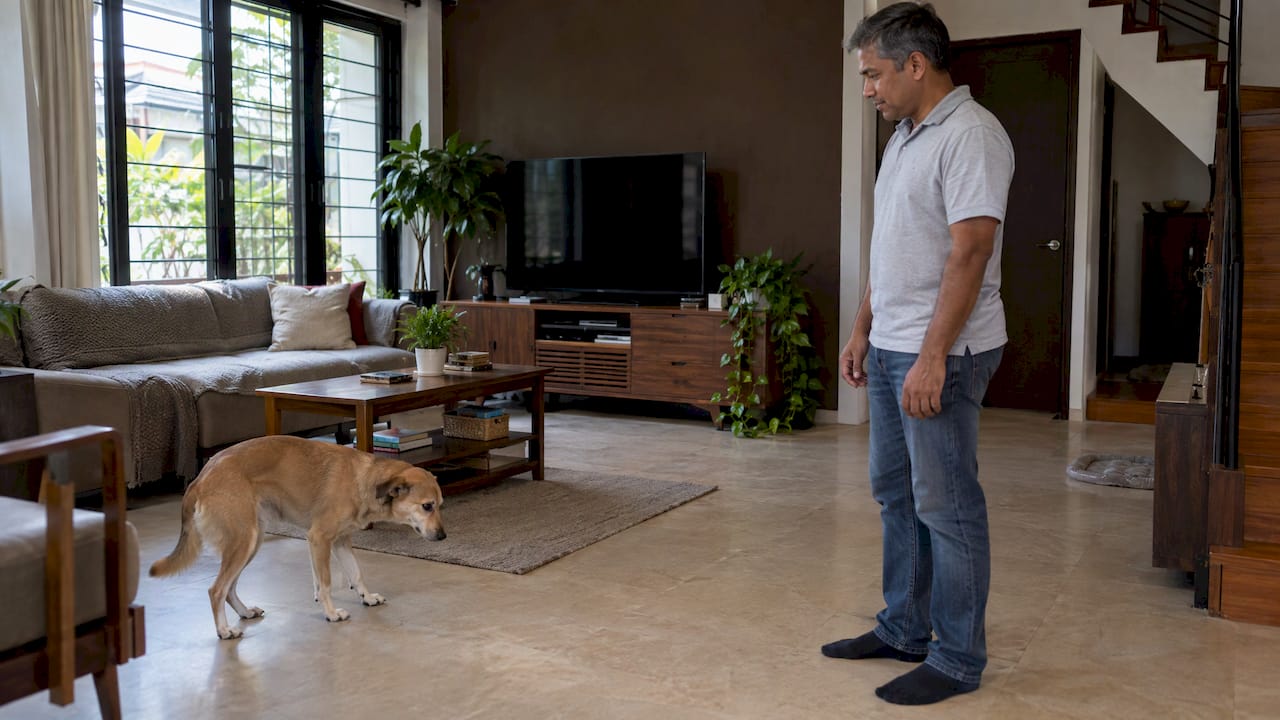
If the greeting includes growling, snapping or lunging, stop the greetings and get help from a qualified behaviour professional. Our article on a dog that growls at visitors explains what the signs mean, and our aggressive behaviour consult is $200-250 per session. If the dog is mostly fearful, our fearful dog classes are designed for that. A dog that is more bark than bounce may need the plan in our guide on how to stop your dog barking at guests. A vet check is also worth doing if the behaviour appeared suddenly, because AVS’s Humane Hierarchy puts health factors first.
What not to do
A few common reactions feel logical but backfire:
Shouting or pushing the dog off. To your dog, this is attention and sometimes a game.
Raising a knee. Rover’s guide, citing certified behaviour consultant Steve Dale, says it is ineffective and can injure the dog.
Using a prong or electric collar. SPCA Singapore says these are a no-no, and the new AVS code points trainers to less intrusive techniques first.
Only ignoring. Without an alternative, your dog gets frustrated and jumps harder. Always pair ignoring with a rewarded sit.
Skipping the practice. Training only when guests arrive means your dog learns while at its most excited.
How we help at Happy-Dog Training
Greeting manners are easiest to build in the place they happen. In a private obedience class at $200 per class, our certified, AVS-accredited trainer works on your dog’s real triggers, with humane, science-based methods. Our trainer has over 20 years of experience, and every client gets free lifetime support after training, so you can come back when a new puzzle appears, such as a house move, a new baby or a visiting relative.
Families with a young dog can start early with our puppy play socialisation classes, at $450 per dog. If you would like a full reset away from the daily chaos, our board and train programme is from $700 per week. You can see all options on our prices page.
Our perspective
Most owners come to us embarrassed about the jumping. They should not be. Your dog is not being rude or dominant, and it is not testing you. It has found something that works, and the people it loves have kept paying it. What changes things is a clear plan that everyone shares. We teach the dog what to do, we make the right answer easy, and we help the family respond the same way each time. We do this with kindness, because a dog that feels safe and understood learns faster and keeps the lesson for good. The best part comes when the doorbell rings and your dog trots to its mat, tail wagging, while your guests take off their shoes in peace. That is the calm, confident home we want for every family, and our lifetime support is there to help you keep it that way. Mark
FAQ
How long does it take to stop a dog jumping on visitors?
That depends on your dog’s age, how long it has been rewarded for jumping and how consistently everyone follows the plan. Many owners see progress within a couple of weeks of daily short practice, but reliability with excited new guests builds more gradually. Keep management in place until the greeting is dependable.
Should I ignore my dog when it jumps?
Ignoring is only half of it. Do not look at, speak to or touch the dog while it jumps, but always give it a clear alternative, such as sitting, and reward that straight away. Ignoring on its own leaves the dog frustrated and often makes the jumping more intense for a while.
Is it okay to let my dog jump on family but not on guests?
It is much harder for a dog to learn that. Dogs do not easily separate “family” from “visitors”, and mixed responses make the habit stronger. Pick one greeting for everyone, and let your dog practise it with family before it tries with visitors.
My dog only jumps on guests and also growls. What should I do?
Separate your dog from guests using a gate or another room, and do not push it into greetings. Growling alongside jumping can point to fear or stress, so a behaviour professional should assess it. We offer behaviour consults for this in Singapore.
Can an older dog learn to stop jumping?
Yes. Older dogs can learn a new greeting just as well, although long-standing habits take consistent practice to replace. Management, a rewarded sit and a shared family plan work at any age.
Sources
Recommended
Comments