Why Start Dog Training Early: A Singapore Puppy Guide
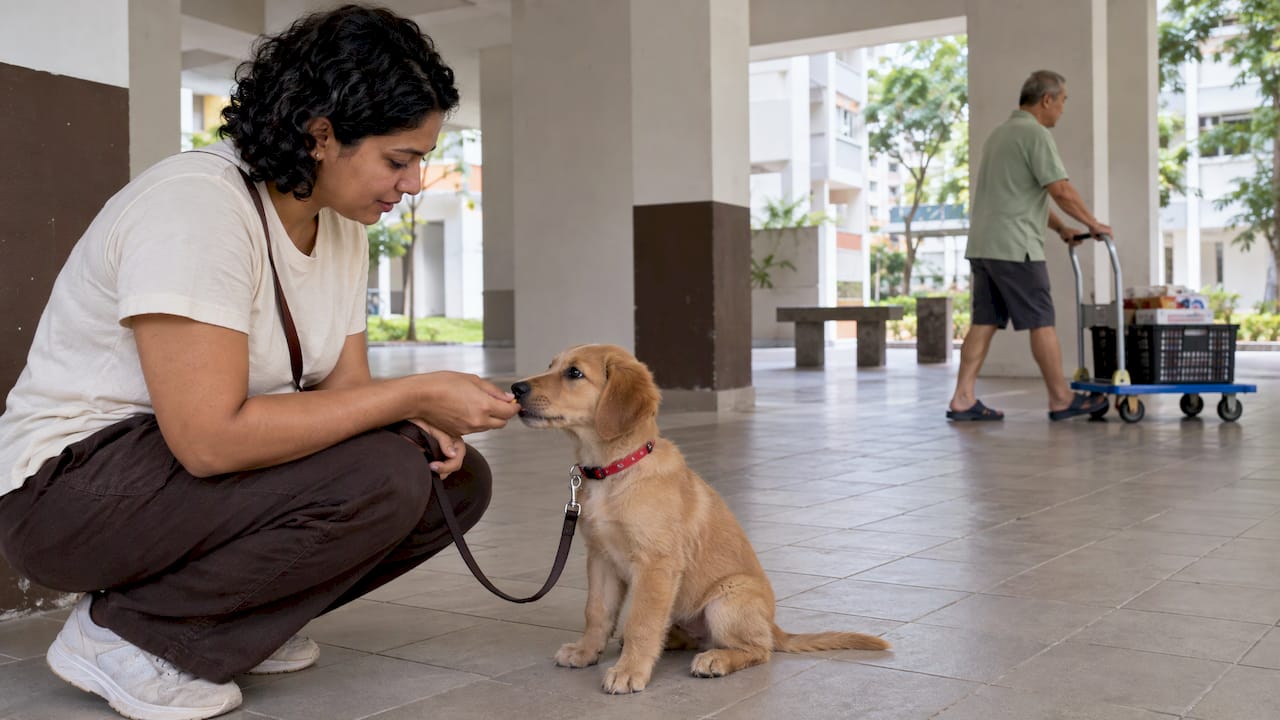
Start training the day your puppy comes home. The first weeks of life are when a puppy forms lasting impressions of people, dogs, noises and new places, and a few minutes of kind, consistent teaching each day shapes the adult dog you will live with in a Singapore flat for the next decade or more. Older dogs can still learn, but early training is easier, gentler and less likely to involve unlearning habits. At Happy-Dog Training, our certified, AVS-accredited trainer has more than 20 years of experience with exactly this stage, and we offer free lifetime support after training.
TL;DR
Puppies have a critical socialisation window of roughly 3 to 14–16 weeks, according to AVS, and what they experience then shapes their adult confidence.
You can socialise safely before vaccinations finish: carry your puppy, invite vaccinated dogs home and join well-run puppy classes.
Basic sit, stay and come give a foundation for family life; early help for fear, aggression or separation worries brings better outcomes.
Older dogs can still learn, but habits take longer to change.
Choose force-free, reward-based methods and an AVS-accredited trainer.
Table of Contents
The window that shapes your dog
Singapore’s Animal and Veterinary Service (AVS) says puppies have a critical socialisation window of about 3 to 14–16 weeks. In this period they are most open to new experiences, and the impressions they form last. Socialisation never stops entirely, but these early weeks matter most.
The stakes are real. The American Veterinary Society of Animal Behavior’s position statement notes that incomplete socialisation raises the risk of fear, avoidance and aggression. It also says behaviour problems, not infectious disease, are the leading cause of death for dogs under three, and the leading reason dogs are given up to shelters. That is a good reason not to wait for “a calmer time”.
In a Singapore context, early exposure means the lift, the void deck, the sound of a motorbike, a neighbour’s trolley, a visitor in a hat, a vet’s table. Each should be a calm, pleasant, short experience.
Can you socialise before vaccinations are complete?
Many owners worry that the window closes before the vaccines finish. AVS addresses this directly: the window comes first, so you socialise safely by:
Carrying your puppy in busy areas so they can watch and listen from safety.
Inviting vaccinated, friendly dogs to your home.
Attending puppy classes run by qualified trainers with proper hygiene standards.
AVS stresses quality over quantity and never forcing an interaction. A puppy who hides behind your legs should be allowed to watch, with treats for staying calm.
Our Puppy Play Socialisation Classes are published at 450 $ per dog. If you want a week-by-week plan, our guide to a safe puppy socialisation plan walks through it, and our note on puppy class costs and when to start helps you budget.
When can formal training begin?
A veterinary centre advises that puppies can begin formal training as soon as they go home, usually around 8 weeks old. Keep sessions short and rewarding. AVS highly encourages basic obedience for puppies: a reliable sit, stay and come to build a foundation during early development.
These skills do practical work in a home:
Sit replaces jumping on guests and children.
Stay keeps a dog put when the door opens or a lift arrives.
Come brings your dog back before a small problem becomes a big one.
Settling on a mat teaches calm while the family eats or works.
Reward-based training, using treats, praise and play, builds confidence along with the skill. Our trainer uses humane, science-based methods tailored to each dog, so a nervous Singapore Special and a bouncy young Retriever each get a plan that suits them.
Early habits are easier than later fixes
The American Kennel Club notes that puppies are more open to new ideas and have not yet built up bad habits. A puppy who has never practised pulling on the lead, barking at the door or mouthing hands has less to unlearn.
That does not mean older dogs are a lost cause. The same guidance says it is never too late to train an older dog, and it may simply take longer to change established habits. Senior dogs benefit too: an AKC trainer says dogs that feel they have a “job” keep a youthful outlook. If your dog is older, check with your vet before starting something new, choose low-impact activities such as scent work, keep sessions short, and adapt cues for any hearing or sight loss. Our K9 Nose Work classes suit this kind of mental work.
Early help for fear, aggression and separation worries
Sometimes a puppy or young dog shows worrying behaviour. Dr Colin Foo of AVS’s Centre for Animal Rehabilitation explains in the Straits Times that once medical causes are ruled out, behaviour modification is key. That means avoiding trigger situations first, then using desensitisation (gradual exposure at very low levels) and counter-conditioning (pairing the trigger with something positive). Punishment often worsens fear and anxiety.
AVS also notes that behaviour problems rarely improve on their own, so early intervention gives better outcomes. Behaviour modification differs from obedience: it changes how a dog feels about a trigger, rather than only what it does.
Signs worth acting on
AVS suggests seeing a qualified professional if your dog shows growling, snapping or biting, severe fear or anxiety, separation anxiety (destructive behaviour, excessive vocalising, toileting when alone) or compulsive behaviours. See your vet first to rule out pain or illness. For serious aggression, severe anxiety or complex cases, a veterinary behaviourist may be needed, and any anti-anxiety medication needs veterinary monitoring.
AVS also says companion breeds such as Mini Poodles, Pomeranians and Chihuahuas have higher tendencies toward separation anxiety, and that Singapore Specials can be timid and fearful. Once your vet has cleared medical causes, we can help with:
Separation Anxiety sessions at 200 $ per class
Reactive Dog Classes at 200 $ per class
An Aggressive Behaviour Consult at 200-250 $ per session
Why force-free methods matter from day one
The Singapore Veterinary Association advocates force-free training as evidence-based, effective and humane. It says aversive tools that cause pain or fear, including choke, prong and electric shock collars, should not be used because they can raise the risk of aggression.
AVS’s advisory urges owners to avoid electronic shock and prong collars, and says they should be used only as a last resort by trained professionals. Mutt Matters founder Anna Koo warns that such devices can suppress growling and lunging, which are a dog’s warning signals, so the dog may learn it is not safe to communicate.
Starting early with rewards means your puppy learns that listening is pleasant, which is the foundation of a trusting bond.
When training is a legal requirement
For some dogs, training is not optional. AVS states that obedience training through an AVS-Accredited Certified Dog Trainer is mandatory for specified breeds under the Animals and Birds (Licensing and Control of Cats and Dogs) Rules 2024, dogs assessed as aggressive or potentially dangerous, and Project ADORE adoptees. The certificate is submitted through PALS within 10 weeks of licence application, arrival or quarantine release, whichever is later.
Our trainer is AVS-accredited, and our Intensive Obedience Plus programme, published at 2500 $, is built for AVS-scheduled dogs. Starting early gives you room to meet the deadline calmly.
Training at home or board and train?
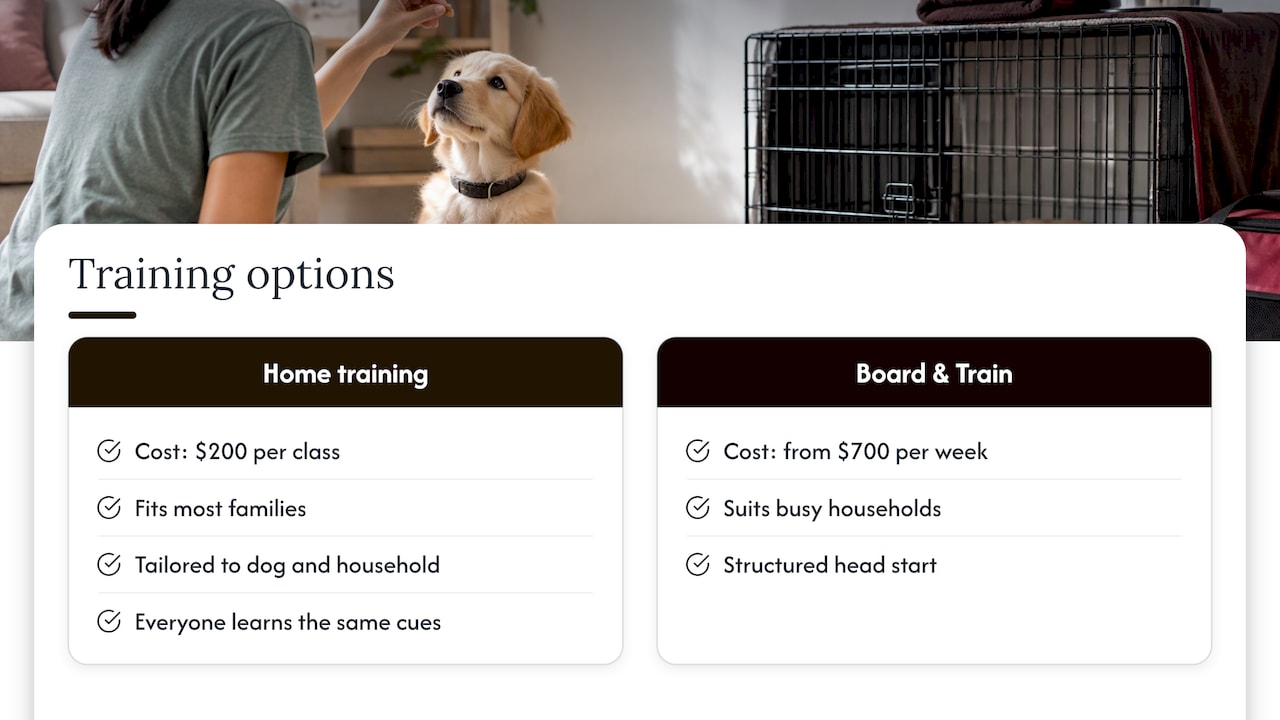
Home training fits most families. Learning happens where problems occur: your door, your lift, your sofa, your routine. Our Private Obedience Dog Training Classes are 200 $ per class and are tailored to your dog and household, so everyone who lives with the dog learns the same cues.
Our Board & Train programme starts from 700 $ per week and suits busy households who want a structured head start. Before choosing it for a young puppy, read our three checks for puppy board and train. AVS has published guidelines for dog training and behaviour rehabilitation, a best-practice resource for owners and trainers in Singapore, which is worth knowing when you compare programmes. Our guide on how to choose a dog trainer in Singapore covers the questions to ask.
Families with children often get the best results when training is part of home life. The skills of patience, turn-taking and reading feelings carry across species, and a guide to social emotional learning in preschool shows how much the same calm, consistent approach helps young children too.
Our perspective
After more than 20 years, the pattern is clear to us: the families who begin early enjoy their dogs sooner. A puppy who is introduced to the world gently, rewarded for good choices and guided by consistent adults grows into a dog who is easy to take along. We build every plan around the individual dog, because a shy puppy and a boisterous one need different things. Training is also about the people, so we coach the whole family, and we offer free lifetime support after training because questions keep coming as dogs grow. If you are reading this with a puppy asleep beside you, you are already at the right time to begin. Mark
Start with a plan for your dog
If your puppy is new, a private class at home or a socialisation class gets the early weeks right. If your dog is older or already struggling, we can build a plan around the behaviour you want to change. See our prices or visit Happy-Dog Training to book.
If you would like to see how other families found the process, read our client reviews.
FAQ
How early can I start training my puppy?
You can begin as soon as your puppy comes home, usually at around 8 weeks. Keep sessions very short and use treats and praise. Socialisation can begin even earlier through carrying, controlled visits and well-run puppy classes.
Is it too late to train my adult dog?
No. Guidance from the American Kennel Club says it is never too late, though changing established habits may take longer. Older dogs often focus well, and low-impact activities such as scent work suit seniors.
What should I teach first?
Start with sit, stay and come, as AVS encourages, plus calm settling and comfortable handling. These give your puppy a foundation for family life and make outings safer.
When should I get professional help?
See your vet first if your dog growls, snaps, bites, shows severe fear or cannot cope alone, so medical causes can be ruled out. Then work with a qualified, force-free trainer, or a veterinary behaviourist for serious or complex cases.
Sources
Recommended
Comments