What is a certified animal behaviorist's role?

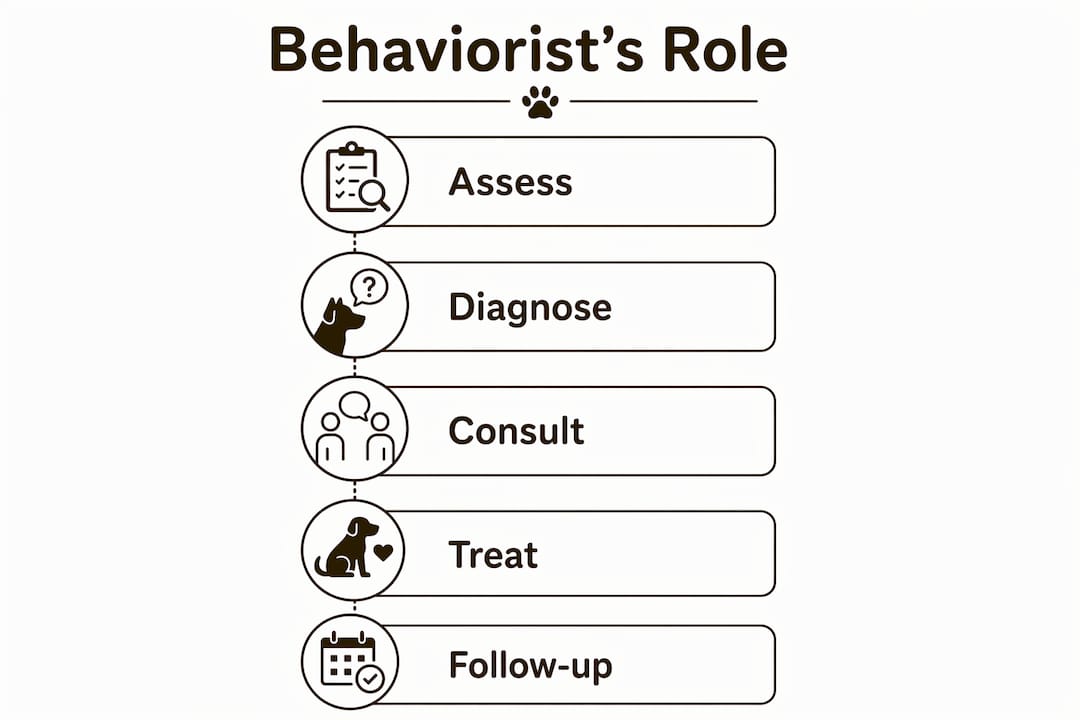
A certified animal behaviorist is a scientifically trained professional who uses evidence-based methods to assess, diagnose, and modify problematic animal behaviour, particularly in dogs. The industry’s recognised credentials include the Certified Applied Animal Behaviorist (CAAB), the Associate Certified Applied Animal Behaviorist (ACAAB), and the Diplomate of the American College of Veterinary Behaviorists (DACVB). Understanding what this role actually involves helps you make a far better decision when your dog is struggling with aggression, anxiety, or any behaviour that feels beyond a standard training class. These professionals do not simply teach your dog to sit. They investigate why your dog behaves the way they do, and build a plan around that answer.
What is a certified animal behaviorist’s role in dog behaviour?
The certified animal behaviorist role centres on one core task: understanding the cause of a behaviour problem before attempting to change it. Behaviourists assess case history, observe the dog across multiple settings, identify triggers and patterns, and determine the underlying emotional or environmental factors driving the problem. This diagnostic approach separates them from most other pet professionals you might encounter.

Think of it this way. A trainer teaches a dog new skills. A behaviourist investigates why a dog is reacting fearfully to strangers, lunging at other dogs, or destroying the house when left alone. The distinction matters enormously when the issue is complex or potentially dangerous.
The animal behaviorist job description also includes consulting with pet owners and, where relevant, with veterinary teams. Behaviour does not exist in a vacuum. Pain, hormonal imbalances, and neurological conditions can all produce or worsen behavioural problems, and a qualified behaviourist knows when to refer you onward.
What qualifications separate a certified behaviourist from other professionals?
Not everyone who calls themselves a “behaviourist” holds formal credentials. The term is unregulated in most countries, which means verifying certification is the single most important step you can take before booking a consultation.
The two primary credentials issued by the Animal Behavior Society are:
CAAB (Certified Applied Animal Behaviorist): Requires a doctoral degree in a biological or behavioural science plus a minimum of five years of professional experience.
ACAAB (Associate Certified Applied Animal Behaviorist): Requires a master’s degree in a relevant field plus at least two years of professional experience.
A third credential, the DACVB (Diplomate of the American College of Veterinary Behaviorists), belongs to veterinary behaviourists. These professionals complete a veterinary degree followed by a specialist residency, giving them the authority to prescribe medication and address medical causes of behaviour problems alongside behavioural ones.
Credential | Minimum education | Can prescribe medication? |
CAAB | Doctoral degree + 5 years experience | No |
ACAAB | Master’s degree + 2 years experience | No |
DACVB | Veterinary degree + residency | Yes |
General behaviour consultant | No regulated minimum | No |
The table above makes one thing clear: credential level varies significantly, and the gap between a CAAB and an uncertified “behaviour consultant” is substantial. A general behaviour consultant may be highly skilled, but without a recognised credential, you have no independent standard against which to measure their expertise.
Pro Tip: When searching for a behaviourist, ask directly for their credential designation. A qualified professional will be proud to share it. If someone is vague about their qualifications, treat that as a signal to keep looking.
What are the duties and responsibilities of a certified animal behaviorist?
The certified animal behaviorist duties follow a structured process that moves from assessment to intervention. Here is what that typically looks like in practice when you bring your dog to a qualified professional:
Detailed history-taking. The behaviourist collects a thorough account of your dog’s background, including early socialisation, previous training, medical history, and the specific circumstances in which problem behaviours occur.
Multi-setting observation. Your dog is observed in different environments and contexts. A dog that lunges on lead may behave very differently off lead, and those differences carry diagnostic weight.
Trigger and cause identification. Distinguishing triggers from root causes is the cornerstone of the entire process. A trigger is what sets the behaviour off. The root cause is the emotional or physical state that makes the dog vulnerable to that trigger in the first place.
Behaviour modification plan design. The behaviourist creates a customised plan using scientifically validated methods. This may include desensitisation, counter-conditioning, or management strategies tailored to your dog’s specific profile.
Owner coaching. You are a central part of the plan. The behaviourist teaches you how to implement strategies consistently at home, because your daily interactions with your dog carry far more weight than any single session.
Collaboration with veterinary professionals. Where physical health may be contributing to the problem, the behaviourist coordinates with your vet or refers you to a veterinary behaviourist.
Pro Tip: Bring a short video of your dog’s problem behaviour to the first consultation. Behaviourists cannot always replicate the exact conditions that trigger a reaction, and footage gives them far more to work with than a verbal description alone.
How does a behaviourist differ from a trainer or behaviour consultant?
This is the question most dog owners ask once they realise their dog’s problem goes beyond basic obedience. The answer comes down to scope, training, and method.
Behaviourists focus on diagnosing and modifying problematic behaviours using scientific principles, rather than teaching obedience or new skills. A trainer’s primary role is skill-building. Teaching your dog to walk nicely on lead, respond to recall, or settle on a mat are all training goals. Addressing the anxiety that causes your dog to bark uncontrollably when you leave the house is a behaviour modification goal.
Behaviour consultants sit somewhere in between. Some hold recognised certifications such as the IAABC’s CDBC (Certified Dog Behaviour Consultant), which requires demonstrated competency and adherence to ethical standards. Others use the title with no formal credential at all. This is why credential verification matters so much.
Key distinctions to keep in mind:
Trainers are best suited to dogs that need to learn new skills or improve manners. They are not typically equipped to handle clinical behaviour problems such as severe aggression or separation-related disorders.
Behaviour consultants vary widely. Check credentials carefully before engaging one for a serious behaviour problem.
Certified behaviourists (CAAB/ACAAB) are the appropriate choice for complex, persistent, or potentially dangerous behaviour issues.
Veterinary behaviourists (DACVB) are the right referral when medical and behavioural causes are intertwined, or when medication may be part of the treatment plan.
For issues like resource guarding, inter-dog aggression, or severe fear responses, a multidisciplinary approach involving both a behaviourist and a vet often produces the best outcomes. You can read more about effective training techniques to understand where training ends and behaviour modification begins.
When should you consult a certified animal behaviorist for your dog?
Knowing when to seek specialist help is one of the most practical things you can take away from this article. Many owners wait too long, hoping the problem will resolve on its own. It rarely does.
Situations that warrant a behaviourist’s involvement include:
Aggression of any kind. Growling, snapping, or biting directed at people or other animals requires professional assessment, not trial-and-error management.
Sudden behaviour changes. A dog that was previously calm and is now reactive, destructive, or withdrawn may have an underlying medical cause. A behaviourist will flag this and refer you to a vet.
Separation-related distress. Persistent barking, destructive behaviour, or toileting indoors when left alone are signs of a clinical problem, not a training gap.
Persistent fear or phobias. Dogs that are chronically anxious around strangers, loud noises, or unfamiliar environments need more than socialisation exercises.
Compulsive behaviours. Repetitive actions such as tail-chasing, shadow-chasing, or excessive licking often have both behavioural and medical components.
When you do book a consultation, come prepared. Bring your dog’s full medical history, a written account of when the problem started, and any video footage you have. The behaviourist’s first appointment is primarily a fact-finding process, and the more information you provide, the more accurate their assessment will be.
Pro Tip: Ask your vet for a referral before your first behaviourist appointment. A recent health check rules out medical causes early and gives the behaviourist a cleaner picture of what they are working with.
Key takeaways
A certified animal behaviorist’s value lies in diagnosis first and modification second. Without understanding the root cause of a behaviour problem, any intervention is guesswork.
Point | Details |
Credentials matter | CAAB, ACAAB, and DACVB are the recognised standards. Verify before booking. |
Diagnosis before intervention | Behaviourists identify root causes, not just triggers, before designing any plan. |
Behaviourists differ from trainers | Trainers build skills; behaviourists address clinical behaviour problems using scientific methods. |
Veterinary collaboration is often needed | Medical causes frequently contribute to behaviour problems. A vet referral is part of good practice. |
Early intervention improves outcomes | Waiting for a behaviour problem to resolve on its own typically makes it harder to treat. |
Why I think most owners underestimate what a behaviourist actually does
After more than two decades working with dogs and their owners in Singapore, the most common misunderstanding I encounter is this: people assume a behaviourist is simply a very experienced trainer. They are not. The distinction is not about seniority. It is about the entire framework through which they approach a dog’s problem.
A trainer asks, “What do I want this dog to do?” A behaviourist asks, “Why is this dog doing what it is doing?” That shift in question changes everything. I have seen dogs labelled as “stubborn” or “dominant” who were actually in chronic pain. I have seen dogs described as “aggressive” who were profoundly fearful and had never been given the tools to feel safe. In both cases, a training programme alone would have made things worse.
The other thing I would encourage you to sit with is this: behaviour change takes time. Owners sometimes expect a behaviourist to produce results in one or two sessions. In reality, a well-designed behaviour modification programme for something like separation anxiety or reactivity may take weeks or months of consistent work. That is not a failure of the process. It is the process working as it should.
If your dog’s behaviour is affecting your quality of life or theirs, do not settle for generic advice. Seek someone with a recognised credential, ask them to explain their methodology, and expect them to involve your vet if there is any possibility of a medical component. That combination gives your dog the best possible chance of a calmer, happier life.
— Mark
How Happy-dogtraining can help with your dog’s behaviour
If your dog is showing signs of aggression, anxiety, or any behaviour that feels beyond a basic training class, Happy-dogtraining is here to help.

Happy-dogtraining’s certified and AVS-accredited trainer brings over 20 years of experience in science-based, humane behaviour work to every consultation. Whether your dog is reactive, fearful, or struggling with aggression, the team designs personalised programmes built around your dog’s specific needs, not a one-size-fits-all approach. Every client also receives free lifetime support after training, so you are never left to manage things alone. Explore the aggressive behaviour consultation service, or visit Happy-dogtraining to find the right programme for your dog today.
FAQ
What does a certified animal behaviorist do?
A certified animal behaviorist assesses behaviour, identifies underlying emotional and environmental causes, and designs customised behaviour modification plans. Their work focuses on diagnosing why a problem occurs, not simply suppressing the symptom.
How is a CAAB different from a DACVB?
A CAAB holds a doctoral degree in a behavioural science and focuses exclusively on behaviour modification. A DACVB is a veterinary specialist who can also prescribe medication and address medical contributors to behaviour problems.
Can anyone call themselves a behaviourist?
Yes. The title “behaviourist” is unregulated in most countries, which means credential verification is the owner’s responsibility. Look specifically for CAAB, ACAAB, or DACVB designations to confirm genuine expertise.
When should I see a behaviourist instead of a trainer?
Consult a behaviourist when your dog shows aggression, persistent fear, separation distress, or any sudden change in behaviour. These are clinical problems that require scientific diagnosis rather than skill-building exercises.
Do I need a vet referral to see a behaviourist?
A referral is not always required, but it is strongly recommended. A recent health check helps rule out medical causes and gives the behaviourist a more complete picture of your dog’s situation from the outset.
Recommended
Comments