What is precision dog training: a clear guide for owners
- Mark McDade
- Jun 23
- 8 min read
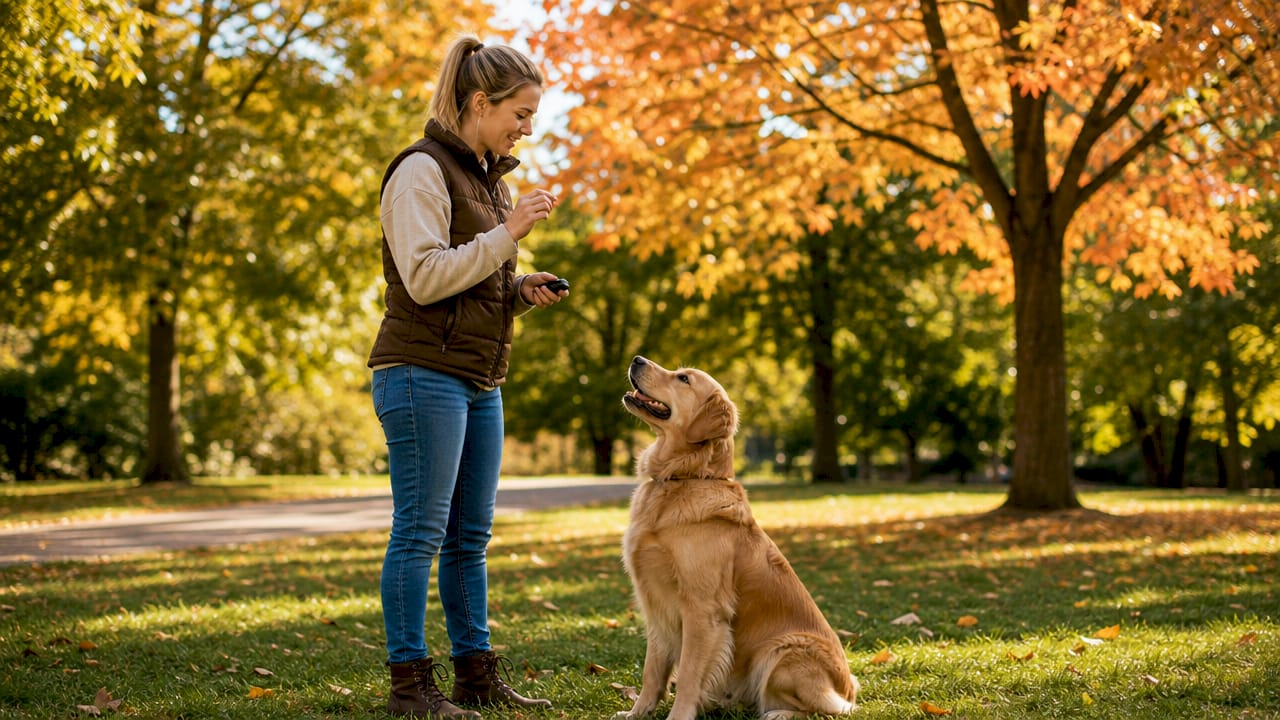
Precision dog training is a method that marks and rewards a dog’s exact behaviour at the precise moment it occurs, building clear understanding and reliable responses. Unlike general reward-based training, precision training uses marker training to create an unmistakable signal, typically a clicker or a verbal cue like “yes,” that tells your dog exactly which action earned the reward. The result is a dog that understands what you want, responds consistently, and stays confident throughout the process. If your dog ignores commands outside the living room or only performs when treats are visible, precision methods address exactly that gap.
What is precision dog training and how does it work?
Precision dog training is defined as a science-based approach that uses tightly timed signals to communicate the exact behaviour a dog should repeat. The industry term for this approach is marker training, and it sits within the broader framework of operant conditioning, where behaviour is shaped by the consequences that follow it. Consequences must occur tightly linked to the exact behaviour to increase future occurrences reliably. That tight link is what separates precision training from simply handing out treats.
The marker, whether a clicker or a spoken word, functions as a bridge between behaviour and reward. Your dog hears the click and knows, with certainty, that a reward is coming and that the behaviour happening at that exact moment caused it. This removes ambiguity completely. Your dog is not guessing; your dog is reading a clear signal.
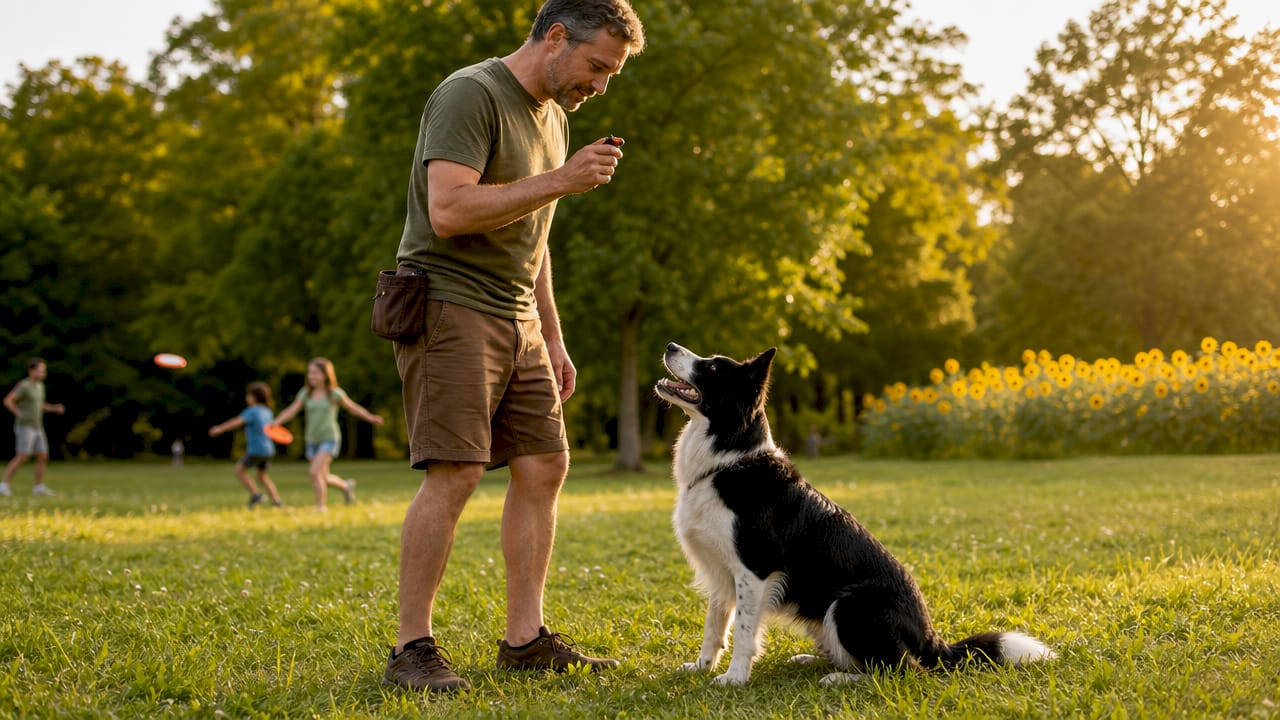
Precision training is not naturally occurring in puppy development. It is a systematic behaviour shaping process that trainers engineer deliberately. That is precisely why it works so well when applied consistently.
How does marker training underpin precision dog training?
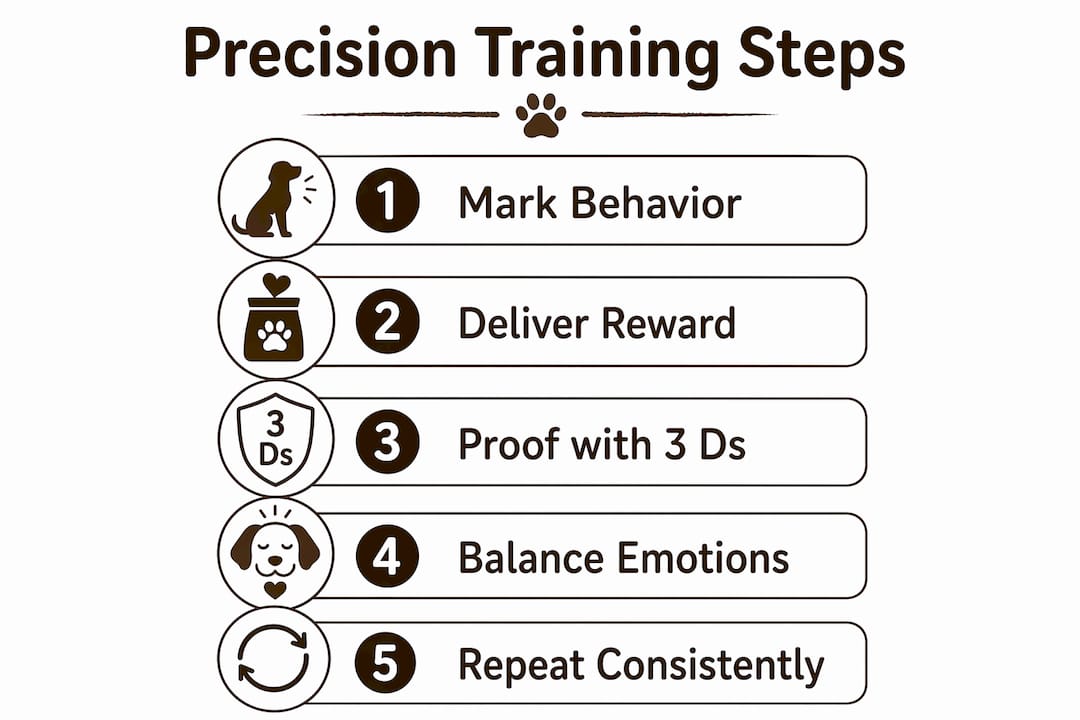
Marker training is the engine of precision dog training. The marker, a clicker or a short verbal cue, acts as a bridge that tells your dog the behaviour happening right now is the one that earns a reward.
Timing is everything. Mis-timing the marker by even a fraction of a second can reinforce the wrong moment. For example, if your dog sits and you click as they begin to stand up, you have rewarded the act of rising, not sitting. That kind of confusion slows learning and creates inconsistent responses.
Before you use the marker to shape behaviour, you need to “charge” it. This means pairing the click with a high-value treat repeatedly until your dog understands the click predicts a reward. Charging the marker typically involves repeating the click-then-treat sequence 10–15 times before expecting any behavioural response. Think of it as teaching your dog the language before asking them to speak it.
The key elements of effective marker training are:
A consistent marker. Use the same sound or word every time. Switching between “yes,” “good,” and “nice” dilutes the signal.
Immediate delivery. Click the instant the behaviour occurs, not a moment after.
High-value rewards. The reward must be worth the effort, especially in the early stages.
Short, focused sessions. Frequent short sessions outperform long, tiring ones every time.
Pro Tip: Sharpen your timing by practising with a bouncing ball. Click the exact moment the ball touches the ground. This drill trains your reaction speed to a professional level before you ever work with your dog.
Improving your own timing is as much a part of precision training as teaching your dog. The clearer your signal, the faster your dog learns.
What is proofing and why does it matter for reliable behaviour?
Proofing is the process of teaching your dog to perform a behaviour reliably across different environments, distances, and distractions. A dog that sits perfectly in your kitchen but ignores the cue at the park has not been proofed. Proofing uses the 3 Ds: Distance, Duration, and Distraction.
Each D represents a separate challenge you increase gradually:
Distance. Start close to your dog and reward well. Slowly increase the distance between you and your dog when giving the cue.
Duration. Ask your dog to hold a behaviour for longer periods before marking and rewarding.
Distraction. Introduce mild distractions first, such as a toy on the floor, before moving to busier environments like a park.
The critical rule is to increase only one D at a time. If you add distance and distraction simultaneously, you double the difficulty and your dog’s success rate drops sharply. A high win-to-loss ratio keeps your dog confident and engaged.
The table below shows how to progress proofing without overwhelming your dog:
Stage | What changes | What stays the same |
Stage 1: Acquisition | Nothing. Dog learns the behaviour. | Environment, distance, duration all minimal. |
Stage 2: Distance | You move further away. | Distraction and duration stay low. |
Stage 3: Duration | Dog holds the behaviour longer. | Distance and distraction stay manageable. |
Stage 4: Distraction | Environment becomes busier. | Distance and duration stay comfortable. |
Stage 5: Real world | All 3 Ds combined gradually. | Reward rate stays high to maintain confidence. |
A common mistake is jumping from a perfect cue in the living room directly to a busy street. That leap sets your dog up to fail. Gradual parameter changes using the 3 Ds keep your dog in a learning state rather than a stressed one. The training environment you choose at each stage directly affects how quickly your dog generalises a behaviour to the real world.
How do you balance precision with your dog’s emotional state?
Precision without attention to your dog’s emotional state produces a stressed, confused dog, not a confident one. True precision means reliable performance across different contexts and challenges, and that reliability only develops when your dog feels safe and engaged throughout training.
Session management is the most underrated skill in precision dog training. End every session while your dog is still keen and succeeding. Pushing through errors or extending sessions until your dog shuts down erodes both confidence and the clarity of your communication. Keeping sessions short and focused and ending on a win is one of the most effective habits you can build.
Here are practical ways to protect your dog’s emotional state during training:
Reward effort, not just perfection. If your dog tries hard but gets it slightly wrong, acknowledge the effort and adjust the task, rather than withholding the reward entirely.
Drop the difficulty when errors increase. Three mistakes in a row is a clear signal the task is too hard. Make it easier immediately.
Watch your dog’s body language. Yawning, looking away, or slow responses signal stress or fatigue. These are your cues to stop or simplify.
Keep your energy calm and consistent. Dogs read your emotional state. Frustration in your voice or posture disrupts the clarity of your signal.
Pro Tip: If you notice your dog making repeated errors, resist the urge to repeat the cue louder or more often. Instead, go back one step to a behaviour your dog knows well, reward generously, and end the session on that success. Recognising training fatigue early saves weeks of retraining.
Clarity and kindness are not opposites in precision training. They work together. The clearer your signal and the more positive your dog’s experience, the faster and more reliably your dog learns.
What are the benefits of precision dog training?
Precision dog training produces measurable improvements in both behaviour and the relationship between you and your dog. Clicker training increases learning speed by up to 50% compared to methods without a clear signal. That speed advantage comes from the clarity of communication, not from any extra pressure on the dog.
The core benefits dog owners report include:
Faster learning. Clear signals mean your dog understands what is being asked more quickly, reducing the number of repetitions needed.
Off-leash reliability. Precision methods build the kind of reliable obedience that holds up at a distance and under distraction, which is the foundation of safe off-leash control.
Reduced confusion. Unambiguous markers eliminate the guesswork that causes dogs to repeat unwanted behaviours or become disengaged.
Greater dog confidence. Dogs trained with precision methods know exactly how to earn rewards. That predictability builds confidence and enthusiasm for training.
Improved behavioural issues. Reactivity, fearfulness, and poor recall all respond well to precision methods because the approach addresses the root cause: unclear communication.
Precision training is not reserved for competition dogs or working breeds. Any dog, regardless of age or breed, benefits from the clarity it provides. The method is particularly effective for dogs with fearfulness or reactivity, where consistent, low-pressure communication is critical to progress.
Key takeaways
Precision dog training works because tightly timed markers, systematic proofing through the 3 Ds, and careful session management combine to build reliable, confident behaviour in any dog.
Point | Details |
Marker timing is critical | Click at the exact moment the behaviour occurs to avoid reinforcing the wrong action. |
Charge the marker first | Pair the click with a treat 10–15 times before using it to shape behaviour. |
Proof with one D at a time | Increase Distance, Duration, or Distraction separately to maintain a high success rate. |
End sessions on a win | Stop while your dog is engaged and succeeding to protect confidence and clarity. |
Precision speeds up learning | Clear signals can increase learning speed by up to 50% compared to methods without a marker. |
What I have learned from years of precision training
Precision training looks simple on paper. In practice, the hardest part is training yourself, not your dog. Most owners I work with underestimate how much their own timing affects their dog’s understanding. A click that arrives half a second late is not a small error. It is a different message entirely.
The most common mistake I see is owners jumping distraction levels too quickly. A dog that performs beautifully in a quiet garden is not ready for a busy street the following day. That leap creates failure, and repeated failure chips away at a dog’s confidence in ways that take much longer to repair than the shortcut saved.
What I find most rewarding about precision methods is the shift in the dog’s attitude. Dogs trained this way start to offer behaviours eagerly. They experiment. They engage. That is the opposite of a dog trained under pressure, which tends to shut down or become anxious. Clarity, delivered with kindness and patience, produces a dog that genuinely enjoys working with you.
My honest advice: practise your marker timing before your next session. Use a bouncing ball, a metronome, or any object with a predictable moment. Get your reaction sharp. Your dog will feel the difference immediately, and so will you.
— Mark
Precision training support from Happy-dogtraining
Precision dog training delivers real results, but applying it well takes guidance, especially when your dog has existing behavioural challenges.

Happy-dogtraining brings over 20 years of experience to personalised, science-based training programmes in Singapore. Whether your dog struggles with reactivity, fearfulness, or basic obedience, the AVS-accredited team applies marker training and proofing principles tailored to your dog’s specific needs. Programmes include free lifetime support after training, so you are never left to figure things out alone. Explore the dog obedience programme or visit Happy-dogtraining to find the right fit for your dog.
FAQ
What is the difference between precision training and regular reward training?
Precision training uses a timed marker, such as a clicker or verbal cue, to signal the exact behaviour that earns a reward. Regular reward training often lacks this precise signal, which can slow learning and create confusion about which behaviour is being reinforced.
How long does it take to charge a marker?
Charging a marker typically takes 10–15 click-then-treat repetitions in a single short session. Most dogs make the association quickly, though some may need a second session before responding reliably to the sound.
What are the 3 Ds in dog training?
The 3 Ds are Distance, Duration, and Distraction. They are the three variables used in proofing to build reliable behaviour across different real-world conditions, increased one at a time to maintain a high success rate.
Can precision training help with fearful or reactive dogs?
Yes. Precision methods are particularly effective for fearful and reactive dogs because clear, consistent communication reduces uncertainty. Happy-dogtraining offers specialist support for anxious dogs using these principles.
How long should a precision training session last?
Sessions should be short and focused, typically 5–10 minutes, ending while your dog is still engaged and succeeding. Longer sessions increase the risk of training fatigue and erode the clarity that makes precision training effective.
Recommended
Comments