What is training fatigue in dogs: 2026 guide

Training fatigue in dogs is defined as a state of mental and physical exhaustion that occurs when a dog is pushed beyond its capacity to learn during a training session, resulting in reduced responsiveness, disengagement, and a temporary loss of learning ability. Many owners mistake this for stubbornness or disobedience, but the two are fundamentally different. Recognising training fatigue early is one of the most important skills you can develop as a dog owner. When you understand what your dog is telling you, every session becomes more productive, and your bond grows stronger with each wagging tail and joyful moment of success.
What is training fatigue in dogs and how do you spot it?
Training fatigue is not simply a dog being tired after a walk. It is a specific pattern of behavioural signs that include a vacant “I’m Over It” stare, slower responses to commands, and wandering off mid-session. These signals are frequently misread as a dog being difficult or uncooperative, when in reality the dog’s brain has simply reached its limit for that session.
Knowing how to identify training fatigue in dogs means watching for both subtle and obvious cues. Here are the most common signs to look out for:
Vacant or glazed expression during commands, sometimes called the “I’m Over It” stare
Delayed responses to cues the dog normally performs quickly and confidently
Increased distractibility, sniffing the ground or looking away persistently
Lying down mid-session or physically moving away from the training area
Yawning, lip licking, or shaking off as stress displacement behaviours
Performing known behaviours incorrectly despite previous success in the same session
Physical signs of overtraining go further. Reluctance to jump or rise, whining during movement, and persistent disinterest in food or play are signals that warrant attention. If these symptoms persist beyond a normal rest period, a veterinary check is worth scheduling.
Breed and energy level influence how these signs appear. A Border Collie may show fatigue through frantic, unfocused behaviour rather than slowing down. A Labrador Retriever might simply flop onto the floor and refuse to engage. Neither dog is being naughty. Both are communicating clearly.

Pro Tip: Keep a short training journal for two weeks. Note the time of day, session length, and the first sign of disengagement you observe. Patterns will emerge quickly, and you will know exactly when your dog’s learning window closes.
How does mental fatigue differ from physical tiredness in dogs?
Mental fatigue and physical tiredness are not the same thing, and confusing them leads to poor training decisions. Physical tiredness is the normal result of exercise. Mental fatigue is a state where the nervous system has been overloaded by concentration, decision-making, and reward-processing during training. A dog can be physically rested and mentally exhausted at the same time.
Five to ten minutes of focused training can be as mentally demanding as a long physical workout. This is why a dog that has just completed a 30-minute obedience session may appear calm but is actually unable to absorb new information. The nervous system needs time to downregulate before learning can resume.
A critical insight that many owners miss: a tired dog is not the same as a relaxed dog. Relying on exhaustion to produce calm behaviour is counterproductive because it does not teach the dog any regulation skills. Dogs kept at high arousal without dedicated calming practice struggle to settle later, even when physically spent.
The risks of ignoring mental fatigue include:
Loss of focus and reduced ability to retain new skills
Increased anxiety around training equipment or locations
Generalised stress that spills into everyday behaviour
Long-term reluctance to engage in training at all
Pro Tip: After physical exercise, give your dog a 10 to 15 minute quiet settling period before beginning any training. This allows the nervous system to shift from arousal to a calm, focused state where learning is actually possible.
What causes dog training exhaustion and how can you prevent it?
The most common causes of dog training exhaustion are sessions that are too long, too intense, too frequent, or poorly timed relative to the dog’s physical and mental state. Experts recommend keeping sessions for new or complex tasks to 5 to 10 minutes, preceded by 20 to 30 minutes of physical exercise and followed by a settling period. Training more than three days per week increases the risk of burnout for most dogs.
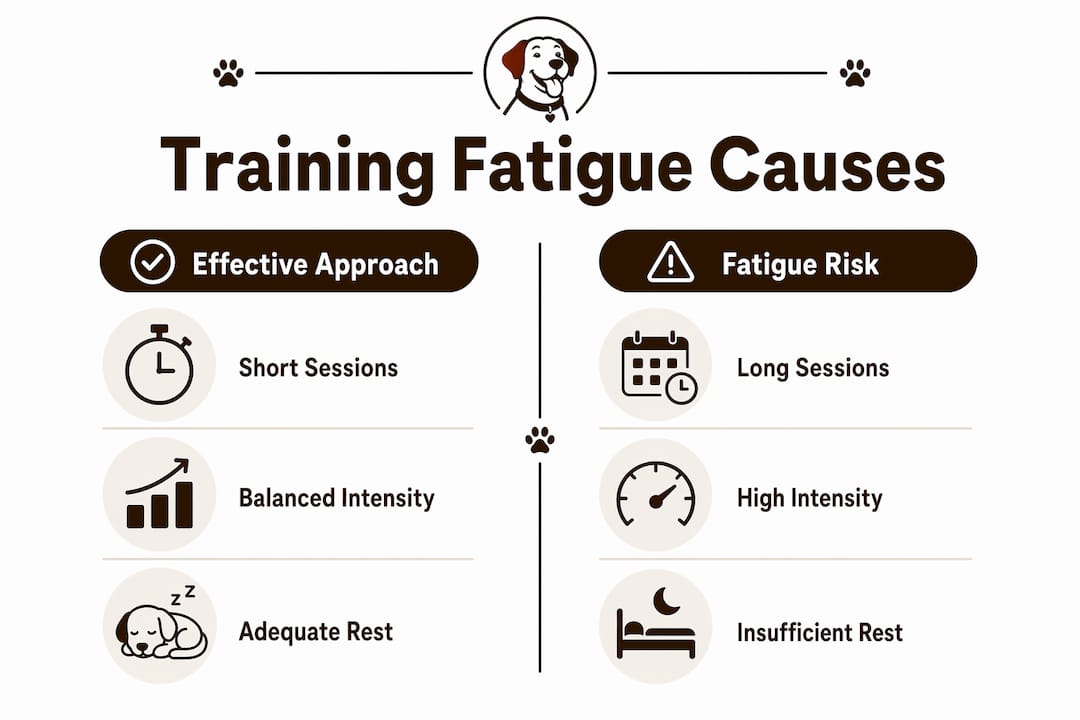
One underappreciated cause is what PetMD describes as weekend warrior syndrome. This occurs when dogs are largely inactive during the week and then subjected to intense physical and mental demands at the weekend. Without gradual conditioning, the body and mind are simply not prepared, and fatigue sets in rapidly. Building fitness and focus capacity gradually, with veterinary input where needed, is the correct approach.
The table below compares training routines that support learning against those that increase fatigue risk.
Routine element | Effective approach | Fatigue-risk approach |
Session length | 5 to 10 minutes for new tasks | 30 to 60 minute continuous sessions |
Pre-training exercise | 20 to 30 minutes of moderate activity | No exercise or intense exercise immediately before |
Settling period | 10 to 15 minutes of calm rest before training | Training immediately after exercise |
Frequency | 3 to 4 short sessions per week | Daily long sessions or weekend-only marathons |
Task complexity | Introduce one new skill per session | Multiple new skills in a single session |
Tailoring your approach to your dog’s age, breed, and energy level matters enormously. Puppies under six months have very short concentration windows, often as little as two to three minutes. Senior dogs may need longer recovery between sessions. High-energy working breeds like Belgian Malinois or German Shepherds can handle more mental load than low-drive companion breeds, but they are also more prone to masking fatigue through sheer drive.
Consulting a customised training plan that accounts for your specific dog’s profile is one of the most effective ways to prevent fatigue from becoming a recurring problem.
How to manage training fatigue when it appears mid-session
Managing dog training fatigue in the moment requires a calm, immediate response. The worst thing you can do is repeat a command more loudly or increase pressure when your dog disengages. Pushing a dog showing stress or fatigue signs by escalating demands reinforces anxiety and damages the dog’s confidence in training. Pausing immediately is best practice.
Here is a practical sequence to follow when you notice fatigue signs mid-session:
Stop the current task without frustration or correction
Ask for one simple, well-known behaviour such as a sit, reward it warmly, and end on that positive note
Give your dog a genuine rest period away from the training area, ideally with water and a comfortable space
Avoid returning to training within the same session unless your dog clearly re-engages with enthusiasm
Longer-term, build your training programme around your dog’s calm-focus windows rather than trying to train through tiredness. Many owners find that morning sessions, before the day’s stimulation accumulates, produce the best results. Incorporating positive reward-based methods keeps sessions motivating and reduces the mental cost of each repetition.
Mental regulation exercises, such as mat training, calm settling on cue, and controlled sniff games, are worth adding to your weekly routine. These activities build the dog’s capacity to self-regulate, which directly reduces the frequency and severity of fatigue episodes over time.
Pro Tip: End every session before your dog shows fatigue, not after. A session that finishes with your dog still engaged and happy builds positive associations with training. A session that ends in disengagement does the opposite.
How do breed and energy levels affect training fatigue and recovery?
Breed and individual energy level create significant variation in how dogs experience and recover from training fatigue. Understanding your dog’s profile helps you set realistic expectations and design sessions that work with their natural tendencies rather than against them.
Breed type | Fatigue threshold | Key consideration |
High-drive working breeds (e.g. Belgian Malinois, Border Collie) | High threshold, but fatigue is masked by drive | Drive can hide injury and stress; owners must set firm session limits |
Sporting breeds (e.g. Labrador Retriever, Golden Retriever) | Moderate threshold | Generally show fatigue clearly; respond well to structured breaks |
Companion and toy breeds (e.g. Cavalier King Charles Spaniel, Shih Tzu) | Lower threshold | Shorter sessions and gentler pacing produce the best results |
Senior dogs of any breed | Reduced threshold and slower recovery | Prioritise rest periods and reduce session intensity with age |
High-drive dogs present a particular challenge. Dogs with strong working drive often mask fatigue with motivation, continuing to work past safe limits because their desire to engage overrides their body’s signals. Handlers who rely on the dog’s enthusiasm as a measure of readiness will consistently overtrain these dogs. Setting a firm time limit regardless of how keen the dog appears is the responsible approach.
For energetic breeds, balancing physical exercise with mental stimulation is not optional. It is the foundation of a sustainable training programme. A Border Collie that receives only physical exercise but no structured mental engagement will not become calmer. It will become more reactive and harder to settle. Pairing physical activity with humane training methods that include mental regulation work produces the balanced, confident dog most owners are hoping for.
If your dog shows persistent lethargy, loss of appetite, or stiffness after rest, consult your veterinarian before continuing training. These signs go beyond normal fatigue and may indicate an underlying health issue that training cannot address.
Key takeaways
Training fatigue in dogs is a state of mental and physical exhaustion that requires immediate recognition and a structured response to protect learning capacity, confidence, and long-term training success.
Point | Details |
Recognise fatigue early | Watch for the “I’m Over It” stare, delayed responses, and wandering off as clear fatigue signals. |
Mental and physical fatigue differ | Five to ten minutes of focused training can exhaust a dog mentally even when it is physically rested. |
Prevent with session structure | Keep new-task sessions to 5 to 10 minutes, with pre-training exercise and a settling period before starting. |
Respond calmly mid-session | Stop, reward a simple known behaviour, and end the session rather than escalating pressure. |
Adapt to breed and age | High-drive dogs mask fatigue; set firm time limits regardless of how engaged the dog appears. |
What I have learned from watching dogs hit their limit
After working with dogs for many years, the pattern I see most often is not owners being unkind. It is owners being too enthusiastic. They want progress. They want their dog to succeed. So they keep going, just a few more repetitions, just one more new skill, and then they wonder why their dog seems to have forgotten everything by the end of the session.
The shift that changes everything is moving away from the idea that more training equals more progress. Quality of engagement matters far more than quantity of repetitions. A dog that finishes a five-minute session confident, focused, and happy has learned more than a dog that spent 40 minutes grinding through commands while mentally checked out.
The other mistake I see regularly is the belief that physical exhaustion is a training strategy. Tiring a dog out does not teach it to be calm. It teaches it to be tired. The moment the dog recovers physically, the same behaviours return because the underlying regulation skills were never built. Structured settling practice, calm on cue, and short focused training windows build the dog you actually want to live with.
Tune into your dog. They are telling you exactly what they need. Your job is to listen before they have to shout.
— Mark
Train smarter with Happy-dogtraining
If you are ready to move beyond guesswork and build a training programme that respects your dog’s energy, focus, and individual needs, Happy-dogtraining is here to help.

Happy-dogtraining’s certified, AVS-accredited trainer brings over 20 years of experience to every session, using science-based, reward-based methods that keep dogs engaged without pushing them to exhaustion. Whether your dog needs foundational obedience work or more targeted behavioural support, the private obedience classes are structured to match your dog’s pace, energy level, and learning style. For dogs that need more intensive support, the 4-week intensive programme offers structured, fatigue-aware training with free lifetime support after completion. Get in touch today to discuss a plan that works for your dog.
FAQ
What is training fatigue in dogs?
Training fatigue in dogs is a state of mental and physical exhaustion caused by overexertion during training sessions, resulting in reduced responsiveness, disengagement, and a temporary inability to learn. It differs from normal tiredness and is often mistaken for stubbornness or disobedience.
How long should a dog training session last?
Experts recommend keeping sessions for new or complex tasks to 5 to 10 minutes, preceded by 20 to 30 minutes of moderate physical exercise and a 10 to 15 minute settling period. Exceeding this regularly increases the risk of burnout.
How do I know if my dog is mentally or physically tired?
Physical tiredness resolves with rest and sleep. Mental fatigue shows as disengagement, slow responses, and distraction even when the dog is physically rested. If your dog is reluctant to engage with food, play, or walks and shows stiffness after rest, consult a vet to rule out illness.
Can I train my dog every day?
Training more than three days per week increases burnout risk for most dogs. Short, well-structured sessions on alternate days with adequate rest produce better long-term results than daily repetition.
Why does my high-energy dog still seem tired after training?
High-drive dogs often mask fatigue through motivation, working past safe limits without obvious signs of tiredness. Even if your dog appears keen, set firm time limits per session. Nutrition also plays a role in recovery, and canine nutrition directly supports engagement and learning capacity between sessions.
Recommended
Comments