Why multiple trainers confuse dogs: what owners must know

Multiple trainers confuse dogs because inconsistent commands, varied rules, and mixed methods disrupt the learning process at a fundamental level. Dogs do not generalise rules across people the way humans do. When your dog hears “sit” from one trainer and “down” from another, or gets rewarded by one person and corrected by the next, the signals become noise. The result is not a stubborn dog. The result is a confused one. Understanding why multiple trainers confuse dogs is the first step towards fixing the problem, and the science behind it is both clear and encouraging.
Why multiple trainers confuse dogs: the core problem
Inconsistent training with multiple trainers using different commands delays progress by 3–4 months compared to the typical 2–3 weeks seen under consistent guidance. That gap is not a minor inconvenience. It represents weeks of frustration for both you and your dog.
Dogs do not generalise learned rules across different trainers or environments without strict consistency. A dog who sits reliably for one person may appear to ignore the same command from another. This is not defiance. The dog is simply responding to a different set of signals, timing, and expectations. Each trainer represents a different “language,” and your dog is trying to learn several at once.

Repetition of commands without consistent follow-through also reduces their urgency. If your dog hears “sit, sit, sit” from one trainer and a single “sit” from another, the word loses its clear meaning. The dog learns that commands are negotiable, not reliable cues for action.
Training scenario | Typical progress timeline |
Single trainer, consistent commands | 2–3 weeks to reliable response |
Multiple trainers, unified approach | 3–5 weeks to reliable response |
Multiple trainers, inconsistent methods | 3–4 months, with frequent regression |
Mixed aversive and reward-based methods | Delayed progress plus increased stress signals |
Pro Tip: Agree on one word per behaviour before training begins. Write the list down and share it with every person who handles your dog. “Sit” must mean “sit” for everyone, every time.
A consistent training routine removes this ambiguity. When every trainer uses the same word, the same timing, and the same reward, your dog builds a clear mental map of what is expected.
How mixed training methods raise stress and aggression
Mixing reward-based and aversive training methods correlates with higher stress and aggression in dogs, with stress signals appearing in 40–50% of cases. That figure reflects a real pattern seen across households where different trainers use different philosophies.
Reward-based training, sometimes called positive reinforcement or marker training, teaches a dog what to do by rewarding correct behaviour. Aversive methods use discomfort or correction to suppress unwanted behaviour. When a dog experiences both from different trainers, the result is unpredictability. The dog cannot learn which response is “correct” because the rules keep changing.
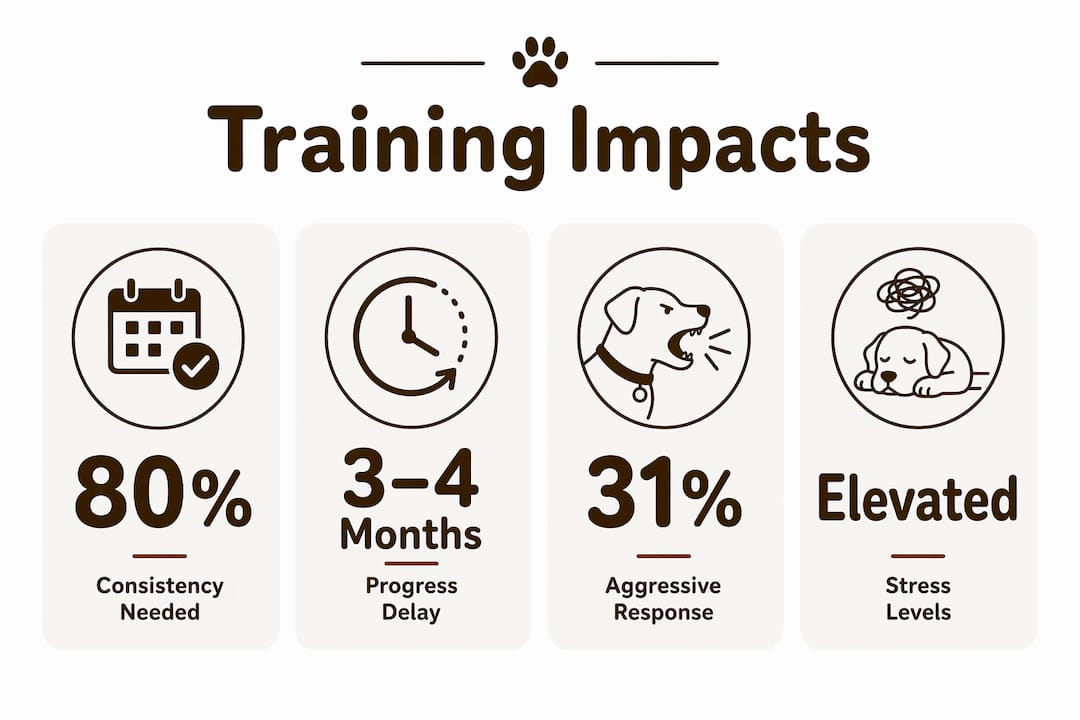
Confrontational techniques such as alpha rolls lead to aggressive responses in 31% of dogs. Physical corrections like hitting or kicking produce aggression in 41–43% of cases. These are not rare outcomes. They are documented, measurable consequences of mixing forceful methods into a training programme.
Dogs trained with rewards-only methods show better learning outcomes, fewer behaviour problems, and stronger bonds with their owners. The evidence is consistent across studies.
The negative effects of aversive or mixed methods include:
Elevated cortisol levels, indicating chronic stress
Frequent stress signals such as lip licking, yawning, and whale eye
Increased reactivity and aggression towards people and other dogs
Reduced willingness to engage or attempt new behaviours
Damaged trust between dog and handler
Pro Tip: If you are working with multiple family members or carers, agree to use reward-based methods exclusively. Mixing philosophies, even occasionally, undermines the entire programme. Choosing training methods by temperament helps you pick the right approach from the start.
What does your dog actually experience with conflicting cues?
Dogs under households with random rules and multiple trainers show elevated cortisol and hyper-vigilance. Hyper-vigilance means your dog is constantly scanning for signals, never fully relaxed, always waiting for the next unpredictable cue. That is an exhausting way to live.
Behavioural experts clarify that dogs misread as stubborn are often trying to decode conflicting commands, not deliberately ignoring them. The hesitation you see before your dog responds is not attitude. It is a cognitive pause while your dog tries to work out which rule applies right now, with this person, in this context.
Multiple family members enforcing rules inconsistently can lead to learned helplessness or hyper-vigilance. Learned helplessness is when a dog stops trying altogether because no response ever produces a reliable outcome. You may notice your dog shutting down, refusing to engage, or appearing “switched off” during training.
“A dog with five bosses is a dog with no boss. When every person in the household sets different rules, the dog cannot form a clear picture of what is expected. The confusion you see is not stubbornness. It is a dog doing its best to make sense of a world that keeps changing the rules.”
Real-world examples of this are common. One family member allows the dog on the sofa. Another does not. One trainer rewards jumping up as a greeting. Another corrects it. The dog learns that rules depend on who is present, not on what the rule actually is. That is a fragile, stressful way to live, and it produces a dog that appears unreliable rather than well-trained. Understanding training fatigue helps you recognise when your dog has reached its limit.
How to coordinate training across multiple people
Behavioural improvement requires 80% consistency as a minimum threshold. That means eight out of every ten interactions must follow the same rules, use the same words, and apply the same consequences. Below that threshold, progress stalls.
The good news is that coordination is a skill, not a talent. Every household can achieve it with a clear plan and commitment from all involved. Here is a practical sequence to follow:
Write a command glossary. List every behaviour you want your dog to learn and assign one word or phrase to each. Post it somewhere visible. Every person who handles the dog uses only those words.
Agree on rules for every context. Decide together whether the dog is allowed on furniture, whether jumping is acceptable, and how greetings are handled. No exceptions for “just this once.”
Standardise your reward timing. Reward within one to two seconds of the correct behaviour. Late rewards teach the wrong lesson. Everyone must understand this.
Hold a brief weekly check-in. Spend five minutes reviewing what is working and what is not. Adjust together, not individually.
Designate one lead trainer. One person takes responsibility for introducing new behaviours. Others reinforce what has already been taught. This prevents conflicting criteria during the learning phase.
Practise in front of each other. Watching how others handle the dog reveals inconsistencies you would never notice otherwise.
Private individual sessions with a single qualified trainer produce faster results than rotating between several instructors with different approaches. Switching trainers forces dogs to relearn basics under different criteria, which causes disengagement and delays. A home obedience training guide gives you the framework to keep all household members aligned between professional sessions.
Dogs perceived as selective listeners are often calculating which human’s cues yield the best outcome. That is not cunning. It is a rational response to an inconsistent environment. Remove the inconsistency, and the selective listening disappears.
Key takeaways
Consistency across all trainers is the single most important factor in successful dog training, and achieving 80% consistency is the minimum threshold for measurable behavioural change.
Point | Details |
Inconsistency delays progress | Mixed trainer approaches delay reliable responses by 3–4 months versus 2–3 weeks under consistency. |
Aversive methods increase aggression | Confrontational techniques produce aggressive responses in up to 43% of dogs. |
Cortisol rises with random rules | Dogs in inconsistent households show elevated stress hormones and hyper-vigilance. |
80% consistency is the threshold | Behavioural improvement requires at least eight in ten interactions to follow the same rules. |
Unified command vocabulary is non-negotiable | Every person handling the dog must use identical words, timing, and rewards for the same behaviours. |
What I have seen after 20 years of working with confused dogs
After two decades of working with dogs and their families, the pattern I see most often is not aggression or fearfulness on its own. It is confusion dressed up as disobedience. A dog that “won’t listen” almost always has a history of receiving mixed messages from the people around it.
The most heartbreaking cases are the dogs whose owners have genuinely tried hard. They have hired multiple trainers, watched hours of videos, and read every article they could find. But each trainer brought a different vocabulary, a different philosophy, and a different set of expectations. The dog was not failing. The system around the dog was failing.
What I advocate for, always, is the human-animal bond as the foundation of everything. That bond is damaged every time a dog receives a correction it did not expect, or a reward that arrives too late, or a command it has never heard before. Rebuilding that bond requires patience, alignment, and a willingness to communicate honestly with everyone in the household.
The owners who see the fastest results are not the ones with the most training experience. They are the ones who get everyone on the same page and stay there. Teamwork between people is what produces a calm, confident dog.
— Mark
How Happy-dogtraining helps you build a consistent approach
If you recognise your dog in any of the scenarios above, you are not alone, and the situation is absolutely fixable.

Happy-dogtraining works with dog owners across Singapore to create clear, unified training programmes that every household member can follow. With over 20 years of experience and AVS accreditation, the approach is grounded in reward-based methods that reduce stress and build genuine confidence in your dog. Whether your dog is reactive, fearful, or simply struggling with basic obedience, the reactive dog class and the 4-week obedience programme are designed to give you and your dog a shared language that sticks. Free lifetime support means the consistency continues long after the sessions end.
FAQ
Why does my dog listen to one person but not another?
Dogs do not generalise rules across people without consistent training. If different household members use different commands or apply rules inconsistently, your dog learns to respond selectively based on who is present.
Can having too many trainers make my dog anxious?
Yes. Dogs in households with inconsistent rules show elevated cortisol and hyper-vigilance. Mixing aversive and reward-based methods from different trainers correlates with stress signals in 40–50% of cases.
How consistent do I need to be for training to work?
Research identifies 80% consistency as the minimum threshold for measurable behavioural change. Below that level, progress stalls and confusion in dog training persists regardless of effort.
Is my dog being stubborn or just confused?
Behavioural experts confirm that dogs labelled as stubborn are usually trying to decode conflicting instructions. The hesitation you see is a cognitive response to mixed signals, not deliberate defiance.
How long does it take to fix confusion from multiple trainers?
Inconsistent training with multiple trainers can delay reliable responses by 3–4 months. Once a unified approach is in place, most dogs show clear improvement within 2–3 weeks.
Recommended
Comments